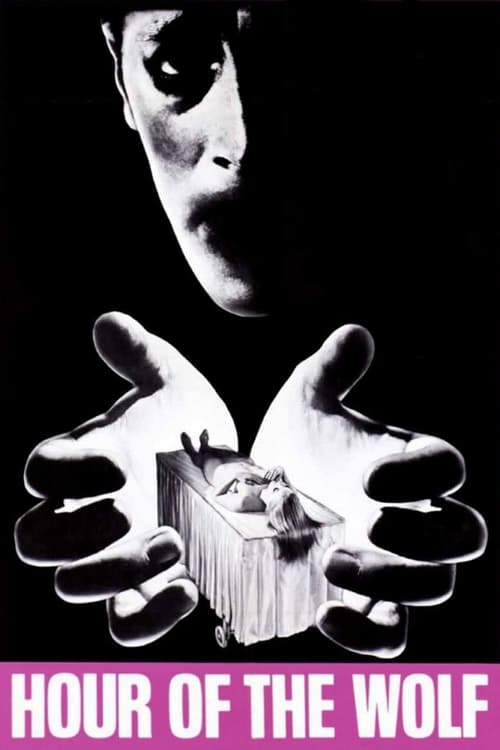
Hour of the Wolf
1968 · Ingmar Bergman
For when you're craving a real scare of the psychological kind — an art-house nightmare to watch late, alone, with the lights off. This is a challenge watch: disturbing, gorgeous, and not easily shaken.
What it's about
A painter and his pregnant wife retreat to a remote, windswept island where he stops sleeping and starts unraveling. The island's other residents — a clutch of aristocrats in a decaying castle — take an unsettling interest in him, and through his diary and his wife's eyes we watch his private demons take on flesh. Whether the horrors are real or projections of a collapsing mind is the film's central, deliberately unanswered question.
The experience
Genuinely frightening in a slow, clammy way — less jump-scares than a mounting dread that logic is giving out. The insomniac dead-of-night stretches are some of the most unnerving passages in cinema, and it leaves you uneasy for days.
Performances
Max von Sydow makes a man's disintegration terrifyingly intimate, and Liv Ullmann, as the wife who loves him and fears what she's absorbing from him, gives the film its aching human anchor.
The craft
Shot in stark black and white, the film borrows the visual grammar of silent-era horror — distorted faces, candlelit corridors, figures that move wrong — and marries it to pin-drop sound design where a ticking clock can raise your pulse. One dinner-party scene, all overlapping chatter and predatory close-ups, is a masterclass in social dread. Watch it in the dark with the sound up.
Why it matters
Bergman's one full plunge into horror became a quiet wellspring for psychological and art-house horror ever since, its fingerprints visible on generations of films about artists coming apart.
Snapshot
Hour of the Wolf (Vargtimmen) is Ingmar Bergman's most sustained experiment in supernatural horror, a film in which the boundary between psychosis and genuine demonology is never resolved but instead used as an instrument of dread. Johan Borg, a painter, retreats with his pregnant wife Alma to a remote Baltic island where a coterie of aristocratic grotesques preys upon his fracturing mind. Whether the demons are real or the projections of a guilt-ridden and violently unbalanced interior life is a question the film declines to answer — and insists that the distinction may not matter. Shot in austere black and white, anchored by two of Bergman's most committed performances, and structurally indebted to German Expressionism and Strindbergian dream logic, the film occupies an eccentric position in the Bergman canon: recognizably his in every stylistic reflex, yet pushed toward registers of the uncanny that he had never before pressed quite so hard.
Industry & production
Hour of the Wolf was produced by Svensk Filmindustri, the studio with which Bergman had worked throughout his career, and was filmed in late 1966, with release delayed until February 1968. It thus arrived in the wake of Persona (1966), which had itself reshuffled expectations of what a Bergman film could do formally. The proximity of the two productions — both starring Liv Ullmann and Max von Sydow, both shot by Sven Nykvist, both concerned with identity and its dissolution — has led many commentators to treat them as companion pieces or a loose diptych, a reading Bergman himself encouraged in interviews, though he was characteristically ambiguous about how programmatic the relationship was.
The production was not without difficulty. Bergman underwent a period of significant psychological strain in the mid-1960s; accounts of the period describe anxiety, what he called a kind of creative paralysis, and a preoccupation with demonic imagery that fed directly into the film's conception. The autobiographical dimensions of Johan Borg's torment — an artist whose monstrous inner life threatens to swallow him — were understood by Bergman's collaborators and have been extensively remarked upon in scholarship, though the exact mapping of life to fiction remains contested. Specific budget figures for the production are not reliably documented in widely available sources.
Technology
The film was shot on 35mm in the Academy ratio (1.37:1), consistent with Bergman's practice at Svensk Filmindustri during this period. Sven Nykvist worked with a primarily studio-based setup at Filmstaden in Råsunda, constructing the castle interiors and the island exteriors on sound stages and backlot spaces. This degree of artificiality was deliberate: the island is meant to feel sealed off from ordinary reality, and the controlled studio environment allowed Nykvist to manage the extreme chiaroscuro the film demands.
The decision to shoot in black and white, at a moment when color was widely available and increasingly expected of prestige productions, was an expressive choice rather than a financial one. Bergman had used black and white throughout the 1960s — Through a Glass Darkly, Winter Light, The Silence, Persona — and regarded it as the appropriate medium for internal and psychic subject matter, a view he articulated in various interviews of the era. The specific quality of the blacks in Hour of the Wolf — dense, absorptive, seemingly sourceless — is among the most technically accomplished aspects of Nykvist's work on the film.
Technique
Cinematography
Nykvist's lighting in Hour of the Wolf operates largely by subtraction. Many of the film's most disturbing sequences derive their power from what is withheld from the frame: figures emerge from and dissolve back into darkness with minimal transition, and the topology of the image is often unstable — it is not always clear where a scene is spatially situated. The faces of Johan's demons, when they are fully revealed, are shot in unsparing close-up, a Bergman signature here pushed toward grotesquerie. The film also employs an extreme contrast between the daylight outdoor sequences — rocky shoreline, open sea light, Alma's fair skin against the pale Nordic sky — and the night interiors, which are almost totally black. This polarity reinforces the day/night, real/hallucinatory structure of the narrative.
The marionette theater sequence, in which the von Merken household performs a scene from Mozart's The Magic Flute, is lit theatrically, as a scene within a scene, and represents one of the film's few moments of relative visual warmth — which makes what follows it tonally devastating. The choice of The Magic Flute is not incidental: it anticipates Bergman's celebrated 1975 television film adaptation of that opera and suggests his persistent investment in the Mozartian interplay of the magical, the erotic, and the fatal.
Editing
Ulla Ryghe, Bergman's editor through much of the 1960s, worked on Hour of the Wolf and was an essential collaborator in constructing the film's unstable temporality. The editing declines to stabilize Johan's hallucinations against the "real" narrative: sequences that begin in apparent naturalism slide into the demonic without clear suture points, and there are moments — particularly in the castle scenes — where the cut itself seems to be the agent of the unreality. The framing device, in which Alma addresses the camera before and after the main narrative, imposes a retrospective structure, but the editing within the main body of the film works against any stable retrospective clarity. The pace is deliberately slow by genre-film standards, relying on extended takes and sparse cutting within scenes.
Mise-en-scène / staging
The staging throughout exploits theater's capacity for frontality — figures frequently address or approach the camera in ways that collapse the distance between interiority and address. Bergman had always been a director of faces, and Hour of the Wolf doubles down: the demons are physically characterized through grotesque, stylized performances and costume that owe a visible debt to German Expressionist cinema. The castle of Baron von Merken is a space without fixed proportions; its corridors and rooms behave according to dreamlike rather than architectural logic.
One of the film's most discussed staging choices is a scene in which Johan recounts a violent incident involving a young boy on the rocks near the shore: as he describes beating the boy, the scene is shown rather than merely described, but in a register that refuses to confirm whether the event happened or was imagined. The staging of Johan's relationship to Alma is also significant — she is often placed slightly behind or beside him, supportive and watchful but outside the demonic frame that closes around him, until the film's final movements suggest that even she has been partially contaminated by his vision.
Sound
The sound design is among the film's most disquieting achievements. Bergman and his sound team use periods of near-total silence as a kind of negative pressure, with the film's occasional bursts of diegetic sound — wind, water, the castle's ambient acoustic — arriving with unusual force. Non-diegetic music is used sparingly; the film exploits the absence of score as much as its presence. The use of Mozart's music within the diegesis (the marionette sequence) operates as a counterpoint to this austerity, and its abrupt end marks a tonal rupture.
Performance
Max von Sydow's Johan Borg is a sustained portrait of disintegration, calibrated to avoid the easy legibility of conventional breakdown sequences. Von Sydow inhabited Bergman's world as no other male actor of the period did, and his physical largeness — an almost geological solidity in many of the Bergman films — is here turned against itself: he is both imposing and helplessly fragile. Liv Ullmann, in her second collaboration with Bergman (after Persona), brings a quality of grieving attentiveness to Alma that is essential to the film's moral architecture; her final monologue, direct to camera, carries enormous weight precisely because the film has denied her any resolution. The supporting cast, including Erland Josephson as Baron von Merken, deploy a stylized unreality that risks tipping into camp but is held in check by the seriousness of the surrounding film.
Narrative & dramatic mode
The film's narrative architecture is formally intricate. An opening title card announces that the events are based on a diary left by Johan Borg; Alma then appears on screen to address the audience directly, establishing herself as the survivor-narrator. This frame is established and then partially abandoned — the main body of the film does not consistently behave as a diary-reading, but instead as something more slippery, in which the boundary between Alma's narrative and direct dramatization becomes porous. By the end, Alma's uncertainty about whether she has merely "absorbed" Johan's demons by living with him is posed as a genuine epistemological question: can proximity to psychosis contaminate perception?
This is not a horror film in the genre sense of a threat-response-resolution arc. Its mode is closer to the oneiric Gothic: the castle, the demons, the boy on the rocks are components of a sustained nightmare whose internal logic is consistent but whose relationship to consensual reality is never anchored.
Genre & cycle
Hour of the Wolf sits at an intersection that has no clean genre label. It draws on the Gothic tradition — the isolated setting, the aristocratic persecutors, the figure of the tormented artist, the suggestion of vampirism — while filtering those materials through the art-cinema commitment to psychological interiority. It belongs alongside a small number of art-horror films produced in Europe in the 1960s, a loose cycle that includes Polanski's Repulsion (1965) and Rosemary's Baby (1968), and which represents a moment when the psychological horror film was being claimed by directors working in an auteurist rather than a genre tradition.
Its relationship to the Romantic artist narrative is equally important. The film is in dialogue with a long tradition — from E.T.A. Hoffmann through Strindberg and Munch — of the male creative genius whose artistic power is inseparable from his susceptibility to demonic forces. Bergman does not entirely endorse this mythology; Alma's perspective keeps a critical distance from Johan's grandiosity even as she grieves him.
Authorship & method
By 1966–1968, Bergman's working method was well established: a close repertory company, a stable studio infrastructure, and an unusually long rehearsal period in which actors worked with the script before cameras rolled. His collaboration with Sven Nykvist, which had deepened since the early 1960s, was by this point a fully developed shared language. Nykvist's ability to find dramatic meaning in faces under minimal or indirect light was ideally suited to Bergman's requirements; their discussions reportedly focused on the quality and direction of light as the primary expressive decision, subordinating set decoration and staging to the luminous surface of the human face.
Bergman wrote the screenplay himself, as was almost invariably his practice. The script reportedly went through significant development before shooting, with elements of the demonic figures revised substantially. Ulla Ryghe's contribution as editor should be understood as co-creative: her structural decisions shaped the film's temporal ambiguity in ways that Bergman acknowledged. The score — used minimally — included music supervised by the production but the precise compositional credits for the non-diegetic elements are not consistently documented across available sources, and caution is warranted in asserting specific composer attributions beyond the Mozart material.
Movement / national cinema
Hour of the Wolf is a product of the Swedish art cinema tradition at its high-water mark, but it also participates in the broader international auteur cinema of the 1960s. Swedish cinema of this period operated within a model in which a small number of internationally recognized directors — Bergman above all, but also Bo Widerberg, Vilgot Sjöman, and others — received sustained institutional and critical support that allowed for work of considerable formal ambition. The Swedish Film Institute, established in 1963, provided structural support for art-cinema production that shaped what kinds of films could be made.
Bergman's work by the late 1960s was simultaneously nationally rooted — in its Lutheran moral landscape, its island settings, its company of Swedish actors — and internationally legible as high-prestige art cinema, circulating in the same festival and repertory theater circuits as Fellini, Antonioni, and Godard.
Era / period
The late 1960s were a period of intense formal experimentation in European art cinema, and Hour of the Wolf arrives in a specific moment: just after Persona's radical self-reflexivity, at the beginning of a period in which Bergman's filmmaking would become still more chamber-scaled and intimately psychological. The broader political turbulence of 1968 has only an oblique relationship to this film, which is largely indifferent to the social world in any direct sense; but the film's preoccupation with authority, predation, and the vulnerability of the individual to structures of power is not without resonance in its moment.
Themes
The film's central preoccupation is the artist's relationship to his demons, understood simultaneously as creative sources and as genuinely destructive forces. Johan's paintings are never shown in a way that allows the audience to assess them; we understand him as an artist through his suffering rather than his work, which is itself a thematic statement about the Romantic myth of creative affliction.
The relationship between Johan and Alma is structured as a meditation on the impossibility of full intimacy: she loves him and cannot reach him; his inner life is so sealed that even his diary, which she reads, only deepens her uncertainty. The film asks whether love can survive the acknowledgment that one's partner's inner world is genuinely alien and potentially monstrous.
The demonic figures of the von Merken household encode several related anxieties: the aristocracy as predatory class, the audience as parasitic consumer of the artist's wound, the libidinal as thanatic. The suggestion of vampirism is consistent with this: they feed on Johan's creative and psychological substance without being destroyed by it, and he is consumed.
The "hour of the wolf" of the title — the period between three and four in the morning, traditionally held to be the darkest hour, when most deaths and most births occur, and when the veil between the living and the dead is thinnest — operates as both a temporal and an ontological figure: the film is set in that hour, extended indefinitely.
Reception, canon & influence
Critical reception. Hour of the Wolf received a mixed but largely respectful critical response on its international release. Some reviewers found it hermetic and self-indulgent, particularly in comparison to the more controlled formal austerity of Persona; others recognized it as a significant extension of Bergman's range. Its reputation has grown considerably in subsequent decades, and it is now regarded as a key work in his filmography, though it remains somewhat less discussed than the "Silence of God" trilogy or Scenes from a Marriage.
Influences on the film (backward). The film's debts are traceable and significant. German Expressionism — in particular The Cabinet of Dr. Caligari (1920) and its conception of the asylum as the frame for a demonic narrative — provides structural and visual precedents. August Strindberg's dream plays, particularly A Dream Play and The Ghost Sonata, inform the film's logic of spaces that transform without spatial continuity and figures that are simultaneously themselves and projections. E.T.A. Hoffmann's tales of doppelgangers and demonic artists are a literary precursor that Bergman drew on knowingly. The influence of Edvard Munch's expressionist iconography — the screaming void, the predatory figure — is visible in both the visual texture and the thematic architecture. Fellini's 8½ (1963), another film about a male artist's fragmentation and his relationship to the women around him, is a proximate contemporary influence.
Legacy and forward influence. Hour of the Wolf's clearest legacy is in the tradition of psychological and art horror that developed in its wake, though direct lines of influence are difficult to establish with certainty. Its conception of the isolated creative figure besieged by a community of predatory aristocrats has structural affinities with Kubrick's The Shining (1980), though whether Kubrick encountered and engaged with the Bergman film is not documented in available sources. Lars von Trier, who has repeatedly acknowledged Bergman as a primary influence, works in a register of psychosexual horror with autobiographical dimensions that bears a family resemblance to Hour of the Wolf, though Trier's formal strategies diverge sharply.
More durably, the film's treatment of the marionette theater as a space of psychological revelation — and its use of Mozart's The Magic Flute as an emblem of the interplay between beauty and the dangerous — fed directly into Bergman's own later work. His 1975 television adaptation of The Magic Flute can be understood in part as a return to and transformation of the material first engaged here, now without the demonic frame, in a spirit of reconciliation with the opera's lightness that the 1968 film conspicuously refuses.
A Deleuzian reading
Watch how a face arrives in *Hour of the Wolf*.
The full Deleuzian reading of Hour of the Wolf →
Reception
Landing right after Persona, it got a muted, somewhat puzzled reception in 1968 — even Bergman spoke of it with reservations. It's since been reclaimed as his one true horror film and a foundational text for arthouse horror.
How Hour of the Wolf was received, from release to now →
Influences: the films it descends from and the films it influenced
- The Cabinet of Dr. Caligari (1920) — Wiene invented the survivor frame-narrative in which a madman's account of demonic possession is structured so the audience cannot locate a stable reality — the direct structural template for Alma's framing of Johan's dissolution — and his studio-built expressionist interiors that obey psychic rather than architectural logic are the visual precedent for Bergman's aristocratic island sets.
- The Phantom Carriage (1921) — Sjöström's double-exposure superimposition gave the supernatural a photographic texture within the image rather than a theatrical stage effect, establishing the Swedish cinema grammar for rendering psychic states as light-based distortions that Bergman inherited directly; his nested frame-narrative of a man shown his past as a condition of reckoning also prefigures Hour of the Wolf's survivor-narrator device.
- Nosferatu (1922) — Murnau's nocturnal chiaroscuro — a single directional light source carving faces out of absolute shadow — is the photographic ancestry Nykvist inherits and refines into his chiaroscuro-subtraction method, in which excess illumination is systematically removed until only the luminous surface of the face survives against darkness.
- Ugetsu (1953) — Mizoguchi's unbroken camera movement that drifts from living characters to arrive at the presence of the dead — transitions between registers of reality achieved through spatial continuity alone, without editorial rupture — prefigures Bergman's refusal to mark Johan's demonic visions as ontologically distinct from his waking experience.
- Eyes Without a Face (1960) — Franju founded art-horror as a formal mode by deploying sustained silences, composed wide shots, and minimal scoring to generate dread in place of shock — with the face as the primary site where horror and desire converge — establishing the aesthetic register Bergman adopts for the aristocratic island sequences, where beauty and predatory violence share the same surface.
- The Trial (1962) — Welles's studio-built spaces follow dream geography rather than architectural logic — corridors opening into impossibly vast halls, rooms that cannot physically adjoin — translating literary oneirism into a specifically cinematic spatial grammar that Bergman inherits for the aristocratic castle, whose interiors refuse spatial continuity between shots.
- 8½ (1963) — Fellini's oneiric montage — fantasy sequences that dissolve into the autobiographical narrative through continuity cutting rather than explicit transition markers, rendering the director-protagonist's projections indistinguishable from memory — provides the structural model for Bergman's treatment of Johan's demonic visions as ontologically continuous with his waking experience.
- Repulsion (1965) — Polanski's studio-constructed domestic interiors that physically respond to the protagonist's psychic dissolution — walls cracking, hallways lengthening, hands erupting through surfaces — combined with Gilbert Taylor's extreme close-ups of a deteriorating face as the primary vessel of psychological horror, directly precedes Bergman's studio-built island spaces and Nykvist's face-centered camera grammar.
- Persona (1966) — Made two years prior with the identical production apparatus — Nykvist, editor Ulla Ryghe, the same repertory actors — Persona established the extreme close-up grammar in which two faces fill the frame until features become interchangeable, and the self-deconstructing narrative frame that Hour of the Wolf inherits and redirects from identity dissolution into Gothic-horror territory.
- The Magician (1958) — Returns to The Magician's Gothic horror of the creative artist under audience pressure, narrated from inside the psyche: the somnambulist-like apparitions haunting the painter Borg echo Aman/Grima's uncanny presence, and the traveling menagerie of aristocratic tormentors reprises the hostile reception scenario of The Magician's bourgeois officials as existential persecution.
- Vampyr (1932) — Transposes art-horror into metaphysical spiritual gravity, treating the vampiric/uncanny as an interior haunting rendered through duration and dread rather than incident.
- The Magic Flute (1975) — Bergman's television adaptation continues Hour of the Wolf's engagement with Mozart as the emblem of beauty's dangerous relationship to the demonic — now stripped of the Gothic frame — redeploying the same theatrical frontality and direct address in a spirit of reconciliation, demonstrating that the formal devices (proscenium staging, face-to-lens contact) carry opposite affective charges when the demonic framing is removed.
- The Shining (1980) — Kubrick's structural use of an isolated creative figure besieged by predatory presences in a studio-constructed labyrinthine space inherits Bergman's basic architecture; the Steadicam functions as his equivalent of Nykvist's face-seeking camera — a tracking device that registers the dissolution of the artist's self through spatial disorientation rather than close-up intensity.
- Possession (1981) — Żuławski extends art-horror into a convulsive register by pushing performers to physical and vocal breakdown through rehearsal-intensive methods that parallel Bergman's repertory company approach, while studio-constructed West Berlin serves as an expressionist externalization of psychic dissolution — the island transformed into a city that physically manifests the couple's psychopathology.
- Antichrist (2009) — Von Trier deploys an apparatus nearly identical to Hour of the Wolf's: an isolated couple in a forest setting, extreme close-ups under high-contrast chiaroscuro lighting (the Nykvist inheritance transmitted through Anthony Dod Mantle), and a narrative in which the female partner is revealed as the conduit for demonic forces the male protagonist cannot confront — a direct structural reworking of Johan and Alma's dynamic.
- Black Swan (2010) — Aronofsky's extreme close-ups pressing against a performer's face until its surface becomes alien and threatening — combined with the staging of an artist destroyed by pursuing perfection through demonic possession — inherits Hour of the Wolf's equation of artistic ambition with psychic dissolution, with Matthew Libatique's high-contrast face-lit cinematography extending Nykvist's chiaroscuro-subtraction logic into a contemporary ballet milieu.
- Nosferatu the Vampyre (1979) — Sven Nykvist's extreme single-source chiaroscuro interiors and Bergman's construction of a male protagonist consumed from within by demonic forces — horror framed as ontological torment rather than external predation — directly prefigures Herzog's conception of Dracula as sufferer rather than predator.
- The Witch (2016) — Bergman's model of the isolated married couple on an island — wife as witness and confessor to a husband consumed by supernatural dissolution — directly informs the Eggers family dynamic, including the staging of disclosure scenes as confrontational two-shots with the woman's face as an instrument of judgment.
- The Third Part of the Night (1972) — Renders an artist's psychic disintegration as literal demonic apparition, the direct template for treating metaphysics and mental collapse as one continuous, unstable horror.
- Face to Face (1976) — Bergman's most explicit externalization of the unconscious as expressionist dream-tableau invading the frame — the device Face to Face extends (and critics faulted as too literal).
- Insomnia (1997) — Sleeplessness staged on a Baltic island under near-perpetual summer light, with Sven Nykvist's naturalistic exteriors turned hostile precisely because there is no shadow available to hide the dread in.
- Bergman Island (2021) — The template for the artist's island as haunted workspace — a blocked creator's sketchbook and insomnia staged in the same Hammars landscape now sold as a Bergman Safari, which Hansen-Løve films as literal heritage-site tourism.
- The Saragossa Manuscript (1965) — Has constructs a nested frame-narrative so labyrinthine that neither protagonist nor viewer can maintain stable orientation between story levels, generating ontological instability through narrative structure alone — a formal parallel to Bergman's survivor-narrator device in which the framing is itself contaminated by what it frames, arrived at through Polish literary tradition rather than Strindberg.
- Teorema (1968) — Pasolini's theatrical frontality — figures positioned perpendicular to the camera plane, staging that refuses naturalistic depth — combined with the predatory visitor who dismantles a bourgeois family by awakening repressed drives, parallels Bergman's aristocratic community as agents of dissolution; both films use formal stagedness to underscore the allegorical, non-naturalistic status of their threatening figures.
Similar films
- Persona (1966) — influence & lineage
- Nosferatu (1922) — influence & lineage
- The Cabinet of Dr. Caligari (1920) — influence & lineage
- The Shining (1980) — influence & lineage
- Antichrist (2009) — influence & lineage
- Possession (1981) — influence & lineage
- The Phantom Carriage (1921) — influence & lineage
- 8½ (1963) — influence & lineage · often watched together
All the films related to Hour of the Wolf →
Watch it with: curated runs of related films
- The Vanishing Self — A run of 1960s–70s modernist art cinema where identity comes undone — people simply vanish, faces are remade, memory bleeds into hostile landscape — that rewards being watched in a stretch, each film deepening the last's dread.