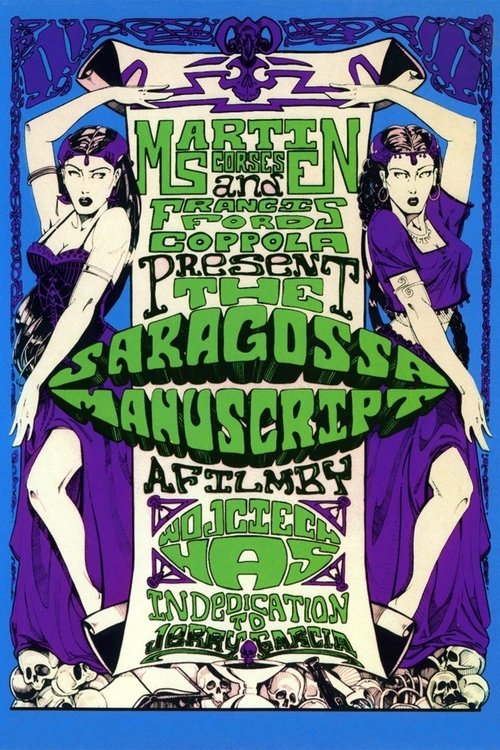
The Saragossa Manuscript
1966 · Wojciech Has
For when you want to surrender a whole evening to something strange and vast — a film to get pleasurably lost in, best when you're feeling adventurous rather than tired.
What it's about
During the Napoleonic Wars, two enemy officers pause mid-skirmish over an illustrated old book — and fall into it. The manuscript recounts a Walloon officer's journey through a haunted Spain of gallows, cabbalists, sheikhs, and seductive sisters, where every stranger has a story, every story contains another, and the tales nest five deep until you're no longer sure which layer of reality you're standing on. Three hours of gorgeous, deadpan labyrinth.
The experience
Playful vertigo — it's funny, eerie, and disorienting all at once, a shaggy-dog epic that treats getting lost as the whole pleasure. It asks for patience and rewards it with the giddy sensation of a puzzle box opening in your hands.
Performances
Zbigniew Cybulski — often called Poland's James Dean — plays gloriously against his brooding image as the bewildered officer, anchoring the madness with wry, mounting confusion.
The craft
Wojciech Has shoots in sumptuous black-and-white widescreen, filling the frame with skulls, ruins, and desert light, while Krzysztof Penderecki contributes a playful, harpsichord-flecked score that keeps the mystery buoyant. The nested structure is engineered with real precision — the film always knows exactly where you are, even when you don't.
Why it matters
A cult landmark of Polish cinema adored by filmmakers for decades — Luis Buñuel, who rarely rewatched anything, saw it three times — and a touchstone for anyone interested in what movies can do with stories inside stories.
Somewhere in the Sierra Morena during the Napoleonic Wars, two enemy officers pause their skirmish to pore over an illustrated tome — and Wojciech Has's three-hour adaptation of Jan Potocki's 1815 novel tumbles into one of cinema's great labyrinths. A Walloon officer's journey through haunted Spain becomes a Chinese box of tales within tales: gallows, cabbalists, sheikhs, and seductive sisters, each narrator interrupted by another until the frames nest five deep and the ground of reality quietly gives way. Has, working in gorgeous black-and-white widescreen with Zbigniew Cybulski — Poland's James Dean — playing gloriously against type, treats the vertigo as comedy as much as mystery, aided by Krzysztof Penderecki's playful, harpsichord-flecked score. Luis Buñuel, who rarely rewatched anything, saw it three times and called it a favorite. Long circulated in mutilated cuts, it was restored to full length in the 1990s through the devotion of Jerry Garcia, with Martin Scorsese and Francis Ford Coppola completing the funding after the Grateful Dead guitarist's death.
A Deleuzian reading
Two officers who are supposed to be shooting at each other stop, because one of them has found a book.
The full Deleuzian reading of The Saragossa Manuscript →
Reception
Barely seen outside Poland for decades — and then only in badly truncated export cuts — it was rescued in the late '90s by a restoration championed by Jerry Garcia and completed by Martin Scorsese and Francis Ford Coppola, and is now firmly canonized as a landmark of Polish cinema.
How The Saragossa Manuscript was received, from release to now →
Influences: the films it descends from and the films it influenced
- Ashes and Diamonds (1958) — Has casts Zbigniew Cybulski and deliberately plays against the tinted-sunglasses, doomed-romantic star persona Wajda had forged, using the actor's own iconography as an ironic counterweight.
- Un Chien Andalou (1929) — As a self-declared Buñuel admirer, Has adopts the surrealist principle of non-causal image succession, where scenes obey dream-association rather than plot logic.
- The Cabinet of Dr. Caligari (1920) — The recursive framing device that dissolves the boundary between a narrator's madness and the tale he tells, so the outer frame is retroactively contaminated by the inner story.
- Dead of Night (1945) — A portmanteau of nested tales sealed by a looping frame that folds the ending back into its opening — the same closed-circuit, eternally-restarting structure Potocki's manuscript enacts.
- Rashomon (1950) — Nested flashback testimonies staged so that objective reality becomes unrecoverable, each embedded account destabilizing the frame that contains it.
- Wild Strawberries (1957) — Unmarked cuts sliding between memory, dream, and present without optical dissolves — the same friction-free passage between narrative layers Has uses to enter each nested story.
- Citizen Kane (1941) — Deep-focus black-and-white staging married to a nested-testimony investigation structure in which each witness's embedded account reframes the whole.
- The Hourglass Sanatorium (1973) — Has's own denser sequel-in-spirit (adapting Bruno Schulz), where sets physically morph mid-shot into new story-spaces, extending Saragossa's technique of nesting worlds inside worlds.
- The Discreet Charm of the Bourgeoisie (1972) — Dreams-within-dreams where each awakening only reveals another dreamer, a recursive-frame gambit Buñuel sharpens after decades in the same surrealist current Has drew on.
- The Phantom of Liberty (1974) — A daisy-chain narrative that hands the film from one character to the next, mirroring Potocki's relay of tellers who each surrender the story to a new narrator.
- Three Crowns of the Sailor (1983) — Ruiz explicitly modeled his infinitely regressing storytellers and baroque deep-focus tableaux on Has, treating narration itself as a labyrinth to be entered.
- Mulholland Drive (2001) — An unreliable-reality labyrinth whose narrative eventually exposes itself as a nested fantasy, deploying Saragossa's device of a frame that turns out to be enclosed by the fiction it seemed to contain.
- The Grand Budapest Hotel (2014) — A matryoshka of frame stories in which each nested teller hands off to the next, the layers explicitly marked by shifting aspect ratios — a formalized version of Potocki's stacked narrators.
- Inception (2010) — Literalizes the nested-story structure as descending dream-levels, where characters physically travel into a story-within-a-story and risk losing the thread back to the frame.
- The Shining (1980) — Kubrick builds dread from Krzysztof Penderecki's avant-garde concert works — the same Polish sonic idiom Has commissioned from Penderecki for Saragossa's score.
- The Fall (2006) — Its nested, recursive frame-tales told by unreliable narrators — stories folding into stories — model the interpenetration of teller and tale that The Fall exploits when Alexandria's misunderstandings rewrite Roy's plot.
- Vikram Vedha (2017) — A pure stories-within-stories architecture where each embedded tale opens another, modeling the recursive frame-tale nesting VV inherits from the Vikram–Betaal cycle.
- The Third Part of the Night (1972) — Recursive nested storytelling and dream-logic doubling from the Polish surrealist strain feed Third Part's looping, self-duplicating narrative architecture.
- On the Silver Globe (1989) — Polish precedent for the recursive, nested-parable architecture where narratives loop inside narratives and characters recount their own chronicle — the structural model behind the found-footage diegesis.
- Last Year at Marienbad (1961) — A contemporaneous European labyrinth of unstable time and reality built from gliding widescreen tracking shots, sharing Has's refusal to anchor the viewer in a single verifiable timeline.
- Valerie and Her Week of Wonders (1970) — An Eastern-bloc surrealist literary adaptation using the same dream-logic dissolves between reality strata, where fantasy and waking life interpenetrate without hierarchy.
- Hour of the Wolf (1968) — Has constructs a nested frame-narrative so labyrinthine that neither protagonist nor viewer can maintain stable orientation between story levels, generating ontological instability through narrative structure alone — a formal parallel to Bergman's survivor-narrator device in which the framing is itself contaminated by what it frames, arrived at through Polish literary tradition rather than Strindberg.
- Marketa Lazarová (1967) — Nested, elliptical non-linear chronicle architecture in period monochrome, privileging labyrinthine structure over continuous story.
- Knights of the Teutonic Order (1960) — Mieczysław Jahoda redeploys the same anamorphic deep-focus lateral track — the camera gliding past figures staged in depth like a frieze — for delirium and recursion rather than pageant.
Similar films
- The Hourglass Sanatorium (1973) — influence & lineage · same viewing thread
- Ashes and Diamonds (1958) — influence & lineage
- The Discreet Charm of the Bourgeoisie (1972) — influence & lineage
- The Battle of Algiers (1966) — shared sensibility
- 8½ (1963) — shared sensibility
- The Hypothesis of the Stolen Painting (1978) — shared sensibility
- Mr. Arkadin (1955) — shared sensibility
- The Criminal Life of Archibaldo de la Cruz (1955) — shared sensibility
All the films related to The Saragossa Manuscript →
Watch it with: curated runs of related films
- The Vanishing Self — A run of 1960s–70s modernist art cinema where identity comes undone — people simply vanish, faces are remade, memory bleeds into hostile landscape — that rewards being watched in a stretch, each film deepening the last's dread.