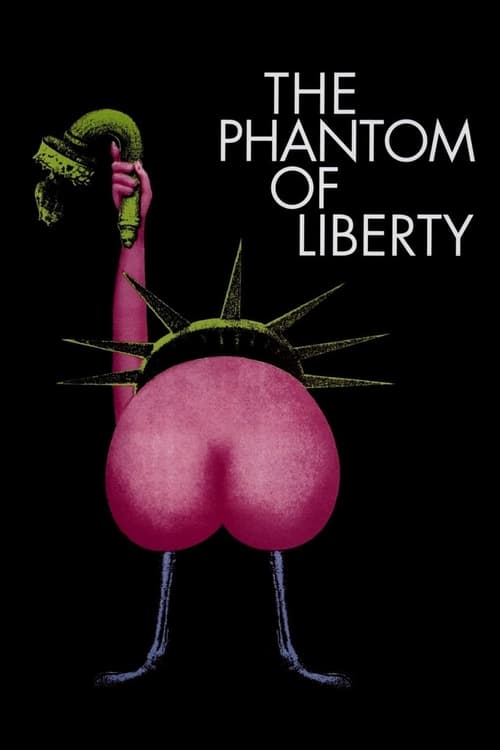
The Phantom of Liberty
1974 · Luis Buñuel
For when you're tired of stories that behave and want a film that breaks every rule with a straight face — adventurous-night viewing, best approached loose and curious rather than expecting a plot to grab onto.
What it's about
There is no protagonist and no plot — the camera simply follows whoever walks out of the frame next, drifting through a chain of episodes from Napoleonic Spain to 1970s Paris. Monks play cards, dinner-party guests scandalize each other by doing perfectly normal things, a sniper takes to a rooftop, and polite society keeps a straight face through all of it.
The experience
Deadpan, absurd, and genuinely unpredictable — every scene sets up a logic and then calmly walks away from it. It's funny in a way that sneaks up on you, and it leaves you looking at everyday rituals a little sideways.
The craft
Made by Buñuel at seventy-four at the peak of his freedom, its structure is the star: scenes hand off mid-stream like a relay race, each staged with elegant, matter-of-fact realism that makes the absurdity land harder. The joke is in the construction itself — how confidently the film abandons everything it starts.
Why it matters
The most structurally radical film of Buñuel's late career, made on the credit of an Oscar win, and a touchstone for every filmmaker who's since dared to let a movie wander off its own plot.
Snapshot
Le Fantôme de la liberté is the most structurally radical film of Luis Buñuel's late French period, and arguably of his entire career. Made at seventy-four, two years after The Discreet Charm of the Bourgeoisie had won him an Academy Award and the largest audience of his life, it uses that credit to fund something close to an anti-film: roughly a dozen episodes, no protagonist, no plot, and no resolution to any of the situations it opens. The camera simply attaches itself to whoever happens to leave the frame next, abandoning one set of characters mid-scene for another, and so travels from Napoleonic Toledo in 1808 to a police riot at a Paris zoo in the present.
The title, Buñuel acknowledged, plays on the opening line of the Communist Manifesto — a specter haunting Europe — with liberty substituted for communism. That substitution is the film's whole argument in miniature. Liberty is not a condition but an apparition: pursued, glimpsed, never possessed, and most often refused by the people who claim to want it. The film opens with Spanish patriots being shot by a French firing squad while shouting "¡Vivan las cadenas!" — long live chains — and ends with police gunfire heard over the impassive face of an ostrich. Between those two points it treats execution, incest, sadomasochism, terrorism, a child who is simultaneously present and officially missing, and a dinner party at which guests sit on toilets around a table and retire alone to a small room to eat. None of it is presented as shocking. It is presented as ordinary, which is the joke and the thesis at once.
Industry & production
The film is the middle panel of the trilogy Buñuel made in France with producer Serge Silberman and Greenwich Film Productions: The Discreet Charm of the Bourgeoisie (1972), The Phantom of Liberty (1974), and That Obscure Object of Desire (1977). Silberman's decisive contribution was structural rather than creative — he gave Buñuel continuity of crew, adequate resources, and an unusual degree of non-interference. After Discreet Charm's Oscar for Best Foreign Language Film, Buñuel was in the rare position of being a commercially bankable avant-gardist, and Phantom is the film he made with that leverage. It is conspicuously less ingratiating than its predecessor.
The production drew on the settled infrastructure of French mainstream cinema: an experienced technical crew, real Paris locations (the Tour Montparnasse, completed only the previous year, supplies the sniper's perch), constructed bourgeois interiors, and a cast assembled from the top rank of French character actors, supplemented by Italian and international performers. As was standard for French productions of the period, dialogue was largely post-synchronized, and several of the non-French cast members were dubbed — a practice that suits the film's slightly denatured, presentational surface.
Detailed budget and box-office figures for the film are not something I can state with confidence, and I would rather leave the gap visible than fill it. What is clear from the release history is that Phantom did not repeat Discreet Charm's crossover success; it was received as the more difficult, more purely surrealist work, and its reputation has grown by way of repertory programming, university curricula, and home-video reissue rather than initial commercial performance.
Technology
Buñuel had no interest in technological novelty and said so repeatedly; he shot in 35mm Eastmancolor at 1.66:1 with conventional equipment and a conventional schedule. The relevant technical facts are subtractive. There is no non-diegetic score — a policy Buñuel had adopted decades earlier, on the grounds that music smuggles emotion into images that should earn it themselves. There are no optical transitions to distinguish dream from waking, no split-screen, no visual effects beyond a handful of practical gags with animals and props.
Two circumstances shaped the working method more than any equipment. First, Buñuel was substantially deaf by the 1970s, which pushed him toward exhaustive pre-scripting and toward a soundtrack built from a small number of loud, legible, deliberately placed events rather than a continuous atmospheric weave. Second, the freedom of the film's content depended on a real technological-legal change: the collapse of pre-release censorship in France after 1968. A film containing a flagellation scene watched by Carmelite monks, an incestuous seduction, and a lecture on the arbitrariness of sexual taboo could not have been made in France ten years earlier, and could not have been made in Franco's Spain at all.
Technique
Cinematography
Edmond Richard, who shot all three of the Silberman films and had earlier photographed Orson Welles's The Trial and Chimes at Midnight, works here in a register of near-total self-effacement. Lighting is even and high-key, interiors are lit as if for a well-appointed television drama, and the camera sits at chest height in medium shot. Depth is used for information rather than expression. The style is deliberately unmarked so that nothing warns the viewer when the world is about to stop making sense: a police commissioner and an ostrich are photographed identically.
The exception is the Toledo prologue, staged in nocturnal chiaroscuro with lanterns and raised muskets in direct quotation of Goya's The Third of May 1808. Richard's Wellesian facility with low-key work surfaces there, and again in the crypt sequence, before the film settles back into its daylight flatness. The most important camera decision is not a lighting choice at all but a rule of attention: the camera is free to lose interest in its subject. It will follow a nurse out of a family drama and into a country inn, then abandon her for a lodger, then abandon him for his students.
Editing
Hélène Plemiannikov, another constant of the late trilogy, cuts for function rather than rhythm. Scenes are assembled in orthodox continuity, and the transgression is entirely at the level of the join between episodes. Each hand-off is motivated by the most banal narrative logic available — someone leaves, someone arrives, someone gives someone a lift — so that the structural outrage is committed in a register of complete politeness. There is no dissolve, no fade, no music sting to mark that the film has just discarded its protagonist for good.
Dreams receive the same treatment. The nocturnal sequence in which a rooster, a postman bearing a letter, an ostrich, and a bell-ringing figure pass through a bourgeois bedroom is cut exactly like the scenes on either side of it. Buñuel had been refusing the visual grammar of "this is a dream" since Los Olvidados, and here the refusal becomes systematic: the film has no ontological hierarchy to signal.
Mise-en-scène / staging
The production design — bourgeois apartments, a police prefecture, a provincial inn, a lecture hall, a family crypt — is meticulously ordinary, which is what makes the inversions land. The celebrated toilet-and-dining-room set is the film's central design idea: guests seated on toilets around a table, conversing amiably about sewage and public health, excusing themselves one at a time to eat in a locked closet. Nothing about the staging signals parody. The blocking, the etiquette, the offering of a place to a guest are all rendered with the deadpan correctness of a period drama.
Objects carry the surrealist charge: obscene postcards that turn out to depict the Arc de Triomphe and Chartres; monks playing cards for holy medals; a telephone ringing inside a coffin; a spider; the ostrich that wanders out of the dream and into the final shot. Buñuel stages these as household facts rather than apparitions, and never grants a reaction shot that would let the audience off the hook.
Sound
With no score, the soundtrack is composed entirely of diegetic events, and Buñuel weights them heavily: gunfire, a slap, footsteps, a telephone, church bells, a storm. The absence of music makes silence available as a tool, and the film uses it — the toilet dinner is played almost entirely on room tone and small talk.
The ending is the boldest sound decision in Buñuel's late work. The two prefects of police arrive to suppress a demonstration at the zoo, the camera declines to show the confrontation, and the film gives us shouts, shots, and cries of liberty over a static close-up of an ostrich's face. The event that the whole film has been circling is delivered entirely off-screen, as audio. It is a formal joke about representation and a political statement at the same time: the repression is continuous, unseen, and does not require our witness.
Performance
The cast — Jean-Claude Brialy, Monica Vitti, Michel Piccoli, Jean Rochefort, Michael Lonsdale, Adolfo Celi, Claude Piéplu, Paul Frankeur, François Maistre, Adriana Asti, Milena Vukotic, and the indispensable bit-player Muni — plays everything absolutely straight. This is the film's most important performance decision and Buñuel's oldest one. The comedy comes from unruffled professional competence in the face of the impossible: policemen filing a missing-persons report on a child standing in the room, taking her description from her own mouth; a doctor delivering a terminal diagnosis and then offering a cigarette; Lonsdale's hatter requesting a whipping with the fastidious courtesy of a man ordering wine. No one winks. The performers behave as though the world's rules are the ones they have always known, which is precisely Buñuel's claim about actual social convention.
Narrative & dramatic mode
Phantom is the purest realization of what film scholars later came to call relay, chain, or network narration. There is no protagonist, no through-line, and no return: characters dropped are gone. Every episode is a first act. The sniper is tried, sentenced to death, and then released to sign autographs; the missing girl is never resolved because she was never missing; the flagellation is interrupted; the lecture is interrupted; the meal is interrupted. Interruption is the film's basic dramatic unit.
Buñuel and Jean-Claude Carrière nest stories inside stories to keep the ground unstable — a woman in a park reads a book about the Toledo episode we have just watched, a professor recounts the toilet dinner as an anecdote — so that the film's own frame is never secure. The one closure it permits is circular: it begins with Spaniards shouting down liberty and ends with a French crowd shouting for it, into gunfire.
The mode is that of the joke and the dream, both of which proceed by association rather than causality, and both of which Buñuel treated as more truthful about human life than plot. The structure has a clear precedent in the picaresque novel and in the Schnitzler-derived circular narrative of Ophüls's La Ronde, but where those forms close their loops, Buñuel simply lets the chain run off the end of the reel.
Genre & cycle
Nominally a comedy; more accurately a late-surrealist satire operating in the fantastique. It belongs to a distinct 1970s European cycle in which the bourgeoisie is anatomized through bodily and social outrage — Marco Ferreri's La Grande Bouffe (1973) and, at the far violent extreme, Pasolini's Salò (1975) — and to the older tradition of the portmanteau film, which Buñuel guts by removing the frame story that normally justifies the anthology.
Within Buñuel's own work it forms a cycle with The Exterminating Angel (1962), The Milky Way (1969), and Discreet Charm: films built on a single arbitrary rule (you cannot leave the room; the pilgrims meet heresies; the dinner never happens; the camera never stays). Phantom is the entry in which the rule is the film's structure rather than its premise.
Authorship & method
Buñuel co-wrote with Jean-Claude Carrière, his collaborator on six films from Diary of a Chambermaid (1964) onward and the single most important creative partner of his late career. By Carrière's account, their method was monastic and ritualized: long isolated stretches in hotels, an exchange of the previous night's dreams over breakfast, and a working rule that anything neither of them could remember the next day was not worth keeping. That memory test is a good description of the film's texture — every episode has the compression and the arbitrary vividness of something recalled rather than constructed.
The continuity of collaborators matters. Edmond Richard on camera and Hélène Plemiannikov in the cutting room had both worked out the house style on Discreet Charm, and the production design gives the film the plausible upholstered surfaces its content needs. There is no composer to credit, by design. Serge Silberman functions as the fourth author in the sense that he made the arrangement possible and repeatable.
Carrière's subsequent career — The Tin Drum, Danton, The Return of Martin Guerre, The Unbearable Lightness of Being, Peter Brook's Mahabharata — carried this compositional intelligence well beyond Buñuel, but the Buñuel films are where his gift for absolutely straight-faced impossibility is most exposed.
Movement / national cinema
Buñuel is the only member of the original Paris surrealist circle to have sustained a fifty-year filmmaking career, and Phantom is his most literal return to the movement's founding procedures: objective chance, the exquisite corpse, the erotics of the forbidden object, and the conviction that bourgeois order is a dream that has agreed to call itself reason. Un Chien andalou (1929) and L'Age d'or (1930) are the direct ancestors; the 1974 film is calmer, better mannered, and considerably more destructive.
Nationally, the film is a triple citizen. It is a French production in French with French stars, made inside the professional cinema that the New Wave had by then largely stopped attacking. It is Spanish in its imaginative furniture — Goya, the Peninsular War, the anticlerical fury, the Toledo prologue that critics have long connected to Gustavo Adolfo Bécquer's legend "El beso," in which a French officer is struck down by a statue for kissing the effigy of a noblewoman. And it carries the residue of Buñuel's Mexican decades, where he learned to make coherent films fast and cheaply. He was an exile who had made a permanent aesthetic out of not belonging anywhere.
Era / period
1974 is late in a specific way. May '68 has receded into disappointment; the New Wave's insurgency has become the establishment; French censorship has relaxed enough to permit almost anything; Franco has a year to live and Spain is visibly waiting. Europe is living with random political violence — the film's sniper, who kills strangers from a tower and is then acquitted by celebrity, reads as a direct response to a decade of terrorism and spectacular public shooting, and to the media apparatus that converts perpetrators into figures of fascination.
The film's politics are anarchist rather than programmatic. Buñuel treats police, church, army, medicine, and the university as interchangeable machines for producing obedience, and the professor's lecture on the relativity of law and custom states the thesis outright before the film proceeds to demonstrate it. Made by a man who had watched the Second Republic, the Civil War, exile, and the postwar settlement, it declines to propose a remedy — which is why it has aged better than most political cinema of its moment.
Reception, canon & influence
Contemporary reception was respectful and somewhat divided. Critics who had embraced Discreet Charm generally recognized Phantom as the freer and more dangerous film, while noting that its refusal of any organizing center made it harder to hold. It did not repeat its predecessor's awards success, and the honors record is comparatively thin — a fact worth stating plainly rather than papering over. Its canonical position was consolidated afterward, through repertory circulation, restored home-video editions, and its adoption as a standard teaching text in courses on narrative theory and surrealism.
Looking backward, the influences are unusually legible. Goya supplies the prologue's composition and the film's sense of reason producing monsters. Sade supplies the libertine dinner, the flagellation, and the systematic method of inverting a moral rule to see what it was resting on. Bécquer supplies the Toledo legend. The surrealist group supplies the compositional procedures. Buñuel's own The Exterminating Angel and The Milky Way supply the episodic, rule-governed architecture, and Ophüls's La Ronde the idea of a narrative passed hand to hand.
Looking forward, the film's structural invention has proved more durable than its provocations. Richard Linklater has explicitly named The Phantom of Liberty as the model for Slacker (1991), whose camera performs the same relay through a single city — and Slacker's influence on American independent cinema effectively laundered Buñuel's device into the mainstream. The wave of network and hyperlink narratives that followed in the 1990s and 2000s owes the film a debt it does not always acknowledge; scholarship on network narration routinely treats Phantom as a founding case, and Raúl Ruiz's campaign against conventional dramatic construction in his Poetics of Cinema has a clear ally here.
Its tonal legacy is at least as large. The deadpan absurdism of Roy Andersson's tableau films, the rule-bound social estrangement of Yorgos Lanthimos, the bourgeois-humiliation comedies of Ruben Östlund, and the digressive absurdist premises of Quentin Dupieux all operate in territory this film mapped: play the impossible perfectly straight, let the characters treat the arbitrary as natural, and refuse to supply the reaction shot. These are affinities and lines of descent of varying directness rather than uniformly documented debts, but the family resemblance is not in dispute.
What endures most is the final image. An ostrich, blinking, while off-screen a state shoots citizens who are demanding their freedom. Buñuel spent fifty years arguing that liberty is something we invoke rather than something we have, and he never made the case more economically than in that last twenty seconds of sound over a bird's indifferent face.
A Deleuzian reading
Six people sit down to dinner and each has a toilet instead of a chair.
The full Deleuzian reading of The Phantom of Liberty →
Reception
Landing between the Oscar-winning Discreet Charm and his swan song, it was received in 1974 as the 'lesser' middle child of Buñuel's late French trilogy — but it's since been reclaimed as maybe the purest, most radical distillation of his surrealism, and a Criterion-canonised essential.
How The Phantom of Liberty was received, from release to now →
How to watch The Phantom of Liberty: what to notice on a first viewing
- Watch for the moment the camera leaves one character to follow another. The camera keeps abandoning whoever it was following, attaching itself instead to someone who happens to walk out of frame. There is no main character to hold onto, only a chain of people the camera keeps handing off.
- Watch how ordinary and correct everyone's manners stay, no matter what's happening. Characters observe every social courtesy, even the ones staged around a request that should scandalize anyone in the room. The politeness is doing real work: it shows how a social ritual can survive almost anything.
- Notice how plainly every scene is lit, however strange it gets. Richard shoots a police commissioner and an unlikely animal with identical even, high-key light, giving the viewer no visual cue that anything is off. Nothing in the image warns you when the world is about to stop making sense.
- Listen for how little music there is in the entire film. With no score at all, the soundtrack runs on plain diegetic sound, footsteps, bells, a telephone, so silence carries real weight. The absence of music leaves you with nothing to tell you how to feel about what you're seeing.
- Watch how straight every actor plays even the most outrageous request. The cast treats impossible situations with unruffled professional competence, no winks, no reaction shots that let you off the hook. The straight-faced performances are the joke; the world's rules are simply the ones everyone already knows.
The whole guide to watching The Phantom of Liberty, with the keys for a rewatch →
Influences: the films it descends from and the films it influenced
- Un Chien Andalou (1929) — Establishes the compositional rule Buñuel still obeys here — admit no image that permits a rational explanation — and joins those images on false continuity ("huit ans après") so the cut reads as ordinary editing while the logic underneath is dream.
- L'Âge d'Or (1930) — The Sadean coda and the garden party where a child is shot and a servant burns without the guests altering their conversation supply the core performance instruction: leave the scandal in frame and withhold the reaction shot.
- Dead of Night (1945) — The definitive framed portmanteau, and the form Phantom negates — Buñuel keeps the anthology's episode length and tonal variety but deletes the club-room frame, forcing the handoff between episodes to carry the architecture alone.
- La Ronde (1950) — The baton-pass chain in which each scene's secondary figure becomes the next scene's subject; Buñuel adopts the relay wholesale and removes Ophüls's meneur de jeu, so no narrator ever announces the transfer.
- The Exterminating Angel (1962) — An arbitrary rule is imposed on a bourgeois group, never explained and never questioned inside the fiction — the rule-governed architecture and obedient-ensemble playing style that Phantom applies to the toilet-and-dinner inversion.
- Simon of the Desert (1965) — The jump from a fifth-century pillar to a modern nightclub is cut at normal continuity rhythm with no optical marker — the same editorial trust in the unmarked rupture that Phantom asks of its dream/waking joins.
- Belle de Jour (1967) — Carrière and Buñuel's decision to distinguish fantasy from fact by nothing at all — no dissolve, no filter, no score — plus the box whose contents are never shown, the direct precursor of Phantom's off-screen climax.
- The Milky Way (1969) — A picaresque road relay in which two travelers hand the film off to unannounced historical tableaux; Phantom secularizes the same episodic, doctrine-driven architecture and drops the two constant pilgrims.
- The Discreet Charm of the Bourgeoisie (1972) — Immediate precursor built by the same crew — Edmond Richard's flat high-key interiors, Hélène Plemiannikov's unmarked dream cuts, Silberman's production, no composer; Phantom retains the nested-dream cutting but removes the recurring dinner party that anchored it.
- The Saragossa Manuscript (1966) — A daisy-chain narrative that hands the film from one character to the next, mirroring Potocki's relay of tellers who each surrender the story to a new narrator.
- That Obscure Object of Desire (1977) — Third Silberman/Carrière/Richard film: it swaps two actresses in a single role without one line of acknowledgment and keeps its terrorist bombings off-screen — the same paired devices, unremarked substitution and unseen atrocity, that close Phantom.
- Buffet froid (1979) — Runs a whole feature on characters treating murder and non-sequitur as routine social business, staged in unstressed wides with no music to license the joke — Buñuel's deadpan-ensemble contract sustained without a single surrealist image.
- Three Crowns of the Sailor (1983) — Narration nested and passed from teller to teller until the containing frame dissolves; Ruiz's Poetics of Cinema argues against central-conflict construction, and Phantom is the working proof he cites that relay alone can carry a feature.
- Slacker (1991) — Linklater has named Phantom as the explicit model — the camera abandons each character mid-sentence to follow whoever crosses the frame, relaying through one city with no protagonist and no return to anyone.
- Songs from the Second Floor (2000) — Locked-off deep-focus tableaux in drained high-key light, absurd events performed with total sincerity and never given a cutaway or reaction shot — Buñuel's deadpan ensemble hardened into a static-frame grammar.
- Code Unknown (2000) — A single boulevard long take passes a discarded paper bag from one stranger to the next, and the strangers it touches then divide the film between them — the relay handoff promoted from transition device to structural principle.
- Dogtooth (2009) — A household runs on invented rules — reassigned vocabulary, arbitrary prohibitions — that no character ever interrogates, shot in bright evenly lit interiors with no score, extending Buñuel's rule-plus-deadpan method into a complete closed system.
- Rubber (2010) — Opens with a monologue declaring that the film's events occur "for no reason," then executes the arbitrary premise with straight procedural seriousness — Phantom's license to build a feature out of a withheld explanation, stated aloud.
- The Square (2017) — The banquet set piece holds on a black-tie audience maintaining composure while a rule of decorum is inverted step by step, the camera refusing to cut away from the non-reaction — Buñuel's toilet-dinner inversion relocated to the art world.
- A Pigeon Sat on a Branch Reflecting on Existence (2014) — Episodic-paratactic chain of loosely linked absurdist vignettes with no central protagonist, the structural template for Andersson's vignette catalog.
- You, the Living (2007) — Its baton-passing structure — loosely linked absurdist episodes handed off from one character to the next with no central plot — is a structural template for Andersson's anthology-of-vignettes form.
- The Belly of an Architect (1987) — Ancestor of the ironic-symbolic, paratactic episodic structure where tableaux accrue by association rather than naturalistic causation.
- The Hourglass Sanatorium (1973) — Structured as a picaresque relay where each scene hands off to the next via a chance encounter, dissolving linear plot into drift — Sanatorium's episodic passage from room to room follows the same baton-passing surrealist logic.
Similar films
- The Discreet Charm of the Bourgeoisie (1972) — influence & lineage · same viewing thread
- The Exterminating Angel (1962) — influence & lineage · same viewing thread
- L'Âge d'or (1930) — influence & lineage · same viewing thread
- That Obscure Object of Desire (1977) — influence & lineage · same viewing thread
- Simon of the Desert (1965) — influence & lineage · same viewing thread
- Belle de Jour (1967) — influence & lineage · same viewing thread
- Un Chien Andalou (1929) — influence & lineage
- Viridiana (1962) — same viewing thread
All the films related to The Phantom of Liberty →
Watch it with: curated runs of related films
- Buñuel and the Bourgeoisie — A run of surrealist provocations where every dinner, prayer, and marriage bed hides an appetite polite society can't admit — watch them together for the way Buñuel (and Pasolini's Theorem) keep pulling the tablecloth out from under the well-heeled.