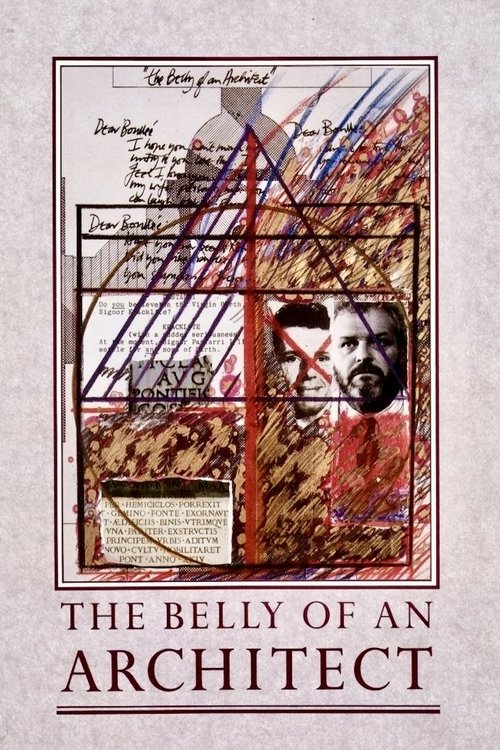
The Belly of an Architect
1987 · Peter Greenaway
For when you want something rigorous and haunting to chew on for days — a slow, gorgeous tragedy rather than an easy watch. Reach for it in an art-house mood, when atmosphere and ideas sound like dinner.
What it's about
An American architect arrives in Rome with his much younger wife to mount a grand exhibition honoring his idol, an 18th-century French visionary who designed monuments too vast to ever be built. As the months of preparation grind on, everything starts to slip — his marriage, his control of the project, his health — and his fixation narrows to bellies: his wife's pregnant one, and his own, seized by pains he becomes convinced are no accident. A portrait of a monumental ego coming apart in a monumental city.
The experience
Stately, strange, and quietly devastating — every frame arranged like a formal painting while a raw human unraveling happens inside it. It's chilly on the surface and surprisingly wrenching underneath, the kind of film that gets sadder the longer you sit with it.
Performances
Brian Dennehy is monumental as Kracklite — a huge man playing a huge appetite, blustering and vulnerable at once, in what many consider the performance of his film career.
The craft
Peter Greenaway, a painter by training, composes Rome into a gallery of symmetries — living bodies against ancient stone, the sick belly against the pregnant one — with an insistent, pulsing score that turns obsession into rhythm. It's ravishing on a big screen, where the architecture can properly loom.
Why it matters
The warmest and most accessible film of Greenaway's celebrated 1980s run, it stands as a gateway into one of British cinema's most uncompromising formal stylists.
Snapshot
Peter Greenaway's third theatrical feature is a film about a man who builds nothing and unmakes himself. Stourley Kracklite, an American architect, arrives in Rome to mount an exhibition honoring the 18th-century French visionary Étienne-Louis Boullée; over the months of preparation his marriage decays, his commission is taken from him, and the abdominal pains he is sure are poison turn out to be cancer. Greenaway, a painter by training and a cataloguer by temperament, builds the picture as a set of rhyming symmetries — the husband's diseased belly against the wife's pregnant one, the living architect against the dead one he idolizes, Augustus Caesar's rumored poisoning against Kracklite's paranoid suspicion of his wife. It is at once the warmest and the most conventionally tragic of Greenaway's films from this period, anchored by a remarkable lead performance from Brian Dennehy, and the most literally monumental: Rome's neoclassical architecture is not setting but co-protagonist. The film sits in the middle of Greenaway's extraordinary run of the 1980s, between A Zed & Two Noughts (1985) and Drowning by Numbers (1988), and remains one of his most accessible works precisely because its formal coldness is organized around a recognizable human grief.
Industry & production
The Belly of an Architect was an Anglo-Italian co-production, shot on location in Rome, that drew on the patronage model sustaining ambitious British auteur cinema in the 1980s. The decisive backer was Channel Four's Film Four International, which under David Rose's commissioning had become the lifeline for filmmakers like Greenaway who could not be financed inside a conventional commercial frame. Italian partners and facilities supported the Roman shoot, and the producer of record was Colin Callender. (Beyond these principals the precise financing stack is reported inconsistently across sources, and I will not reconstruct figures I cannot verify; no reliable budget or box-office numbers should be asserted.)
The production's signal industrial gamble was casting. For a film built around a single sustained performance, Greenaway chose Brian Dennehy — an American character actor then best known for supporting and heavy roles in Hollywood genre pictures (First Blood, Cocoon, Silverado). It was, on paper, an improbable fit with Greenaway's mannered, anti-naturalistic house style, and it proved one of the most fruitful pieces of against-type casting in the director's career. Around Dennehy the film assembled an international ensemble: Chloe Webb (fresh from Sid and Nancy) as the wife, Louisa; Lambert Wilson as the urbane Italian seducer Caspasian Speckler; Sergio Fantoni and Stefania Casini in the orbit of the Speckler family who underwrite and ultimately appropriate the exhibition. The mixing of an American lead, a French actor, and Italian players reflects both the co-production's economics and Greenaway's interest in Rome as a meeting-ground of foreigners.
Technology
The film was produced and exhibited on 35mm, in the analog, photochemical idiom standard for European art cinema of the period; it predates the digital intermediate and the computer-driven compositing that Greenaway would later embrace eagerly (the video layering of Prospero's Books in 1991, and beyond). The technological "instrument" most thematically charged inside the film is not the camera but the photocopier and the postcard: Kracklite obsessively reproduces images — reproductions of Boullée's drawings, photographs of statuary bellies, copies of his own torso — defacing and recombining them on the office Xerox. Greenaway, who began his career as an editor at the Central Office of Information and was fascinated by archives and reproduction, makes the act of copying a motif: the architect who can build nothing original spends his days generating degraded duplicates. The film's "technology," in other words, is bureaucratic and reprographic, a quiet commentary on creation reduced to facsimile.
Technique
Cinematography
The cinematographer was Sacha Vierny, the French master who had shot Alain Resnais's Hiroshima mon amour and Last Year at Marienbad and who became Greenaway's essential collaborator from A Zed & Two Noughts onward. Vierny's work here is built on frontality, symmetry, and slow, stately camera movement. Roman monuments — the Vittoriano (the "wedding cake" monument to Victor Emmanuel II), the Pantheon, the Piazza del Popolo, Piazza Navona — are framed head-on, centered, and held, so that human figures are dwarfed within rigorously balanced architectural geometry. Vierny lights for a warm, golden classicism that flatters the travertine and marble while leaving the human drama feeling slightly embalmed, a body laid out among masterworks. The compositional rhyme between the curved dome, the rounded statue, and the swelling belly is achieved largely through this insistence on centered, planimetric framing: the eye is trained to read bodies as architecture and architecture as body.
Editing
The editing credit is generally given to John Wilson, who cut for Greenaway in this period. The film's rhythm is deliberately un-Hollywood: long takes, scenes that hold past the point of conventional dramatic economy, and a structural reliance on tableaux that the cutting respects rather than fragments. Greenaway's editing logic is paratactic and serial — built from discrete, framed units laid side by side like exhibits in a gallery — rather than driven by continuity tension. The result is a procession of set-pieces (banquets, exhibition halls, hospital rooms) whose accumulation, not their causal velocity, produces the sense of a life closing down.
Mise-en-scène / staging
This is the film's deepest stratum. Greenaway stages the action as a series of living paintings, with actors arranged frontally within architectural frames and props deployed with curatorial precision — fruit, postcards, photographs, the recurring imagery of bellies in classical sculpture. The exhibition that Kracklite is mounting becomes a mise-en-abyme of the film's own method: a room of reproductions and models, obsessively ordered. Costuming and color tie characters to the building's palette. The decisive staging conceit is scale: humans are repeatedly placed so that monumental architecture overwhelms them, dramatizing the film's thesis that the architect's dream of permanence in stone is a denial of the perishable body.
Sound
The score is the work of the Belgian minimalist composer Wim Mertens, whose piece "Struggle for Pleasure" became the film's signature — a circling, melancholy, gently propulsive theme that recurs over the Roman vistas — set against far harsher material by the American composer Glenn Branca, whose dissonant, massed guitar symphonics supply the death-haunted, anguished register. This is a notable departure from the Michael Nyman scores associated with Greenaway's surrounding films, and the Mertens/Branca pairing gives Belly a distinctive emotional bandwidth: Mertens for the ache of mortality and beauty, Branca for the body's violence and dread. The dialogue, often delivered in a flat, declamatory manner consistent with Greenaway's anti-naturalism, sits within a precisely designed soundscape of Roman space.
Performance
Dennehy's Kracklite is the film's center of gravity and the chief reason it moves audiences who find Greenaway's other work chilly. He gives the bulk and gruffness of the Hollywood heavy a tragic dimension — a big American body literally failing among the eternal stones of Europe, clutching his gut, reproducing his pain on a photocopier, sliding from imperious confidence into paranoid ruin. The performance is large but disciplined, and it earned Dennehy the strongest reviews of his screen career. Chloe Webb plays Louisa as alternately tender and exasperated, her pregnancy the film's living counter-image to Kracklite's decay; Lambert Wilson lends Caspasian a cool predatory charm as he relieves Kracklite of both his wife and his commission.
Narrative & dramatic mode
Beneath the formal apparatus is a surprisingly classical tragedy of jealousy and mortality — Greenaway has, more than once, structured a film around a man's downfall, and here the armature is close to Othello crossed with a memento mori. Kracklite's reading of Roman history (the rumor that Augustus was poisoned by his wife Livia) feeds a delusion that Louisa is poisoning him, when the true agent is the cancer in his belly. The dramatic mode is ironic and symbolic rather than psychological: characters function partly as figures in an argument about bodies, buildings, and time. Yet the trajectory is legible and emotionally direct — decline, dispossession, death — and the film closes on a stark simultaneity, Kracklite's fatal fall from the Vittoriano set against the birth of his child, life and death rhyming in a single architectural frame.
Genre & cycle
The film resists genre in the marketing sense; it is an art-cinema drama, an "intellectual melodrama," and a tragedy of obsession. Within Greenaway's own output it belongs to a cycle of mid-1980s features organized around a controlling conceit and a fascination with the body, decay, and taxonomy — A Zed & Two Noughts (decomposition and symmetry), The Belly of an Architect (the body and the building), Drowning by Numbers (counting and death), culminating in The Cook, the Thief, His Wife & Her Lover (1989). Belly is the most humanist and the most singular-protagonist-driven entry in that sequence.
Authorship & method
Greenaway is the rare director whose method is fully foregrounded as content. Trained as a painter, steeped in the conventions of European art history, and obsessed with systems — lists, numbers, alphabets, catalogs — he composes films as curated arrangements rather than naturalistic flows. Belly makes this method its subject by being about a curator-architect mounting an exhibition. The authorship is genuinely collaborative within a stable workshop: Sacha Vierny's painterly cinematography is inseparable from Greenaway's compositional thinking; the score here comes not from the expected Michael Nyman but from Wim Mertens and Glenn Branca, a choice that reshapes the film's affect; John Wilson's editing serves the tableau structure. Greenaway wrote the screenplay himself, as he did throughout this period, grounding the fiction in real architectural history — Boullée, the visionary neoclassicist of unbuilt megastructures like the Cenotaph for Newton — and in Roman antiquity, weaving documented historical material into an invented psychological drama.
Movement / national cinema
Belly is a product of 1980s British art cinema as underwritten by Channel Four, the institutional engine behind a remarkable cohort (Greenaway, Derek Jarman, and others) whose work would have had no commercial home otherwise. But it is a deliberately deterritorialized British film: its director's sensibility is shaped less by British social realism than by Continental modernism — Resnais (via Vierny), the European tradition of the film as essay and tableau. Shot in Rome with an international cast, it belongs to a strand of itinerant European art cinema in which the foreigner-in-Italy confronts the weight of the classical past, a lineage stretching back through Rossellini and the modernist art film.
Era / period
The film captures a specific late-1980s moment in two senses. Industrially, it embodies the brief, fertile window when public-service television money (Channel Four) sustained uncompromising auteur features before the financing landscape shifted. Aesthetically, it arrives just before Greenaway's full plunge into electronic image-making; it is among the last of his works conceived in a purely photochemical, location-bound idiom, its grandeur derived from real Roman stone rather than digital layering. Its preoccupations — the body as site of dread, mortality stripped of consolation, the postmodern obsession with reproduction and the archive — are very much of their cultural instant.
Themes
The governing theme is the opposition of permanence and perishability: the architect's dream of building for eternity set against the failing, mortal body. Boullée, the worshipped predecessor, designed monuments that were largely never built — pure, deathless idea — while Kracklite, who reveres him, possesses only a decaying belly and can complete nothing. The pregnant belly and the cancerous belly are the film's central rhyme, creation and destruction lodged in the same word and the same anatomy. Around this cluster: jealousy and the paranoid misreading of the body's signals (the Augustus/Livia motif); the relation between the copy and the original, reproduction as a degraded substitute for making; and the foreigner's awe and impotence before the monumental past. Greenaway treats these less as a message than as a set of formal correspondences to be arranged and contemplated.
Reception, canon & influence
Critically, the film was well received as a step toward wider accessibility for Greenaway, and the consensus singled out Brian Dennehy's performance as a revelation — the discovery of unexpected tragic depth in an actor pigeonholed by Hollywood. It screened on the international festival circuit at the time of its release; I will not assign it specific competition prizes I cannot confirm, but its standing rests less on awards than on the durability of Dennehy's work and the film's reputation as the most emotionally legible of Greenaway's major features.
Looking backward, the film's influences are erudite and explicit: the historical figure of Étienne-Louis Boullée and the neoclassical theory of the sublime monument; Roman imperial history and the literature of poisoning; the European tradition of the painterly, essayistic art film, mediated through Sacha Vierny's lineage from Resnais; and a deep grounding in art history and architecture native to Greenaway's painter's training. The minimalist musical language of Wim Mertens connects it to the wider 1980s minimalism that also shaped Greenaway's Nyman-scored films.
Looking forward, Belly consolidated the international art-house reputation that Greenaway would cash in with the far more notorious The Cook, the Thief, His Wife & Her Lover two years later, and it stands as a key text in the broader project of films that treat architecture and the body as mirror images. Its most concrete legacy may be its enduring use as a case study — in film, architecture, and cultural-studies pedagogy — of cinema's capacity to think about buildings, mortality, and the will to monumental permanence. For Dennehy, it remained a touchstone performance, cited thereafter as evidence of a range his Hollywood career rarely asked him to show.
A Deleuzian reading
A man stands at an office photocopier in Rome, pressing his own torso to the glass.
The full Deleuzian reading of The Belly of an Architect →
Reception
Respectfully but quietly received in 1987 — it premiered in competition at Cannes, then got overshadowed two years later by the scandal of The Cook, the Thief. It has since been steadily reappraised as Greenaway's warmest, most humane film, with Brian Dennehy's performance the centerpiece of the rediscovery.
How The Belly of an Architect was received, from release to now →
Influences: the films it descends from and the films it influenced
- Last Year at Marienbad (1961) — Direct ancestor through cinematographer Sacha Vierny, whose architectural tracking shots and frontal framing of monumental neoclassical spaces Greenaway inherits wholesale for Belly's Roman locations.
- Hiroshima mon amour (1959) — Establishes the Vierny–Resnais essayistic mode of treating architecture and the body as memory-objects, the painterly art-film grammar Greenaway extends into curated tableaux.
- The Draughtsman's Contract (1982) — Greenaway's own earlier feature that codifies the rigid symmetrical frontality, framed-window compositions, and a numerate Englishman undone within a grand estate — Belly transplants the same staging to Rome.
- A Zed & Two Noughts (1985) — Sibling in which Vierny's bilaterally symmetrical, Vermeer-lit tableaux and a clinical obsession with decay and the body's corruption directly anticipate Belly's memento-mori physiology.
- Salò, or the 120 Days of Sodom (1975) — Ancestor in staging neoclassical architecture as a closed system of power and bodily degradation, the symmetrical interior as torture-chamber that Greenaway secularizes into illness.
- The Conformist (1970) — Vittorio Storaro's monumental fascist-era Roman architecture, deep symmetrical perspectives and the human figure dwarfed by built scale, supplies the visual rhetoric of permanence Belly interrogates.
- The Phantom of Liberty (1974) — Ancestor of the ironic-symbolic, paratactic episodic structure where tableaux accrue by association rather than naturalistic causation.
- The Cook, the Thief, His Wife & Her Lover (1989) — Direct descendant that cashes in Belly's reputation, escalating the frontal proscenium staging, framed color-coded chambers, and the body as the site where appetite and mortality collide.
- Prospero's Books (1991) — Descendant pushing the living-paintings and catalog-of-images method to its limit, the human body annotated and exhibited like an architectural plate.
- The Pillow Book (1996) — Descendant extending the reprographic motif — the body as inscribed, copied surface — into literalized calligraphy on skin, sustaining Belly's copy-and-original theme.
- The Belly of an Architect's score lineage — Drowning by Numbers (1988) — Sibling whose minimalist score and game-systems counting structure share Belly's use of repetitive minimalist music (Mertens/Nyman idiom) to organize paratactic tableaux.
- The Draughtsman's lineage heir — The Falls (1980) — Sibling establishing the catalogue/list architecture and pseudo-documentary cataloging impulse that structures Belly's exhibition-as-narrative.
Similar films
- The Cook, the Thief, His Wife & Her Lover (1989) — influence & lineage
- The Draughtsman's Contract (1982) — influence & lineage
- A Zed & Two Noughts (1985) — influence & lineage
- Synecdoche, New York (2008) — influence & lineage
- The Great Beauty (2013) — influence & lineage
- The Brutalist (2024) — shared sensibility
- The Dead (1987) — shared sensibility
- Barry Lyndon (1975) — shared sensibility