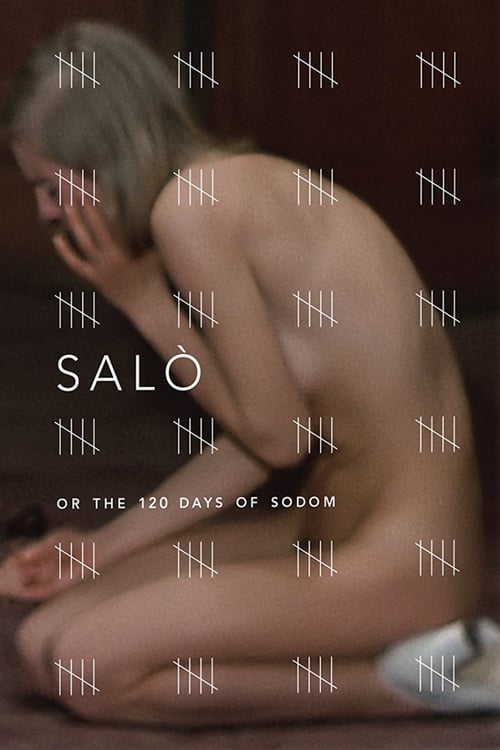
Salò, or the 120 Days of Sodom
1976 · Pier Paolo Pasolini
Only for when you deliberately want the hardest thing cinema has to offer — a confrontation, not an evening's entertainment. This is challenge in its purest form; there is no comfort here, and it should be approached knowingly.
What it's about
In the dying days of Mussolini's regime, four men of absolute power — a duke, a bishop, a magistrate, a president — seal themselves in a villa with a group of abducted teenagers and enact a program of total domination drawn from the Marquis de Sade. What follows is a ritualized descent through humiliation, sexual violence, and cruelty, staged with the cold formality of a state ceremony. It is fascism examined not as history but as an appetite.
The experience
Punishing, clinical, and deliberately unbearable — the film keeps its distance, framing atrocity with a composure that makes it worse. It doesn't shock you and let you go; it grinds, and it leaves a residue that lasts for days.
The craft
Pasolini stages horror with paradoxical elegance: symmetrical compositions, opulent art-deco interiors, and a serene classical surface that never flinches into sensationalism. The formal beauty is the point — cruelty administered with taste and order. The detachment of the camera, especially in the final stretch, is among the most discussed choices in film history.
Why it matters
Pasolini's final film, completed just before his murder, it became the benchmark for banned and censored cinema — seized, prosecuted, and debated for decades — and remains the reference point for any argument about what art is permitted to show.
Snapshot
Salò, or the 120 Days of Sodom (Salò o le 120 giornate di Sodoma) is the final film of Pier Paolo Pasolini, completed shortly before his murder in November 1975 and released in 1976. It transplants the Marquis de Sade's unfinished 18th-century novel The 120 Days of Sodom to the Republic of Salò — the Nazi-backed puppet state in northern Italy where Mussolini's regime made its last stand between 1943 and 1945. Four libertines of absolute power (the Duke, the Bishop, the Magistrate, and the President) abduct eighteen young men and women and subject them, over the course of the narrative, to a graduated program of humiliation, sexual violation, torture, and finally murder. The film remains among the most notorious in the history of cinema: a work that almost no one defends as pleasurable and that a substantial body of critics defends as a rigorous, despairing allegory of fascism, consumer society, and the reduction of human beings to objects of consumption. It is studied as much as it is shunned, and its reputation is inseparable from the violence of Pasolini's death weeks after he finished it.
Industry & production
The film was produced by Alberto Grimaldi through Produzioni Europee Associate (PEA), the producer behind much of Pasolini's late work and behind Bernardo Bertolucci's Last Tango in Paris. It was an Italian–French co-production, shot in 1975, largely in and around Salò and Mantua in northern Italy, with interiors at a villa whose rationalist-modern architecture reinforces the film's clinical coldness. Pasolini came to Salò directly from the popular and commercially successful "Trilogy of Life" — The Decameron (1971), The Canterbury Tales (1972), and Arabian Nights (1974) — bawdy, life-affirming adaptations of medieval story collections. Salò was conceived in conscious, brutal repudiation of that trilogy; Pasolini's published "Abjuration of the Trilogy of Life" articulates his disgust at how the sexual liberation he had celebrated had been co-opted and commodified.
The production was overshadowed and then defined by catastrophe. Pasolini was murdered on the night of 1–2 November 1975 on the beach at Ostia, before the film's public release; the precise circumstances and authorship of his killing remain contested to this day. The film therefore reached audiences as a posthumous work, which sharpened both its mythology and the moralism it attracted. It was promptly seized and prosecuted for obscenity in Italy and banned outright in numerous countries; legal and distribution battles over Salò continued for decades, and it carried a reputation as one of the most heavily censored films ever made. Where the historical record on the production is thin or disputed — particularly around the post-production decisions Pasolini did not live to oversee in full, and the still-unresolved facts of his death — it should be treated as genuinely uncertain rather than settled.
Technology
Salò is a conventionally photographed 35mm color feature; its power lies not in technological novelty but in the disciplined withholding of cinematic spectacle. Pasolini, who had moved across his career from the rough 16mm-inflected realism of his early films toward more composed images, here uses a restrained, almost academic photographic grammar. There is no reliance on optical effects, and the violence — even at its most extreme in the final movement — is rendered through staging, framing, and sound rather than through elaborate special-effects technology. The film's technical conservatism is itself a strategy: the horror is presented with the even, unhurried surface of an official document.
Technique
Cinematography
The cinematography is credited to Tonino Delli Colli, Pasolini's longtime collaborator and one of the great Italian cinematographers (later director of photography on Sergio Leone's Once Upon a Time in America). The look is cool, even, and deliberately undramatic. Delli Colli and Pasolini favor measured medium and wide shots that hold the libertines and their victims within the same frame, refusing the close-up's invitation to identification or catharsis. The palette is muted and wintry; the modernist villa's clean lines and the formal arrangement of bodies produce a chilling sense of order imposed on atrocity. Crucially, the camera frequently observes the worst acts at a distance, even through a window or with an aestheticizing detachment, so that the spectator is implicated in the position of the watching libertine.
Editing
The editing, by Nino Baragli (another habitual Pasolini collaborator, also associated with Leone), serves the film's architectural structure rather than generating suspense or momentum. Cutting is unhurried and observational; sequences are allowed to play out with a ritual deliberateness that matches the libertines' methodical program. The film is organized into named "circles" borrowed from Dante — the Antechamber of Hell, the Circle of Manias, the Circle of Shit, and the Circle of Blood — and the editing reinforces this segmentation, moving the spectator through a descending, classified inferno rather than a conventional rising dramatic arc.
Mise-en-scène / staging
Mise-en-scène is the film's central expressive instrument. The action is confined almost entirely to the villa, a closed world of polished floors, tasteful furnishings, and tableaux that recall the formal compositions of painting. Pasolini stages the abuse with a horrible decorum: the libertines preside from chairs like a tribunal or an audience, female narrators (the signore) recount erotic tales from a staircase as if performing, and the victims are arranged, numbered, and displayed. This theatricality — bodies organized into friezes, rituals of dress and undress, a grotesque marriage, communal meals of excrement served as banquets — turns power into spectacle and consumption literal. The staging consistently equates fascist authority with connoisseurship, treating human beings as objects to be cataloged, savored, and discarded.
Sound
The sound design alternates between cultivated music and the noises of degradation. Ennio Morricone provides the score, used sparingly; a recurring piano motif lends an incongruous gentleness. The film famously frames its conclusion with the distancing device of music heard on a radio. Most pointedly, the film's final image is accompanied by a turn toward a popular dance tune as two young guards talk of ordinary life, a banal grace note that underscores how atrocity coexists with normality. Throughout, the contrast between refined sound and obscene image is one of Pasolini's sharpest tools of estrangement.
Performance
The cast mixes professional and non-professional players, in keeping with Pasolini's lifelong practice. The four masters are played by experienced actors — Paolo Bonacelli as the Duke, Giorgio Cataldi as the Bishop, Umberto Paolo Quintavalle as the Magistrate, and Aldo Valletti as the President — who perform with a chilling, bureaucratic blandness rather than melodramatic villainy. The victims are largely young non-professionals whose ordinariness is essential to the design. The female storytellers, among them Hélène Surgère, deliver their pornographic recitations with poised, salon-like composure. The performance register across the film is deliberately flat and ceremonial, denying the audience the relief of recognizable psychological motivation.
Narrative & dramatic mode
Salò is structured not as a story with characters who change but as a descent, modeled explicitly on Dante's Inferno and on Sade's encyclopedic catalog of cruelty. After an opening "Antechamber of Hell" in which the victims are rounded up and the rules established, the film proceeds through three "circles," each governed by escalating transgression and introduced by a narrator's tale. There is no redemptive arc, no rescue, no moral reversal; the dramatic mode is anti-dramatic by design, a system grinding toward its predetermined end. This refusal of conventional narrative pleasure is itself the argument: by denying suspense, identification, and catharsis, Pasolini blocks the spectator from consuming the violence as entertainment and forces a colder, more analytic confrontation.
Genre & cycle
The film resists easy genre placement. It is at once a literary adaptation, a political allegory, and a horror film of a uniquely austere kind. It belongs to no comfortable cycle, though it is sometimes discussed alongside the 1970s European "art-horror" of bodily extremity and, more uneasily, cited by critics in relation to exploitation traditions it stands utterly apart from in intent. Its closest kinships are intellectual rather than generic: Sade's libertine philosophy, Dante's structured cosmology, and the European tradition of the political parable. Within Pasolini's own career it functions as the dark counter-cycle to the Trilogy of Life — the inversion of that earlier celebration of the body into a vision of the body as commodity and corpse.
Authorship & method
Salò is a profoundly authored film, the culmination of Pasolini's thinking as poet, novelist, theorist, and Marxist–Catholic provocateur. He adapted the screenplay from Sade, working with the collaboration of Sergio Citti and drawing on a structure indebted to Roland Barthes's reading of Sade and to Dante. His method fused high literary architecture with documentary-derived casting and a painter's eye for composition. The key collaborators are the spine of his late period: cinematographer Tonino Delli Colli, editor Nino Baragli, and composer Ennio Morricone, each of whom Pasolini had worked with repeatedly, plus production designer and costume work that grounds the film in the precise period textures of 1944–45. Pasolini's authorial signature is the dialectical method itself — the use of beauty (composition, music, Renaissance allusion) to frame ugliness, so that the film's form continually indicts its content and the viewer's act of watching.
Movement / national cinema
The film stands in the broad current of postwar Italian cinema while standing apart from any school. Pasolini emerged from the legacy of neorealism — his early work used non-professional actors and real locations — but by Salò he had developed a personal, intellectual cinema unlike that of any contemporary. The film is inescapably tied to Italian national history: it is a reckoning with fascism set in the literal final geography of Mussolini's regime, made by an artist who was also a public intellectual engaged in fierce debate about the trajectory of postwar Italian society. It can be read as a late, embittered entry in Italian cinema's long postwar effort to confront the Fascist era, and as part of Pasolini's broader polemic against what he saw as a new "consumerist" fascism replacing the old.
Era / period
The setting is the Republic of Salò of 1944–45, the twilight of Italian Fascism, and the film's period specificity is exact and pointed. But Pasolini repeatedly insisted the film was not merely about historical fascism. He read it as an allegory of power in any form that reduces human beings to consumable objects, and specifically as a critique of the consumer capitalism of 1970s Italy — the same "anthropological mutation" he denounced in his contemporaneous essays and journalism. The historical period thus operates on two levels: as a precise reconstruction of a real moment of collapse, and as a mirror held up to the present in which Pasolini believed a subtler, more total domination was underway.
Themes
The governing theme is power as consumption: the libertines literally and figuratively eat, use, and discard human bodies, making the equation of fascism, sadism, and consumerism explicit. Related strands run throughout — the commodification of the body and of sexuality, the corruption of every institution (aristocracy, church, judiciary, finance, embodied in the four masters); the complicity of the spectator who watches; the destruction of innocence and of the young by the old and powerful; and the perversion of language, ritual, and culture into instruments of control. Pasolini frames sexuality not as liberation but as the field on which domination is enacted, a deliberate repudiation of his earlier celebration of erotic vitality. Beneath it all lies a bleak metaphysics: a world without God, grace, or escape, organized entirely around the will of those who hold absolute power.
Reception, canon & influence
On release, Salò provoked outrage, prosecution, and bans across many countries; it was condemned as obscene and indefensible, and for years was effectively unavailable in numerous territories. Yet alongside the revulsion grew a serious critical literature defending it as a rigorous and morally serious work — a position consolidated over the following decades, notably by the film's inclusion in the Criterion Collection and by sustained academic attention. The critical consensus has never been comfortable: the film is widely regarded as both nearly unwatchable and genuinely important, an extremity that demands to be reckoned with rather than enjoyed. It is now firmly canonized within studies of Pasolini, of political cinema, and of cinematic transgression, even as it remains restricted or controversial in distribution.
The influences on the film are explicit and literary: the Marquis de Sade above all, Dante's Inferno as structural template, Roland Barthes's structuralist reading of Sade, and Pasolini's own Marxist and Catholic intellectual formation, set against the autobiographical rupture with his Trilogy of Life. Its influence forward is harder to trace through direct imitation, precisely because few filmmakers have attempted anything comparable; rather, Salò became a permanent reference point — the limit case invoked in debates about censorship, the ethics of representing atrocity, and the boundary between art and obscenity. Directors associated with confrontational European cinema and the later "New Extremity" inherited its central problem of implicating the spectator in violence, and critics regularly measure transgressive cinema against it. Its most enduring legacy may be conceptual: it stands as the definitive test of the claim that the unbearable can be made the legitimate subject of serious art, and as the haunting final statement of one of postwar cinema's most uncompromising artists.
A Deleuzian reading
A man stands at a window and raises a pair of opera glasses.
The full Deleuzian reading of Salò, or the 120 Days of Sodom →
Reception
Banned, seized, and prosecuted around the world for decades — the UK didn't pass it uncut until 2000 — it's since been canonized as the definitive final statement of a major artist, complete with a prestige Criterion edition and a permanent seat in the arthouse canon.
How Salò, or the 120 Days of Sodom was received, from release to now →
Influences: the films it descends from and the films it influenced
- The 120 Days of Sodom (novel→method) (1785) — Source text whose catalog-structure — a presiding committee, serial enumeration of passions, and escalation toward the unspeakable — Pasolini transposes literally into the film's segmented architecture rather than dramatizing as plot.
- Inferno (Dante, structural template) (1320) — Provides the explicit chaptering — Anteinferno, Circle of Manias, Circle of Shit, Circle of Blood — that replaces narrative arc with a graded descent, each 'circle' a tableau of intensifying degradation.
- Mamma Roma (1962) — Establishes Pasolini's painterly frontal composition and non-professional casting drawn from documentary instinct, the figurative-art framing he later weaponizes against the content in Salò.
- The Gospel According to St. Matthew (1964) — Pasolini's method of staging reverent tableaux with Renaissance pictorial allusion and ironic high/low musical counterpoint — beauty framing meaning — is the formal grammar Salò inverts toward horror.
- Trilogy of Life (Decameron / Canterbury Tales / Arabian Nights) (1971) — The episodic, body-centered, anthology storytelling of these films is the joyous thesis whose autobiographical 'abjuration' Salò directly answers by recasting the same enumerative episodic form as commodified atrocity.
- Theorem (1968) — Pasolini organizes the film's serial atrocities within a geometrical structure (the four Dantean circles) that directly inherits Teorema's pentagonal theorem-architecture, retaining the same devotional attention to faces and bodies under duress and the same non-psychological performance register as a method of political autopsy.
- Satyricon (1969) — Donati's production and costume design — the same designer, the same enclosed theatrical space approach, the same strategy of costuming bodies as pictorial objects — and the frieze-composition of victims arranged in tableaux apply Satyricon's peplum-inversion logic to Italian Fascism, replacing Roman antiquity with Salò's villa.
- Viridiana (1962) — Inherits the cinema of cruelty and the blasphemous-tableau composition, staging degradation in cold, frontal, painterly arrangements that descend from the Last Supper freeze-frame.
- The Decameron (1971) — Systematically inverts every device of The Decameron with the identical crew: the same frontal framing now used for clinical surveillance, the same anthology-of-tales structure now delivered by seated narrators in a closed villa, the same nudity now stripped of joy and rendered as commodity.
- Medea (1969) — The direct material line: Dante Ferretti, whose career Medea launched, carries forward its principle of sets built as historical fact rather than period decor — the discipline he then took to Fellini, Gilliam and Scorsese.
- Funny Games (1997) — Inherits Salò's central device of implicating the viewer — withholding catharsis and using cold, distanced framing so that watching atrocity becomes the film's accusation against the watcher.
- Irréversible (2002) — New Extremity work that adopts Salò's strategy of formal rigor (durational fixed framing, structural ordering) deployed to make sustained, near-unwatchable violence a deliberate ethical ordeal.
- Twentynine Palms / later Dumont (2003) — Extends the post-neorealist lineage of non-professional casting and affectless, detached wide framing toward an austere art-horror in which brutality erupts without dramatic cushioning.
- Antichrist (2009) — Carries forward the gambit of wrapping extreme bodily horror in chapter-segmented structure and self-conscious beauty so that aesthetic form continually indicts its own atrocious content.
- The House That Jack Built (2018) — Explicitly cites the Dantean descent and catalog-of-atrocities form, staging murder as enumerated 'incidents' that make the spectator's continued attention the subject of the film.
- A Serbian Film (2010) — The recurrent modern 'limit case' measured against Salò — using methodical escalation of unrepresentable acts as explicit political allegory of a population's complicity, inheriting Salò's censorship-flashpoint role.
- Vinyl / Salò-citation in Pasolini-era extremity criticism — The Piano Teacher (2001) — Translates Salò's bureaucratic blandness of cruelty into a clinical study of power-as-consumption, performing degradation with the same affectless, undramatized restraint.
- Yes (2025) — Catalogs the body as commodity across chaptered 'circles,' weaponizing the grotesque as an indictment of power — the cold structural cruelty Yes echoes.
- The Painted Bird (2019) — Pasolini's adaptation of an extreme literary work as systematic ideological argument about fascism — using graphic content as analysis rather than spectacle, organized in titled circles — provides the ethical and structural framework for The Painted Bird's refusal to soften Kosiński's episodic violence into legible tragedy.
- Hunger (2008) — Composes bodily degradation and excrement into deliberate, aestheticized tableaux held as formal images — the precedent for Hunger's abstract excrement-smeared wall murals shot as composition rather than shock.
- Ichi the Killer (2001) — The art-cinema precedent for staging extreme degradation as a clinical interrogation of the spectator's complicity, the 'is this inquiry or assault' frame Ichi inherits.
- Martyrs (2008) — Stages torture as a clinical, systematized institutional procedure with flatly refused catharsis, implicating the spectator in the act of watching — the template for Martyrs' final-act apparatus.
- Week-end (1967) — Shares the Brechtian use of detached wide framing and bourgeois cannibalism-as-allegory to refuse identification and indict the spectator's appetite for the spectacle of violence.
- The Conformist (1970) — Bertolucci, Pasolini's protégé, mounts the same period-precise fascist-aesthetic critique through Delli Colli-era Italian craftsmanship, using immaculate design to expose the bureaucratic blandness of complicity.
- The Damned (1969) — Visconti's operatic anatomy of a family's moral collapse under Nazism shares Salò's project of locating fascism in private libidinal corruption staged as decadent tableau.
- The Night Porter (1974) — Contemporary Italian film binding fascist power to sexual sadism, dramatizing the same victim/torturer dialectic that Salò abstracts into ritual rather than romance.
- Pasqualino Settebellezze (Seven Beauties) (1975) — Released the same year, it likewise renders fascist atrocity through degradation and survival-as-complicity, testing how far grotesque comedy and horror can frame political guilt.
- In the Realm of the Senses (1976) — The immediate transgressive counterpart: explicit sexuality pushed past representability and into prosecution, posing the same art-versus-obscenity legal test that defined Salò's reception.
- The Belly of an Architect (1987) — Ancestor in staging neoclassical architecture as a closed system of power and bodily degradation, the symmetrical interior as torture-chamber that Greenaway secularizes into illness.
- Titus (1999) — Dante Ferretti's design school: fascist-era setting and coolly composed tableaux that stage atrocity as formal spectacle, the 'violence-as-spectacle' design grammar Ferretti reprises for Taymor.
- The Devils (1971) — Composes power and cruelty as formal tableaux of institutional sadism, sharing The Devils' suppressed-cut censorship history and its indictment of authority's obscenity.
- One Way or Another (1976) — An enclosed villa as sadistic power laboratory, with ritualized degradation staged in liturgical, rule-bound formality — the same year's sibling in staging power as closed ceremonial rite.
- Seven Beauties (1975) — Delli Colli-shot tableaux of degradation deployed as anti-cathartic indictment of fascist power, made the same year with the same cinematographer's clinical eye.
Similar films
- In the Realm of the Senses (1976) — influence & lineage
- The Conformist (1971) — shared sensibility
- Theorem (1968) — shared sensibility
- 1900 (1976) — shared sensibility
- One Way or Another (1976) — shared sensibility
- The Decameron (1971) — shared sensibility
- Hitler: A Film from Germany (1978) — shared sensibility
- On the Silver Globe (1989) — shared sensibility
All the films related to Salò, or the 120 Days of Sodom →