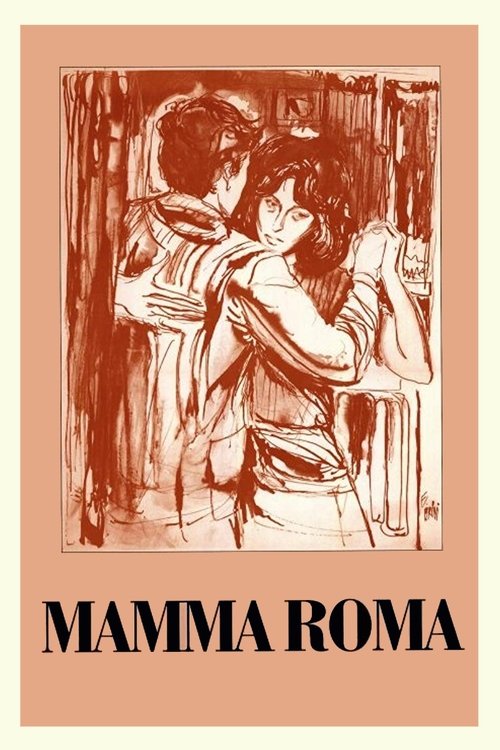
Mamma Roma
1962 · Pier Paolo Pasolini
For when you want to be devastated by a mother's love — a film about hoping ferociously against the odds. Emotionally heavy; save it for a night when you can give it your full heart.
What it's about
A middle-aged Roman prostitute, finally free of her pimp, buys a market stall and an apartment in the housing projects at the city's edge, determined to build a respectable life for the teenage son she gave up as an infant. Her dream of middle-class dignity collides with the return of her past and the boy's drift toward petty crime on the city's periphery.
The experience
It swings between raucous, life-force comedy — much of it pouring straight out of Anna Magnani — and a gathering sense of doom, so you laugh and dread in the same scene. Earthy and sacred at once, it leaves a lasting ache.
Performances
Anna Magnani is volcanic as Mamma Roma — bawdy, tender, defiant, her great cackling laugh masking bottomless fear for her son. It's one of the towering performances of Italian cinema, a legendary star colliding with a director determined to use her differently.
The craft
Pasolini shoots the raw locations and non-professional faces of the Roman outskirts like Renaissance sacred art — compositions borrowed from religious painting, ordinary people framed as saints and martyrs. That collision of gutter and altar gives the film its unmistakable look.
Why it matters
A bridge between postwar neorealism and the more radical poetic cinema that followed, it cemented Pasolini as one of Italy's most provocative and important filmmakers.
Snapshot
Mamma Roma is Pier Paolo Pasolini's second feature, made in 1962, one year after Accattone and while its director was already a celebrated poet, novelist, and screenwriter rather than a career filmmaker. It is the story of a Roman prostitute (Anna Magnani) who, freed at last of her pimp, buys a market stall and a new apartment in the housing projects at the city's edge, hoping to install her teenage son Ettore in a respectable petit-bourgeois life — a project that the return of the pimp, and the son's drift into petty crime, destroys. The film fuses the raw locations and non-professional supporting cast of postwar neorealism with a deliberately iconic, painterly visual style drawn from early-Renaissance sacred art, and it is anchored by one of the most celebrated stars of Italian cinema playing against, and often in tension with, the director's anti-naturalistic method. It stands, with Accattone, as the foundational statement of Pasolini's cinema of the Roman sottoproletariato — the sub-proletarian underclass of the borgate.
Industry & production
The film was produced by Alfredo Bini's company Arco Film, which had backed Accattone and would remain Pasolini's principal producer through the early 1960s. Coming off the succès de scandale of his debut, Pasolini was able to secure a more ambitious production, most conspicuously by casting Anna Magnani — an international star since Rossellini's Roma città aperta (1945) and an Academy Award winner for The Rose Tattoo (1955) — in the title role. This was a marked shift from Accattone, which had been built entirely around non-professionals. The picture was made largely on location in Rome's peripheral quarters, using the vast INA-Casa public housing estates and the surrounding wasteland of ancient ruins as its principal setting, a choice that was as much ideological as economic. Mamma Roma premiered at the Venice Film Festival in the late summer of 1962. It provoked controversy in Italy over its frank subject matter, and the period immediately around it was one of persistent legal harassment for Pasolini — most notoriously the blasphemy conviction attached to his 1963 episode film La ricotta — though the precise legal history of Mamma Roma itself is often summarized loosely, and I would flag that the detail of any specific prosecution of this film should be treated with caution.
Technology
Technologically the film is unremarkable by design: it was shot on 35mm black-and-white stock at a moment when much prestige Italian production was moving toward color and widescreen spectacle. Pasolini's aesthetic was consciously "primitive" — he spoke of approaching cinema with the reverence of someone handling a sacred object rather than exploiting the medium's fluency — and the film's technical means are correspondingly restrained. There are no optical pyrotechnics; the innovation, such as it is, lies not in apparatus but in the willful archaism of composition and cutting, a refusal of the polished continuity style that the available technology could easily have delivered.
Technique
Cinematography
The cinematography is by Tonino Delli Colli, who had shot Accattone and would become one of the great Italian directors of photography (later Leone, and again Pasolini). His black-and-white here is high-contrast and sculptural, giving the faces of the non-professionals the weight of carved figures and lending the concrete housing blocks and the fragments of Roman aqueduct a stark monumentality. Pasolini's signature device is frontality: characters are frequently framed head-on, in centered, near-symmetrical compositions that quote the frescoes of Masaccio and the panel painters of the Italian Trecento and Quattrocento. The most famous camera figures in the film are the two long nocturnal tracking shots in which Mamma Roma walks the street at night, talking without pause, while a succession of men — clients, acquaintances, hangers-on — drift into and out of the moving frame around her. These sustained lateral tracks turn her monologue into a kind of aria and are among the most discussed passages in Pasolini's early work.
Editing
Editing is credited to Nino Baragli, another long-term Pasolini collaborator. The cutting reinforces the frontal, iconic conception: rather than smoothing action into seamless continuity, it tends to hold on faces and set up frontal shot/reverse patterns that read as a succession of tableaux. The rhythm is deliberately unhurried in the street sequences and tightens sharply in the final movement, culminating in the montage of Ettore's death.
Mise-en-scène / staging
The staging is where Pasolini's program is most legible. The film opens with a wedding banquet for the pimp Carmine, composed and lit in explicit homage to Leonardo's Last Supper, complete with pigs led in as unruly guests — a sacred-profane collision established in the very first sequence. The geography of the film is itself a thesis: the gleaming but soulless INA-Casa apartment blocks stand beside the ruins of a Roman aqueduct and an old church, so that the modern housing project is perpetually shadowed by the ancient and the sacred. Pasolini stages the sub-proletarian world not as documentary reportage but as a fallen landscape charged with religious resonance.
Sound
The soundtrack is built substantially on pre-existing classical music — the film's score is associated with Antonio Vivaldi, whose instrumental writing lends the borgata an incongruous solemnity, much as Bach's St Matthew Passion had done in Accattone. (I would note the exact attribution and arrangement credits vary in how they are reported, and should be verified against the titles.) Against this "high" music Pasolini sets diegetic popular song — the sentimental and dance numbers of the wedding feast and the street — so that the sacred and the vulgar coexist on the soundtrack as they do in the image. As was standard in Italian production of the era, the film was post-synchronized rather than recorded with live sound.
Performance
Performance is the film's most fraught and fascinating register, because it stages a genuine collision of methods. Magnani brings the full, expressive, theatrically shaded technique of a neorealist star; Pasolini, by contrast, directed his non-professionals — Ettore Garofolo as the son and Franco Citti as the pimp Carmine — as expressive surfaces, casting for face and body and shaping their delivery from outside. The friction between Magnani's practiced emotional realism and Pasolini's anti-naturalistic conception is well documented as a source of tension during the shoot, and many critics read it directly on screen: Magnani is magnificent and yet somehow at odds with the film around her. Garofolo, reportedly discovered by Pasolini outside the profession, gives Ettore a sullen, sensuous passivity, and his final scene is the emotional and iconographic climax of the picture.
Narrative & dramatic mode
Structurally the film is a tragedy in the classical sense: a protagonist whose one aspiration — social respectability, a legitimate life for her son — is defeated by forces both external (the returning pimp who can expose her past) and internal (the son's own nature and the class into which he is born). The dramatic mode is melodrama raised to the pitch of tragedy, with the maternal-sacrificial plot of the "fallen woman" story reworked into a Marxist parable about the impossibility of escaping one's class. The narration moves from comic and buoyant registers in its first half — Mamma Roma's ebullience, her schemes — toward an accelerating catastrophe, and it withholds any redemptive consolation. The ending, with Mamma Roma's cry framed against the aqueduct and the city, offers grief without transcendence.
Genre & cycle
Mamma Roma belongs to several overlapping lineages at once. It is a late, mutated descendant of neorealism, sharing that movement's locations, dialect, and social conscience while rejecting its documentary transparency. It is a maternal melodrama, drawing on the long tradition of the sacrificial mother and the redemptive-then-doomed prostitute. And it forms, together with Accattone, the core of Pasolini's own short cycle of borgata films about the Roman sub-proletariat, a body of work continued in fragments such as the La ricotta episode before he turned toward myth and allegory. Its immediate cyclical companion is Accattone: the two films share a producer, cinematographer, editor, dialect world, and the actor Franco Citti, and are almost always discussed as a pair.
Authorship & method
The film is a near-total authorial statement. Pasolini wrote and directed it, and the screenplay grows directly out of his own literary work on the Roman underclass — the novels Ragazzi di vita (1955) and Una vita violenta (1959) — and out of his experience writing dialect dialogue for other directors, including work associated with Fellini's Le notti di Cabiria. His method here crystallizes what he would later theorize: a "cinema of poetry," a reverence for the profilmic reality of faces and places, and a systematic borrowing from sacred painting. His key collaborators are the throughline of his early career: cinematographer Tonino Delli Colli and editor Nino Baragli, both essential to translating his painterly conception into moving images; the recruitment of dialect and casting help from within the Citti circle (Franco Citti onscreen, his brother Sergio Citti a habitual collaborator on Roman speech); and, on the soundtrack, the appropriation of Vivaldi in place of a bespoke composed score, part of Pasolini's strategy of "contamination" between high and low culture. The decisive authorial gamble was the casting of Magnani — an attempt to bend a great professional star to a non-professional aesthetic that produced both the film's grandeur and its internal strain.
Movement / national cinema
The film is a central document of Italian cinema's transition out of neorealism. It emerges from the neorealist inheritance — Magnani herself is a living link to Rossellini's Rome — but it deliberately breaks the neorealist contract of humble, transparent observation, replacing it with a stylized, iconographic, ideologically explicit vision. Pasolini's work thus sits at the head of a distinctly modernist current in postwar Italian cinema, contemporaneous with but distinct from Fellini's and Antonioni's modernisms, defined by its Marxist-Catholic dialectic and its rootedness in the specific sociolinguistic reality of the Roman periphery.
Era / period
Mamma Roma is precisely a film of the Italian "economic miracle" of the late 1950s and early 1960s, and it is best understood as a critique of that boom. The INA-Casa housing estates in which Mamma Roma stakes her hopes are monuments of postwar reconstruction and modernization; the film's argument is that this new prosperity offers the sub-proletariat only the illusion of ascent, a modern surface laid over unchanged structures of exploitation. The juxtaposition of new apartment blocks with Roman ruins makes the point temporally: the miracle is a thin, recent stratum over an ancient and unredeemed poverty. The film belongs, too, to the extraordinarily fertile early-1960s moment of Italian art cinema, released within a few years of L'avventura, La dolce vita, and 8½.
Themes
The governing theme is the impossibility of class mobility — the tragic conviction that one cannot buy one's way, or one's child's way, out of the sub-proletariat. Around this cluster several of Pasolini's lifelong preoccupations: the fusion of the sacred and the profane, whereby prostitutes, thieves, and the poor are figured through the imagery of Christian martyrdom; the maternal, both as fierce love and as a form of possessiveness that helps doom the son; the loss of an archaic, "sacred" pre-industrial world to the leveling advance of consumer modernity; and the entanglement of Marxism with Catholicism that structures Pasolini's entire worldview. Ettore's fate — punished, feverish, finally dying — is presented as a secular Passion, the sacrifice of the innocent-guilty poor.
Reception, canon & influence
Critically, Mamma Roma has long been read in the shadow of Accattone, and a persistent strand of commentary holds that the very presence of Magnani, magnificent as she is, sits uneasily with Pasolini's non-professional aesthetic — that the film is at war with its own star. At the same time it has been consistently valued for Magnani's performance, for Delli Colli's photography, and above all for its closing sequence, and its critical standing has risen over the decades; its restoration and canonical home-video release (notably by the Criterion Collection) confirmed its place in the Pasolini canon and in the broader canon of postwar Italian cinema.
Looking backward, the film's influences are unusually explicit and are as much pictorial and literary as cinematic. Its deepest debts are to Italian painting — Masaccio, the Trecento and Quattrocento frescoes, Leonardo's Last Supper (quoted in the opening banquet), and, most famously, Andrea Mantegna's foreshortened Lamentation over the Dead Christ, which Pasolini reproduces in the framing of the dying Ettore strapped to a prison bed. Behind it also stand the neorealist tradition it revises and Pasolini's own novels of the borgate.
Looking forward, the film's legacy is substantial. It helped establish, with Accattone, an entire iconography of the Roman periphery — the borgate as a subject and a moral landscape — that would echo through later Italian cinema's treatment of the urban margins. Pasolini's frontal, painterly compositional grammar and his practice of scoring the profane with sacred or classical music became recognizable authorial signatures that later filmmakers have cited and imitated. And the collaboration itself proved seminal: Delli Colli, Baragli, and the Citti circle carried forward into Pasolini's subsequent masterworks, from Il vangelo secondo Matteo to the later mythic films. More diffusely, Mamma Roma stands as a key early instance of a modernist, politically engaged art cinema that treats the poor not as objects of pity but as bearers of a fallen sacredness — an approach whose influence extends to any subsequent cinema that has sought the transcendent in the socially abject.
A Deleuzian reading
Pigs at the Last Supper.
The full Deleuzian reading of Mamma Roma →
Reception
It landed in scandal — after its 1962 Venice premiere it drew an obscenity complaint from Italian authorities, and many considered it a step down from Accattone. Now it's canonized as one of the great Italian films and a peak Anna Magnani performance, with the Criterion stamp to prove it.
How Mamma Roma was received, from release to now →
How to watch Mamma Roma: what to notice on a first viewing
- Watch faces shot straight-on, centered, almost like a painting. Pasolini frames characters frontally in near-symmetrical compositions that quote early Renaissance panel painting rather than naturalistic coverage. The compositions borrow the weight of sacred art for people the church and state have written off.
- Watch the tracking shot as Mamma Roma walks and talks at night. The camera moves beside her without cutting while men drift into and out of the frame around her, and she never stops talking. The shot isn't her point of view or a neutral record. Two attentions share the frame, hers and the director's.
- Notice the new apartment blocks standing right beside the old aqueduct. Pasolini repeatedly frames the modern housing project against Roman ruins and a church, so the ancient and sacred shadow every scene of the new life. The geography argues that you can't buy your way out of where you actually come from.
- Watch the high-contrast black and white on the actors' faces. Delli Colli's photography gives ordinary faces the carved weight of sculpture, especially in close-up on the non-professional cast. It treats these Roman sub-proletarians with the visual dignity usually reserved for saints.
- Watch Magnani's face compared with the faces of the non-actors around her. She brings constant, expressive micro-movement, while Pasolini directs Ettore Garofolo and Franco Citti as still, posed surfaces. The mismatch is well documented as real tension during the shoot, and you can watch it play out on screen.
The whole guide to watching Mamma Roma, with the keys for a rewatch →
Influences: the films it descends from and the films it influenced
- Accattone (1961) — The immediate template: Pasolini and Delli Colli first fixed the frontal, low-angle 'holy card' framing of borgata faces and the scoring of pimp-and-thief squalor with Bach's St. Matthew Passion, a contamination strategy Mamma Roma repeats with Vivaldi.
- Roma città aperta (1945) — Establishes the exact Anna Magnani icon Pasolini reweaponizes — the volcanic proletarian mother of the Roman periphery — so that her professional grandeur productively clashes against his non-professional cast.
- Ladri di biciclette (1948) — The neorealist protocol Pasolini revises: real streets, non-actors cast for their faces, and a plot engine of economic desperation, but Pasolini overlays it with sacred iconography rather than documentary humility.
- La terra trema (1948) — Visconti's use of an entire non-professional community speaking untranslated dialect, framed with painterly compositional rigor, models the fusion of vernacular authenticity and formal beauty Pasolini pursues in Roman dialect.
- Le notti di Cabiria (1957) — Pasolini wrote the Roman borgata dialect dialogue for Fellini here, directly rehearsing the sottoproletariato speech and the sacred-prostitute figure that his own films then center.
- La passion de Jeanne d'Arc (1928) — The prototype of frontal, sculptural close-ups that treat the suffering human face as a devotional object, the grammar behind Pasolini's treatment of faces as Trecento fresco material.
- Pickpocket (1959) — Bresson's non-professional 'models' emptied of theatrical performance, plus classical music (Lully) laid over petty crime to find transcendence in the abject, parallels Pasolini's sacralizing of thieves.
- Bellissima (1952) — Recasts Magnani as the archetypal sacrificial working-class mother crystallized in Bellissima, fusing neorealist street milieu with operatic melodrama around her performance.
- Il vangelo secondo Matteo (1964) — The direct payoff of the Mamma Roma method — same crew (Delli Colli, Baragli), non-professional faces cast as Renaissance-painting types, sacred tableaux, and appropriated music replacing a composed score.
- Mean Streets (1973) — Scorsese transplants the sacred-and-profane structure and the scoring of neighborhood violence with liturgical/pop music to Little Italy, treating petty criminals as bearers of Catholic guilt and grace.
- L'humanité (1999) — Dumont casts non-professionals whose faces are held in long, frontal contemplation and locates a wounded transcendence in the socially abject, an explicitly post-Pasolinian 'cinema of poetry.'
- La Haine (1995) — Extends the borgata-as-moral-landscape into the French banlieue using high-contrast black-and-white and roaming tracking shots to monumentalize peripheral youth as tragic class subjects.
- Gomorra (2008) — Inherits the Accattone/Mamma Roma iconography of the Italian urban periphery, casting locals and shooting the concrete borgate as a fallen sacred geography of the sottoproletariato.
- Lazzaro felice (2018) — Rohrwacher revives Pasolini's holy-fool among the rural poor, using non-professionals, 35mm's rough textured aesthetic, and painterly religious tableaux to find sacredness in economic exploitation.
- Rosetta (1999) — Carries forward the tragic-mother-and-marginal-child class narrative with a non-professional lead, though substituting relentless handheld proximity for Pasolini's frontal tableaux.
- Salò, or the 120 Days of Sodom (1976) — Establishes Pasolini's painterly frontal composition and non-professional casting drawn from documentary instinct, the figurative-art framing he later weaponizes against the content in Salò.
- La Chimera (2023) — Frontal, Renaissance-painting framing of the Roman sub-proletariat that sacralizes the profane margins — Pasolini's iconographic staging La Chimera quotes in its tomb tableaux.
- La commare secca (1962) — Bertolucci, Pasolini's assistant on Accattone, made his debut the same year from a Pasolini story, extending the borgata subject and the frontal treatment of marginal Roman youth.
- Rocco and His Brothers (1960) — A contemporaneous post-neorealist melodrama of the Roman subproletariat, pairing Magnani's operatic maternal pathos with documentary peripheral settings — the same neorealist-melodrama tension worked in parallel.
- Caravaggio (1986) — Its closing dead-son composition quotes Mantegna's foreshortened Dead Christ outright, the precedent for Jarman building shots as recreations of specific Old Master canvases.
- Volver (2006) — Magnani again as the fierce mother preserving dignity amid squalor; Volver inherits the neorealist maternal icon whose earthiness gives melodrama documentary weight.
Similar films
- Accattone (1961) — influence & lineage · same viewing thread
- Bicycle Thieves (1948) — influence & lineage · same viewing thread
- Rome, Open City (1945) — influence & lineage
- Nights of Cabiria (1957) — influence & lineage
- Gomorrah (2008) — influence & lineage
- Bellissima (1952) — same viewing thread
- Rocco and His Brothers (1960) — same viewing thread
- Two Women (1960) — same viewing thread
All the films related to Mamma Roma →
Watch it with: curated runs of related films
- Neorealism and Its Shadows — Watch these together to see Italy from the ground up — the unemployed, the sharecropped, the compromised — from neorealism's birth to its stylish, sinister heirs.