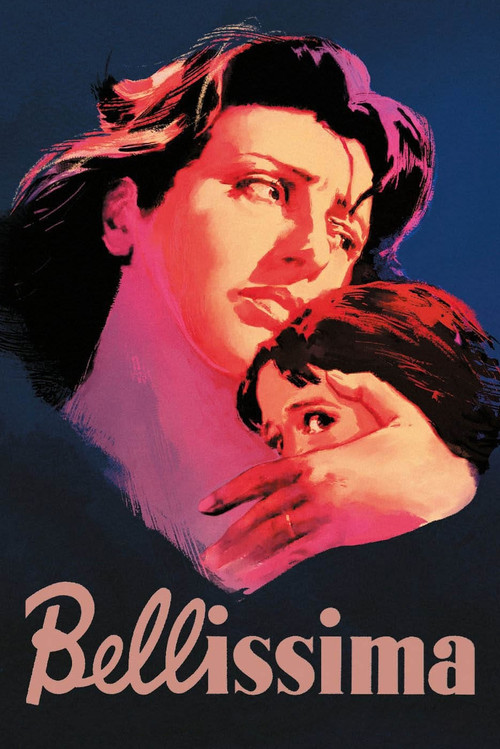
Bellissima
1952 · Luchino Visconti
For when you want a film with bite — sharp about showbusiness and ambition but with a warm, beating heart at its center. It leaves you moved rather than cynical.
What it's about
When a famous director puts out a casting call for a little girl, a working-class Roman mother named Maddalena drags her small daughter to Cinecittà and into the child-star sweepstakes — elbowing through crowds of other mothers, paying for lessons and photos the family can't afford, sacrificing everything for a dream that may only be hers. It's a satire of the movie business told from the wrong side of the studio gates.
The experience
Fast, funny, and increasingly bruising — it plays as comedy until you realize how much is at stake for this family, and the last stretch lands with real force. You laugh, then feel complicit in what you were laughing at.
Performances
Anna Magnani, in what's widely considered one of her greatest roles, is a force of nature — torrential, hilarious, and then suddenly, devastatingly tender. The film is essentially built around her, and she carries every frame.
The craft
Visconti turns a documentary eye on the dream factory itself, shooting the real chaos of Cinecittà auditions with a satirist's timing and a neorealist's honesty about money, class, and hope. The script keeps flipping comedy into heartbreak without grinding gears.
Why it matters
A pivotal film in Visconti's career — the bridge between his neorealist tragedies and his later melodramas — and an enduring landmark of cinema examining its own machinery of stardom.
Snapshot
Bellissima is Luchino Visconti's third feature, a caustic and tender chronicle of a working-class Roman mother who drags her small daughter into the child-star sweepstakes at Cinecittà. Built almost entirely around Anna Magnani in the role of Maddalena Cecconi, the film is at once a comedy of maternal delusion and a bruising exposé of the movie industry's machinery of hope. It occupies a pivotal place in Visconti's development: made after the fisherman's tragedy of La terra trema (1948) and before the aristocratic melodrama of Senso (1954), it turns neorealism's documentary gaze back on the dream factory itself. The result is a work that is both inside the popular Italian idiom — vernacular, star-driven, funny — and sharply critical of the illusions that idiom sells. It is widely regarded as one of Magnani's supreme performances and one of the era's most self-aware films about cinema.
Industry & production
Bellissima was produced in the early-1950s Italian industry, a moment when neorealism's international prestige was colliding with the commercial imperatives of a recovering domestic film business and the looming competition of television and Hollywood imports. The project originated from a story idea by Cesare Zavattini, the theorist-screenwriter who was neorealism's most influential ideologue and Vittorio De Sica's regular collaborator. That provenance matters: the film's premise — ordinary people queuing outside Cinecittà — is quintessential Zavattini, a "man in the street" subject turned into drama. Visconti developed the screenplay with Suso Cecchi d'Amico, who would become his most enduring writing partner, and with Francesco Rosi, then early in a career that would make him a major director in his own right.
The production is inseparable from its setting. Much of the action unfolds at Cinecittà, the vast Roman studio complex built under Fascism in the 1930s and, by 1952, the working heart of Italian filmmaking. Shooting a film about the industry within the industry's own walls gave Bellissima an unusual documentary charge. Its casting compounded the reflexivity: the fictional director conducting the child-star search is played by Alessandro Blasetti, a real and prominent Italian director whose career stretched back to the silent and Fascist eras and encompassed exactly the kind of grand, popular cinema the film gently satirizes. The presence of an actual studio director "playing himself" blurs the line between fiction and reportage in ways that anticipate later meta-cinema.
The film's assistant-director ranks are frequently cited as a roll call of future talent — Rosi worked closely on the production, and Visconti's orbit in this period included young collaborators who would go on to significant careers. Precise, individually documented credits for every junior role should be treated with the usual caution, but the general point is well established: Bellissima was made within a milieu that functioned as an informal training ground for a generation of Italian filmmakers.
Technology
Technologically, Bellissima is a conventional early-1950s production: 35mm black-and-white photography, the Academy aspect ratio, and studio-standard optical and sound equipment of the period. There is no widescreen (CinemaScope had not yet arrived in Italy) and no color — Visconti would not shoot in color until Senso. The interest of the film's technology lies less in any innovation than in its subject: Bellissima is a movie about movie technology, staging screen tests, projection sessions, and the apparatus of the studio. Scenes set around cameras, lights, and a screening room make the machinery of cinema literally visible, so that the film's ordinary technical means become, thematically, its content. The soundtrack's use of recorded operatic music (see Sound) also reflects the standard practice of the day, in which pre-existing classical recordings could be woven into a score.
Technique
Cinematography
The photography is credited to Piero Portalupi (some sources additionally credit Paul Ronald). It is a functional, high-contrast black-and-white style rather than a showcase for pictorial virtuosity, and that restraint is purposeful: the camera stays close to Magnani, following her through the crowded courtyards, tenement corridors, and studio spaces of the story. The visual texture alternates between the semi-documentary crowding of the Cinecittà scenes — masses of mothers and children, handled with a neorealist feel for the collective — and tighter, more theatrical framings of Maddalena at home and in confrontation. The lighting favors clarity and legibility of performance over expressionist effect, keeping the emphasis on faces and on Magnani's ferociously mobile presence. The style thus sits between neorealism's location naturalism and a more classical, actor-centered studio look, mirroring the film's transitional position in Visconti's career.
Editing
Editing is credited to Mario Serandrei, one of the most important Italian editors of the era and a long-standing Visconti collaborator (their association ran across much of the director's career). The cutting serves performance and rhythm: it gives Magnani's monologues and outbursts room to build, while the crowd and audition sequences are assembled to convey scale, chaos, and the assembly-line processing of hopeful children. A key structural pivot is the projection-room sequence late in the film, in which Maddalena watches the studio's reaction to her daughter's screen test; the editing there orchestrates the collision between her private investment and the industry's indifferent, even mocking, gaze.
Mise-en-scène / staging
Even in this relatively naturalistic register, Visconti's theatrical instincts and his feeling for social milieu are evident. The staging is attentive to class texture — the cramped apartment, the shared courtyard, the economic precariousness that makes stardom look like salvation — and to the choreography of crowds at the studio. Visconti, who came to film from a background steeped in opera and theater, arranges group scenes with a sense of ensemble and of space that already points toward the more overtly operatic mise-en-scène of his later work. The domestic interiors are used to dramatize the strain the star-chasing scheme puts on Maddalena's marriage and household, so that the physical setting continuously registers the human cost of her ambition.
Sound
The most discussed element of the film's sound is its use of Gaetano Donizetti's comic opera L'elisir d'amore on the soundtrack; the additional music and its arrangement are associated with Franco Mannino, who worked with Visconti in this period (readers should treat the exact division of composing and arranging credit with appropriate caution). The choice of Donizetti's opera about love, illusion, and a "magic elixir" is pointed: it comments ironically on Maddalena's own susceptibility to the intoxicating promise of stardom. As with much Italian cinema of the time, dialogue was post-synchronized, and the soundtrack foregrounds Magnani's voice — its volume, speed, and Roman inflection — as a central expressive instrument.
Performance
Bellissima is, above all, a performance film, and Anna Magnani's Maddalena is its engine and its glory. Magnani, already an icon of Italian screen acting after Roma città aperta (1945), delivers a portrayal of enormous range — voluble, funny, fierce, vain, and finally devastatingly lucid. She modulates between comic energy and raw emotional exposure, and the film's structure is essentially a vehicle designed to let her occupy nearly every scene. Around her, Walter Chiari plays Alberto Annovazzi, the smooth studio operator who exploits Maddalena's hopes; the small daughter Maria is played by a young child performer whose relative passivity is itself part of the point, throwing the mother's projected ambitions into relief. Alessandro Blasetti's appearance as the director adds a documentary authenticity to the studio scenes.
Narrative & dramatic mode
The narrative is a compact, character-driven arc organized around a single obsessive pursuit: Maddalena's determination to make her daughter a star. Its dramatic mode fuses comedy and pathos — for much of its length it plays as a satirical comedy of manners about a mother's folly, only to darken into something closer to tragedy of disillusionment. The turning point is recognition: Maddalena comes to see how the industry regards her child and, by extension, herself, and must reckon with what her ambition has cost. Crucially, the film resolves not in cynicism but in a reclamation of maternal love over the fantasy of fame. This blend of the comic and the melodramatic, anchored by a woman's emotional journey, is characteristic of a strain of Italian popular cinema, but Visconti gives it an unusual reflexive and critical edge.
Genre & cycle
The film can be placed at the intersection of several categories. It belongs to the tradition of the "backstage" or industry film — cinema about cinema — and specifically to the subgenre that scrutinizes the star-making apparatus and its exploitation of ordinary dreamers. It is also a domestic melodrama and a comedy centered on a mother figure, drawing on the popular Italian tradition of the strong-willed working-class heroine that Magnani embodied. In relation to the neorealist cycle then dominant, Bellissima is both a participant and a critique: it retains neorealism's interest in everyday people and social observation while turning a skeptical eye on the very industry and illusions that neorealism itself operated within.
Authorship & method
As author, Visconti here reveals the double nature that defines his oeuvre: the socially engaged observer of neorealism and the theatrically inclined dramatist of grand emotion. His method on Bellissima combined location-inflected realism (the studio milieu, the crowds, the class texture) with a firm reliance on star performance and dramatic construction — an approach closer to classical directing of actors than to neorealism's use of non-professionals. The key collaborators frame this method. The story came from Cesare Zavattini, grounding the film in neorealist social premise; the screenplay was shaped with Suso Cecchi d'Amico (Visconti's essential writing partner across many later films) and Francesco Rosi. Cinematography by Piero Portalupi kept the emphasis on legibility and performance; editing by Mario Serandrei, Visconti's habitual editor, shaped rhythm and the crucial projection-room climax; and the musical dimension, built around Donizetti and associated with Franco Mannino, supplied the ironic operatic counterpoint. Above all, the collaboration with Anna Magnani defines the film's authorship as much as Visconti's direction does — this is a work conceived to harness her.
Movement / national cinema
Bellissima is a landmark within Italian national cinema and a significant document in the history of neorealism — precisely because it stands at the movement's threshold. By 1952 neorealism's classic phase was passing, and the film registers that transition from within: it uses neorealist materials (ordinary people, real locations, social critique) to interrogate the illusions of the national industry. It also exemplifies the centrality of Cinecittà and of the star system to Italian film culture, and it belongs to a distinctly Italian tradition of self-reflexive, industry-conscious filmmaking. Within Visconti's own trajectory — from Ossessione (1943) through La terra trema to Senso and beyond — it marks the hinge between his neorealist beginnings and the operatic melodramas of his maturity.
Era / period
The film is a product of early-1950s Italy: a nation rebuilding after the war, its cinema internationally celebrated yet commercially pressured, its capital's studios humming with production. The period context is legible throughout — the economic precarity that makes stardom seem like a life raft, the mass of hopefuls drawn to Cinecittà, the aspirational pull of the movies in a culture where cinema was a dominant popular art. In this sense Bellissima is a period portrait of the dream of fame in postwar Italy, and of an industry at a moment of self-conscious transition.
Themes
Several intertwined themes give the film its lasting force. Illusion versus reality is central: the seductive fantasy of stardom set against the mundane and often cruel truth of how the industry operates. Closely related is the theme of cinema as dream factory and machine of exploitation, dramatized through the studio's indifferent processing of hopeful children and the opportunists who profit from parental longing. Motherhood and sacrifice anchor the emotional core — Maddalena's love, at first distorted into ambition and possessiveness, is ultimately purified into protective devotion. The film also probes class and aspiration, showing how economic want feeds the hunger for fame, and self-reflexivity, using the movie-about-movies structure to question the ethics of the very medium in which it works. The Donizetti motif of the love potion underscores the overarching idea of intoxication and awakening.
Reception, canon & influence
Critically, Bellissima has long been esteemed, above all for Anna Magnani's performance, frequently ranked among the finest of her career, and for the sophistication of its self-reflexive engagement with the film industry. It is generally regarded as a key transitional work in Visconti's filmography and a notable entry in the history of Italian cinema, though it has sometimes been viewed as a comparatively minor or intimate film beside his epics — a judgment later reappraisals have tended to revise upward. Detailed period box-office figures and the full spread of contemporary reviews are not something I can reconstruct reliably here, and I will not invent them.
Influences on the film (backward). Bellissima draws on the neorealist project associated with Zavattini and De Sica, on the popular Italian melodrama and comedy traditions embodied by Magnani, and on Visconti's own operatic and theatrical formation. The choice to build the film around Donizetti connects it to the long Italian dialogue between opera and popular drama.
Legacy (forward). The film's most durable contribution is its place in the lineage of reflexive cinema about cinema — works that dramatize the dream factory and the price of the fantasy of stardom. Within Visconti's career it prefigures the fusion of realism and operatic emotion that would culminate in his later masterpieces, and it stands as a crucial demonstration that neorealist means could be turned to self-critique. It also helped cement the Magnani–Visconti collaboration as a high point of Italian screen acting. More broadly, Bellissima endures as a touchstone for any film that looks skeptically at the machinery of fame and the exploitation of ordinary people's hopes — a subject that has, if anything, only grown more resonant.
A Deleuzian reading
Maddalena Cecconi watches a roomful of studio men watch her daughter's screen test, and she hears them laugh.
The full Deleuzian reading of Bellissima →
Reception
Dismissed on release as 'minor Visconti' — a lightweight interlude between La Terra Trema and Senso — it's since been reappraised as one of his warmest films, and Anna Magnani's stage-mother Maddalena now routinely turns up in lists of the greatest screen performances ever.
How Bellissima was received, from release to now →
How to watch Bellissima: what to notice on a first viewing
- Watch how close the camera stays to Magnani in the crowd. Portalupi's photography follows her through courtyards, corridors, and studio queues in flat, functional black and white, never pulling back for a wide establishing shot. The nearness keeps you inside her hustle instead of judging it from a distance.
- Listen for Donizetti's opera about a love potion. Franco Mannino's arrangement threads L'elisir d'amore through the soundtrack, an aria about a magic elixir that promises love. The music keeps commenting on Maddalena's own faith in a cure that does not exist.
- Watch how much of Magnani's body stays in motion. She talks, gestures, paces and startles through nearly every scene, comic one moment and raw the next, rarely landing in one register for long. Her restlessness is the character, a woman with too much energy and nowhere approved to put it.
- Count how many strangers handle Maria before the test. An acting coach, a hairdresser, a photographer, and a studio operator each take a turn with the girl, one after another, like stations on a line. The girl passes hand to hand like product, though the story never says so directly.
The whole guide to watching Bellissima, with the keys for a rewatch →
Influences: the films it descends from and the films it influenced
- Rome, Open City (1945) — Forged the raw, improvisatory verismo register of Anna Magnani that Bellissima is expressly built to harness — the unpolished, full-throated working-class emotionalism Visconti recruits as his structuring instrument.
- Bicycle Thieves (1948) — Supplies Zavattini's 'pedinamento' method — trailing one ordinary protagonist through socially textured episodes of a city — which Bellissima inherits directly from its Zavattini story premise.
- Ossessione (1943) — Visconti's own earlier graft of operatic melodrama onto a realist working-class milieu, the double register that Bellissima refines into ironic self-critique.
- La Terra Trema (1948) — Establishes Visconti's choral staging of a whole community in deep, sculpted frames, redeployed in Bellissima as the operatic crowd choreography of the Cinecittà casting mob.
- Show People (1928) — Founds the reflexive studio-comedy genre — an aspirant navigating the machinery of a real studio (MGM), with the industry cameoing as itself — the exact backstage-industry template Bellissima transplants to Cinecittà.
- What Price Hollywood? (1932) — Codifies the discovery-and-exploitation arc in which the dream factory consumes a naive hopeful, the narrative motor of Bellissima's comedy-to-tragedy turn.
- A Star Is Born (1937) — Provides the screen-test/discovery structure and its skeptical anatomy of stardom's human cost, which Bellissima inverts into the cruelty of the projection-room verdict.
- 8½ (1963) — Extends the cinema-about-cinema mode; its screen-test sequence directly develops Bellissima's projection-room audition, where filmed footage is scrutinized and judged as verdict on a life.
- Mamma Roma (1962) — Recasts Magnani as the archetypal sacrificial working-class mother crystallized in Bellissima, fusing neorealist street milieu with operatic melodrama around her performance.
- Rocco and His Brothers (1960) — The full flowering, within Visconti's oeuvre, of the realism-plus-operatic-emotion synthesis that Bellissima first trials on an intimate scale.
- Day for Night (1973) — Continues the affectionate-yet-skeptical anatomy of the filmmaking apparatus, exposing the labor and artifice behind the fantasy that Bellissima interrogates from the aspirant's side.
- Cinema Paradiso (1988) — Italian reflexive ode organized around the projection booth, echoing Bellissima's projection-room climax as the site where cinema's illusion is both loved and unmasked.
- Mulholland Drive (2001) — Carries forward the audition-as-exploitation and illusion-versus-reality dissection of the dream factory, dramatizing the same devouring of an outsider's stardom fantasy Bellissima anatomizes.
- Sunset Boulevard (1950) — Contemporary reflexive dissection of the dream factory that, like Bellissima, casts real industry figures playing versions of themselves to sharpen the illusion-versus-reality critique.
- All About Eve (1950) — Parallel backstage-industry drama built on the hunger for stardom and the machinery of performance, sharing Bellissima's anatomy of ambition curdling into exploitation.
- Singin' in the Rain (1952) — Same-year movie-about-movies whose central dubbing/post-synchronization gag mirrors Bellissima's own post-synced sound and its projection-booth reveal of the gap between voice and image.
- The Bad and the Beautiful (1952) — Contemporary exposé of the studio system's manipulations, staging the price ordinary talent pays to the industry — Bellissima's theme rendered from inside Hollywood's own machinery.
- Volver (2006) — Anna Magnani's voluble, full-bodied working-class matriarch is the exact performance model for Cruz — the padded hips, the hands-on-waist stance, the grief pitched at operatic volume that Almodóvar has Cruz consciously reincarnate.
Similar films
- Mamma Roma (1962) — influence & lineage · same viewing thread
- Rocco and His Brothers (1960) — influence & lineage · same viewing thread
- Bicycle Thieves (1948) — influence & lineage · same viewing thread
- Obsession (1943) — influence & lineage · same viewing thread
- Rome, Open City (1945) — influence & lineage
- 8½ (1963) — influence & lineage
- Two Women (1960) — same viewing thread
- The Leopard (1963) — same viewing thread
All the films related to Bellissima →
Watch it with: curated runs of related films
- Neorealism and Its Shadows — Watch these together to see Italy from the ground up — the unemployed, the sharecropped, the compromised — from neorealism's birth to its stylish, sinister heirs.