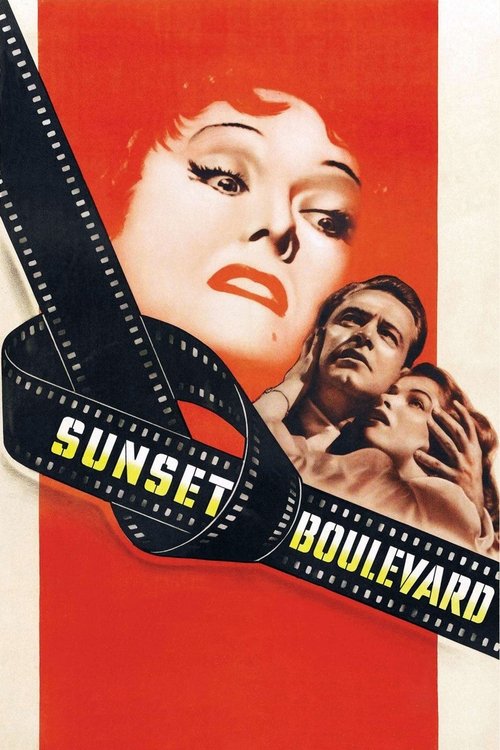
Sunset Boulevard
1950 · Billy Wilder
For when you want a wicked classic with teeth — a moody late-night watch that's endlessly entertaining while it unsettles you. One of the safest bets in all of old Hollywood for a first-time viewer.
What it's about
A broke Hollywood screenwriter on the run from repo men turns into the driveway of a decaying Sunset Boulevard mansion — and into the orbit of Norma Desmond, a silent-film queen the world forgot, who is certain her triumphant return to the screen is at hand. Hired to polish her comeback script, he's drawn deeper into her sealed-off world of faded glamour, a devoted butler, and delusion thick enough to live inside.
The experience
Deliciously dark — part ghost story, part poison-pen love letter to Hollywood, narrated with some of the most quotable hard-boiled wit ever written. It's funny and creepy in the same breath, and its grip tightens steadily into something genuinely haunting.
Performances
Gloria Swanson, herself a real silent-era star, gives one of cinema's monumental performances — grand, terrifying, and heartbreaking at once — while William Holden's dry, self-loathing narration defines noir cool, and Erich von Stroheim is quietly devastating as the butler.
The craft
Billy Wilder's script is a machine of perfect lines, and the high-contrast black-and-white photography turns the rotting mansion into a gothic dream — candelabras, a dead-eyed swimming pool, a pipe organ moaning in drafts. Casting genuine relics of the silent era gives the whole thing an eerie documentary charge no fiction could fake.
Why it matters
The definitive film about Hollywood devouring its own, its lines and images stitched into the culture — the template every showbiz satire and faded-star story since has had to reckon with.
Snapshot
A screenwriter discovered floating dead in a Hollywood swimming pool narrates, in retrospect, the months of entrapment that killed him. Joe Gillis, broke and fleeing debt collectors, ducks into a crumbling Norma Desmond mansion on Sunset and finds himself absorbed into the delusion of a former silent-screen queen who believes her return to pictures is imminent. Sunset Boulevard is simultaneously a noir, a ghost story, a Gothic melodrama, and a corrosive autopsy of the Hollywood machine itself. Shot in high-contrast black and white on the Paramount lot with a genuine relic of the silent era in its central role, the film arrives at a formal severity that matches its nihilistic subject. Its opening gambit — a dead man speaking — had been tried before in literature but was startling on screen; its closing image, Norma Desmond descending the staircase into the cameras she has hallucinated, remains one of the most terrifying conclusions in American cinema.
Industry & production
Sunset Boulevard was a Paramount production, developed by director Billy Wilder and his long-term producing partner Charles Brackett, with a third collaborator, D.M. Marshman Jr., brought in to supply the original story idea. It was the last major collaboration between Wilder and Brackett, a partnership that had yielded Double Indemnity (1944), The Lost Weekend (1945), and A Foreign Affair (1948); the working relationship fractured during production, partly over temperamental differences about how far to push the material's misanthropy.
The casting of Gloria Swanson as Norma Desmond was a calculated act of meta-history. Swanson had been one of the most famous stars of the silent era — associated above all with Cecil B. DeMille, who directed her in a series of popular domestic melodramas in the late 1910s — and her film career had contracted sharply with the coming of sound. Her presence collapses the distance between fiction and biography in ways the film openly exploits: DeMille appears as himself, on the set of a film he was actually shooting at Paramount, greeting Norma with the warmth of genuine acquaintance. Similarly, Erich von Stroheim, cast as Max von Mayerling, Norma's butler and former director-husband, was himself a legendary silent-era filmmaker whose career had been systematically destroyed by studio interference — his casting imports a second layer of authentic Hollywood tragedy into the fiction. Buster Keaton, Anna Q. Nilsson, and H.B. Warner appear as Norma's card-playing friends, "the waxworks," all genuine survivors of the silent era.
Montgomery Clift was initially announced for the role of Joe Gillis but withdrew, reportedly feeling the dynamic of a young man kept by an older woman would damage his image. William Holden, whose career at this point was in a plateau, was cast instead; the performance became one of the defining roles of his career. Nancy Olson was nominated for an Academy Award for Best Supporting Actress for her performance as Betty Schaefer, the studio script reader who represents the film's brief, fragile glimpse of ordinary human feeling.
Technology
Sunset Boulevard was shot in black and white in an era when Technicolor was increasingly available and associated with prestige. The choice was deliberate — color would have softened the Expressionist severity Wilder and his cinematographer John F. Seitz were after, and would have worked against the film's roots in the noir tradition they had cultivated together on Double Indemnity. Seitz used panchromatic stock and pushed the contrast in ways that gave the Desmond mansion's interiors an almost tactile shadow density.
The film's most technically distinctive achievement is its opening — the body of Joe Gillis seen from beneath the surface of the swimming pool, the camera looking up through the water while police photographers crowd the edge above. Seitz constructed a mirrored apparatus submerged in the pool to capture this perspective; accounts of the exact method differ in secondary sources, and the production records at Paramount provide the authoritative version, but what is clear is that the image required significant engineering and represents one of the more spatially disorienting point-of-view constructions in studio-era Hollywood.
Franz Waxman's score was recorded using the standard orchestral resources of a major studio production. The main-title cue — with its urgent, galloping rhythm and the deliberate distortion suggesting something off-kilter beneath the surface — has been cited by subsequent film composers as an influence on horror-adjacent dramatic scoring.
Technique
Cinematography
Seitz and Wilder built the visual grammar of the film around the tension between enclosure and exposure. The Desmond mansion interiors are shot with low-angle setups, canted frames, and deep focus that makes rooms feel enormous and predatory, the ceilings pressing down while the background stretches into shadow. Chiaroscuro is extreme: windows cut hard rectangles of light into otherwise dark spaces. When Norma performs for Joe — dancing, running the projector showing her old films — Seitz uses the light sources diegetically, so she moves in and out of illuminated patches as if subject to a private spotlight.
The film's few outdoor sequences — the Paramount lot, a brief excursion to a car dealer — are shot with an abrupt shift toward naturalistic, flatter light, enforcing the sense that the mansion exists in a different order of reality. The pool, bookending the film, is shot each time with a particular stillness; the opening sequence's subaqueous perspective gives the water a metaphysical quality it carries for the rest of the picture.
Editing
Doane Harrison and Arthur Schmidt cut the film with a rhythm calibrated to Gillis's sardonic narration. The voiceover guides the pacing in ways characteristic of noir — ellipsis is licensed by the narrator's retrospective authority, and the film moves quickly through exposition that might otherwise require extended scenes. The editing becomes noticeably slower in the mansion sequences, dwelling inside static compositions in a way that mirrors Norma's arrested time. The climactic staircase descent is handled in a series of long takes interrupted only at the moment Norma turns fully toward the camera, when the cut is sharp and sudden, as if the hallucinated newsreel cameras have actually caught her.
The original cut of the film opened with Gillis's body in the Los Angeles County morgue, surrounded by other corpses who introduce the story; preview audiences reportedly laughed at this sequence, and it was replaced with the current opening. That excised footage is extant and has been discussed in detail by film historians; the current opening is by any measure the superior construction.
Mise-en-scène / staging
The Desmond mansion — for exterior shots, a property on Wilshire Boulevard — is dressed with an excess that reads as a symptom. The organ in the entryway, the gilt furniture, the cage for Norma's pet chimpanzee, the framed portraits of Norma on every wall: the space has been sealed against time and re-papered with her own image. Wilder and his production designer Hans Dreier (with Sam Comer on set decoration) conceived the décor as a character in itself, registering the pathology of someone who has made a shrine of her own celebrity.
The staging of Norma and Joe's interactions systematically places Norma above Joe in the frame — on the staircase, on the chaise longue while he works at a desk below, at the head of the table during their Christmas dinner. This consistent spatial hierarchy makes the rare moments of reversal — Gillis towering over her when he decides to leave — electrically charged.
Sound
The film's sound design makes aggressive use of silence within the mansion. Street noise, studio bustle, and the ordinary sounds of 1950 Los Angeles are audible whenever Gillis is outside; they vanish almost completely inside the mansion, replaced by Waxman's orchestral underpinning and the sounds of Norma's world: the creak of the house, her projection room's whirring, her own voice. This acoustic segregation reinforces the film's central idea — that the mansion is a different temporal zone.
Waxman's score is unusually ironic in its application. The main theme's grotesque waltz cadences accompany Norma's most delusional moments with a musical language simultaneously glamorous and disturbed.
Performance
Swanson's performance operates in a register most studio actors of the period were never asked to reach. She deploys the broad, physical expressivity of silent performance — the extended eye contact, the gestural amplitude — but uses it with self-awareness; the film asks whether Norma's theatrical manner is delusion or performance, and Swanson keeps both readings simultaneously available. She neither softens the character's narcissism nor plays her as simply villainous; there are moments of genuine, devastating pathos, particularly in the scenes where she watches her own old films projected in the darkened screening room.
Holden's performance is the structural counterweight: dry, world-weary, fundamentally passive. Gillis is the noir protagonist who cannot act effectively on his own behalf, and Holden plays that paralysis without ever quite turning it into sympathy. Von Stroheim brings an enormous, quiet dignity to Max that transforms what could have been a servile role into something genuinely mysterious.
Narrative & dramatic mode
The film's narrative conceit — the dead narrator — creates an irony that saturates every scene. The audience knows from the first image that Joe Gillis will not survive the story he is telling; this foreknowledge shifts suspense from plot mechanics toward the observation of character and psychology. We watch Norma's delusion with the fixed attention we might bring to a specimen, and the film rewards this attention by making the delusion coherent from within its own logic.
The dramatic mode is closest to classical tragedy in its insistence on inevitability and hubris, grafted onto a noir skeleton. The Gothic element — the sealed house, the woman who has stopped the clocks, the servant who serves a fantasy — connects the film to a tradition running from Dickens's Miss Havisham through the American Southern Gothic. The element that distinguishes Sunset Boulevard from both traditions is its specific Hollywood subject matter: the pathos is inseparable from the economics of stardom, and the tragedy has a material cause — the technological transformation of the industry that rendered an entire generation of performers obsolete.
Genre & cycle
Sunset Boulevard arrives at the height of Hollywood film noir, and Wilder had been central to that cycle since Double Indemnity. It shares noir's retrospective narration, femme fatale structure (Norma as the dangerous woman who ensnares the protagonist), and visual vocabulary. But it systematically inverts the genre's gender dynamics: the "femme fatale" is old, the "hero" is deliberately kept, and the film's real subject is not crime but show business.
The film inaugurated what might be called Hollywood Gothic — a cycle of films set in the industry's own shadow, examining celebrity, obsolescence, and delusion. Whatever Happened to Baby Jane? (1962) is its most direct descendant within the studio era: an older actress, a sealed house, a performance history that has curdled. The cycle continues through Robert Altman's The Player (1992) and David Lynch's Mulholland Drive (2001), which uses Sunset Boulevard's narrative structure — the dead woman narrating the story of her own destruction — with considerable explicitness.
Authorship & method
Wilder's authorship of Sunset Boulevard is exercised primarily through the script and the precision of his staging; he has described himself, in various interviews, as fundamentally a writer-director for whom the screenplay is the irreducible foundation. The collaboration with Brackett and Marshman produced a script whose sardonic voice — maintained in Gillis's narration — is recognizably Wilder's, marked by his European émigré's simultaneously admiring and appalled relationship to Hollywood culture.
John F. Seitz was among the most technically accomplished cinematographers in studio Hollywood; his collaborations with Wilder produced some of the defining visual texts of the American noir. Franz Waxman, a fellow German émigré, had scored major Paramount and Universal productions through the 1940s; his work here won the Academy Award for Best Original Score. The editor Arthur Schmidt would go on to a long career that included Back to the Future (1985) and Forrest Gump (1994); his collaboration with Harrison on Sunset Boulevard is a relatively early career credit.
Movement / national cinema
Sunset Boulevard belongs to Hollywood studio filmmaking at a moment of genuine anxiety — about television, about the antitrust decrees that had just broken up the vertical integration of the studio system, about the decline of the golden age's financial certainties. Wilder, Brackett, Seitz, and Waxman were all European émigrés whose Hollywood careers had been shaped by their distance from the industry's mythology; this outsider perspective, shared across the key creative team, may account for the film's refusal of any redemptive or nostalgic reading of its subject.
The Expressionist visual vocabulary Seitz deploys — shadow composition, distorted perspective, the subjective rendering of psychological states — derives from the German Expressionist tradition that shaped Weimar cinema and carried over into Hollywood filmmaking via émigré directors and cinematographers throughout the 1930s and 1940s.
Era / period
The film captures 1950 Hollywood at a specific, legible historical moment. The studio system is visibly intact but already under pressure; the Paramount lot where much of the film was shot appears on screen as an ordinary working environment. The specific trauma the film addresses — the displacement of silent film performers by the sound revolution of the late 1920s — was roughly twenty years old at the time of production, close enough to living memory that Swanson's casting carried immediate biographical resonance for audiences of the period.
Themes
The film's dominant themes converge on the relationship between performance and self-delusion. Norma Desmond cannot distinguish between the persona the film industry constructed for her and a self; her tragedy is that the industry discarded the former without offering any means of maintaining the latter. The film treats fame as a form of addiction and its withdrawal as a species of death.
A secondary complex of themes concerns the ethics of complicity: Joe Gillis knows from very early that Norma is psychotically delusional, and his choice to remain — partly financial desperation, partly a more troubling comfort — makes him a study in moral cowardice the film refuses to excuse. The narrator's detached, wisecracking voice is revealed, over the course of the film, as a defense mechanism against self-knowledge.
Hollywood itself is a theme: the film anatomizes the machinery of celebrity, the disposability of creative labor (Gillis is a "hack screenwriter" by his own description), and the industry's capacity to generate and then abandon the very images it depends upon.
Reception, canon & influence
Backward influences. The most immediate formal antecedent is the noir tradition Wilder himself had helped establish; beyond that, the Gothic house-as-psychological-prison connects to a lineage running from du Maurier's Rebecca and before. The figure of the reclusive woman in arrested time has Dickensian precedents. The dead narrator, unusual in cinema, had literary currency. Wilder's European formation — his Viennese origins, his Weimar film culture — inflects the film's Expressionist visual logic.
Critical reception. The film's initial reception was overwhelmingly positive. It was nominated for eleven Academy Awards at the 23rd ceremony and won three — for Original Screenplay, Original Score (Waxman), and Art Direction. Critical consensus placed it immediately among the significant American films of the postwar period. A preview screening reportedly elicited an infuriated response from Louis B. Mayer, who objected to the film's treatment of the industry; the substance of his exact words has been reported in various forms in film histories, and the account should be treated with the caution appropriate to anecdote, but some form of hostile reaction from studio establishment figures appears well-documented.
Forward legacy. The film's influence operates on at least three levels. As a Hollywood self-critique, it established a mode that subsequent filmmakers have returned to repeatedly — the industry as subject, examined from within with a mixture of love and contempt. As a Gothic character study of celebrity pathology, it inaugurated a type: the grande dame in decline, the performance that cannot be retired, the house that has become a mausoleum. Whatever Happened to Baby Jane?, Fedora (Wilder's own 1978 return to the theme), and Mulholland Drive are the most direct inheritors.
The film has also exercised a persistent influence on theatrical production: Andrew Lloyd Webber's stage musical adaptation (1993) had considerable commercial success and introduced the material to a generation with no primary relationship to Hollywood history. The final line — "All right, Mr. DeMille, I'm ready for my close-up" — passed into the general vocabulary of English-language culture as an idiom for theatrical self-presentation at the moment of reckoning. That the line is slightly misremembered in popular usage (Norma says "I'm ready for my close-up, Mr. DeMille") is itself a small demonstration of how thoroughly the film has been absorbed into the cultural substrate it depicts.
A Deleuzian reading
A man floats face-down in a swimming pool, and the camera watches him from below — looking up through the water at the cops and the news photographers crowding the rim.
The full Deleuzian reading of Sunset Boulevard →
Reception
No flop-to-classic story here — it landed 11 Oscar nominations in 1950 even as old Hollywood recoiled (Louis B. Mayer reportedly raged that Wilder had disgraced the industry that fed him). The scandalized-insiders-vs-instant-classic tension has only burnished its legend since.
How Sunset Boulevard was received, from release to now →
Influences: the films it descends from and the films it influenced
- Double Indemnity (1944) — Wilder and Seitz developed the technical blueprint here — retrospective voiceover confession by a doomed, morally compromised protagonist — which Sunset Boulevard inherits wholesale while inverting the gender dynamic of entrapment.
- The Cabinet of Dr. Caligari (1920) — The film codified the grammar Wilder absorbed in Berlin: canted frames and architectural distortion as a visual language for psychosis externalized in built space, the direct source of the Desmond mansion's tilted corridors and predatory ceilings.
- Citizen Kane (1941) — Toland's deep-focus plus extreme low-angle compositions to make interiors feel enormous and predatory is the direct model for Seitz's staging of the Desmond mansion; the Xanadu-as-pathology logic — decor that mirrors a great figure's collapse — is the structural prototype.
- Rebecca (1940) — Hitchcock codified the Hollywood Gothic-mansion formula for the studio era: decor as psychological weapon, the dominant woman controlling domestic space through overwhelming presence, and a male newcomer drawn into a house he cannot exit.
- Laura (1944) — Preminger's noir constructs its narrative around a dead woman as absent center, with the retrospective-entrapment framing device; the posthumous-perspective structure is the closest American noir precedent for Gillis's dead-man narration.
- The Lost Weekend (1945) — The immediately prior Wilder-Seitz-Brackett collaboration established their shared practice of expressionist shadow and low-angle staging to track a self-destructive male protagonist's psychological deterioration — a visual system Sunset Boulevard inherits directly.
- Pandora's Box (1929) — Pabst's late Weimar cinema — shooting performance through fragmentary close-ups and expressionist spatial compression — is the specific context in which Gloria Swanson's silent-era physicality was itself forged, making her casting a direct invocation of this tradition.
- Mildred Pierce (1945) — The noir confession-frame taken to its logical extreme: the narrator of the retrospective analepsis is already dead when the film begins, making the dramatic irony absolute and structurally total from the first image — the culmination of the framing-device tradition Wilder and Curtiz both drew from in 1944–45.
- Gilda (1946) — Wilder extends Gilda's retrospective male voiceover to its structural limit by having the narrator already dead, and the female star whose self-presentation as glamour-image has consumed her actual self — Norma Desmond as the system that made Gilda into myth, turned inside out — is the formal and thematic consequence of the performance-identity theme Gilda established.
- The Postman Always Rings Twice (1946) — Inherits and intensifies the retrospective voiceover-confession device, the dead-man-narrating frame making explicit the fatalism Postman delivers through Frank's death-row narration.
- Sullivan's Travels (1941) — John Seitz's cinematography plus a self-reflexive Hollywood-devours-its-own narrative extends both Sullivan's DP method and its industry introspection.
- Nightmare Alley (1947) — Carries forward the circular framing narrated from the end and the tragic hubris of a fallen showbiz figure, structuring the story as an autopsy of its own protagonist.
- Vertigo (1958) — Hitchcock extends Wilder's meta-casting logic — Kim Novak cast precisely for her constructed femininity — and Bernard Herrmann's score develops the ironic-orchestral tradition Waxman established: music that comments on its own grandiosity while scoring obsessive delusion.
- Whatever Happened to Baby Jane? (1962) — Aldrich directly inherits Hollywood Gothic: the decaying mansion, the aging female star performing her own obsolescence through silent-era physical excess, and the horror-comedy of two women locked in a domestic space where past celebrity constitutes the pathology.
- Fedora (1978) — Wilder self-consciously revisits his own film — Holden again as the narrator-investigator, an aging European actress with an invented persona, posthumous framing, and the Expressionist mansion as trap — a late-career formal dialogue with Sunset Boulevard's exact grammar.
- Barton Fink (1991) — The Coens deploy the hotel-as-Gothic-trap in the precise Desmond-mansion logic: extreme low-angle compositions that make ceilings threatening, a writer protagonist absorbed by a monstrous host, and decor — the peeling wallpaper — as the building's pathology made material.
- Ed Wood (1994) — Burton's deliberate return to black and white and his meta-casting of Martin Landau as Bela Lugosi — a genuine Hollywood relic performing his own obsolescence with silent-era physicality — directly inherits Wilder's strategy of importing celebrity biography into Gothic fiction.
- Mulholland Drive (2001) — Lynch extends Hollywood Gothic into surrealism while retaining Sunset Boulevard's specific formal grammar: Expressionist shadows, canted frames, a female protagonist destroyed by the industry system, and a posthumous/dream narration structure that organizes the whole.
- Contempt (1963) — Wilder's technique of casting living Hollywood figures (Cecil B. DeMille, Buster Keaton) as themselves to collapse fictional narrative and industry biography is the formal precedent for Godard's casting of Fritz Lang as himself, loading the character with the accumulated weight of Weimar Expressionism, Nazi exile, and Hollywood decline.
- The Apartment (1960) — The complicity-as-entrapment architecture — a man who accommodates a powerful patron's desires for advancement and finds the accommodation corrupting — is Wilder's recurring moral geometry, transposed here from Hollywood's self-portrait into corporate Manhattan; both films use the protagonist's narrated self-awareness as ironic counterpoint to his continuing complicity.
- The Shawshank Redemption (1994) — Pioneers retrospective first-person voiceover as the film's emotional and structural center, the narration delivered with hindsight that frames every scene as already-completed memory.
- Psycho (1960) — The noir-gothic hybrid in which a decaying Victorian mansion traps a figure performing a fractured identity around a lost self — Norma Desmond staging stardom for a phantom audience — prefigures Norman Bates's performance of 'Mother,' with the same architectural duality of imposing exterior and psychic ruin, and the same male interloper drawn in and then destroyed.
- Chinatown (1974) — Wilder established Los Angeles as a setting where physical beauty and systemic corruption are inseparable, and Alonzo's amber palette directly inherits Wilder and Franz Planer's approach of rendering the city in light too flattering for its moral content — glamour as camouflage rather than contrast.
- Carlito's Way (1993) — Establishes the proleptic editing structure — opening on the protagonist already dead, then narrating retrospectively toward that known conclusion — that Carlito's Way adopts precisely: the film's first image is Carlito already shot, his voiceover explaining how we arrived at the frame we are watching.
- All About Eve (1950) — Mankiewicz builds the same meta-commentary machinery simultaneously: the deliberate import of real theatrical biography into fiction through casting, and the aging female star's relationship to her own obsolescence as the film's secret subject, with industry cannibalism as genre.
- In a Lonely Place (1950) — Ray shoots Hollywood-industry paranoia with Burnett Guffey's chiaroscuro in the same year and noir grammar; the creative male protagonist whose pathology destroys the woman who could rescue him is the parallel structural unit, shot through the same Expressionist shadow system.
- Stage Fright (1950) — Meta-casts a faded star (Swanson) performing a version of herself and destabilizes its narration's reliability, twinning Stage Fright's Dietrich star-persona play and its untrustworthy storytelling.
- Ace in the Hole (1951) — Wilder's immediately prior film, sharing Doane Harrison's editorial supervision and the corrosive narrator-victim view of an industry that consumes its own.
- Kind Hearts and Coronets (1949) — Structured around a doomed narrator recounting his own downfall in mordant voiceover, the same ironic retrospective-confession frame delivered in the same year's register.
- Limelight (1952) — Contemporary confessional portrait of the silent-era artist made obsolete by a changed medium, even sharing Buster Keaton as an emblem of vanished screen comedy.
- The Music Room (1958) — The decaying grand mansion as mausoleum for an obsolete glory, inhabited by a self-destructively proud performer staging one final show — the same house-and-last-performance architecture as Biswas's zamindar.
- Bellissima (1952) — Contemporary reflexive dissection of the dream factory that, like Bellissima, casts real industry figures playing versions of themselves to sharpen the illusion-versus-reality critique.
- H-8... (1958) — Models the foretelling narration: a voice that discloses the ending in advance and then anatomizes how the doomed arrived there, the exact rhetorical gambit of H-8...'s omniscient voiceover.
Similar films
- Rebecca (1940) — influence & lineage · same viewing thread · often watched together
- Double Indemnity (1944) — influence & lineage · same viewing thread
- All About Eve (1950) — influence & lineage
- In a Lonely Place (1950) — influence & lineage
- Mulholland Drive (2001) — influence & lineage
- The Lost Weekend (1945) — influence & lineage
- Laura (1944) — influence & lineage
- Pandora's Box (1929) — influence & lineage
All the films related to Sunset Boulevard →
Watch it with: curated runs of related films
- The Golden Age of Suspense — A run of immaculate mid-century crime pictures — Hitchcock plus his sharpest rivals — where guilt, obsession, and dangerous romance are staged in gorgeous black-and-white; watch them close together and the shared DNA of the perfect-murder plot lights up.
Film essays and courses that include it
- The Unreliable Eye: Cinema's First Person
- Fade In to Fracture: The Screenplay from Architecture to Anarchy
- The Grammar of Shadow: Chiaroscuro from Expressionism to Digital Noir
- The Dream at the End of the Road: Los Angeles & California
- The Flesh Betrays: Cinema's Body-Horror of Vanity and Age
- The Second Act: When the Role Rhymes with the Career
- The Celluloid Mirror: A Century of Metacinema
- The Cynic Who Believed
- The Art That Sound Killed at Its Peak
- The Death of the Factory
- Consumed by the Image