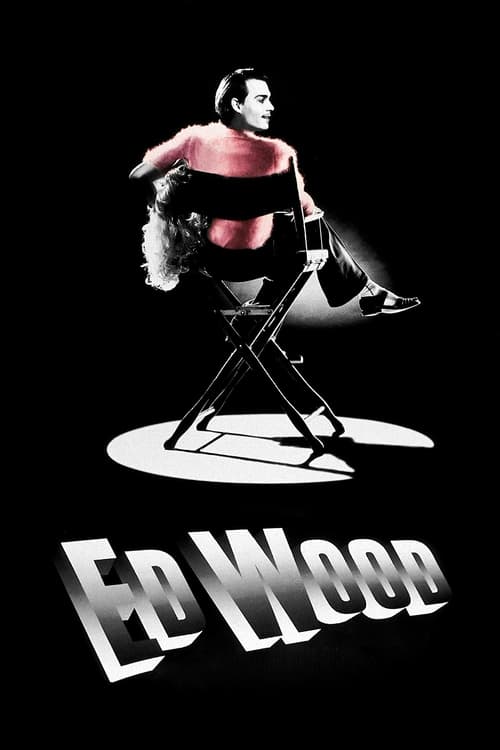
Ed Wood
1994 · Tim Burton
For when you need a movie about loving what you do even when you're bad at it — a comfort watch for anyone who's ever made something nobody asked for. Great for a night when you want to laugh and feel tender about failure at the same time.
What it's about
The mostly true story of Edward D. Wood, Jr., the 1950s Hollywood outsider later crowned the worst director of all time — a relentlessly optimistic, angora-loving dreamer who shot his no-budget B-movies with a found family of misfits. At its heart is his unlikely friendship with Bela Lugosi, the fading, morphine-addicted horror icon Wood puts back in front of a camera. It follows the chaotic making of the films that would earn Wood immortality for all the wrong reasons.
The experience
Warm, funny, and unexpectedly moving — it plays the disasters for laughs but never sneers, and the affection between Wood and Lugosi sneaks up on you. You come out oddly inspired by a man whose enthusiasm completely outran his talent.
Performances
Johnny Depp plays Wood with unkillable, wide-eyed sincerity, and Martin Landau's turn as Bela Lugosi — profane, proud, heartbreaking — won him the Academy Award for Best Supporting Actor.
The craft
Tim Burton shoots it in gorgeous black and white that lovingly mimics the cheap 1950s genre pictures Wood himself made, so the film looks like an exquisite version of the junk it celebrates. The screenplay by Scott Alexander and Larry Karaszewski, drawn from an oral-history biography, finds real structure and grace in a life usually treated as a punchline.
Why it matters
A box-office flop that became one of the most acclaimed films of Burton's career, it permanently rewrote Ed Wood's reputation from industry joke to patron saint of passionate amateurs, and set the template for biopics about so-called failures.
Snapshot
Ed Wood is Tim Burton's black-and-white biographical comedy-drama about Edward D. Wood, Jr., the Poverty Row filmmaker later enshrined by cult reputation as "the worst director of all time." Working from Rudolph Grey's oral-history biography Nightmare of Ecstasy, screenwriters Scott Alexander and Larry Karaszewski and director Burton reframe a figure of ridicule as a figure of tenderness: a relentlessly optimistic dreamer whose enthusiasm outstrips his talent, and whose chief act of grace is the friendship he offers the aging, morphine-addicted horror star Bela Lugosi. The film follows Wood (Johnny Depp) through the making of Glen or Glenda (1953), Bride of the Monster (1955), and Plan 9 from Outer Space (shot 1956, released 1959), surrounded by a troupe of Hollywood misfits. Released to strong reviews and weak ticket sales, it won two Academy Awards and has since become widely regarded as one of Burton's finest and most personal works — an outsider's love letter to outsiders.
Industry & production
The project originated with Alexander and Karaszewski, who had been developing a Wood biography on spec; Michael Lehmann was initially attached, and Burton — coming off Batman Returns (1992) — became involved as director and, with Denise Di Novi, producer. The most consequential production fact is a fight over format. Burton insisted the film be shot in black and white, and Columbia, which had the project in development, balked at releasing a monochrome picture. The film went into turnaround and was picked up by Disney's Touchstone Pictures, which released it. This is well documented in the film's production history, though the precise internal negotiations are known mainly through later interviews rather than a complete contemporaneous record.
Ed Wood was a commercial disappointment. It was an expensive prestige picture relative to its subject — a story about no-budget filmmaking made with studio resources — and it did not recover its costs in theaters; contemporaneous and retrospective accounts consistently describe it as a box-office failure. I will not cite specific gross figures here, as the widely circulated numbers vary and I cannot verify a single authoritative total. What is not in dispute is the critical warmth and awards recognition that followed, which secured the film's reputation independent of its theatrical returns.
Technology
The film was shot on 35mm black-and-white stock, an increasingly rare choice for a mid-1990s studio release and central to the film's meaning as much as its look. The monochrome photography evokes both the Universal horror cycle Wood worshipped and the cheap contemporary B-pictures he actually made, collapsing the distance between glamour and schlock. The production's most celebrated technical achievement is prosthetic: the makeup transforming Martin Landau into Bela Lugosi, executed by Rick Baker with Ve Neill and Yolanda Toussieng, which won the Academy Award for Best Makeup. Just as pointedly, the film deliberately reproduces the crude technology of Wood's own productions — the wobbling cardboard sets, the visible strings on flying-saucer models, the stock-footage octopus — recreating bad special effects with good ones, so that the artifice reads as affectionate homage rather than mockery.
Technique
Cinematography
Stefan Czapsky, who had shot Edward Scissorhands and Batman Returns for Burton, photographed Ed Wood in a lustrous black and white that lends dignity to squalid soundstages and rented back lots. The visual grammar is period-conscious without being pastiche: expressionist pools of shadow around Lugosi recall the gothic horror tradition, while the scenes of Wood's own shoots adopt the flat, over-lit clumsiness of the films he was actually making. The camera frequently glides with an eager, forward optimism that mirrors Wood's temperament, and the compositions treat the derelict fringes of Hollywood with a romantic gloss that is itself an argument about how to see its subject.
Editing
Chris Lebenzon, a regular Burton collaborator, cut the film with a brisk comic rhythm that keeps the ensemble's misadventures buoyant while allowing the Lugosi scenes to slow and deepen. The editing sustains a difficult tonal balance — broad farce during the chaotic production sequences, elegiac quiet in the passages of Lugosi's decline — and repeatedly stages Wood's boundless confidence against evidence of his output's badness, letting the cut carry the film's central irony without underlining it.
Mise-en-scène / staging
Production design (Tom Duffield) and costume (Colleen Atwood) reconstruct early-1950s Los Angeles at its threadbare margins — cramped apartments, dingy studios, the Brown Derby and Musso & Frank as islands of aspiration. The staging repeatedly frames Wood's troupe as a found family gathered in shabby rooms, and reserves its most careful compositions for moments of performance-within-performance: Wood in angora directing in drag, Vampira posed in tableau, Lugosi delivering a monologue to an empty set. The film's texture depends on the loving accumulation of period detail rather than spectacle.
Sound
With Danny Elfman — Burton's near-constant composer — absent during this period following a rupture in their partnership, the score was composed by Howard Shore. Shore's music leans into theremin-inflected, sci-fi-horror pastiche, quoting the sonic idiom of the very B-movies Wood adored and turning it toward warmth and melancholy rather than menace. The sound design likewise commits to period fidelity, and the film's recreations of Wood's productions reproduce the tinny, canned quality of cheap 1950s soundtracks.
Performance
Performance is the film's great subject and its great strength. Johnny Depp plays Wood as an irrepressible, gee-whiz enthusiast — a portrait pitched deliberately at the edge of caricature, all sunny denial and showbiz patter, which reframes delusion as a kind of heroism. Martin Landau's Bela Lugosi is the film's soul: profane, wounded, courtly, and haunted, a fading star confronting addiction and obsolescence. Landau won the Academy Award for Best Supporting Actor for the role. The surrounding ensemble is deep — Sarah Jessica Parker as Dolores Fuller, Patricia Arquette as Kathy O'Hara, Bill Murray as Bunny Breckinridge, Jeffrey Jones as Criswell, Lisa Marie as Vampira, and George "The Animal" Steele as Tor Johnson. Vincent D'Onofrio appears as Orson Welles in the film's pivotal invented scene (with Welles's voice dubbed by Maurice LaMarche).
Narrative & dramatic mode
The film adopts the shape of the show-business rise story but withholds the rise: its structure is a sequence of productions, each ending in obscurity rather than triumph, so that the conventional arc of ambition is quietly hollowed out. Its dramatic engine is not success but persistence, and its true through-line is the Wood–Lugosi friendship, which supplies the emotional stakes the career narrative refuses. The film is candid about being a shaped account — most explicitly in the climactic Musso & Frank encounter between Wood and Orson Welles, an exchange that never happened and that the film offers frankly as inspirational fable, two auteurs at opposite poles of budget and reputation united by the will to make their own pictures. The screenplay also compresses and rearranges the historical record and ends on the up-note of Plan 9's premiere, stopping well short of Wood's later decline into alcoholism and pornography — a choice of emphasis, not deception, that keeps the film inside its chosen register of hopeful comedy.
Genre & cycle
Ed Wood sits at the intersection of the biopic, the backstage Hollywood movie, and the affectionate genre homage. It belongs to a 1990s revival of the biographical film, but it pointedly rejects the form's usual reverence for greatness. Alexander and Karaszewski would go on to define a distinct strain of the "anti-biopic" — the biography of a marginal, disreputable, or failed figure treated with unexpected seriousness — continuing it in The People vs. Larry Flynt (1996) and Man on the Moon (1999). Within Burton's filmography it belongs to his recurring cycle of sympathetic-outsider portraits, extending the lineage of Edward Scissorhands. As a film about the making of low-budget horror and science fiction, it is also a work of loving genre archaeology, reanimating the aesthetics of 1950s exploitation cinema from the inside.
Authorship & method
The film is best understood as a convergence of authorships. Burton, himself a Hollywood eccentric whose sensibility was formed by monster movies and matinee horror, found in Wood a distorted mirror — the difference between them being talent and fortune, not devotion — and the film's generosity toward its subject reads as a director's argument about the dignity of obsessive creation. Screenwriters Scott Alexander and Larry Karaszewski supplied both the structure and the moral stance, refusing camp condescension in favor of empathy. Cinematographer Stefan Czapsky realized the black-and-white vision that Burton fought the studio to keep. Editor Chris Lebenzon shaped its tonal oscillation between farce and elegy. Composer Howard Shore, stepping in for Danny Elfman during a break in Burton's signature collaboration, gave the film a distinctive musical identity drawn from B-movie sci-fi. The result is unusually unified: a director's personal project whose empathy is inseparable from the writers' conception.
Movement / national cinema
Ed Wood is a product of American studio filmmaking made in an auteur-driven, quasi-independent spirit — a prestige picture greenlit on the strength of a star director's clout yet formally uncommercial in its monochrome and its downbeat subject. It reflects the New Hollywood inheritance by which idiosyncratic filmmakers operated inside the studio system, and it participates in a broadly reflexive American cinema of the 1990s preoccupied with Hollywood's own history and margins. It is not affiliated with any organized movement; its lineage is the American genre tradition, filtered through a director's cinephilia.
Era / period
The film was released in 1994, at a high-water mark of the Burton–Depp partnership and amid a wider vogue for the biopic. Its own diegetic period is the early-to-mid 1950s — the era of Poverty Row exploitation, television's encroachment on the studios, the twilight of the first horror stars, and a repressive social climate against which Wood's transvestism and his troupe of oddballs register as quietly transgressive. The film's nostalgia is double-edged: it romances the period's cheap glamour while acknowledging the poverty, addiction, and marginalization at its edges.
Themes
The dominant theme is outsider artistry — the value of making something, badly and without permission, against indifference. Closely bound to it is the gap between ambition and ability, which the film treats not as a joke at Wood's expense but as the human condition rendered visible. Chosen family and loyalty run throughout: Wood's assembly of the rejected — a fading addict, an aging wrestler, a television horror hostess, a genteel drag performer — into a working troupe is the film's emotional core. The Lugosi strand foregrounds aging, obsolescence, and mortality, and the mercy of being seen at the end of a career. Identity and self-invention surface in Wood's angora and cross-dressing, presented without prurience as simply part of who he is. And undergirding everything is a meditation on optimism as both delusion and grace — the film neither fully endorses nor debunks Wood's faith in his own work.
Reception, canon & influence
Critically, Ed Wood was warmly received, praised for Depp's and especially Landau's performances, for Czapsky's photography, and for the unexpected sweetness of its conception; commercially it failed to find an audience. It won two Academy Awards — Best Supporting Actor for Martin Landau and Best Makeup — and its reputation has grown steadily since, so that it is now frequently ranked among Burton's best films and cited as a peak of the Depp–Burton collaboration.
Its influences run backward into the very material it depicts: the Universal horror cycle and Bela Lugosi's Dracula-era stardom that Wood revered; the Poverty Row and drive-in exploitation films of the 1950s; and Wood's own pictures, whose crude effects and earnest awfulness the film lovingly restages. Burton's cinephile affection for monster movies and classic Hollywood glamour is legible in every frame, and the black-and-white aesthetic consciously invokes that vanished studio idiom.
Forward, the film's most concrete legacy is the anti-biopic template that Alexander and Karaszewski carried into The People vs. Larry Flynt and Man on the Moon — the serious, empathetic biography of a marginal or disreputable subject — an approach that reshaped the genre's possibilities. The film also durably revised Edward D. Wood, Jr.'s cultural standing, converting a punchline into a folk hero of independent creativity and drawing renewed attention to his work. Within Burton's career it stands as the fullest statement of his abiding sympathy for the misfit, and it remains a touchstone for filmmakers and critics interested in what it means to make art without the sanction of talent or success.
A Deleuzian reading
A flying saucer crosses a paper sky and the wire holding it up is right there in the shot.
The full Deleuzian reading of Ed Wood →
Reception
A box-office flop in 1994 despite rave reviews — it couldn't even crack $6 million — Ed Wood has since been widely reappraised as Tim Burton's best film, the answer most critics and fans now give when ranking his career.
How Ed Wood was received, from release to now →
Influences: the films it descends from and the films it influenced
- The Cabinet of Dr. Caligari (1920) — Originates the painted, hard-edged expressionist shadow and skewed depth that Czapsky's high-contrast 35mm B&W consciously channels through the Universal-horror lineage the film restages.
- Nosferatu (1922) — Model for the forward-gliding camera and shadow-as-menace vocabulary that Burton borrows to lend Wood's cheap sets a silent-horror grandeur they never earned on their own.
- Dracula (1931) — Bela Lugosi's Old-World cadence, hand gestures, and iconography are the direct performance text Landau reconstructs — down to accent and posture — making the film a portrait of this specific stardom's afterlife.
- Bride of Frankenstein (1935) — Supplies the Universal idiom of the sympathetic monster and camp-inflected pathos that underwrites the film's refusal to mock its 'monstrous' subjects.
- Freaks (1932) — Establishes the empathetic framing of the marginal and 'unfilmable' as dignified community rather than spectacle — the moral stance the anti-biopic adopts toward Wood's troupe.
- Citizen Kane (1941) — The invented Wood–Welles diner scene explicitly canonizes Welles's independent-auteur myth as Wood's mirror, and the deep-focus B&W glamour is the vanished studio craft the photography quotes.
- Sunset Boulevard (1950) — Template for the B&W Hollywood elegy built on a faded star clinging to lost fame — the exact tonal register of the Lugosi scenes and their farce-to-eulogy oscillation.
- Glen or Glenda (1953) — Its earnest confessional angora-and-stock-footage aesthetic is literally recreated on screen, the film reverse-engineering Wood's own crude technique as loving pastiche.
- Plan 9 from Outer Space (1959) — The wobbling hubcap saucers, cardboard headstones, and continuity-breaking Lugosi double are meticulously restaged as 'recreated bad effects' — craft in the service of reproducing anti-craft.
- Day for Night (1973) — Portrays filmmaking as joyful devotional labor persisting through incompetence and chaos — Truffaut's creed that making films is a way of loving the world, transposed to a director with no talent but total faith.
- The People vs. Larry Flynt (1996) — Alexander & Karaszewski carry the identical anti-biopic method here — empathetic, non-condescending portraiture of a disreputable outsider — the structural template Ed Wood pioneered.
- Man on the Moon (1999) — The same writing team extends the performance-within-performance conceit and refusal of camp judgment onto Andy Kaufman, treating provocation as sincere vocation.
- Big Eyes (2014) — Burton reunites with Alexander & Karaszewski to reapply the outsider-artistry biopic to Margaret Keane, again arguing for the dignity of derided popular art.
- The Disaster Artist (2017) — The most direct heir: a straight-faced, affectionate reconstruction of an earnest incompetent (Wiseau) shot-for-shot restaging his own bad film — Ed Wood's method transposed to The Room.
- Confessions of a Dangerous Mind (2002) — Affectionate showbiz biopic of a disreputable American entertainer rendered through loving period-pastiche reconstruction of its era's media.
- Basic Sanitation, the Movie (2007) — The template for tender homage to amateur, no-budget monster filmmaking, staging DIY special effects and rubber-suit ingenuity as heroism rather than ridicule.
- Superboys of Malegaon (2025) — Establishes the affectionate-biopic register that treats a technically inept filmmaker's boundless conviction as heroic rather than mockable — the tonal contract of dignifying the amateur that Kagti and Grover adopt wholesale.
- An Adventure in Space and Time (2013) — Gatiss-acknowledged model in which Martin Landau's fading Bela Lugosi — an aging actor confronting obsolescence — supplies the exact template for Bradley's Hartnell, and both films locate real pathos in cheap, hand-built genre production.
- Gods and Monsters (1998) — Empathetic B&W-Hollywood biopic of James Whale that mines the same Universal-horror nostalgia and outsider-in-the-studio-system pathos from the opposite end of the lineage.
- Auto Focus (2002) — Shares the serious, non-judgmental biography of a disreputable fringe-Hollywood figure, extending the Alexander/Karaszewski moral neutrality toward a compulsive subject.
- American Splendor (2003) — Advances the anti-biopic's dignifying-the-marginal impulse and its performance-within-performance layering (actor beside real subject) into self-reflexive documentary hybrid.
- Mank (2020) — Extends the meticulous monochrome period-Hollywood reconstruction and the invented-behind-the-scenes-scene device, fictionalizing studio-era craft in the same nostalgic B&W register.
- Fear and Loathing in Las Vegas (1998) — Depp's physical impersonation methodology — adopting the subject's posture, verbal tics, and material props as character skeleton rather than mimicry — is the same technique he applies to Thompson four years later; the film's period production design reconstructs a specific decade's vernacular as simultaneously affectionate elegy and American Dream irony.
- The Aviator (2004) — A fellow obsessive-Hollywood-outsider biopic using expressive monochrome/period stylization rather than naturalism, sharing the strategy of letting visual texture embody the subject's era and mania.
- Nouvelle Vague (2025) — An affectionate Academy-ratio black-and-white biopic that finds romance in the scrappy mechanics of low-budget filmmaking — the same monochrome-homage register and making-of warmth.
- One Cut of the Dead (2017) — Celebrates ragged, under-resourced filmmaking powered by sheer collective enthusiasm over technical competence — One Cut's emotional thesis.
- Bingo: The King of the Mornings (2017) — The affectionate, meticulously reconstructed portrait of a vanished low-culture entertainment world and its self-mythologizing showman shares Bingo's collaborative-reconstruction method and tone.
Similar films
- Edward Scissorhands (1990) — shared sensibility
- Sweeney Todd: The Demon Barber of Fleet Street (2007) — shared sensibility
- Beetlejuice (1988) — shared sensibility
- The Lighthouse (2019) — shared sensibility
- Big Fish (2003) — shared sensibility
- Blow (2001) — shared sensibility
- Edvard Munch (1974) — shared sensibility
- Guillermo del Toro's Pinocchio (2022) — shared sensibility