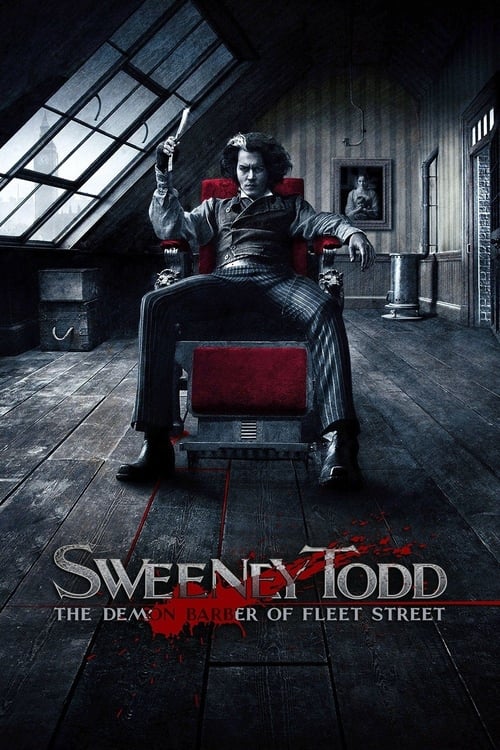
Sweeney Todd: The Demon Barber of Fleet Street
2007 · Tim Burton
For when you want your musical with teeth — a stylized, theatrical night of revenge and gallows humor. Not one for the squeamish; ideal if 'gorgeous and gruesome' sounds like a compliment.
What it's about
A barber returns to Victorian London under a new name, transported years earlier on a false charge by a judge who coveted his wife. Setting up shop above Mrs. Lovett's struggling pie shop, he turns his razor toward revenge — and the two tenants strike up a grimly practical partnership that keeps the pie shop suspiciously well supplied. It's Stephen Sondheim's celebrated stage musical filmed as full-blooded horror: the songs carry the story, and the violence is not hidden.
The experience
Macabre, funny, and genuinely bloody — a swooning Gothic melodrama where people sing beautifully about terrible things. The tone walks a razor's edge between operatic tragedy and pitch-black comedy, and it commits completely to both.
Performances
Johnny Depp plays Todd as a hollowed-out man burning from the inside, and Helena Bonham Carter's Mrs. Lovett finds a daydreaming pathos under the ghoulish practicality; Alan Rickman makes the judge's menace disturbingly human. Depp's turn earned him major awards attention.
The craft
Burton drains London to ash-gray so that every splash of red detonates, and shoots Sondheim's score — one of the most admired in musical theater — like Grand Guignol opera. The production design's soot-and-velvet Victoriana is immaculate, and the near-through-sung structure means the music is the film: good speakers matter.
Why it matters
One of the rare modern Hollywood musicals to keep its source's darkness fully intact, it stands as a high-water mark of the Burton–Depp collaboration and proof that Sondheim could survive the screen with his bite intact.
Horror · Gothic · Splatter & gore · Horror comedy & camp. A sung Gothic revenge opera in ash-grey Victorian London, where the gallows humor is pitch-black and red blood sprays across the screen.
Snapshot
Tim Burton's Sweeney Todd is an adaptation of Stephen Sondheim and Hugh Wheeler's 1979 stage musical, itself derived from Christopher Bond's 1973 play and the Victorian penny-dreadful legend of the murderous Fleet Street barber. It is a rare beast in modern Hollywood: a full-throated, near-through-sung movie musical shot as a Grand Guignol horror film, in which the songs carry the plot and the violence is graphic, arterial, and unhidden. Benjamin Barker, transported on a false charge by a judge who covets his wife, returns to London as "Sweeney Todd" bent on revenge, and forms a grotesque commercial partnership with the pie-shop keeper Mrs. Lovett, who disposes of his victims by baking them into pies. Burton strips Sondheim's already dark operetta of its choral framing and social commentary and reforges it as an intimate, monochrome revenge tragedy centered on Johnny Depp and Helena Bonham Carter. The film is one of the most commercially and critically successful stage-to-screen musical adaptations of its era, and stands as the fullest expression of Burton's long-running gothic sensibility applied to material that meets it head-on.
Industry & production
The film was produced by DreamWorks Pictures and Warner Bros. in association with several partners including Parkes/MacDonald and The Zanuck Company, with Richard D. Zanuck — a frequent Burton producer — among the credited producers. Distribution was split territorially, with Paramount/DreamWorks and Warner Bros. involved in the release. It opened in December 2007, positioned squarely in the awards-season corridor, and was rated R in the United States for graphic bloody violence — an unusually uncompromising choice for a studio musical, and one that signaled the production's refusal to soften the property for a broad family audience.
The screen rights to Sondheim's musical had circulated in development for years, with various directors and stars attached at different points; the record of that long gestation is real but the specific attachments should be treated cautiously rather than stated as settled fact. What is documented is that the project came together with John Logan writing the adapted screenplay and Burton directing, and that Sondheim retained meaningful involvement in — and approval over — how his work was handled. Principal photography took place primarily at Pinewood Studios outside London, allowing the production to build the film's stylized Victorian world on soundstages rather than on location. The reported production budget was modest by studio-tentpole standards, and the film went on to be a solid commercial performer worldwide; precise gross figures vary across sources, so they are best characterized qualitatively — a genuine success for an R-rated musical — rather than pinned to a number here.
Technology
Sweeney Todd was made on the cusp of the industry's transition to digital acquisition but belongs firmly to the photochemical tradition, shot on 35mm film by Dariusz Wolski. Its most conspicuous technological dimension is not the capture format but the aggressive manipulation of color in post-production: the entire film is pushed toward a desaturated, ashen, near-monochrome palette — cold grays, blacks, bone-whites, and bruised blues — against which the blood registers as an almost fluorescent, non-naturalistic red. This deliberate divorce of the blood's hue from any realistic reference is a stylistic thesis executed through color grading and effects work. The throat-slittings and their spectacular gouts of blood combine practical effects with digital enhancement, and the falling bodies dropped through Sweeney's tilting barber chair into the bakehouse below are staged as engineered gags. The film sits within Burton's broader practice of building heightened, artificial worlds through a blend of physical craft and digital finishing rather than photographed reality.
Technique
Cinematography
Wolski's photography is austere and controlled, favoring a cold, low-saturation image that reads almost as tinted black-and-white. Light is often hard and directional, carving faces out of gloom; the London of the film is perpetually overcast, sooty, and enclosed, with little relief of open sky or warm tone. The camera is generally restrained and composed rather than restlessly mobile, giving the numbers room to play as staged performance while occasionally opening into sweeping crane and effects-driven views of a computer-augmented Victorian cityscape. Flashbacks and Sweeney's memories of his lost family are rendered in warmer, bleached, idealized color that pointedly contrasts with the drained present, using palette itself as a marker of time and loss.
Editing
Chris Lebenzon, Burton's longtime editor, cut the film. Because Sweeney Todd is essentially through-composed, the editing is bound to the music: cuts must respect Sondheim's phrasing, the internal architecture of numbers like "A Little Priest" and "Epiphany," and the interweaving of simultaneous vocal lines. The film's most celebrated set-piece of editing is the "By the Sea"/kitchen fantasy and the parallel construction of "Johanna," which cross-cuts multiple characters and locations against a single continuous musical line, and the systematic montage of Sweeney's murders — a sequence of throat-cuttings compressed and rhythmized so the killings accumulate into a grim mechanical routine.
Mise-en-scène / staging
The film's visual world is dominated by Dante Ferretti's production design and Colleen Atwood's costumes. Ferretti builds a vertical, cramped, storybook London — Mrs. Lovett's pie shop and the barber shop stacked above it, the bakehouse below, a set of spaces connected by the film's signature death-chute. The design language is expressionist and theatrical, all steep angles, grime, and looming shadow, closer to a haunted illustration than a period reconstruction. Atwood dresses the characters in silhouettes that externalize their natures: Sweeney's severe black-and-white barber's garb and shock of white-streaked hair, Mrs. Lovett's pale, corseted, faintly Victorian-goth extravagance. The staging keeps the tragedy claustrophobic and interior, reserving expansive imagery for fantasy and memory.
Sound
Sound is the film's organizing principle, since it is a musical. Sondheim's score and lyrics are the spine, adapted and orchestrated for the screen with a reduced, more intimate scale than a full pit orchestra, and mixed to foreground the sung dialogue. Crucially, the cast performed their own vocals, recorded for the production, and the film integrates these performances with the same close, conversational miking one would give spoken dialogue rather than the belted, proscenium-scaled delivery of stage musical theater. The result is a more naturalistic, sometimes near-whispered vocal texture. The score was trimmed for the film: material was cut or shortened, most notably the recurring choral "Ballad of Sweeney Todd" that frames the stage version, removing the Brechtian Greek-chorus commentary and pulling the audience closer inside the story.
Performance
Depp plays Sweeney as a coiled, inward, near-catatonic figure who erupts only in violence and in song, his singing voice untrained and rock-inflected rather than legit-theatrical — a choice that suits the film's intimate scaling. Bonham Carter's Mrs. Lovett is the film's warmth and its horror at once: pragmatic, lovelorn, appallingly casual about cannibalism, delivering the black comedy that offsets Depp's monomania. Alan Rickman brings silken menace to Judge Turpin and Timothy Spall a reptilian obsequiousness to Beadle Bamford. Sacha Baron Cohen's rival barber Pirelli supplies broad comic bombast, and the young performers — Jamie Campbell Bower and Jayne Wisener as the lovers Anthony and Johanna, Ed Sanders as the boy Toby — anchor the ballad material. The performances are pitched for camera and microphone, restrained where a stage cast would project.
Narrative & dramatic mode
Sweeney Todd is a revenge tragedy in operatic dress. Its dramatic mode is through-sung musical theater translated to film: exposition, interiority, seduction, and plotting are all carried in song, with relatively little spoken scene work. The structure is classically tragic — a wronged man's just grievance metastasizes into indiscriminate slaughter, and the machinery of his revenge circles back to destroy the very thing he sought to recover. The film braids several plots: Sweeney's pursuit of the Judge, Mrs. Lovett's entrepreneurial and romantic designs on Sweeney, and the young lovers' escape narrative, all converging in a bakehouse finale of layered recognitions and reversals. Tonally it fuses horror, black comedy, and melodrama, using Mrs. Lovett's gallows humor (above all in "A Little Priest," where the pair improvise a taxonomy of human pies by profession) as counterweight to Sweeney's grief and rage.
Genre & cycle
The film sits at the intersection of the movie musical and the horror film — a combination that is historically uncommon and commercially risky. Within the 2000s revival of the screen musical, it is an outlier: where Chicago (2002), Dreamgirls (2006), and Hairspray (2007) offered spectacle and uplift, Sweeney Todd offered an R-rated bloodbath. It draws on the Grand Guignol tradition of theatrical horror and the penny-dreadful sensationalism of its source, and it belongs to the broader gothic-horror lineage that runs through Burton's own filmography. It is also a landmark in the small cycle of prestige stage-to-screen Sondheim and Broadway adaptations, notable for preserving rather than diluting the difficulty of its source.
Authorship & method
Sweeney Todd is a strong authorial statement precisely because director and material are so aligned. Burton had spent two decades building a body of work — Beetlejuice, Edward Scissorhands, Sleepy Hollow, Corpse Bride — defined by gothic romanticism, morbid whimsy, expressionist design, and sympathy for monstrous outsiders; Sondheim's Sweeney is an outsider-monster par excellence, and the pairing reads as inevitable. The film is also the product of Burton's repertory method: it is one of his many collaborations with Depp, and it features Bonham Carter, his partner at the time. His key craft collaborators are similarly long-standing associates: editor Chris Lebenzon and costume designer Colleen Atwood had worked with him repeatedly, and production designer Dante Ferretti — a titan of European art direction associated with Fellini, Pasolini, and Scorsese — supplied the film's most decorated element. John Logan, a dramatist and screenwriter with a strong theatrical background, adapted the book. The one authorship that must be handled carefully is Sondheim's: he is the composer-lyricist of the source and was involved in and consulted on the adaptation, but the specifics of his input on casting and cuts should be described as documented collaboration rather than embroidered with invented detail.
Movement / national cinema
The film does not belong to a movement in the art-cinema sense; it is a studio-financed Hollywood production. It is, however, an Anglo-American object in its making — shot in Britain at Pinewood with a largely British supporting cast and British craft talent — and it draws deeply on English cultural material: the Victorian London of Dickensian imagination, the penny dreadful, and English music-hall and melodrama traditions. Its truer lineage is stylistic rather than national: German Expressionism, the theatrical horror of Grand Guignol, and the gothic strain of studio filmmaking that Burton had spent his career elaborating.
Era / period
The film is set in an unspecified, storybook nineteenth-century London — Victorian in texture but consciously unmoored from documentary period accuracy, a mythic city of soot and shadow rather than a reconstructed one. As a product of its own moment, 2007, it belongs to the mid-2000s revival of the Hollywood musical and to a late-photochemical, pre-full-digital phase of studio filmmaking. It also arrives at a mature point in Burton's career, before his subsequent turn toward large-scale effects tentpoles, and represents one of his last films rooted primarily in built sets and practical craft.
Themes
The film's governing themes are revenge and its self-consuming logic: Sweeney's grievance is legitimate, but his vengeance becomes indiscriminate, and the tragedy insists that a revenge without limit devours the avenger and the innocent alike. Class and predation run underneath — the literal consumption of the poor and the powerful reimagined as pie, a savage social metaphor that the film, having cut the choral commentary, delivers through the story itself rather than through direct address. Obsession and monomania define Sweeney; longing, self-delusion, and displaced domesticity define Mrs. Lovett, whose dream of a normal life with Sweeney is built atop mass murder. Grief and the impossibility of recovering the past thread through the "Johanna" material and the figure of the Beggar Woman, whose identity supplies the film's cruelest final recognition. Corruption of institutional authority — the judge and the beadle who administer injustice — frames the whole as a story about a world that manufactures its own monsters.
Reception, canon & influence
Critically, Sweeney Todd was widely and warmly received as one of Burton's strongest films and a bold, uncompromised screen musical, praised for its design, its tonal control, and the Depp–Bonham Carter pairing, with some dissent centered on the untrained singing voices and the sheer volume of gore. Its awards profile is the clearest index of its standing: it won the Academy Award for Best Art Direction (Dante Ferretti and Francesca Lo Schiavo) and received nominations including Best Actor for Depp and Best Costume Design for Colleen Atwood; at the Golden Globes it won Best Motion Picture — Musical or Comedy, and Depp won Best Actor in that category. (These awards outcomes are well documented; I state only those I can attribute with confidence.)
Looking backward, the film's influences are layered and traceable: Sondheim and Wheeler's 1979 musical directly; behind it Christopher Bond's 1973 play, which supplied the revenge-tragedy framework and the sympathetic origin for Sweeney; and behind that the Victorian penny-dreadful serial that first popularized the Fleet Street legend. Stylistically it draws on German Expressionism, Hammer-era and Grand Guignol horror, and Burton's own prior work. Looking forward, its legacy is chiefly as a proof of concept and a high-water mark: it demonstrated that a genuinely dark, R-rated, through-sung musical could be made at studio scale and succeed critically and commercially, and it remains a reference point in debates about how to translate Sondheim — and difficult stage musicals generally — to film without sanding down their edges. Its most durable influence lies in its craft, particularly the near-monochrome-with-red color strategy that has become a widely cited example of expressive palette design in contemporary cinema.
A Deleuzian reading
The chair tips back and a man goes through the floor.
The full Deleuzian reading of Sweeney Todd: The Demon Barber of Fleet Street →
Reception
A critical hit in 2007 — Depp took the Golden Globe and an Oscar nod for it — but its reputation has shifted with hindsight: it's now widely eulogised as the last genuinely great Burton–Depp collaboration before the partnership curdled into self-parody.
How Sweeney Todd: The Demon Barber of Fleet Street was received, from release to now →
How to watch Sweeney Todd: The Demon Barber of Fleet Street: what to notice on a first viewing
- Notice the barber shop stacked directly above Mrs. Lovett's pie shop. Ferretti builds London as a vertical structure, shop over shop over bakehouse, with a chute running through it. The film keeps returning to this stacked space rather than opening onto the wider city. The single vertical set makes the story's downward pull into something you can see, not just infer.
- Watch how the color drains to gray, black, and bone. Wolski keeps the image cold and low-saturation throughout, with hard directional light carving faces from gloom. Blood is the one color left with any life. Draining every other color makes the red register as pure appetite rather than injury.
- Listen for the singing delivered like spoken, whispered conversation. The cast's vocals are close-miked and conversational rather than belted for a theater balcony, giving Depp and Bonham Carter a near-whispered, intimate texture. This scale makes a stage musical feel like private confession caught by a camera.
- Watch how still Sweeney stays until song or violence breaks it. Depp plays Sweeney coiled and near-catatonic; he erupts only when he sings or kills, never in ordinary movement or gesture. His stillness sets up everyone else in the film as more alive than he is.
Influences: the films it descends from and the films it influenced
- The Cabinet of Dr. Caligari (1920) — Supplies the expressionist vertical-set grammar Burton and Dante Ferretti graft onto Fleet Street — painted, distorted, claustrophobic architecture where warped angles and jagged verticals externalize a diseased psyche rather than depict a real city.
- Nosferatu (1922) — Model for the hard-directional, high-contrast key lighting and the gaunt monster-as-outsider silhouette; the chalk-faced, hollow-eyed Sweeney is lit and framed as a Murnau vampire stalking through shadow.
- Bride of Frankenstein (1935) — Template for sympathetic-monster staging and macabre gothic whimsy played straight, a horror register Burton inherits wholesale in making a serial murderer a tragic romantic figure.
- The Curse of Frankenstein (1957) — Hammer-horror precedent for saturated arterial red bursting against muted period design — the deliberate use of vivid, almost lurid blood as a color event in an otherwise restrained palette.
- Sweeney Todd, the Demon Barber of Fleet Street (1936) — Direct penny-dreadful screen ancestor of the same Fleet Street legend, establishing the barber-chair-and-trapdoor murder apparatus and the Grand Guignol relish for the throat-slitting as spectacle.
- West Side Story (1961) — Landmark for treating a stage musical's dance and song as cinematically staged tragedy rather than filmed theater, licensing the operatic, near-through-sung translation of hard material to screen.
- Cabaret (1972) — Proof that a musical could be adult, desaturated, and morally bleak; Fosse's rejection of the bright MGM palette for a decadent, shadowed one is the tonal permission Sweeney Todd cashes in.
- Sleepy Hollow (1999) — Burton's dry run at Hammer-horror homage in near-monochrome fog with punctuating gouts of red blood, developed with Colleen Atwood and shot as a deliberately desaturated period gothic.
- Repo! The Genetic Opera (2008) — Directly downstream horror-musical that copies Sweeney's through-sung gore aesthetic — industrial gothic sets, arterial red against desaturation, and operatic butchery — for a splatter-opera audience.
- Les Misérables (2012) — Takes Sweeney's untrained-intimate-vocal wager further with live on-set singing and extreme close-miked vocals, prioritizing raw emotional immediacy over dubbed studio perfection.
- Into the Woods (2014) — The next major Sondheim-to-screen adaptation released in Sweeney's wake, wrestling with the same problem — how to film Sondheim's dense, dark contrapuntal lyrics without sanding the edges — with Depp again cast as a predatory figure.
- Anna and the Apocalypse (2017) — Horror-musical hybrid that inherits Sweeney's core license — that a genuinely gory, through-sung musical can be sustained feature-length — pairing music-bound cutting with graphic violence.
- Edward Scissorhands (1990) — Burton's own bladed-outsider prototype with Depp — pale, scissor-fingered gothic romantic — whose costume-as-character silhouette and expressionist suburban-gothic design directly prefigure the razor-wielding barber.
- Corpse Bride (2005) — Immediately-prior Burton musical with Depp and Bonham Carter singing, working out the blue-gray death-world-versus-color palette logic and the morbid-operetta idiom Sweeney Todd extends into live action.
- Dancer in the Dark (2000) — Contemporary demonstration that a musical could be a brutal tragedy ending in execution, using an untrained-voiced lead (Björk) for raw intimate vocals over technical polish — the same anti-Broadway singing ethic Burton embraces.
- Moulin Rouge! (2001) — Fellow flagship of the mid-2000s musical revival built on music-bound cutting, where the edit is cut to the score's rhythm and song drives narrative continuity rather than pausing it.
- Chicago (2002) — The commercial proof-of-concept for the revival that made Sweeney Todd financeable, staging numbers as expressionist internal fantasy and cross-cutting song against dramatic action.
Similar films
- Edward Scissorhands (1990) — influence & lineage
- Sleepy Hollow (1999) — influence & lineage
- Corpse Bride (2005) — influence & lineage
- Cabaret (1972) — influence & lineage
- Beetlejuice (1988) — shared sensibility
- Ed Wood (1994) — shared sensibility
- Bram Stoker's Dracula (1992) — shared sensibility
- Alice in Wonderland (2010) — shared sensibility
All the films related to Sweeney Todd: The Demon Barber of Fleet Street →