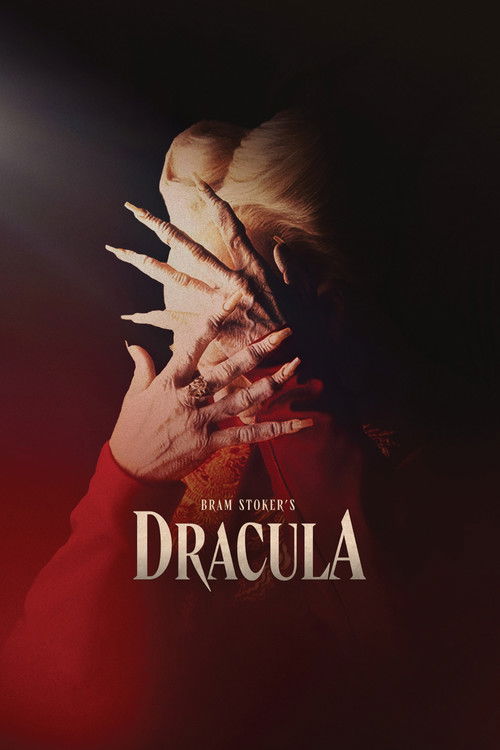
Bram Stoker's Dracula
1992 · Francis Ford Coppola
Megalopolis is the decade's great folly narrative: self-funded with $120M of wine money, chaotic Cannes premiere, a pulled trailer with AI-fabricated critic quotes, on-set conduct allegations, and a defiant "I don't care" tour. The conversation is about the mythology of the last mogul-auteur.
For a gothic autumn night when you want horror that's lush and romantic rather than grim — candles-and-red-wine viewing. It asks you to embrace the theatrical; taken that way, it's a feast.
What it's about
A centuries-old count, damned by his own grief-stricken blasphemy, discovers that a young London lawyer's fiancée is the image of the wife he lost — and crosses from Transylvania to Victorian England to claim her. What follows is Stoker's novel told closer to the book than the movies usually dare: the diaries and letters, the band of vampire hunters, the creeping contagion — but reimagined as a delirious, blood-soaked love story.
The experience
Feverish and operatic — every frame drips with velvet, shadow, and blood, swinging between genuine dread, swooning eroticism, and grand melodrama. It's excessive on purpose, and if you surrender to the excess it's intoxicating.
Performances
Gary Oldman is astonishing as Dracula, playing him at every age and shape — ancient courtier, young seducer, beast — and making a monster genuinely heartbroken. Anthony Hopkins tears into Van Helsing with unhinged relish, and Winona Ryder carries the film's tragic center.
The craft
Coppola made a modern blockbuster using only the tricks of early cinema — in-camera illusions, miniatures, rear projection, double exposures — just as Hollywood went digital, and the handmade artifice gives it a texture nothing else from the era has. Eiko Ishioka's Oscar-winning costumes are characters in themselves, and the shadow-play, sound design, and score make it a true big-screen sensory experience.
Why it matters
A hit that revived the gothic horror romance for the '90s and proved old-fashioned practical craft could out-dazzle the coming digital wave; its costumes, makeup, and sound all won Academy Awards.
Snapshot
Coppola's Bram Stoker's Dracula is a deliberate anachronism: a 1992 studio blockbuster built almost entirely from optical and in-camera effects that predate the sound era, released the same season Hollywood was reorganizing itself around digital compositing. It is a horror film shot as an opera of longing — a story of erotic obsession, epidemic contagion, and technological modernity dressed in the costume of Victorian melodrama.
The film returns to Stoker's 1897 epistolary novel more faithfully than the Universal or Hammer traditions did, restoring the frame narration, the multiplicity of narrators, the vampire hunter Van Helsing's grotesque comedy, and characters (Quincey Morris, Arthur Holmwood, Jack Seward) that decades of adaptation had trimmed. But it grafts onto that structure an invention that is not Stoker's: the reincarnation romance, in which Mina Harker is the returned soul of Dracula's suicide-dead wife Elisabeta, and the vampire's invasion of England becomes a quest for reunion rather than a purely predatory expansion. That single addition converts the novel's xenophobic thriller into a tragic love story, and it is the interpretive decision on which every argument about the film turns.
James V. Hart's screenplay and Coppola's staging treat the 1890s as a hinge: the decade of Freud, of the Kodak snapshot, of the phonograph, of the arrival of cinema itself. Dracula in London is a creature of the past walking into the age of mechanical reproduction, and Coppola makes the movies themselves a motif — the Count courts Mina in a cinematograph tent. The film's excesses are inseparable from its argument. It is maximalist because desire in it is maximalist.
Industry & production
The project reached Coppola through a script by James V. Hart that had circulated in development, with Winona Ryder attached as an advocate for the material; Coppola came to it having spent the 1980s and early 1990s in a long recovery from the financial catastrophe of One from the Heart (1982) and the collapse of his Zoetrope studio. He had returned to studio work as a director-for-hire and part-owner of his own creative destiny only intermittently, and The Godfather Part III (1990) had been made under enormous commercial pressure. Dracula was, in the plainest industrial sense, a chance to make a large-scale genre picture for a major studio — Columbia, then under Sony ownership — with a budget in the range typical of an early-1990s A-list production, and with the promise that a horror title with a marquee director could open wide.
Coppola's central production strategy was a form of controlled austerity disguised as opulence. The film was made almost entirely on soundstages, with no location shooting in Eastern Europe; Transylvania, the Borgo Pass, Whitby, and London were built, painted, and matte-composited. This was both an aesthetic decision — a wish for the artificiality of studio-era cinema and of silent-era fantasy — and an economic one, since a controlled stage environment made the film's dense schedule of in-camera trickery feasible.
The most widely reported production story concerns the visual effects: Coppola dismissed an effects team and replaced their approach with one built on antique techniques, handing significant responsibility to his son Roman Coppola, who supervised the second unit and the film's optical work. The reported instruction — that anything the film needed should be achievable by methods available to filmmakers of the 1890s — became the production's governing constraint. Whatever the exact sequence of events (accounts of the dismissal vary in detail across interviews and making-of accounts), the resulting film is verifiably free of digital effects in any significant capacity, which by 1992 was already an eccentric position.
Casting was a mix of prestige and studio calculation, and it is the film's most contested element. Gary Oldman as Dracula and Anthony Hopkins as Van Helsing were actors of the stage and of character work; Ryder and Keanu Reeves were young American stars whose casting broadened the film's commercial reach and whose English accents drew immediate and lasting criticism, Reeves's especially. Reeves has himself spoken in later interviews about the difficulty of the part. Coppola surrounded them with a supporting company — Sadie Frost, Richard E. Grant, Cary Elwes, Bill Campbell, Tom Waits as Renfield — that leans theatrical.
The film was a substantial commercial success, one of the highest-grossing releases of its year worldwide and a clear win for Columbia; precise figures vary by source and I won't assign a number here. It also generated a small industry of ancillary product typical of the period, and it revived the studio-gothic as a viable production category, directly enabling Mary Shelley's Frankenstein (1994) and Wolf (1994) as prestige-monster projects.
Technology
The film is best understood as an argument about film technology conducted in the medium of film technology.
Its effects vocabulary is pre-digital and largely pre-1930: forced perspective; in-camera matte work; multiple exposure and bipack printing; miniatures; rear and front projection; reversed footage run backwards through the camera or printer; the use of raw speed changes to make figures glide or lurch. Dracula's shadow moves independently of him — achieved practically, with a separately operated shadow puppet or a second performer, not rotoscoped. Blood floods a room and a map of Europe bleeds through; the vampire brides materialize out of a bed. The transformation of Dracula into a mass of rats, a wolf-thing, a swarm — these are realized through creature effects, puppetry, and edit-point substitutions rather than morphing software, which by 1991 had already been demonstrated spectacularly in Terminator 2: Judgment Day.
That timing matters. Bram Stoker's Dracula arrives at the exact moment when digital effects became the default answer to the question "how do we show the impossible." Coppola answered it the other way, and the film therefore preserves a working catalog of techniques that were about to become obsolete. There is a texture consequence: the optical composites carry visible grain shifts, edges, and density changes that read as film rather than as seamless illusion, and the film accepts — even courts — that visible seam. The illusions are meant to be recognized as illusions, which aligns them with the film's interest in the birth of cinema as a magic show.
The soundtrack technology of the period also shapes the film. Released in the first years of digital theatrical sound, its mix is dense and low-heavy, with Wojciech Kilar's score and the sound design layered into a near-continuous wall.
Technique
Cinematography
Michael Ballhaus, the German cinematographer who came out of Fassbinder's company and had become Scorsese's regular collaborator, shot the film. Ballhaus brings two traditions: the expressionist German inheritance of hard shadow and distorting composition, and the restlessly mobile camera he had developed for Fassbinder (the celebrated 360-degree tracking shot) and Scorsese.
The palette is saturated to the point of stylization — Dracula's reds against Carfax grays, the Transylvanian blues and blacks, the amber-lit interiors. Ballhaus and Coppola compose in depth and in layers, using the studio environment to build shots that combine foreground miniature, mid-ground performance, and painted or projected backing in a single take. Silhouette is a recurring device: Dracula rendered as a shape against a colored sky, the castle as a cutout, the wolf's outline. Iris-ins and iris-outs, dissolves that hold both images at equal strength, and superimpositions that let one image bleed through another — Dracula's eyes over a landscape, a peacock's tail becoming a train tunnel — dominate the transitional grammar. These are silent-cinema figures, and the film uses them without irony.
The camera moves constantly but rarely aggressively; it drifts, encircles, and rises. Where the film goes handheld or destabilized, it is in the Transylvanian sequences and in Renfield's asylum, where the world is meant to be coming apart.
Editing
Anne Goursaud, Nicholas C. Smith, and Glenn Scantlebury are credited on the edit. The cutting is one of the film's most distinctive and most divisive elements: it is associative rather than continuous. Rather than dissolving conventionally between locations, the film matches on graphic shape and color — a droplet, an eye, a circle of light — so that Whitby and Transylvania interpenetrate. Cross-cutting is used not merely to build suspense but to make explicitly erotic parallels: Lucy's assault in the garden intercut with the storm, Mina and Dracula's consummation intercut with the killing of Lucy, the Count's transformations intercut with Mina's reactions.
The film also compresses ruthlessly. Stoker's slow accumulation of documentary evidence — the novel's whole method — is telescoped into montage passages, voice-over from journals and letters, and title-like inserts of handwriting and typewriting. Some critics have found the result breathless to the point of incoherence in the London half, where plot mechanics (Lucy's transfusions, Van Helsing's diagnosis, the hunt) get less breathing room than the romance. That is a fair structural criticism: the reincarnation plot takes the oxygen that the ensemble hunt needs.
Mise-en-scène / staging
Production designer Thomas Sanders and, critically, costume designer Eiko Ishioka give the film its signature. Ishioka — a Japanese graphic and theatrical designer whose background was in advertising and stage rather than screen costume — designed clothes that function as sculpture and as symbol rather than as period reconstruction. Dracula's red robe with its enormous train that pools across the floor; the armor of the prologue, molded to resemble flayed musculature; the white-haired old Count's high-piled coiffure and blood-red gown; Lucy's burial dress with its pleated Elizabethan ruff, part bridal, part reptilian. Ishioka's work won the Academy Award for Costume Design, one of three Oscars the film received — the others were for Sound Effects Editing and for Makeup (Greg Cannom, Michèle Burke, Matthew W. Mungle).
The staging is frankly theatrical. Interiors are shallow and frontal in places, deep and cavernous in others; characters are frequently arranged in tableaux. Coppola stages the castle sequences with an eye to Murnau and to Cocteau's La Belle et la Bête — corridors that seem alive, doors that open on their own, a candelabra held by an unseen hand. The asylum is a Piranesian cage. Whitby is a picture-book England. Nothing pretends to be a real place; everything is a stage for a mental state.
Sound
Wojciech Kilar's score is one of the great late-century horror scores: built on a descending four-note motif that functions as Dracula's signature, a wordless choral texture for the vampire brides, and a surging, string-driven love theme ("Love Remembered," "Mina's Photo"). Kilar, a Polish composer from the same generation and milieu as Górecki and Penderecki, brings a minimalist-liturgical austerity that resists the Hollywood horror idiom of stingers and clusters. The score is repetitive by design, insistent, and often played at devotional volume. Annie Lennox's end-credits song "Love Song for a Vampire" extends the film's romantic reading into the pop register.
The sound design (recognized with the Academy Award for Sound Effects Editing) works in dense layers: whispers under dialogue, animal noise, the mechanical rhythm of trains and typewriters against the organic sounds of blood and breath. Dracula's voice itself is a designed object — Oldman's old-man Count speaks in a strangled, high, Eastern-inflected register that is processed and doubled in places.
Performance
The performances are pitched at operatic scale, and the film's coherence depends on accepting that register. Oldman plays four or five distinct beings — the armored prince, the ancient courtier, the young dandy in blue glasses, the wolf-creature, the dying penitent — and shifts vocal placement and physical carriage between them. His performance is a transformation act in the old theatrical sense.
Hopkins, made the same year as his Silence of the Lambs Oscar, plays Van Helsing as a manic, obscene, half-comic scientist, cackling and eating during autopsies; it is the film's most destabilizing choice and one that some critics read as flippant and others as Stoker-faithful (the novel's Van Helsing is genuinely strange). Tom Waits's Renfield is a grotesque of real pathos. Sadie Frost's Lucy carries the film's most explicit eroticism and its most brutal punishment.
Ryder's Mina is the load-bearing performance — she must sell a reincarnation the script asserts more than dramatizes — and her work is strongest in stillness. Reeves's Harker is the film's most frequently attacked element, the accent stranded between registers; his casting is a reasonable target, though the part as written gives him little but victimhood and horror.
Narrative & dramatic mode
The film is structured as a frame-and-flashback: a 1462 prologue (narrated by Van Helsing) establishes Vlad's crusade, Elisabeta's suicide, and Vlad's blasphemous renunciation of God, before the main action begins in 1897. This prologue is Coppola and Hart's invention as a causal device — it converts vampirism from a condition into a curse chosen in grief.
Within the 1897 story, the film preserves the novel's polyphony: journal entries, letters, and phonograph recordings are voiced over by their writers, so the narration passes between Harker, Mina, Lucy, Seward, and Van Helsing. This is a genuinely faithful structural move, and one that almost no prior adaptation attempted. But the film subordinates the epistolary machinery to a melodramatic through-line — the doomed lovers — with the result that the hunt-and-detection plot of the novel's second half, where the men assemble evidence and pursue Dracula back to Transylvania, is heavily compressed.
The dramatic mode is melodrama in the technical sense: externalized emotion, moral clarity dissolved into pathos, coincidence and destiny doing the work of causality, and music carrying meaning that dialogue does not. The ending — Mina beheading Dracula in the castle chapel, the ceiling fresco healing, his face restored — resolves the film as redemption rather than as extermination. Stoker's novel ends with a killing; Coppola's ends with a mercy. That is the sharpest measure of the adaptation's distance from its source, notwithstanding the possessive title.
Genre & cycle
The film sits at the junction of the vampire film, the costume romance, and the erotic thriller cycle that dominated early-1990s Hollywood. Its immediate genre context is a lull: after the Hammer cycle exhausted itself in the mid-1970s and the vampire film scattered into art cinema (Nosferatu the Vampyre, 1979), teen comedy (The Lost Boys, Fright Night, 1985–87), and the AIDS-inflected art-horror of The Hunger (1983), there had been no large-scale, respectable, studio-mounted Dracula.
Coppola's film restored the vampire to A-picture status and re-fused it with the historical romance, and its success defined a short cycle: Interview with the Vampire (1994), Mary Shelley's Frankenstein (1994, produced by Coppola), Wolf (1994), Dracula: Dead and Loving It (1995, the inevitable parody), and further out, Sleepy Hollow (1999) and From Hell (2001). The "sympathetic, erotic, tragic vampire" that would dominate the following two decades of popular culture is not Coppola's invention — Anne Rice's Interview with the Vampire (1976) precedes it by sixteen years, and Dan Curtis's Dark Shadows (1966–71) and his 1974 TV Dracula with Jack Palance had already tried the lost-love device — but Coppola's film is the version that made it a mainstream, big-budget default.
It is also, plainly, a film about contagion made at the height of the AIDS crisis. Blood transfusion, infection through intimacy, a disease carried from elsewhere into a complacent metropolis, and a group of men with instruments trying to understand what is killing their friend: the resonance was noted by critics at the time and is not subtext so much as text.
Authorship & method
Coppola's authorship here is that of an impresario. He had taught a version of this material — he has described using the novel in his work with actors, and the production famously ran a rehearsal period in which the cast read the novel aloud and worked through the text before shooting. His method on this film is to commit totally to a stylistic system and then let collaborators build inside it.
James V. Hart (screenplay) supplies the reincarnation conceit and the epistolary architecture. Hart's script is the film's structural spine and its most debated component; it is simultaneously the most textually faithful Dracula screenplay to that date and the one that changes the story's meaning most fundamentally.
Michael Ballhaus (cinematography) supplies the German expressionist lineage and the mobile camera. His participation connects the film directly to Fassbinder and to Scorsese, and gives the studio artifice a European rather than a Hollywood-gothic accent.
Eiko Ishioka (costume) is arguably the film's co-author. Her designs are not illustrations of the script; they are propositions about the characters — Dracula as flayed body, as insect, as flame. Coppola granted her extraordinary latitude, and the film's visual identity is more hers than anyone's after Coppola himself.
Wojciech Kilar (music) brings a concert-hall austerity that keeps the film from tipping into camp; the score treats the material as tragedy and insists on it.
Roman Coppola (second unit / visual effects) executes the antique-effects program, which was as much a research project as a production task.
Anne Goursaud, Nicholas C. Smith, Glenn Scantlebury (editing) implement the associative cutting scheme.
Thomas Sanders (production design) and the makeup team of Greg Cannom, Michèle Burke, and Matthew W. Mungle complete the physical world.
Movement / national cinema
The film is an American studio production, but its aesthetic citizenship is European and specifically German. It descends from Nosferatu (1922) — Coppola quotes Murnau's shadow-on-the-stairs and rat imagery directly — and from the broader Weimar expressionist practice of building emotion into the set. Ballhaus's presence makes that lineage material rather than merely allusive.
Its second lineage is French: Cocteau's La Belle et la Bête (1946), for the enchanted castle and the idea that the monster's tragedy is the film's subject. Its third is Japanese, through Ishioka, whose design vocabulary is unmoored from Western period costume and closer to kabuki and to graphic poster art.
Within American cinema, the film belongs to the "movie brat" generation's late phase — the moment when Coppola, Scorsese, Spielberg, and De Palma were making expensive personal films inside studio structures. And within Coppola's own career, it belongs with One from the Heart and Rumble Fish as an experiment in total studio artifice, rather than with the naturalist Godfather/Conversation mode.
Era / period
1992 sits at a threshold. Digital effects were about to reorganize production; the vertically integrated conglomerate studios (Sony had bought Columbia in 1989) were consolidating; and the home-video and laserdisc markets made lavish catalog titles newly valuable. Coppola's film is a conglomerate-era blockbuster made with pre-conglomerate craft.
Culturally, the film's 1897 setting is chosen for its own threshold quality. The screenplay foregrounds the technologies of the fin de siècle — the typewriter, the phonograph, the telegraph, photography, the moving picture — and stages Mina and Dracula's courtship at a cinematograph show, with early actuality footage playing behind them. The point is explicit: cinema and the modern Dracula are contemporaries, born in the same decade, and the film that is representing him is also the technology that made him a mass figure.
Themes
Desire as damnation. The film's organizing claim is that love and predation are the same energy. Dracula's curse originates in grief, not evil, and his crimes are pursued as courtship. Every act of vampirism is filmed as seduction.
Blood, contagion, and the body politic. Blood is currency, sacrament, inheritance, and infection. Transfusion scenes are given the weight of surgery and of violation. The film's period medicine — Seward's morphine, Van Helsing's diagnostic authority — sets the scientific management of bodies against a disease that science cannot name.
Modernity versus the archaic. Machines are everywhere: the typewriter that lets Mina become the group's archivist, the phonograph cylinder, the train, the cinematograph. Dracula is defeated by an alliance of technicians, and yet the film's sympathies are not with them.
Repression and its return. Lucy's punishment — she is the sexually forward woman, and she is staked, beheaded, and silenced — is the film's most Victorian gesture and its most uncomfortable. Whether the film critiques that logic or simply performs it with relish is the central question in feminist readings of it.
Faith, apostasy, and redemption. The prologue's renunciation of God and the finale's restoration of the fresco frame the whole film as a religious narrative: a curse incurred by blasphemy, lifted by a woman's act of love. This is the film's largest departure from Stoker and the source of its critics' strongest objection — that it forgives a mass murderer.
Reception, canon & influence
Critical reception in 1992 was sharply split, and it split along a consistent line: reviewers who admired the film's visual invention and reviewers who found the performances and the romance fatal. Praise clustered on the design, the effects, Oldman, and Coppola's ambition; criticism clustered on Reeves's and Ryder's accents, Hopkins's broadness, tonal instability, and the sense that spectacle had overwhelmed dread. The film was not generally regarded as frightening, which for a Dracula picture was itself a complaint.
Awards recognition was strong in the craft categories: three Academy Awards (Costume Design, Makeup, Sound Effects Editing) and a nomination for Art Direction. Its commercial performance was robust, which mattered more than the reviews for its industrial legacy.
Influences on the film (backward). Stoker's 1897 novel, read closely and restored structurally. Murnau's Nosferatu (1922) for its shadow-play, rats, and pestilence. Tod Browning's Dracula (1931) and the Universal tradition it founded, mostly as something to react against. Hammer's Terence Fisher–Christopher Lee cycle (1958 onward) for color, blood, and eroticism. Cocteau's La Belle et la Bête (1946) for the enchanted-castle grammar. Dreyer's Vampyr (1932) for its dislocated space. Silent cinema's optical vocabulary throughout. Dan Curtis's television Dracula (1974) and Anne Rice's fiction for the sympathetic-vampire template. Coppola's own One from the Heart for the commitment to soundstage artifice. Ishioka's non-Western design tradition. And the AIDS epidemic as the contemporary frame.
What it shaped (forward). Most immediately, the mid-1990s literary-gothic cycle: Interview with the Vampire (1994) and Mary Shelley's Frankenstein (1994), the latter produced by Coppola under the same author's-name branding — a title convention the film's success established. More durably, it consolidated the tragic-romantic vampire as the dominant popular form, the lineage that runs through Buffy the Vampire Slayer's Angel, Underworld, Twilight, The Vampire Diaries, and Penny Dreadful. Kilar's score became a reference point for horror scoring that prefers liturgical weight to shock. Ishioka's designs entered fashion and music-video vocabulary directly and made her an internationally sought designer for film (The Cell, The Fall, Mirror Mirror) until her death in 2012.
Its most interesting influence, though, is negative and recent: as digital effects became total, the film's handmade illusionism acquired a value it did not have in 1992. Contemporary critical writing now treats it as a landmark of practical effects and of maximalist studio craft, and its reputation has risen accordingly — from a divisive, gaudy prestige-horror picture to a film routinely cited as one of the last great demonstrations of what a camera and a printing machine can do. Coppola's own late work, particularly Megalopolis (2024), makes clear that the studio-as-laboratory impulse behind Dracula was never a detour but a constant.
A Deleuzian reading
Dracula's shadow does not obey him.
The full Deleuzian reading of Bram Stoker's Dracula →
Reception
A big hit in 1992 ($200M+ worldwide, three Oscars) but critically divided over its wild swings in tone and casting; today it's been fully embraced as a maximalist gothic feast, celebrated precisely for the operatic excess critics once side-eyed.
How Bram Stoker's Dracula was received, from release to now →
How to watch Bram Stoker's Dracula: what to notice on a first viewing
- Watch Dracula's shadow on the castle wall move without him. Coppola and Ballhaus keep giving the shadow its own agenda. The silhouette reaches while Oldman stands still. It was done in camera, with a cutout arm worked just off-frame. The shadow is a second creature in the shot, not decoration, which is the film's whole method in one image.
- Watch for irises closing, and for one image bleeding through another. Instead of ordinary dissolves, the film transitions with silent-era figures: iris-ins, iris-outs, superimpositions. Dracula's eyes float over a landscape. A peacock's tail becomes a train tunnel. Coppola built a 1992 blockbuster out of 1890s tricks, so the grammar itself belongs to the century the story is set in.
- Watch the reds: robe, blood, sky, candlelight against Carfax grays. Ishioka dresses the old Count in a blood-red gown and the young prince in armor molded like flayed muscle. Red keeps flooding rooms and maps rather than sitting on objects. The color stops describing things and becomes the temperature the whole film is held at.
- Count how many different bodies and voices Oldman uses. Armored prince, withered courtier with piled hair, young dandy in blue glasses, wolf-thing. Each has its own vocal placement, posture, and walk. The old Count's voice is strangled and high. Oldman is playing a series of replacements rather than one man, so Dracula never settles into a single person.
- Listen for the four descending notes, and for wordless voices. Kilar's motif returns at devotional volume whenever Dracula's will is working. The brides get a wordless choir. Underneath, whispers run below dialogue alongside animal noise and machine rhythm. The music treats the story as tragedy, not as scare material, and it insists on that before any character does.
The whole guide to watching Bram Stoker's Dracula, with the keys for a rewatch →
Influences: the films it descends from and the films it influenced
- Nosferatu, eine Symphonie des Grauens (1922) — Murnau's autonomous shadow — Orlok's hand climbing the stairwell — is revived as a live-action gag: Coppola casts Oldman's silhouette from a separately operated arm so the shadow acts independently of the body standing beside it, all achieved in-camera rather than by matte.
- Dracula (1931) — Supplies the proscenium framing and the Renfield-in-the-asylum structural slot that Hart's script retains, while Lugosi's cape-and-widow's-peak silhouette is quoted as Ishioka's opening costume specifically so it can be visibly discarded.
- Vampyr (1932) — Dreyer's dislocated space — shadows peeling off their owners, the camera assuming a corpse's point of view through the coffin window — licenses Dracula's unmotivated floating camera and its bier's-eye and grave's-eye setups.
- Napoléon (1927) — The silent optical grammar Coppola's own Zoetrope had championed in its 1981 restoration — iris-in and iris-out as punctuation, stacked superimposition, masked and split frames — becomes Dracula's transition vocabulary in place of conventional dissolves.
- La Belle et la Bête (1946) — Cocteau's enchanted-castle rule — doors that open themselves, candelabra held by hidden arms, movement reversed in the camera — is the governing method for Castle Dracula, where every impossibility is executed live by wires, reversal and off-frame operators.
- Horror of Dracula (1958) — Hammer's saturated color blood and its eroticized bite — the bared throat, the consenting victim — are escalated into arterial reds and Lucy's seduction; Christopher Lee's red-eyed animal physicality is quoted directly in Oldman's contact-lens close-ups.
- Kwaidan (1964) — The wholly studio-built otherworld with painted skies and kabuki-derived garment as the chief carrier of meaning — the non-Western design tradition Eiko Ishioka works from when the armor and robes, not the sets, become the film's architecture.
- Martha (1974) — Ballhaus's full 360-degree circling track around the couple; he brings the same orbiting, mirror-conscious camera to Dracula, resolving the lovers' scenes by revolving the frame rather than by cutting.
- Dracula (1974) — Richard Matheson's teleplay supplies the reincarnated-lost-wife motive that Hart's screenplay adopts as its structural premise, converting Stoker's predator into a mourning lover and reorganizing the whole plot around a romance the novel does not contain.
- One from the Heart (1982) — Coppola's own proof that an entire city can be built on a Zoetrope stage and that lap dissolves and lighting changes can replace cuts; Dracula reuses the method wholesale, shot on soundstages with transitions realized in-camera.
- Mishima: A Life in Four Chapters (1985) — Eiko Ishioka's theatrical, hand-crafted, saturated costume-and-set design method carries forward from Mishima; Coppola, who executive-produced Mishima with Lucas, here foregrounds the same anti-realist stagecraft.
- Interview with the Vampire (1994) — Takes the tragic-romantic vampire template and the literary-source branding, and matches the method: period interiors built and lit by candle, with transformation and aging done in prosthetic makeup rather than optical or digital morphing.
- Mary Shelley's Frankenstein (1994) — Produced by Coppola under the author's-name title convention Dracula established, and built on the same operatic method: whip-pan and crane camera as constant motion, practical creature makeup, and unembarrassed theatrical tableau staging.
- The Cell (2000) — Ishioka's costume design becomes the film's principal world-building engine, exactly as in Dracula — garment as architecture, the dress carrying the set's job — a role she was hired into on the strength of the Oscar-winning Dracula work.
- Crimson Peak (2015) — Explicitly continues the handmade gothic: iris transitions as chapter punctuation, a full multi-storey house built practically to shoot inside, and a red/gold palette carried by costume against desaturated surroundings.
- Nosferatu (2024) — Restores the epistolary/frame architecture Hart recovered and does its shadow work by the same means — Orlok's silhouette cast in-camera from period-correct practical sources onto real surfaces rather than composited in post.
- Megalopolis (2024) — Confirms Dracula's studio-as-laboratory as a constant rather than a detour: in-camera trickery, painted and projected backings, and frankly theatrical tableau staging chosen over photoreal digital effects.
- The Portrait of a Lady (1996) — Direct collaborator debt: Wojciech Kilar's surging European-Romantic gothic scoring, imported wholesale to give James's drawing-room cruelty a register of supernatural dread.
- The Fall (2006) — Eiko Ishioka's Oscar-winning costume design here — clothing built like load-bearing sculpture with saturated symbolic color — is the exact method she reprises for the bandit, the Indian, and the mystic in The Fall.
- Vampire Hunter D: Bloodlust (2001) — Recast the vampire as tragic doomed lover in dense in-camera shadow and painterly texture, directly feeding Bloodlust's Meier-and-Charlotte doomed-romanticism core.
- What We Do in the Shadows (2014) — Its insistence on in-camera, on-set illusion — disembodied shadows, practical transformations — models the film's rule of doing bat-morphs and levitation with wires and reversed film rather than CGI.
- Harry Potter and the Goblet of Fire (2005) — Graveyard-gothic theatricality and bodily-resurrection iconography — the ritual regeneration of a monstrous body from viscera and blood — behind Voldemort's cauldron rebirth in the churchyard climax.
- Twilight (2008) — Reinvented the vampire as tragic Byronic suitor bound by courtly-romance restraint, supplying the chaste-but-charged doomed-lover courtship idiom Edward inherits.
- The Age of Innocence (1993) — Ballhaus, one year later, reprises the identical toolkit — iris-outs, saturated color-wash dissolves, gliding tableau camera over period detail — using optical punctuation as emotional commentary on repressed desire.
- The Ninth Gate (1999) — Wojciech Kilar carries the Dracula scoring method into another occult-literary picture — choral and low-brass ostinato, liturgical processional weight, dread built as ritual rather than as shock sting.
- Hannibal (2001) — Gothic-operatic monster recast as courtly seducer, with the temptation/courtly-romance register and lush orchestral scoring Scott applies to Lecter and Clarice.
- Frankenstein (2025) — The forerunner of the model del Toro consolidates: a maximalist literary-gothic built on in-camera, practical, theatrically staged effects rather than CGI.
- Death Becomes Her (1992) — Same-year gothic tale of the undying, decaying body, pursuing the identical 'immortality corrupts the flesh' spectacle through bravura in-camera and optical effects.
Similar films
- Vampyr (1932) — influence & lineage · often watched together
- Nosferatu (2024) — influence & lineage
- Nosferatu (1922) — influence & lineage
- Interview with the Vampire (1994) — influence & lineage
- Crimson Peak (2015) — influence & lineage
- The Age of Innocence (1993) — influence & lineage
- Dracula (2025) — same viewing thread
- "Wuthering Heights" (2026) — same viewing thread
All the films related to Bram Stoker's Dracula →
Watch it with: curated runs of related films
- Drunk on Design — Watch these together for the rush of maximalist, color-drenched cinema where a woman is made, remade, or consumed by an art form — ballet, fashion, gothic desire — and the production design does half the storytelling.