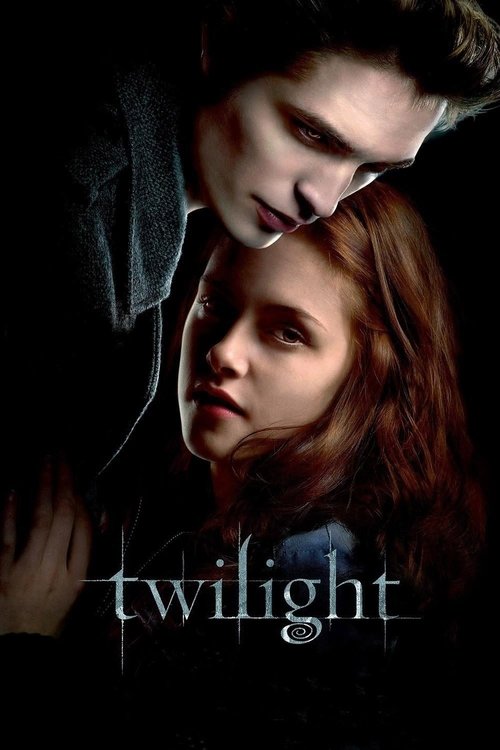
Twilight
2008 · Catherine Hardwicke
For when you want to fall into an all-consuming crush — a blanket, a gray evening, zero irony required. Equally good as sincere comfort viewing or a nostalgic rewatch with friends.
What it's about
Bella Swan moves to a perpetually rainy small town in Washington to live with her dad, expecting nothing. Instead she becomes fixated on Edward Cullen, a beautiful, unnervingly aloof classmate who turns out to be a vampire frozen at seventeen — drawn to her and dangerous to her in equal measure. It's a first-love story where the boy is the temptation and the threat at once.
The experience
Moody, rain-soaked, and swoony — all charged glances, held breath, and overcast forests. It takes teenage longing completely seriously, which is exactly why it works if you meet it on its own terms, and part of the fun if you don't.
Performances
Kristen Stewart's twitchy, inward Bella and Robert Pattinson's tortured Edward became instantly iconic — two stars minted in a single film, playing obsession with a conviction the material demanded.
The craft
Catherine Hardwicke gives it a distinctive look — blue-gray light, handheld intimacy, mossy Pacific Northwest forests — that grounds the supernatural romance in real teenage awkwardness. The indie-leaning soundtrack and that muted palette defined a whole mood other films spent years chasing.
Why it matters
A cultural earthquake: it turned a book fandom into a box-office force, launched a five-film saga, made overnight stars of its leads, and proved that films aimed at teenage girls could drive Hollywood — reshaping what studios greenlit for years.
Snapshot
Twilight is the screen adaptation of Stephenie Meyer's 2005 young-adult novel, directed by Catherine Hardwicke from a screenplay by Melissa Rosenberg and released by the then-independent Summit Entertainment in November 2008. It transposes a durable Gothic template — the mortal girl drawn to an immortal, dangerous beloved — into the overcast register of contemporary teenage life in the Pacific Northwest. Bella Swan (Kristen Stewart) relocates to the perpetually rain-soaked town of Forks, Washington, and becomes fixated on Edward Cullen (Robert Pattinson), a preternaturally beautiful classmate who proves to be a vampire suspended, in body and appetite, at seventeen. The film's cultural significance far outran its modest scale: it converted an already fervent literary fandom into a theatrical phenomenon, launched a five-film franchise, minted two generational stars, and became a touchstone in debates about female-authored and female-addressed popular cinema. Its aesthetic — desaturated blue-gray light, handheld intimacy, a swooning pop-classical score — became shorthand for a whole cycle of supernatural YA romance that followed. Whatever one's verdict on the picture, its place in late-2000s film and industry history is secure.
Industry & production
Twilight is, in the first instance, a story about an independent distributor betting on a fanbase. Summit Entertainment had recently been recapitalized as a full-fledged studio, and the Meyer adaptation became its signature early gamble. The property had passed through development elsewhere — a version had been in the works at Paramount/MTV Films — before Summit acquired it and steered it toward a comparatively faithful, relatively inexpensive production rather than a high-concept reworking. The budget was modest by studio-tentpole standards, widely reported at roughly $37 million, a figure consistent with the film's regional shoot and restrained effects load.
The commercial outcome reset expectations for the category. The film opened strongly in November 2008 — its opening-weekend gross is widely documented in the vicinity of $69 million domestically — and went on to a worldwide theatrical total many times its negative cost, numbers that immediately greenlit the sequels and established Summit as a going concern on the strength of a single franchise. Crucially, the audience skewed young and female, a demographic the industry had long claimed was hard to open a movie on; Twilight's performance became Exhibit A in a broader reappraisal of that assumption. Melissa Rosenberg, a working television writer, adapted the novel and would continue as the franchise's principal screenwriter, lending the series unusual continuity of authorship on the page even as directors rotated. The film's production identity — Summit, a female director, a female screenwriter, source material by a woman, a female-centered marketing campaign — was itself part of the story the industry told about it.
Technology
Twilight is not a technology-forward film, and its interest lies partly in that restraint. It was made in the transitional late-2000s moment when digital capture was ascendant but photochemical origination remained common for character-driven work; the picture's grainy, weather-beaten texture is consistent with a naturalistic, location-driven image rather than a slick, heavily processed one. The visual-effects burden is light and targeted: the vampires' signature skin-that-glitters-in-sunlight, occasional bursts of superhuman speed rendered as smeared, blurred motion, the tree-climbing and leaping that stage the Cullens' inhumanity, and the climactic confrontation's more conventional stunt-and-effects work. These are accents on a live-action, performance-first film, not its engine. Color grading does heavy lifting — the pervasive blue-gray tonality is a deliberate digital-intermediate choice as much as a function of Oregon weather — but the film pointedly avoids the maximalist, weightless CGI spectacle of the era's superhero cinema. That modesty was both an economic necessity and an aesthetic signature, and it distinguishes the Hardwicke installment from the glossier sequels that followed.
Technique
Cinematography
Elliot Davis, Hardwicke's longtime collaborator, shot the film, and the photography is its most discussed formal element. The palette is famously drained of warmth: cool blues, greens, and grays dominate, keyed to the sunless microclimate of Forks and to the emotional temperature of Bella's isolation and longing. The camera is frequently handheld and mobile, favoring close, roving framings that keep the viewer inside the characters' proximity — an approach carried over from Hardwicke's earlier work with restless, subjective adolescent perspective. Nature is photographed as saturated, encroaching presence: mist, moss, wet asphalt, dense evergreen. Against this, the vampires are lit and graded to read as unnaturally pale and luminous, their faces a source of light in a dim world. The visual grammar consistently privileges intimacy over grandeur; even the forest and mountain-vista compositions serve the romance rather than a landscape sublime.
Editing
Nancy Richardson edited the film. The cutting mediates between two registers the screenplay must hold together: the slow-burn, glance-heavy build of the central attraction, and the compressed melodrama of the third-act threat plot. The romance sequences favor duration and held looks — the film's tension is largely a matter of withheld contact — while the action beats and the vampire-speed effects rely on quicker, more elliptical assembly. The result is a picture that many viewers experience as unhurried in its middle and abruptly propulsive at its close, a rhythm dictated by the source novel's own lopsided structure.
Mise-en-scène / staging
Hardwicke stages the film around thresholds and charged spaces: the fluorescent high-school biology lab where Bella and Edward first sit together, the Cullens' airy glass-and-timber modernist house set against wilderness, the truck cab, the bedroom, the forest clearing. Production design contrasts the ordinary, lived-in textures of Bella's world — her father's small-town house, the diner, the school — with the Cullens' rarefied, curated environment, marking the vampires' apartness through habitat. The much-noted baseball sequence, in which the Cullens play during a thunderstorm so their superhuman crack of bat-on-ball is masked, is the film's clearest set-piece translation of the supernatural into staged spectacle, and it doubles as the picture's most kinetic scene.
Sound
Sound design supports the naturalism — rain, wind, forest ambience — while the film's aural identity is carried heavily by its music (see below). The vampire-speed and combat moments deploy amplified, stylized sound to sell velocity and force that the image only partly renders. But the film is, on the whole, a quiet one, and its soundscape is calibrated for the hush of an overcast, rural setting.
Performance
The film's fortunes rest on its two leads. Kristen Stewart plays Bella with a guarded, interiorized flatness — hesitant cadence, downcast physicality, bitten-lip reticence — a performance style that polarized viewers and became one of the era's most parodied and most defended acting choices. Robert Pattinson's Edward is pitched between courtliness and torment, his stillness and clenched restraint standing in for the vampire's constant self-suppression around Bella's blood. The supporting Cullens and the human classmates fill out a broad ensemble, and Billy Burke's low-key, affectionate turn as Bella's father Charlie is frequently singled out as a grounding human note. The central chemistry — awkward, intense, unresolved — is the film's real special effect.
Narrative & dramatic mode
The film operates in the mode of subjective romantic melodrama, filtered almost entirely through Bella's point of view and desire. Its dramatic engine is not plot but proximity: the accumulation of near-touches, confessions, and dangers that draw the lovers together against Edward's stated conviction that he is lethal to her. This is a courtship structured as an ethics of restraint, in which longing is intensified precisely by prohibition. The external threat — a trio of nomadic, human-hunting vampires, one of whom (James) fixes on Bella as prey — arrives comparatively late and functions less as the story's substance than as the pressure that forces the romance to declare itself. The register is earnest and heightened, closer to Gothic romance and the "sick-lit"/YA melodrama tradition than to horror, despite the vampiric premise.
Genre & cycle
Twilight sits at the intersection of the vampire film, the teen romance, and the Gothic, and it is best understood as a domestication of the vampire toward romance rather than dread. Its most consequential generic gesture is precisely that softening: the vampire as beloved and protector rather than predator, sunlight rendered as beauty (the glittering skin) rather than annihilation, abstinence and self-control substituted for the genre's traditional carnality. In doing so it draws the vampire back toward its nineteenth-century Romantic and Byronic roots even as it strips out the erotic menace of the modern tradition. Commercially, the film became the anchor of a supernatural-YA-romance cycle, and its success is inseparable from the parallel print booms in paranormal romance and dystopian YA. It is a genre hybrid whose innovations were as much tonal as formal — the assertion that the vampire could be the object of a teenage girl's aspirational, chaste devotion.
Authorship & method
The film is unusually legible as a work of collaborative female authorship layered over female source material. Catherine Hardwicke, whose background was in production design and whose breakthrough Thirteen (2003) and Lords of Dogtown (2005) established her feel for volatile adolescent subjectivity, brought a handheld, empathetic, teen-centered sensibility to what might otherwise have been treated as impersonal franchise product; the film's texture — its weather, its awkward intimacy, its interiority — bears her signature. Notably, Hardwicke did not return for the sequels, a much-discussed rupture that gave the series a stylistic reset from the second film onward and made the first installment feel, in retrospect, like the most idiosyncratic of the saga. Melissa Rosenberg wrote the screenplay and remained the franchise's continuing screenwriter. Cinematographer Elliot Davis, a repeat Hardwicke collaborator, is central to the film's look. Composer Carter Burwell — best known for his long association with the Coen brothers — contributed the score, including the recurring piano theme ("Bella's Lullaby") that became one of the film's most identifiable elements; Burwell likewise did not continue with the series. Editor Nancy Richardson shaped the rhythm. Stephenie Meyer, as the novel's author, was an active presence around the production. The film is thus a rare instance of a major commercial launch authored substantially by women at the levels of source, script, and direction.
Movement / national cinema
Twilight is a mainstream American studio production and belongs to no art-cinema movement. Its more meaningful placement is within a distinctly American industrial formation of the late 2000s: the franchise-launch strategy built on pre-sold literary IP with an activated fanbase, executed here by an independent-turned-major distributor rather than one of the legacy studios. It also belongs to a regional American cinema of the Pacific Northwest — the shoot was based largely in Oregon, with additional Washington locations — and the film leans hard on that region's climate and forests as constitutive of its mood. If it has a lineage, it is the American teen film crossed with the transatlantic Gothic-romance literary tradition, not a national or aesthetic movement in the film-historical sense.
Era / period
The film is emphatically of its late-2000s moment. It arrived amid a wave of literary-YA adaptations and at the leading edge of the "paranormal romance" surge in popular culture; it predates and in some measure prefigures the wave of female-addressed franchise properties that studios pursued in the following decade. Its digital-intermediate color aesthetic, its music-supervision-driven soundtrack culture (the film's song compilation was a marketing and commercial event in its own right, and the tie-in album became a notable seller), and its fandom mechanics — online communities, "Team Edward"/"Team Jacob" partisanship, red-carpet mania — are all characteristic of the transitional media environment of 2008, when web-native fandom was reshaping how films were marketed and received. It stands as a period marker for the industrialization of fan enthusiasm.
Themes
The film's governing theme is desire organized around restraint and danger — a romance in which love is inseparable from the beloved's capacity to destroy the lover. Abstinence is its most analyzed motif: Edward's refusal, his discipline against appetite, has been read (including in relation to Meyer's own background) as a coding of chastity and deferred consummation, and the film's eroticism is entirely a matter of what is withheld. Adjacent themes cluster around it: adolescent self-erasure and the totalizing intensity of first love; the outsider's longing to be chosen; mortality and the seduction of the immortal; protection that shades into control. The picture also runs a persistent thread on the natural world as both refuge and threat — the Northwest wilderness as the space where the lovers can finally be alone and where predation is literalized. These themes have made the film a durable object of feminist and cultural criticism, which has argued over whether its romance is aspirational, regressive, or both at once.
Reception, canon & influence
Critical reception at release was mixed to divided, and notably out of step with the film's audience fervor: reviewers frequently found the pacing slow, the tone overwrought, and the lead performances mannered, while a significant minority praised Hardwicke's atmosphere, the film's sincerity about adolescent feeling, and its refusal of ironic distance. That gap between critics and devoted viewers became part of the film's identity and of the discourse around female-coded popular culture more generally — the picture was subjected to a level of mockery that critics have since argued was inflected by condescension toward its teenage-girl audience, and it has undergone a partial critical reappraisal on those grounds.
Looking backward, the film's influences are a legible Gothic-Romantic inheritance — the doomed, dangerous lover of Wuthering Heights (a text the novel explicitly invokes) and the Byronic vampire lineage running from Polidori through Dracula and into modern romantic-vampire fiction — routed through the conventions of the American teen movie and refracted by Hardwicke's naturalistic, subjective style.
Looking forward, its legacy is substantial and multi-directional. It anchored a four-film continuation and made a global brand of its two leads, whose subsequent careers deliberately diverged toward auteur and independent work in ways often read against their Twilight origins. It confirmed for studios the commercial force of female-driven, fandom-powered franchises and helped shape the pursuit of comparable YA properties in the years after. Its aesthetic and tonal template — desaturated romance, chaste-but-charged supernatural courtship — became a recognizable idiom widely imitated and widely parodied. And it became a fixture of cultural criticism and, latterly, of affectionate reassessment, its "sparkling vampire" now a stable reference point in the broader history of how the vampire has been reimagined for successive generations. Few films of its era have been so simultaneously derided and consequential.
A Deleuzian reading
A fluorescent biology lab.
The full Deleuzian reading of Twilight →
Reception
Savaged by critics and treated as a punchline in 2008 even as it made a fortune, Twilight has since been warmly reclaimed — the 'Twilight renaissance' recast Hardwicke's moody, blue-tinted original as the genuinely good one, sincere teen-girl filmmaking that got mocked for its audience rather than its craft.
How Twilight was received, from release to now →
How to watch Twilight: what to notice on a first viewing
- Watch how still Pattinson keeps Edward in the biology lab. Jaw set, body rigid, eyes forward. He holds the pose through the whole scene while Stewart keeps stealing looks. The effort of not moving is the entire content of the scene. His face carries a capacity he is refusing to use, so the restraint reads as pressure rather than as calm.
- Watch the blue-gray drain the warmth out of everything. Elliot Davis grades the greens and grays cold across Forks: wet asphalt, moss, overcast sky, classroom fluorescents. Only the Cullens' faces are permitted to look like sources of light. The grade puts the whole town at one temperature, so isolation is something you are looking at continuously.
- Notice the handheld camera crowding in beside Bella. Hardwicke and Davis use the roving, skin-close camera they built on Thirteen and Lords of Dogtown. It does not observe her looking. It gets in close and looks unsteadily along with her. The film plays as first person, so you are placed inside her attention rather than watching it from outside.
- Count how long the film holds on a look. Nancy Richardson lets the glances run. Scenes are built out of duration and withheld contact rather than incident, and almost nothing happens in the middle hour except proximity. The tension comes from time passing without touch, so waiting is what the film is actually staging.
- Look at the Cullens' glass house against the forest. A modernist box of glass and timber at the wilderness edge, all sightlines outward. Bella's world is Charlie's small house, the diner, the truck cab. The design keeps the two worlds apart. The woods press in around everything ordinary, so the danger has a habitat long before it has a name.
The whole guide to watching Twilight, with the keys for a rewatch →
Influences: the films it descends from and the films it influenced
- Thirteen (2003) — Hardwicke and DP Elliot Davis's handheld, skin-close camera pressed into a teenage girl's volatile interiority — the empathetic first-person adolescent gaze Twilight transplants wholesale onto genre material.
- Lords of Dogtown (2005) — Established Hardwicke/Davis's overcast, available-light regional naturalism and roaming handheld coverage of youth subculture, the exact texture that gives Twilight its weathered Pacific-Northwest surface rather than gloss.
- The Virgin Suicides (1999) — Model for the desaturated, gauzy-diffusion melodrama of unreachable adolescent longing scored to dreamy pop — subjective female interiority rendered as soft-focus atmosphere rather than plot.
- Bram Stoker's Dracula (1992) — Reinvented the vampire as tragic Byronic suitor bound by courtly-romance restraint, supplying the chaste-but-charged doomed-lover courtship idiom Edward inherits.
- Interview with the Vampire (1994) — Codified the beautiful, brooding, interiorized male vampire — melancholy stillness and flattened affect as romantic allure — the performance register Robert Pattinson operates in.
- Near Dark (1987) — Female-directed relocation of the vampire from castle to American regional landscape as an outsider surrogate-family and contagion-as-romance, dropping gothic trappings for naturalistic Americana.
- The Hunger (1983) — Pioneered the eroticized, luminous vampire-skin surface and slow-burn glamour of desire-as-texture that Twilight literalizes in its glittering-skin VFX.
- Wuthering Heights (1939) — The dangerous-lover-on-the-moors staging Meyer's novel explicitly invokes — destructive passion framed through windswept threshold spaces and doomed-romance melodrama.
- Miller's Crossing (1990) — Exemplifies Carter Burwell's signature method of a single aching solo-instrument melodic leitmotif carrying a film's emotion — the same compositional approach that yields 'Bella's Lullaby.'
- Dracula (2025) — Extends the rehabilitation of the vampire from predator to doomed cross-time lover for a mass audience, the commercial current Besson's tragic-lover framing rides.
- The Lost Boys (1987) — Stages vampire courtship as seduction of the teen audience-surrogate — lingering, backlit two-shots of an immortal presented as object of desire — and, with Elliot Davis shooting, again uses a curated needle-drop soundtrack as the film's emotional spine.
- The Twilight Saga: New Moon (2009) — Direct continuation that inherited the franchise's desaturated melodrama and duration-held-looks grammar while smoothing Hardwicke's handheld idiosyncrasy into a cleaner studio register.
- The Twilight Saga: Eclipse (2010) — Extended the saga's interiorized-flatness performance mode and threshold-space staging even as it hardened the palette toward action, showing the template surviving directorial turnover.
- Fifty Shades of Gray (2015) — Literal Twilight-fanfiction offspring, female-authored and fandom-powered, reproducing the desaturated restraint-and-charge courtship and the dangerous-controlling-lover dynamic for an adult market.
- The Hunger Games (2012) — Greenlit in Twilight's wake as proof of the female-driven YA franchise, extending its desaturated handheld regional look and subjective first-person adolescent framing to dystopia.
- A Girl Walks Home Alone at Night (2014) — Female-directed vampire romance that pushes Twilight's craft to art-film extremes: chaste threshold-space courtship built almost entirely from held looks, stillness, and pop-scored longing.
- Only Lovers Left Alive (2013) — Languid, desaturated vampire-lovers mood piece that inherits the abstinent, restraint-driven register — romance as atmosphere and duration rather than incident.
- Let Me In (2010) — American chaste-vampire romance rendered in the same wintry desaturated palette and patient held-look intimacy, confirming the post-Twilight idiom of restrained supernatural courtship.
- Divergent (2014) — Sets the cool desaturated teal-blue YA-adaptation grade and the built-in-readership, split-final-film transmedia packaging model that Divergent's grade, casting, and marketing mirror.
- Let the Right One In (2008) — Contemporaneous chaste-vampire romance built on identical craft: desaturated blue-gray palette, glacial pacing, held silences and duration-held looks standing in for consummation.
- Harry Potter and the Goblet of Fire (2005) — Robert Pattinson's Cedric visibility fed directly into his casting, and the film extends the same desaturated teen-gothic romance mode into a rival family-audience franchise.
Similar films
- Let the Right One In (2008) — influence & lineage
- Interview with the Vampire (1994) — influence & lineage
- "Wuthering Heights" (2026) — shared sensibility
- Speak (2004) — shared sensibility
- 10 Things I Hate About You (1999) — shared sensibility
- The Perks of Being a Wallflower (2012) — shared sensibility
- Flipped (2010) — shared sensibility
- Titanic (1997) — shared sensibility