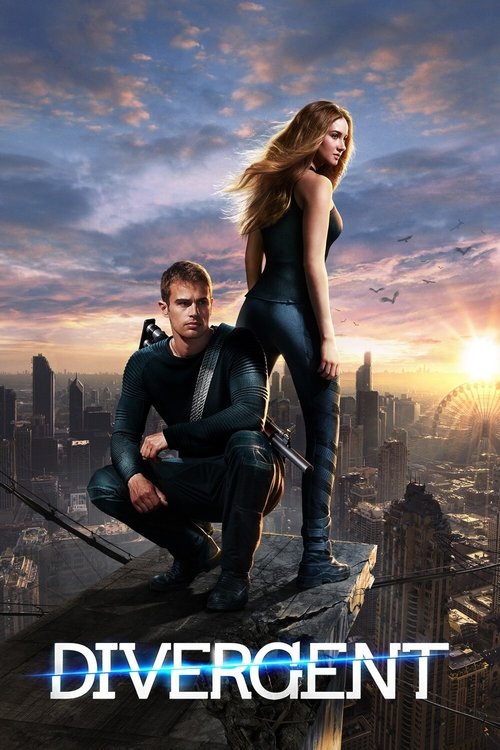
Divergent
2014 · Neil Burger
For when you want an easy, absorbing binge-starter — teenage-underdog wish fulfillment you can half-watch with snacks, or revisit for early-2010s nostalgia. Pure comfort, no homework.
What it's about
In a walled future Chicago, society sorts everyone into five factions by personality — selfless, brave, honest, peaceful, intelligent. At her coming-of-age test, Beatrice 'Tris' Prior learns she doesn't fit any single box: she's Divergent, a category the system can't tolerate. Choosing the daredevil Dauntless faction, she hides what she is while training under the guarded instructor Four — and begins to uncover a plot that makes people like her a target.
The experience
A brisk, straightforward YA adventure — training montages, first love, and simmering conspiracy, more propulsive than surprising. It's engineered comfort-food dystopia: the pleasure is watching an underdog find her nerve.
Performances
Shailene Woodley grounds the schematic material — she plays Tris's fear and resolve with a naturalism the genre rarely bothered with, and it's the reason the film works at all.
The craft
Neil Burger keeps the machinery moving efficiently, and the fear-simulation sequences — dream-logic tests rendered as slick effects setpieces — give the film its most distinctive imagery. The ruined-Chicago production design does a lot with a mid-range budget.
Why it matters
The definitive artifact of the post-Hunger Games YA-dystopia gold rush — a franchise-starter whose rise and eventual fizzle traces the whole boom-and-bust of the genre. It made Woodley a leading lady.
Snapshot
Divergent is the screen adaptation of Veronica Roth's 2011 debut novel, the opening installment of a young-adult dystopian franchise mounted by Summit Entertainment under the Lionsgate umbrella in the immediate wake of The Hunger Games. Directed by Neil Burger and headlined by Shailene Woodley as Beatrice "Tris" Prior, it transposes a familiar coming-of-age anxiety — the terror and promise of self-definition — onto a schematic future Chicago sorted into five personality "factions." The film is best understood less as an original vision than as a carefully engineered franchise starter: a mid-budget, PG-13, effects-supported adventure aimed at the same teen-and-crossover audience that had made Katniss Everdeen a cultural fixture. Its interest for a study of influence lies precisely in that derivativeness — it is a near-perfect specimen of a Hollywood cycle at its commercial peak, and its subsequent decline maps the exhaustion of that cycle in miniature.
Industry & production
Divergent was produced by Summit Entertainment, the studio that had launched the Twilight saga and was, by 2014, a Lionsgate subsidiary — meaning the same corporate entity controlled both the Twilight and Hunger Games franchises and sought a third YA pillar. The property was optioned early: Summit acquired film rights around the novel's 2011 publication, positioning the adaptation to arrive while the source's readership was still expanding. Douglas Wick and Lucy Fisher (Red Wagon Entertainment) served as lead producers, with Roth attached in a consulting capacity.
The screenplay is credited to Evan Daugherty and Vanessa Taylor. Daugherty brought recent franchise experience (Snow White and the Huntsman); Taylor, a veteran of prestige television including Game of Thrones, was engaged to deepen the interior and romantic dimensions. The budget is generally reported in the mid-$80-million range — substantial but deliberately below tentpole scale, a calibrated bet appropriate to an unproven film brand. The production shot largely on location in Chicago in 2013, exploiting the city's recognizable skyline and industrial architecture as a ready-made ruined-metropolis backdrop, which lent physical scale without the cost of wholesale set construction.
Casting was the decisive industrial gamble. Woodley, coming off strong indie notices in The Descendants and The Spectacular Now, was cast as Tris before her fuller stardom; Theo James, then relatively unknown, took the male lead, Four. The ensemble was stacked with recognizable names to broaden appeal — Kate Winslet as the antagonist Jeanine Matthews, plus Ashley Judd, Jai Courtney, Ray Stevenson, Maggie Q, Tony Goldwyn — and salted with rising young performers (Miles Teller, Zoë Kravitz, Ansel Elgort) in a strategy familiar from the ensemble YA model. The film opened in March 2014 and performed strongly enough to green-light the sequels, though it did not reach the stratospheric numbers of its chief rival.
Technology
Divergent is a conventionally resourced digital-era studio production, and its technology is more workmanlike than pioneering. The film relies on the by-then-standard toolkit of digital cinematography, extensive digital set extension, and computer-generated environments to enlarge Chicago into a walled, half-abandoned city. The most technology-forward material is the recurring "fear landscape" and aptitude-test simulations — subjective, hallucinatory sequences that blend practical staging with visual-effects compositing to render psychological states as physical space (walls closing in, a shattering glass tank, a swarm of crows). These serve as the film's principal effects set-pieces, standing in for the spectacle other franchises located in arenas or battlefields.
The record on the precise capture format and camera package is not something I can state with confidence, and I will not invent it; what is clear is that the film sits comfortably within the mainstream digital-intermediate pipeline of its moment, with a color-graded, desaturated palette applied in post. The visual effects were distributed among several vendors in the standard studio manner, servicing environment work and the simulation sequences rather than any single signature technique.
Technique
Cinematography
Director of photography Alwin H. Küchler — whose earlier credits include Danny Boyle's Sunshine and Joe Wright's Hanna — brings a restrained, cool-toned, largely handheld sensibility. The photography favors a muted, silvery palette that reads the ruined city as overcast and institutional; the faction system is subtly color-coded, and the camera tends toward naturalistic light in the Abnegation and Dauntless interiors. Küchler's handheld coverage in the Dauntless training and initiation sequences lends kinetic immediacy to the physical trials, while the simulation sequences allow more expressionistic, destabilized framing. The overall look is competent and legible rather than authored; it prioritizes clarity of geography and the reading of Woodley's face over stylistic assertion.
Editing
The picture is credited to editors Richard Francis-Bruce (an Oscar-nominated cutter associated with David Fincher and the Mad Max lineage) and Nancy Richardson (an experienced hand on YA and ensemble material). At roughly 140 minutes, the film runs long for its genre, and its structure is essentially a training narrative: a first act of world-building exposition, a lengthy middle of Dauntless initiation, and a compressed third act of conspiracy and revolt. The editing's central challenge is pacing that initiation stretch, which functions as both character development and spectacle; the cutting is conventional continuity work, tightening in the action and simulation passages and slowing for the Tris-Four romance.
Mise-en-scène / staging
Production design (Andy Nicholson, later Oscar-nominated for Gravity) is the film's most concrete achievement. The five factions are given distinct material vocabularies — the austere grays of self-abnegating Abnegation, the black-clad, graffiti-and-industrial Dauntless compound built into a subterranean "pit," the clinical glass-and-steel of intellectual Erudite. The repurposing of real Chicago landmarks (a derelict, overgrown Navy Pier; the elevated train system reimagined as the Dauntless mode of transit) grounds the invented society in recognizable decay. The great wall enclosing the city is the governing spatial idea: the whole film is staged as an enclosure whose limits Tris will eventually test.
Sound
The score is by Junkie XL (Tom Holkenborg), working in the propulsive, percussive, electronically inflected mode then ascendant in action scoring. The soundtrack also foregrounds contributions from pop artist Ellie Goulding, whose songs are woven prominently through key emotional and montage sequences — a commercially minded cross-promotional strategy typical of the YA cycle, integrating a marketable pop identity into the film's sonic texture. Sound design in the simulation sequences carries much of their disorientation, using subjective, enveloping effects to distinguish hallucination from waking reality.
Performance
Woodley anchors the film with a grounded, unglamorous physicality and emotional transparency that most critics singled out as its strongest asset; she plays Tris's transformation from timid Abnegation initiate to capable Dauntless with a naturalism carried over from her indie work. Theo James supplies a guarded, brooding counterweight as Four. Kate Winslet, cast against her prestige register as the coldly rational Jeanine, lends the antagonist a bureaucratic menace. The wider ensemble is functional; several of the supporting figures (Teller's antagonistic Peter, Kravitz's Christina) are sketched more than developed, a consequence of the source's first-person compression.
Narrative & dramatic mode
The film operates in the mode of the initiation narrative crossed with the dystopian awakening. Its dramatic engine is the classic bildungsroman structure — a protagonist leaving home, undergoing trials within a chosen community, and discovering both her own exceptional nature and the rot in the social order. The faction system externalizes an adolescent question (what kind of person am I?) as a literal, enforced sorting; Tris's "Divergence" — her refusal to fit a single category — is the narrative's central metaphor and its plot mechanism. The story is told largely from Tris's restricted point of view, which structures the audience's discovery of the world alongside hers. The dramatic register is earnest and interior for much of its length, pivoting to conspiracy thriller and open revolt only in the final act, when Jeanine's plot to use a mind-controlling serum against the Divergents is exposed.
Genre & cycle
Divergent belongs unambiguously to the early-2010s young-adult dystopian cycle, the dominant Hollywood teen genre of its moment. The lineage runs from the Twilight saga (which established the YA-blockbuster template and Summit's business model) through The Hunger Games (2012), which fused that template with dystopian politics and a female action lead — the exact formula Divergent reproduces. Contemporaries and successors in the cycle include The Maze Runner (also 2014), The Giver, and The 5th Wave. The cycle's shared DNA is legible throughout: a repressive, categorically organized society; a "chosen" or anomalous teenage protagonist; a romance subplot; a trials-and-training structure; and a multi-book, multi-film architecture designed for serialization. Divergent is a near-textbook entry, which is both its commercial logic and, critically, its liability.
Authorship & method
Neil Burger is a director of intelligent, mid-scale genre pictures — The Illusionist (2006), the perception-thriller Limitless (2011) — rather than a franchise specialist, and Divergent reflects a competent journeyman's approach: faithful, legible, unshowy. Burger directed only the first installment; he did not return for the sequels, which passed to Robert Schwentke, a discontinuity that contributed to the series' tonal drift. His method here privileges the source's beats and the star's performance over authorial signature.
The key collaborators shape the film more than any singular vision does: Küchler's cool cinematography, Nicholson's production design, Holkenborg's electronic score, and the Daugherty-Taylor screenplay's balance of world-building and romance. The essential authorial fact is that Divergent is an adaptation first — its "author" is in large part Veronica Roth's novel and the franchise apparatus built to monetize it, with Burger and his collaborators executing rather than originating.
Movement / national cinema
This is mainstream American studio filmmaking of the post-Hunger Games franchise era, produced within the Hollywood tentpole system. It is not aligned with any art-cinema movement; its "movement," properly speaking, is an industrial one — the transmedia YA franchise as a studio growth strategy following the collapse of the mid-budget original film. Its Chicago shooting locations tie it to the broader early-2010s dispersal of American production to tax-incentivized cities beyond Los Angeles.
Era / period
Divergent is a document of Hollywood circa 2014, the high-water mark and beginning of the ebb of the YA-dystopia boom. It arrived when studios were racing to convert every successful young-adult book series into a multi-film property, and when the female-led action franchise had been commercially validated. It also belongs to the period's aesthetic conventions: desaturated digital grading, electronic-percussive scoring, pop-song integration, and the two-part-final-book release strategy the industry was then adopting. Its later sequels' underperformance and the eventual cancellation of the planned concluding film register the period's end — the market saturation that closed the cycle.
Themes
The governing theme is the tension between social categorization and individual identity. The faction system dramatizes the anxiety of being defined and sorted — an allegory that resonates with adolescence, standardized testing, and personality typologies — while "Divergence" valorizes the refusal to be reduced to a single trait, a flattering message of exceptional individuality aimed squarely at its teen audience. Adjacent themes include the passage from a family of origin to a chosen community; the confrontation of fear as the path to selfhood (literalized in the fear-landscape simulations); the danger of technocratic rule, embodied by the coldly rational Erudite faction and its use of mind-control to seize power; and the awakening of political consciousness in a young protagonist. The film's treatment of these ideas is broad and legible rather than probing — the allegory is a delivery system for an empowerment fantasy more than a sustained political critique.
Reception, canon & influence
Critical reception was mixed to lukewarm. Reviewers widely praised Woodley's committed central performance and found the production design and world-building serviceable, but the dominant critical line was that the film was overlong, expositional, and conspicuously derivative of The Hunger Games — a competent but unnecessary echo of a superior template. It was a commercial success sufficient to sustain the franchise, opening strongly and drawing well from the built-in readership, though it did not approach the cultural or box-office magnitude of its model.
The influences on the film are transparent: Roth's novel most directly, and behind it the whole lineage of dystopian and sorting fiction — Lois Lowry's The Giver, the caste and conditioning schemes of Huxley's Brave New World, and the immediate industrial precedents of Twilight (business model) and The Hunger Games (genre template and female-action-lead formula). The initiation-trial structure draws on a long tradition of coming-of-age and military-training narratives.
Its influence forward is more modest and largely negative-cautionary. Divergent spawned two sequels — Insurgent (2015) and The Divergent Series: Allegiant (2016), both directed by Robert Schwentke — whose diminishing box-office returns led Lionsgate to cancel the planned finale (Ascendant) and to explore, then abandon, a television continuation, leaving the franchise conspicuously unfinished. This trajectory became an industry object lesson in the risks of the two-part-final-film strategy and of over-investing in derivative YA properties; the Divergent series is frequently cited as a marker of the cycle's exhaustion and the point at which studios began retreating from the model. On the talent side, the film consolidated Shailene Woodley's and Theo James's profiles and gave early exposure to Teller, Elgort, and Kravitz. In the canon, Divergent is remembered less as a work of intrinsic importance than as a representative artifact — the clearest available specimen of the YA-dystopia franchise cycle, valuable to film history precisely for how completely it typifies, and how instructively it failed to sustain, a briefly dominant commercial form.
A Deleuzian reading
Crows.
The full Deleuzian reading of Divergent →
Reception
Landed in 2014 as the heir apparent to The Hunger Games — shrugged off by critics, embraced by teens — and is now remembered less for itself than as the franchise that famously never got to finish, after Allegiant underperformed and the final film was quietly canceled.
How Divergent was received, from release to now →
How to watch Divergent: what to notice on a first viewing
- Notice the gray of Abnegation, black of Dauntless, glass of Erudite. Andy Nicholson's production design gives every faction its own material vocabulary, so costume and set tell you someone's social role before they speak. A society built entirely on reading people at a glance, called a mark: a sign legible because of the chain it belongs to.
- Watch how close and handheld the camera stays in training. Küchler's handheld coverage tightens on Woodley's body through the Dauntless trials, then loosens into more expressionistic framing once the simulations begin. The shift in camera behavior tells you when the film wants you to feel physical risk versus psychological unease.
- Listen for Ellie Goulding's songs entering during training montages. Junkie XL's percussive score drives the action, then pop songs by Goulding surface at emotional peaks and montage stretches, a marketable layer laid over the score. The soundtrack was built as much for cross-promotion as for atmosphere, a signature move of the YA franchise era.
- Watch Woodley's face more than her stunts during trials. The camera consistently favors reading her transparency over stylizing the action around her, letting small shifts in expression carry the transformation. Her unglamorous naturalism, carried over from her indie work, is what holds the film together more than any effect does.
- Notice the pause before Tris answers in the aptitude test. The test measures the gap between what she perceives and what she does, and her result comes back inconclusive instead of sorted. That hesitation is what the reading calls the interval: the gap between input and action that a living thing, unlike a rock, has.
The whole guide to watching Divergent, with the keys for a rewatch →
Influences: the films it descends from and the films it influenced
- The Hunger Games (2012) — Establishes the handheld, restricted-POV camera tethered to a single adolescent female protagonist moving through a lethal selection-and-training gauntlet — the female-action-lead template Divergent replicates beat for beat.
- Twilight (2008) — Sets the cool desaturated teal-blue YA-adaptation grade and the built-in-readership, split-final-film transmedia packaging model that Divergent's grade, casting, and marketing mirror.
- Gattaca (1997) — Renders a caste-sorted dystopia through immaculate color-graded production design that codes social rank chromatically — the direct precedent for Divergent's faction-color-coding.
- Equilibrium (2002) — Builds a faction-uniformed, emotion-regulating society around an insider-enforcer trained in combat who defects — the factioned-society-plus-trainee-arc structure Divergent inherits.
- The Matrix (1999) — Codifies the training-program simulation as a discrete VFX space where the mind physically fights conjured threats — the template for Divergent's serum-induced 'fear-landscape' sequences.
- Full Metal Jacket (1987) — Provides the boot-camp initiation spine — recruits broken down and reforged under a sadistic instructor and ranked by cut-lines — that structures the Dauntless training second act.
- Harry Potter and the Sorcerer's Stone (2001) — Popularizes the ceremonial sorting of adolescents into color-coded, temperament-defined houses as the world-building and identity engine Divergent's Choosing Ceremony reworks.
- Limitless (2011) — Burger's own VFX toolkit for visualizing altered subjective cognition (the fractal infinite-zoom clarity) is reused as the hallucinatory, drug-induced fear-landscape imagery.
- Logan's Run (1976) — Model of the enclosed sorting-society dystopia whose enforcer protagonist defects and uncovers the system's lie — the discover-the-order-is-false plot architecture.
- Starship Troopers (1997) — Processes militarized youth through a propaganda-saturated training academy with fascist recruitment iconography — the aesthetic behind Dauntless's cult-of-fearlessness pageantry.
- The Hunger Games: Catching Fire (2013) — Part of the YA-dystopia franchise cycle Catching Fire anchored: a faction-coded, costume-stratified society organized around a young female lead resisting a controlling regime.
- The Illusionist (2006) — Extends Burger's deception motif into staged simulation environments—illusory test spaces the protagonist must read as constructed, a sci-fi transposition of the magician's frame.
- Insurgent (2015) — Direct sequel that inflates Divergent's fear-landscape device into feature-length, physics-warping VFX set-pieces, extending the film's one signature technique as its whole spectacle.
- The 5th Wave (2016) — Late-cycle YA dystopia pairing a naturalistic young female lead with a militarized youth-training regimen, riding the female-lead-plus-training-camp template Divergent normalized.
- The Divergent Series: Allegiant (2016) — Franchise closer whose collapse under the split-final-film strategy made it the cautionary endpoint of the exact transmedia-franchise apparatus Divergent typified.
- The Maze Runner (2014) — Same-cycle YA dystopia deploying identical desaturated handheld camerawork on a cohort of youths surviving a rule-bound enclosed trial governed by an unseen authority.
- The Giver (2014) — Dramatizes assigned-social-role dystopia through a literal monochrome-to-color palette, sharing Divergent's categorization-vs-individual-identity theme rendered chromatically.
- Ender's Game (2013) — Runs a gifted youth through simulated combat trials staged as immersive VFX training environments indistinguishable from reality — kin to the fear-landscape sims.
- Maze Runner: The Death Cure (2018) — Parallel entry in the same commercial cycle, built on faction/walled-city world-building and a training-to-rebellion arc that terminates in an assault on the controlling authority.
Similar films
- The Hunger Games (2012) — influence & lineage
- The Maze Runner (2014) — influence & lineage
- The Hunger Games: Catching Fire (2013) — shared sensibility
- The Hunger Games: The Ballad of Songbirds & Snakes (2023) — shared sensibility
- The Fault in Our Stars (2014) — shared sensibility
- Maze Runner: The Death Cure (2018) — shared sensibility
- Snowpiercer (2013) — shared sensibility
- Dawn of the Planet of the Apes (2014) — shared sensibility