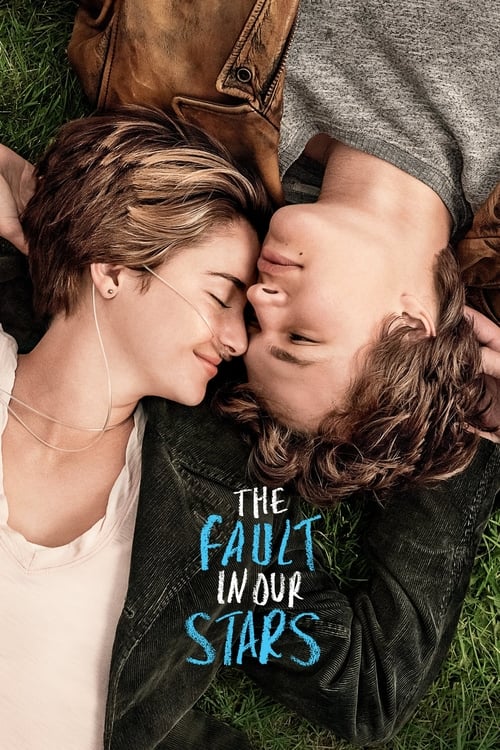
The Fault in Our Stars
2014 · Josh Boone
For when you need a good cry and want to feel it coming — a love story to watch with tissues in reach, alone or with someone you can sniffle next to. Emotionally intense, but comfort-food in structure.
What it's about
Hazel is sixteen, sharp-tongued, and terminally ill — her cancer is managed, not cured, and she knows exactly how her story ends. At a support group she can barely tolerate, she meets Augustus Waters, a cocky, charming survivor who decides she's the most interesting person in the room. What follows is a first love conducted in full view of mortality, including a pilgrimage to Amsterdam to track down the reclusive author of Hazel's favorite book.
The experience
Funny and flirty for longer than you'd expect, then openly, unashamedly a tearjerker. It earns its emotions through the banter — these kids joke about death because they live with it — so when the sadness comes, it feels honest rather than manipulative.
Performances
Shailene Woodley is the reason it works: her Hazel is wry, guarded, and completely believable, dodging every saintly-sick-girl cliché the material invites.
The craft
The screenplay, by the writers behind some of the era's best teen romances, keeps John Green's voice — literate, joke-forward, unafraid of big feelings. The direction stays intimate and unfussy, trusting the two leads' faces to do the work.
Why it matters
A massive sleeper hit that proved a modest, contemporary teen romance could out-punch dystopian franchises, and the defining film of the YA adaptation wave's sincere, realist wing.
Snapshot
The Fault in Our Stars is the screen adaptation of John Green's 2012 young-adult novel, a first-person love story between two teenagers who meet at a cancer support group. Directed by Josh Boone from a screenplay by Scott Neustadter and Michael H. Weber, and produced by Fox 2000 (a specialty label of 20th Century Fox), the film starred Shailene Woodley as Hazel Grace Lancaster and Ansel Elgort as Augustus Waters. It arrived at a specific commercial moment: the studio YA adaptation cycle of the early 2010s had been dominated by dystopian action franchises (The Hunger Games, Divergent), and Fault represented the intimate, contemporary-realist alternative — a romance rather than a saga, a single film rather than a multi-part franchise. It is best understood as the high-water mark of the "sick-lit" or terminal-illness romance strain of teen cinema, and as a case study in how a devoted online fandom (Green's "Nerdfighter" community, cultivated through the Vlogbrothers YouTube channel) could be converted into theatrical demand. The film is unusually faithful to its source, foregrounding voice-over narration, literary self-consciousness, and a deliberate resistance to sentimental cliché — even as it operates squarely within a sentimental tradition.
Industry & production
The project originated at Fox 2000, the label headed by Elizabeth Gabler that specialized in book-to-film adaptations (it had earlier produced Life of Pi and The Devil Wears Prada). Producers included Wyck Godfrey and Marty Bowen of Temple Hill Entertainment, the same producing team behind the Twilight series — a lineage that signals both the YA-adaptation expertise and the fandom-management savvy the studio brought to bear. The screenwriting pair Neustadter and Weber came to the film off (500) Days of Summer and The Spectacular Now (the latter also starring Woodley), giving the production a track record in bittersweet, non-formulaic romance.
The film was made as a modestly budgeted studio release rather than a tentpole; contemporaneous trade reporting placed its production budget in the low tens of millions, though I won't assert a precise figure. Its commercial success was widely reported as substantial relative to that budget — it opened strongly and grossed well into the hundreds of millions worldwide — but I will avoid citing specific box-office totals I cannot verify here. What is uncontroversial in the record is that the film was a clear financial success and validated the intimate-YA-romance model as commercially viable alongside the franchise model.
A defining feature of the production was John Green's visible, endorsing involvement. Green documented the shoot to his enormous online following, and Woodley and Elgort were promoted heavily through social channels aimed directly at the existing readership. The casting itself drew early fan controversy (particularly over physical fidelity to the book's characters) that the production and author actively addressed in public — an early example of author-and-studio managing an adaptation's reception in real time through social media. Principal photography took place substantially in and around Pittsburgh, Pennsylvania, standing in for the novel's Indianapolis setting, with a sequence shot in Amsterdam, a location central to the story's plot.
Technology
Technologically the film is conventional for a mid-2010s studio drama and does not advertise innovation; its craft is invisible by design. It was shot and finished digitally, consistent with the near-total digital-capture norm for contemporary romance and drama by 2014. The film's "technology," in the sense that matters to its meaning, is diegetic rather than production-side: Hazel's portable oxygen concentrator and nasal cannula are constant physical presences, and the plot turns on communication technology — text messages, video calls, and email — rendered onscreen in ways typical of the period's attempts to make digital messaging cinematic. The narrative's inciting engine is a novel (the fictional An Imperial Affliction) and its reclusive author, so the film's relationship to media is literary and analog even as its characters' daily lives are mediated by screens. There is no significant use of visual effects as a stylistic feature; the production's technical ambition was tonal control, not spectacle.
Technique
Cinematography
Cinematography was by Ben Richardson, who had shot Beasts of the Southern Wild and The Spectacular Now. Richardson brought a naturalistic, available-light sensibility associated with contemporary American independent film: soft, warm interiors, handheld intimacy in dialogue scenes, and a preference for shallow focus that isolates the two leads. The visual grammar privileges faces and small gestures over landscape or event. The Amsterdam sequences introduce a heightened, storybook palette — canal light, the Anne Frank House, a candlelit restaurant — that briefly lifts the film into romance's dreamier register before returning it to the plainer textures of illness and home. The overall look deliberately avoids the glossiness of studio romance in favor of something closer to indie realism, a choice consistent with Richardson's background and with the film's stated ambition to feel honest rather than sentimental.
Editing
The editing, credited to Robb Sullivan, is structured around Hazel's first-person subjectivity. Voice-over narration threads the film, and the cutting supports a memoir-like flow — scenes are shaped as recollected experience rather than as a propulsive plot. The film paces its two movements distinctly: an unhurried, comedic-tender first act built on conversation, and a compressing, more elliptical final act as illness accelerates. Onscreen text messages are integrated into the cutting as a device to keep the courtship legible and buoyant. The editorial restraint at the emotional climaxes — holding on performance rather than over-cutting for effect — is part of the film's strategy of earning feeling through stillness.
Mise-en-scène / staging
The staging is domestic and small-scale: bedrooms, living rooms, a church basement support group, hospital rooms, a backyard. Production design keeps Hazel's world specifically middle-class and lived-in, grounding the melodrama in ordinary texture. Recurrent staging motifs organize the film — the support-group circle with its literal and figurative "heart of Jesus" rug; the cannula and oxygen tank as blocking constraints on the actors' movement; and the symbolic props drawn from the novel (the unlit cigarette Augustus holds as a "metaphor," the swing set, Anne Frank's house as a site of the first kiss). The Amsterdam restaurant scene is staged as a self-conscious set-piece of romance, its artifice acknowledged within the film. Throughout, the mise-en-scène balances the iconography of teen romance against the unglamorous apparatus of chronic illness.
Sound
The score was composed by Mike Mogis and Nate Walcott, both associated with the band Bright Eyes, and the soundtrack leaned heavily on curated indie-pop and singer-songwriter tracks — a needle-drop strategy typical of 2010s YA and indie romance, used to signal authenticity and youthful taste. The soundtrack album was a significant commercial component of the release. Sound design is otherwise naturalistic and unobtrusive, with the mechanical hiss and rhythm of Hazel's oxygen equipment serving as a quiet, persistent sonic reminder of her condition. Music does substantial emotional work at the film's turning points, in keeping with the conventions of the romantic melodrama.
Performance
Performance is the film's central instrument. Shailene Woodley's Hazel is wry, guarded, and intelligent, resisting the "brave sick girl" archetype; her performance carries the voice-over's dry humor and the film's insistence on the character's interiority. Ansel Elgort plays Augustus with a deliberately theatrical charm — a boy performing confidence — that the narrative gradually strips back to vulnerability. Woodley and Elgort had appeared together in Divergent (as siblings), and their evident ease reads as intimacy onscreen. Laura Dern, as Hazel's mother, anchors the adult performances with a grounded warmth, and Willem Dafoe appears in a sharply against-type turn as Peter Van Houten, the caustic, disappointing author — a performance that punctures the film's romanticism at a crucial juncture. Nat Wolff provides comic and tonal contrast as the friend Isaac. The ensemble's restraint is what keeps the material from tipping fully into mawkishness.
Narrative & dramatic mode
The film's dramatic mode is confessional romantic melodrama filtered through first-person literary narration. Hazel's voice-over frames the story as her own telling, and the film repeatedly thematizes storytelling itself: the characters are obsessed with a novel that ends mid-sentence, and they crave — and are denied — a proper ending, a metafictional mirror of their own foreshortened lives. The structure is a compressed tragic romance: meeting, courtship, a journey (Amsterdam) that delivers both fulfillment and a double blow (the author's cruelty; the revelation of Augustus's recurrence), and a foreshortened final movement toward loss. Crucially, the film inverts the audience's expectation of whose death it is building toward, and it withholds conventional catharsis in favor of a muted, articulate grief. The recurring line-of-thought — "okay" as a private vow, the eulogy Hazel writes — organizes the film's meaning around language as the only durable thing two mortal people can give each other.
Genre & cycle
The Fault in Our Stars sits at the intersection of the teen romance and the illness melodrama (the "weepie" or, in publishing terms, "sick-lit"). Its immediate genre lineage runs through Love Story (1970) and the terminal-romance tradition, updated with the ironic, self-aware voice of 2010s YA. Within its own moment it belongs to the studio YA-adaptation cycle but represents its intimate, realist wing rather than the dystopian-franchise wing. It also participates in the "smart teen" tradition — films that credit adolescent characters with genuine intelligence and articulateness — alongside its own screenwriters' The Spectacular Now and the broader lineage of John Hughes and Cameron Crowe. Its commercial success helped consolidate a brief cycle of terminal-illness teen romances that followed in the mid-2010s (for example, Me and Earl and the Dying Girl and Everything, Everything), positioning Fault as the cycle's defining and most successful entry.
Authorship & method
Authorship here is genuinely distributed, and the film is unusual in how visibly it shares authority with its source novelist. Josh Boone, directing his second feature after Stuck in Love, was by his own account a devoted admirer of Green's book, and his method prioritized fidelity to the novel's voice and its balance of humor and grief. The screenwriters Scott Neustadter and Michael H. Weber functioned as the crucial translators of that voice, preserving the book's dialogue and metafictional apparatus while compressing its plot — a continuation of their signature mode of unsentimental romance. John Green occupied an unusually authorial role for a source novelist: publicly endorsing the adaptation, documenting production, and lending the film the credibility of his direct relationship with readers. Among key collaborators, cinematographer Ben Richardson supplied the naturalistic visual identity, and composers Mike Mogis and Nate Walcott (with the film's music supervision) supplied its indie-inflected emotional palette. The "author" of the film, then, is a coalition — director, screenwriting duo, novelist, and a producing team (Godfrey and Bowen) experienced in converting literary fandom into cinema.
Movement / national cinema
The film is a product of mainstream American studio cinema, specifically the specialty-label wing (Fox 2000) that bridged Hollywood and the sensibility of American independent film. It is not part of any formal movement, but it draws stylistically on the American indie realism of the late 2000s and 2010s — the naturalistic lighting, needle-drop scoring, and unglamorous domestic settings associated with that milieu, transmitted here through crew (Richardson) and screenwriters who came from that world. Its Amsterdam sequences are tourist-eye rather than European-art-cinema in sensibility; the film remains firmly within an American commercial idiom throughout.
Era / period
Fault is emblematic of the early-to-mid-2010s: the peak of the studio YA adaptation, the rise of social media and YouTube personalities as marketing infrastructure, and a moment when Fox 2000's book-to-film pipeline was still robust (that label would later be wound down after the Disney acquisition of 21st Century Fox). It captures a specific media culture in which a novel could be launched to a pre-built online audience and its film sold directly to that audience. It is also a period document of pre-franchise-fatigue optimism about mid-budget original(ish) studio drama aimed at young women — a demographic and budget tier that the industry increasingly struggled to serve theatrically in the years that followed.
Themes
The film's governing themes are mortality and meaning-making. Its central question — how to live and love within a foreshortened lifespan — is pursued without recourse to religious consolation or heroic uplift; the film insists that "some infinities are bigger than other infinities," valuing the intensity rather than the duration of a life. Storytelling and the desire for a satisfying ending form a second, metafictional theme: the characters' need for the reclusive author to "finish" his novel dramatizes the human refusal to accept that lives, too, end mid-sentence. Related motifs include the tension between being remembered and the vanity of demanding remembrance (Augustus's fear of oblivion versus Hazel's more modest wish simply to have loved and been loved); the ethics of pity, as Hazel resists being treated as a "grenade" who will only hurt those around her; and the dignity of ordinary, un-heroic suffering. The film's much-discussed refusal of easy sentiment is itself thematic — a claim that honesty about death is a form of love.
Reception, canon & influence
Critical reception was generally favorable, with the strongest praise reserved for Shailene Woodley's performance, which many reviewers singled out as the film's anchor and a breakout dramatic turn. Critics who admired the film credited it with treating teenage feeling and terminal illness seriously and with wit; skeptics found the material manipulative or the romance idealized, a familiar critical divide for the weepie genre. I'll avoid attributing specific quotations or scores, but the consensus in the record is of a well-received, well-acted adaptation that pleased its core audience and won qualified respect from critics.
Influences on the film (backward): The film inherits the terminal-romance lineage of Love Story and the broader tradition of the Hollywood illness melodrama; the articulate-teen tradition of Hughes and Crowe and, more immediately, its own screenwriters' (500) Days of Summer and The Spectacular Now; and the naturalistic American indie aesthetic transmitted by cinematographer Ben Richardson. Its metafictional preoccupation with an unfinishable novel is drawn directly from John Green's source text rather than from cinema.
Legacy / what it shaped (forward): The Fault in Our Stars helped define and popularize the mid-2010s terminal-illness YA cycle, and its commercial success reinforced the industry model of adapting online-cultivated literary fandoms into films marketed through social media. It cemented Shailene Woodley and Ansel Elgort as young leads and demonstrated a viable, intimate alternative to the dystopian YA franchise. Its cultural footprint — quotable lines, iconography, and its status as a touchstone "cry movie" for a generation of viewers — has proven durable in popular memory. The film's more diffuse legacy lies in how it modeled the direct author-audience-studio relationship that would become increasingly central to adaptation marketing. Its lasting canonical standing is as the defining example of its narrow genre rather than as a landmark of film form; that is a fair and honest placement of its importance.
A Deleuzian reading
An unlit cigarette.
The full Deleuzian reading of The Fault in Our Stars →
Reception
A monster hit in summer 2014 — the peak of the YA adaptation wave and Tumblr-era teen sincerity — it's since settled into affectionate nostalgia territory: less a film people defend as great cinema than a time capsule everyone of a certain age cried to.
How The Fault in Our Stars was received, from release to now →
How to watch The Fault in Our Stars: what to notice on a first viewing
- Watch the cigarette Augustus keeps in his teeth, unlit. Augustus carries the cigarette through the early scenes, explaining it as a risk he chooses but refuses to let kill him. The object breaks the usual smoking cue and asks you to interpret rather than assume.
- Listen for the hiss of Hazel's oxygen concentrator under every scene. The mechanical sound runs beneath dialogue and music alike, never fully leaving the mix even in tender or funny moments. It keeps the illness present as a constant condition rather than a dramatic event.
- Watch how still Woodley's face stays compared to Elgort's shifting one. Hazel's expression holds a single wry, guarded quality scene to scene, while Augustus's face moves through small, escalating gestures of performed confidence. Two different ways of using a face let you see one character enduring and one performing.
- Notice the support-group circle sitting on the heart-of-Jesus rug. Characters take turns speaking in this room; nothing anyone says changes anything, so the scene just holds their voices and faces. No action is possible here, so watching and enduring become the only available response.
The whole guide to watching The Fault in Our Stars, with the keys for a rewatch →
Influences: the films it descends from and the films it influenced
- Love Story (1970) — Codified the doomed-young-lovers weepie architecture — a retrospective voice-over framing a beloved's foreknown death — that Fault's terminal-romance structure directly reprises.
- Terms of Endearment (1983) — Model for the cancer-death melodrama that braids comedy with grief across domestic, small-scale scenes, the tonal humor-and-mortality balance Boone works to preserve.
- The Breakfast Club (1985) — Established the tradition of taking adolescent interiority seriously through hyper-articulate ensemble dialogue that underwrites Fault's smart-teen voice.
- Say Anything... (1989) — Crowe's romantically eloquent teenager and needle-drop-cued emotional beats feed Fault's articulate-teen dialogue and indie-soundtrack scoring.
- A Walk to Remember (2002) — Set the studio terminal-illness teen-romance template (a source-novel adaptation) built on earnest restraint and faith in sentiment that Fault inherits.
- (500) Days of Summer (2009) — Screenwriters Neustadter and Weber's signature unsentimental-romance mode — voice-over subjectivity plus curated indie needle-drops — carries straight into Fault.
- Beasts of the Southern Wild (2012) — Cinematographer Ben Richardson's naturalistic available-light, handheld, shallow-focus visual grammar is the same identity he transposes onto Fault.
- Stuck in Love (2012) — Boone's debut established his novelist-centered, literary-voice-fidelity method and multi-strand domestic staging that he carries into Fault.
- Me and Earl and the Dying Girl (2015) — Extends the sick-lit teen film with metafictional first-person narration and self-aware onscreen text and interstitial devices layered over the illness story.
- Paper Towns (2015) — Second Neustadter-Weber John Green adaptation replicating the direct author-audience-studio marketing model and articulate-teen voice-over that Fault proved viable.
- Everything, Everything (2017) — Sick-lit YA romance that visualizes text-message exchanges as animated diegetic space, extending Fault's texting-as-intimacy onscreen-text device.
- Midnight Sun (2018) — Studio sick-lit romance following Fault's template of a terminally ill young heroine, restrained ensemble, and needle-drop-driven emotional scoring.
- Five Feet Apart (2019) — Terminal-illness teen romance foregrounding diegetic oxygen and medical equipment (cystic fibrosis) as staging and symbolic props, the sick-lit cycle Fault crystallized.
- All the Bright Places (2020) — Set the reader-to-viewer YA terminal-romance template Bright Places follows — a faithful adaptation that preserves the novel's first-person interiority and refuses to soften the difficult ending to protect the built-in fanbase's emotional contract.
- The Spectacular Now (2013) — Same Neustadter-Weber screenwriting duo plus Shailene Woodley in a naturalistic indie teen romance, sharing the restrained-realist performance register Fault adopts.
- If I Stay (2014) — Same-year YA illness melodrama built on first-person voice-over subjectivity and a single young female lead anchoring the film's reckoning with mortality.
- Love, Simon (2018) — Studio adaptation of an online-beloved YA novel that extends the smart-teen film through first-person voice-over and integrated onscreen digital text.
- Me Before You (2016) — Contemporaneous bestseller sick-lit adaptation using a terminal-illness deadline plot and curated pop needle-drops to court the same YA-crossover tearjerker audience — MBY's closest companion piece.
- Before I Fall (2017) — Set the studio template for the sincere YA-literary mortality adaptation — first-person voice, indie-pop needle-drop soundtrack, earnest register — the exact commercial mode Before I Fall operates within.
- The Last 10 Years (2022) — Extends the same foreknown-mortality romance in which the countdown is stated up front and the couple bargains over whether to love knowing the loss is guaranteed.
Similar films
- Five Feet Apart (2019) — influence & lineage
- All the Bright Places (2020) — shared sensibility
- Love, Rosie (2014) — shared sensibility
- The Perks of Being a Wallflower (2012) — shared sensibility
- Divergent (2014) — shared sensibility
- Me Before You (2016) — shared sensibility
- We Live in Time (2024) — shared sensibility
- The Notebook (2004) — shared sensibility