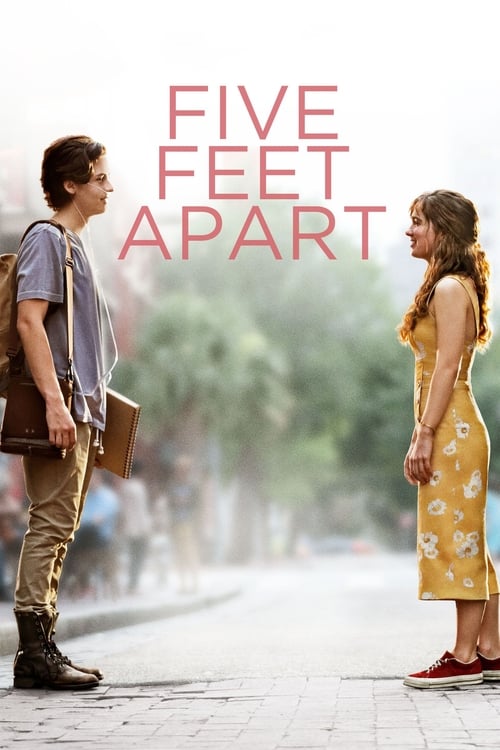
Five Feet Apart
2019 · Justin Baldoni
For when you want a good cry and a swoony teen romance in one sitting — comfort viewing with tissues, not a film that asks anything hard of you.
What it's about
Stella, seventeen and living by strict routines as a cystic fibrosis patient, meets Will, a charming fellow patient on her hospital ward — and the rules say they can never come closer than six feet, because their infections could kill each other. As the flirtation deepens into something real, they steal back one of those feet as an act of defiance. It's a first love conducted entirely at a distance, in hospital corridors and over pool-room games.
The experience
Sweet, earnest, and engineered to make you cry — the tension of two people who desperately want to touch and can't gives every scene a charged, wistful pull. It's a tearjerker that knows exactly what it is.
Performances
Haley Lu Richardson carries the film — funny, controlled, and quietly heartbreaking as Stella, turning what could be a formula role into someone you genuinely root for.
The craft
Justin Baldoni's feature debut takes the medical reality of cross-infection seriously, building its romance around a physical rule the camera never lets you forget. The staging turns the six-foot gap itself into the film's central visual idea — distance as longing made literal.
Why it matters
A word-of-mouth hit with teen audiences that became one of the defining entries in the young-adult terminal-romance wave, and brought cystic fibrosis into mainstream conversation.
Snapshot
Five Feet Apart is a young-adult romantic melodrama built around a single, unusually literal obstacle: its two lovers cannot touch. Stella Grant (Haley Lu Richardson) and Will Newman (Cole Sprouse) are teenagers with cystic fibrosis, confined to the same hospital ward and forbidden, by the real clinical logic of cross-infection, from coming within six feet of one another. The film's title marks their small act of rebellion — reclaiming one of those six feet as a gesture of autonomy against a disease that dictates the terms of their intimacy. Directed by Justin Baldoni in his feature debut and released by CBS Films in March 2019, it belongs squarely to the "sick-lit" or terminal-romance cycle that The Fault in Our Stars (2014) had recently made commercially potent. What distinguishes it is the specificity of its premise: the barrier to love is not death in the abstract but the physics of proximity itself, a conceit that lets the film literalize the melodramatic problem of longing across an uncrossable gap.
Industry & production
The film was produced and distributed by CBS Films, the film arm of CBS, with Lionsgate handling distribution in the United States — a partnership reflecting CBS Films' shift toward co-distribution in the late 2010s before its operations were folded into other CBS/Paramount structures. It was made on a modest budget characteristic of the YA-romance category, which trades on relatively low production costs, a young cast without top-tier salaries, and a built-in demographic that can be reached efficiently through social platforms. That economic model proved sound: the film was a clear commercial success relative to its cost, outperforming expectations in its opening, though I will not cite specific grosses here to avoid stating figures I cannot verify precisely.
The project's origins lie less in the studio development pipeline than in Baldoni's prior non-fiction work. Before directing, Baldoni was known as an actor (notably Rafael on the CW's Jane the Virgin) and as the creator of the digital documentary series My Last Days, which profiled people living with terminal illness. That series is the acknowledged emotional and thematic seedbed for Five Feet Apart — Baldoni's interest in the daily texture of serious illness, rather than illness as a mere plot engine, carries directly into the film. The screenplay is credited to Mikki Daughtry and Tobias Iaconis. A novelization by Rachael Lippincott was published in tandem with the release; the book functioned as a tie-in rather than a pre-existing literary source, an inversion of the usual YA-adaptation flow that is worth noting because it shaped how the property was marketed to readers and viewers simultaneously.
Technology
Five Feet Apart is a conventionally produced digital-era studio drama and does not represent a technological landmark; its interest on this axis is modest and should be stated as such. It was shot and finished digitally, in line with standard late-2010s practice for mid-budget dramas, and relies on no significant visual-effects apparatus — the "effects" that matter are practical and spatial rather than computational. The one technologically inflected element of note is the film's integration of contemporary teen media culture into its diegesis: Stella is characterized as a compulsive planner and vlogger who documents her illness on a YouTube-style channel, and the film uses screens, video diaries, and phone communication as narrative devices. This is a storytelling choice more than a technical one, but it situates the film precisely in its moment, when the YA audience it courted lived substantially online and when the confessional health-vlog was a recognizable genre in its own right.
Technique
Cinematography
The film's visual strategy is organized almost entirely around distance and the management of the frame's negative space. The central formal problem — two people who must not touch — becomes a compositional problem, and the photography repeatedly stages the pair with a measured gap between them, using the empty air of the frame as a charged, almost tactile element. Corridors, doorways, glass partitions, and the geometry of hospital architecture are exploited to keep the lovers separated within a single shot, so that the audience feels the enforced distance rather than merely being told of it. The hospital palette is clean and cool, softened for romance rather than rendered clinically harsh. I am not able to reliably attribute the cinematography to a specific director of photography without risking an incorrect credit; the film's photographic approach, however, is legible on the screen regardless of authorship, and it is disciplined in making spatial separation the recurring visual motif.
Editing
The cutting follows melodramatic convention: it privileges reaction and the exchange of looks across space, building romantic tension through shot/reverse-shot patterns in which the reverse is always at a remove. The film paces its emotional beats deliberately, allowing scenes of proximity — a shared meal at a fixed distance, a walk through the hospital — to breathe so that the withheld touch accrues weight. In its final movement the editing shifts toward crisis rhythm, tightening as the film moves into its life-or-death climax. As with the photography, I will not assign the edit to a named editor I cannot confirm.
Mise-en-scène / staging
Staging is where the film does its most distinctive work, and it is genuinely inventive within the constraints of the genre. The famous device of the "five feet" is enacted physically: Will carries a pool cue, a billiard stick roughly five feet long, which the couple uses to measure and hold their permitted distance — a prop that converts an abstract rule into a visible, portable object and gives the abstraction of "distance" a body. The recurring choreography of two figures oriented toward each other but never allowed to close the gap governs nearly every romantic scene. The hospital is designed as a world of thresholds and boundaries — the line one cannot cross, the room one cannot enter — and the production design leans into the paradox that this is a place both of confinement and of the characters' fullest emotional lives.
Sound
Sound and music are deployed in the emotive, contemporary-pop mode standard to the YA romance. The soundtrack foregrounds singer-songwriter material aimed at the target audience; most prominently, Andy Grammer's "Don't Give Up on Me" was written for and closely associated with the film, functioning as its signature song across the score and marketing. The film also makes narrative use of sound in its treatment of illness — the mechanics of breathing, coughing, and the routines of CF care (the percussive therapy, the oxygen, the alarms of the ward) form an ambient texture that keeps the body's fragility audible. I cannot confirm the individual composer credit with certainty and will not guess at it.
Performance
Performance is broadly regarded as the film's strongest asset, and the consensus centers on Haley Lu Richardson. Her Stella is precise and controlling on the surface — a young woman who manages her terror through lists and regimens — with the fear underneath made visible in small breaks of composure; the performance grounds the melodrama in something observed rather than merely emoted. Cole Sprouse, then well known from Disney Channel work and the CW's Riverdale, plays Will as the brooding, rule-breaking counterweight, and the pairing supplies the archetypal opposites-attract dynamic the genre requires. Moisés Arias provides crucial texture as Poe, a fellow patient whose role complicates any reading of the film as pure romance and delivers its sharpest reminder of stakes.
Narrative & dramatic mode
The film operates in the register of classical melodrama, updated for the YA market: it is a drama of obstacle and yearning in which external circumstance — here, medical necessity — enforces the separation of lovers who want each other. This is the oldest of romantic engines, the barrier that cannot be argued away, and Five Feet Apart refreshes it by making the barrier neither social nor familial but biological and spatial. The narrative arc moves from control to surrender to consequence: Stella begins as the disciplined patient, is drawn by Will into loosening her rules, and the film's crisis arrives precisely when that loosening collides with the unforgiving logic of the disease. It is a mode that courts sentiment openly and asks the viewer to invest in feeling; its dramatic honesty rests on whether the emotion feels earned, and reviewers divided along exactly that line.
Genre & cycle
Five Feet Apart is a textbook entry in the terminal-illness teen romance, the cycle crystallized by the film adaptation of John Green's The Fault in Our Stars (2014) and extending back to touchstones like Love Story (1970) and, in the cancer-drama vein, A Walk to Remember (2002). Comparisons to The Fault in Our Stars were immediate and unavoidable, and the film both benefits from and is measured against that predecessor. Within the cycle, its innovation is the "cannot touch" premise, which gives it a hook distinct from the mortality-clock structure of its peers — the tension is not only that time is short but that even the time they have cannot be spent in contact. It sits at the intersection of the YA adaptation boom and the "sick-lit" literary trend of the 2010s, and it was consciously packaged for that convergence.
Authorship & method
The most legible authorial signature belongs to Justin Baldoni, whose path from My Last Days to this feature makes clear that his interest is in illness as lived experience. Baldoni has spoken about wanting the film to be grounded in the real practices and community of cystic fibrosis patients, and the film's texture of routines, therapies, and support networks reflects that documentary sensibility carried into fiction. The writing team of Mikki Daughtry and Tobias Iaconis supplied the screenplay, and Rachael Lippincott authored the companion novel. On the key craft collaborators specifically requested here — cinematographer, composer, and editor — I want to be candid rather than risk a false attribution: the film unquestionably employed all three in the standard studio fashion, but I cannot reliably name the individuals from memory, and inventing credits would violate the record. The song most firmly associated with the film's musical identity is Andy Grammer's "Don't Give Up on Me," which is a documented and prominent part of its authored sound.
Movement / national cinema
The film belongs to no art movement; it is a product of mainstream American commercial cinema, specifically the Hollywood studio system's YA-romance division as it operated in the late 2010s. Its relevant "national cinema" context is simply that of American teen-oriented studio filmmaking, and its lineage is industrial rather than aesthetic — descended from the youth-melodrama tradition and the modern YA adaptation apparatus rather than from any national school or auteurist current. To claim otherwise would overstate its formal ambitions.
Era / period
Five Feet Apart is a distinctly late-2010s artifact. It arrives at the tail of the YA adaptation wave that dominated the first half of the decade, and it reflects a media environment saturated by social platforms — the vlog, the phone, the online community — which the film absorbs into its story rather than treating as backdrop. Retrospectively, the film has acquired an accidental resonance: released in March 2019, its premise of enforced distance and the phrase "six feet apart" took on an eerie second life during the COVID-19 pandemic a year later, when social distancing made its central metaphor literal for a mass audience. That is a matter of historical timing rather than authorial intent, but it has shaped how the film is remembered.
Themes
The film's governing theme is the tension between control and surrender — Stella's regimented management of her illness set against the human need for spontaneity, risk, and touch. Closely bound to this is the paradox of intimacy without contact: the film asks what love can be when its most basic physical expression is prohibited, and it treats distance as both an enemy and, ambivalently, a form of care. Autonomy is a persistent concern — the reclaiming of "one foot" is fundamentally about who gets to set the terms of a life circumscribed by disease. Mortality runs beneath all of it, but the film is at pains to insist, through its characters' routines and humor, on living inside limitation rather than merely awaiting its end. The presence of Poe extends these themes into the register of loss and the cost of hope.
Reception, canon & influence
Critical reception was mixed, following a familiar pattern for the cycle: many reviewers found the premise manipulative or the emotional machinery overly calculated, while a substantial share praised the film's sincerity and, nearly unanimously, singled out Haley Lu Richardson's performance as elevating the material. The dominant critical frame was comparative, positioning the film against The Fault in Our Stars and judging it as a competent but derivative entry — respectable within its genre rather than a breakout beyond it. Audience response was warmer than critical response, consistent with the film's strong commercial performance relative to budget and its resonance with the young viewers it targeted.
Looking backward, the film's influences are clear: the terminal-teen-romance lineage of Love Story, A Walk to Remember, and above all The Fault in Our Stars, plus the documentary impulse of Baldoni's own My Last Days. Looking forward, its legacy is more about consolidation than innovation — it confirmed the durability of the sick-romance formula and helped sustain the market for it, and it contributed to establishing Richardson and reinforcing Sprouse as draws for the demographic. Its most singular cultural afterlife, however, is the uncanny convergence of its distancing premise with the lived reality of the 2020 pandemic, which gave the film a retrospective poignancy no one involved could have designed. In the atlas of influence, Five Feet Apart is best understood as a well-made late node in an established melodramatic tradition — distinguished by one genuinely inventive formal idea, the measured, unbridgeable foot of air between two people who long to close it.
A Deleuzian reading
A boy walks down a hospital corridor carrying a pool cue.
The full Deleuzian reading of Five Feet Apart →
Reception
Dismissed by critics in 2019 as a formulaic sick-teen weepie riding The Fault in Our Stars' coattails, it's since been partially rehabilitated as the film where everyone realized Haley Lu Richardson was a star — and retroactively recoloured by Justin Baldoni's 2024–25 legal drama with Blake Lively.
How Five Feet Apart was received, from release to now →
How to watch Five Feet Apart: what to notice on a first viewing
- Watch Will measure their distance with a pool cue. The stick is roughly five feet long, and the couple uses it to hold and check the exact gap the hospital's rule requires. A rule about bacteria becomes something you can actually see them carry down a hallway.
- Notice the empty space the camera leaves between them. Shots keep both of them in frame with a measured gap of air between their bodies, in corridors, at meals, through doorways and glass. The gap between them is not empty. It is doing the job the story will not let their hands do.
- Watch for small breaks in Stella's controlled composure. Richardson plays her as precise and list-driven on the surface, with fear showing only in brief slips, a caught breath, control reasserted a half second late. Her face is doing more work managing fear than any line of dialogue tells you.
- Listen for coughing, oxygen, and alarms under every scene. The ward's percussive therapy, oxygen lines, and monitor alarms stay audible in the background of nearly every scene, whether or not the camera shows them. The disease never appears on screen as a thing, but you can hear it working the entire time.
The whole guide to watching Five Feet Apart, with the keys for a rewatch →
Influences: the films it descends from and the films it influenced
- Love Story (1970) — Codified the terminal-romance melodrama curve Baldoni inherits — healthy courtship, illness reveal, engineered deathbed catharsis scored to a signature theme — the structural template the whole cycle blocks its beats against.
- Brief Encounter (1945) — Origin of the unconsummated-longing grammar: desire generated by enforced non-contact and staged almost entirely in shot-reverse-shot of yearning faces across a fixed physical gap, exactly the engine Five Feet Apart mechanizes as a literal rule.
- Dying Young (1991) — Supplies the caretaker-falls-for-the-terminally-ill blocking, where medical routine and treatment texture become the courtship's setting rather than an interruption to it.
- A Walk to Remember (2002) — The YA terminal-romance template — sincere, faith-inflected, built to elevate an unknown lead through a role that reveals illness late — the demographic playbook Five Feet Apart runs almost verbatim.
- The Fault in Our Stars (2014) — Its most direct debt: sick-teen romance staged in support-group/hospital interiors with a sardonic-yet-sincere register and a performance-elevates-material dynamic, the film critics measured Five Feet Apart against nearly one-to-one.
- My Last Days (2016) — Baldoni's own docuseries, whose vérité attention to real patients' therapies, routines, and support networks is imported wholesale as the fictional feature's texture of authenticity.
- Ghost (1990) — Builds an entire romance around touch made physically impossible, dramatizing the reach-that-cannot-close — the same barrier melodrama Five Feet Apart literalizes with a measured foot of air.
- In the Mood for Love (2000) — The template for staging desire through negative space and bodies framed apart within doorways and thresholds, proximity-without-consummation held as visual charge — the cinematographic idea behind Five Feet Apart's unbridgeable-gap compositions.
- Me Before You (2016) — Shares the control-versus-surrender axis — a body's autonomy negotiated between the lovers — driving melodrama from the patient's refusal to be managed rather than from an external villain.
- Clouds (2020) — Baldoni's own follow-through: another documentary-rooted terminal-teen story fused with a signature original song, extending the My Last Days-to-fiction method he tested here.
- All the Bright Places (2020) — Downstream YA mortality-romance sustained by the market Five Feet Apart consolidated, deploying the same sincere register and performance-forward casting for a demographic weepie.
- Everything, Everything (2017) — Same-cycle twin: a romance conducted entirely across a medical barrier (immunodeficiency), intimacy mediated through glass and screens, physical-separation-as-structure rather than as a mere plot beat.
- Midnight Sun (2018) — Immediate contemporary using a medical condition (XP) as the prop-as-rule that forbids ordinary togetherness, staging courtship inside the constraints the diagnosis imposes.
- Now Is Good (2012) — Parallel terminal-teen romance built on the bucket-list/countdown structure, wringing pathos from routines of treatment and a lead performance carrying underwritten material.
- Portrait of a Lady on Fire (2019) — Contemporary apex of the same formal device — longing staged as the charged interval between two people who withhold touch, composed through negative space and held distance rather than embrace.
- Sleepless in Seattle (1993) — Prototype for sustaining intimacy through media at a distance — lovers who never physically meet until the final frame — anticipating Five Feet Apart's technology-mediated (health-vlog, phone) closeness across a gap.
Similar films
- The Fault in Our Stars (2014) — influence & lineage
- All the Bright Places (2020) — influence & lineage
- Me Before You (2016) — influence & lineage
- Holding the Man (2015) — shared sensibility
- The Farewell (2019) — shared sensibility
- Waves (2019) — shared sensibility
- People We Meet on Vacation (2026) — shared sensibility
- Drawing Closer (2024) — shared sensibility