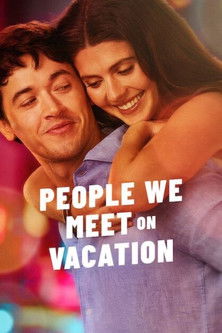
People We Meet on Vacation
2026 · Brett Haley
For a cozy night in when you want to fall in love — low stakes, big feelings, vacation scenery included. Pure comfort viewing, ideal with a blanket and someone to elbow during the obvious moments.
What it's about
Poppy is a free-spirited travel writer who books first and thinks later; Alex is a high-school English teacher who irons his packing list. For a decade these opposite best friends took one summer vacation together every year — until something broke the tradition, and their friendship with it. Now they're trying one more trip, and the film moves between that reunion and the sun-soaked vacations that came before, asking whether the person you travel best with might be the one you're meant to love.
The experience
Warm, breezy, and quietly aching underneath — the pleasure of watching two people who obviously belong together take the scenic route. It's a smile-through-it watch with a lump-in-the-throat streak.
The craft
Adapted from Emily Henry's bestselling novel, it uses a cross-cut structure — the fraught present-day trip braided with flashbacks to a decade of summers — so the romance assembles itself like a memory. Brett Haley, who cut his teeth on tender, small-scale indie dramas, brings that softness to studio rom-com territory.
Why it matters
It's part of the concentrated wave of Emily Henry adaptations that helped drive the rom-com's mid-2020s revival on screen — book-club romance becoming a screen genre of its own.
Snapshot
People We Meet on Vacation is a Netflix romantic comedy adapted from Emily Henry's 2021 bestselling novel of the same name, directed by the American independent filmmaker Brett Haley. The premise is a friends-to-lovers structure organized around an annual summer trip: Poppy, a free-spirited travel writer, and Alex, a cautious homebody of a high-school English teacher, became best friends on a college road trip and kept a yearly vacation tradition until a rupture ended it — and the film, like the book, alternates a present-day attempt at reconciliation with flashbacks across nine summers of trips. Released on the platform in January 2026 at a runtime of 118 minutes, the film stars Emily Bader as Poppy and Tom Blyth as Alex, and it arrived as one of the most visible entries in the concentrated wave of Emily Henry screen adaptations that the mid-2020s industry assembled around her readership. Its reception split along a now-familiar fault line for the streaming rom-com: a healthy 78 percent approval on Rotten Tomatoes against a middling 50 on Metacritic, with the sharpest critics finding glossy scenery where characterization should be, and a very large audience regardless — 17.2 million Netflix views in its opening weekend. The lineage the film carries is intact in the finished work: a beach-read literary property, a director known for gentle, music-forward relationship dramas, and a genre cycle — the literary-adaptation rom-com — that the 2020s rebuilt around pre-sold readerships and platform economics.
Industry & production
The film's source is Emily Henry's People We Meet on Vacation, published in 2021 by Berkley (an imprint of Penguin Random House), a commercial and critical success that helped make Henry one of the defining romance novelists of the decade. Her catalog became a sought-after adaptation pipeline in the 2020s, with multiple titles optioned in a short span; this project is part of that portfolio strategy, in which a single author's proven readership de-risks a slate of romantic comedies. The finished film is a modestly budgeted production at $14.3 million — mid-range by streaming-original standards and consistent with a genre that spends on locations and stars rather than effects. The screenplay is credited to Yulin Kuang, Amos Vernon, and Nunzio Randazzo; filming took in New Orleans and Spain, locations that double as settings in the story's itinerary. The rom-com's return as a viable commercial form in this period is closely tied to streaming economics — platforms treating the genre as reliable library and engagement fare — and to the demonstrated conversion of a large, organized online romance readership (the "BookTok" phenomenon) into a built-in audience. The film's opening-weekend viewership of 17.2 million is the clearest evidence that the model worked here: whatever critics made of the execution, the pre-sold audience showed up.
Technology
People We Meet on Vacation is not a technologically distinctive production, and its craft is deliberately transparent: a contemporary romantic comedy finished for Netflix delivery, engineered to read well on televisions, laptops, and phones. That delivery context shows in the imagery critics described — bright, sunlit, high-legibility photography that one reviewer characterized as glowing and another compared to the slick surface of travel brochures. The genuinely relevant technological fact remains distribution rather than capture: as a streaming original, the film was built for simultaneous global release on a single platform, with clean, close-miked dialogue and a palette calibrated for small-screen viewing rather than large-format spectacle.
Technique
Cinematography
The cinematographer is Rob C. Givens, a frequent Haley collaborator, and the finished film bears the director's established visual signature: warm, naturalistic light and a camera that serves faces and places rather than drawing attention to itself. Caroline Siede at The A.V. Club singled out the glowing warmth of Givens's photography as one of the film's assets. The vacation structure gives the imagery an itinerary — the story moves through New Orleans, Croatia, Squamish, Barcelona, Tuscany, and Boston — and the settings function as both spectacle and emotional register, mapping onto the couple's shifting intimacy across years. The sharpest dissent on the photography came from The Spool, which found the images pretty but shallow: slick in the manner of travel-brochure pages, without the depth of feeling the locations might have carried. That disagreement is really a disagreement about the whole film — whether the sun-washed surfaces are a pleasure or a substitute for interiority — but both camps describe the same object: a bright, postcard-forward travelogue aesthetic.
Editing
Editing is the structural heart of the adaptation, because Henry's book is built on interleaved chronology — a present-tense reconciliation braided with nearly a decade of prior trips. The film, cut by editor Evan Henke, commits fully to that architecture, alternating the present-day storyline with flashbacks across nine summers so that the audience tracks both the mystery of what broke the friendship and the accumulating evidence that the two belong together. Critics divided on how well the cutting logic pays off. Siede found the flashback structure reasonably clever as a delivery mechanism for the story's dramatic irony. The Spool argued the opposite: that the constant temporal shifting prevents any single period from building a firm character foundation, so the leaps across years skim the relationship rather than deepening it. Both readings confirm that the dual timeline is where the film's storytelling lives — the withholding and timed release of the rupture is the engine, and the film's uneven reception largely tracks how persuasive individual critics found that engine.
Mise-en-scène / staging
The genre's staging grammar governs here: two-shots that keep the leads in a shared frame, blocking that uses physical proximity as an emotional index, and production design — credited to Colin Wilkes — that distinguishes each vacation locale while quietly characterizing the two protagonists, Poppy's spontaneity against Alex's restraint. The film's memorable set pieces are built on exactly this logic: a goofy, neon-lit bar dance in New Orleans, an argument staged in the rain, and a tender sequence in which one friend nurses the other through illness — each a conventional rom-com station rendered through location and physical business. Costume does significant structural work as well: Blyth and Bader have described using wardrobe changes as character anchors across the timeline, the clothes marking where each character is in life as the film jumps among its nine summers. In a structure where the audience must instantly place each flashback, design and costume carry much of the orientation burden.
Sound
Music has been a signature of Haley's cinema — Hearts Beat Loud is organized around songwriting, and his features repeatedly use score and needle-drops to carry sentiment. His longtime composer Keegan DeWitt scores this film as well, continuing one of the director's most durable collaborations. The soundtrack's pop selections drew more comment than the score: Siede noted a Taylor Swift needle-drop and faulted the film's music choices for failing to do the period-anchoring work a decade-spanning structure invites — the songs do not pin characters or flashbacks to specific years the way a nostalgia-coded soundtrack might. Dialogue clarity and the rhythm of banter are the other load-bearing sound elements in a genre built on verbal chemistry, and the film's mixing is in the clean, close-miked register standard for streaming comedy.
Performance
The film is a two-hander resting on Emily Bader's Poppy and Tom Blyth's Alex, supported by a deep comic bench — Sarah Catherine Hook, Lucien Laviscount, Miles Heizer, Jameela Jamil, Molly Shannon, and Alan Ruck. The individual performances earned real praise: The Spool credited Bader with sustaining Poppy's restless energy while letting a gloomier undercurrent show through it, and found Blyth especially skilled at carrying Alex's feeling in his face rather than his lines — exactly the restraint-as-warmth problem the role sets. The pairing itself divided critics sharply. The Spool and Siede both found the central chemistry lacking; Siede's version of the complaint was that the leads read as polished, confident movie stars rather than as the vulnerable, mutually awkward friends the premise requires. Yet the aggregate critical summary on the film's Wikipedia page describes reviews as generally positive and specifically complimentary of the leads' chemistry — a genuine split in the record, and a telling one, since whether this particular friendship convinces is the whole wager of a friends-to-lovers film. Haley's production method bet heavily on it: the two actors traveled together to locations including Spain before and during the shoot expressly to build an offscreen friendship the camera could draw on.
Narrative & dramatic mode
The film's dramatic mode is the friends-to-lovers romantic comedy executed through a braided, retrospective structure. In the present-day frame, Poppy reconnects with Alex — on something of a false pretense — to attend his brother's wedding in Barcelona, and the reunion's early tension plays out in the transit spaces of travel itself, beginning in an airport. Against that frame, the flashbacks accumulate nine summers of shared trips and near-misses. The engine is dramatic irony: the audience, watching a decade of declined opportunities, is positioned to see the romance the characters keep refusing to name. Two questions drive the plot — what happened to end the friendship, and whether the present-day trip can repair it — and the dual timeline releases those answers on a controlled schedule. This is a comedy of recognition rather than of obstacle-and-farce: the barrier to union is internal — fear, self-protection, a friendship too valuable to risk — which places the film in the more introspective, character-driven wing of the genre. The stakes are emotional and relational throughout.
Genre & cycle
People We Meet on Vacation sits squarely within the 2020s revival of the streaming romantic comedy after the genre's commercial retreat in the 2010s. More specifically, it belongs to a distinct sub-cycle: adaptations of contemporary literary romance novels with strong pre-sold readerships, of which Emily Henry's body of work is the leading example. The cycle is characterized by present-day settings, professional-class protagonists, wittier and more interior scripts than the broad studio rom-coms of the 2000s, and a marketing strategy that converts online book communities into opening audiences — a conversion this film demonstrated emphatically with its opening-weekend viewership. Haley has been explicit that he also aimed the film backward at an older model: he has said he saw the friends-to-lovers plot as an opportunity for a nineties rom-com feel and cited When Harry Met Sally as a touchstone — the canonical text of the can-men-and-women-be-friends tradition this story inherits.
Authorship & method
The clearest directing signature belongs to Brett Haley, whose independent features — The New Year, I'll See You in My Dreams, The Hero, Hearts Beat Loud, and the young-adult adaptation All the Bright Places — share a consistent sensibility: humane, low-key, emotionally sincere relationship stories that trust actors and lean on music. That profile made him a coherent choice for a warm literary rom-com, and the finished film confirms the continuity of his team: cinematographer Rob C. Givens and composer Keegan DeWitt, both longtime collaborators, are credited here, joined by editor Evan Henke. The screenplay — the project's central craft problem, converting Henry's interleaved-timeline prose into scene structure — is credited to Yulin Kuang, Amos Vernon, and Nunzio Randazzo. Haley has described an unusually collaborative method with the writers, working scenes together so that the characters' emotional maturity builds legibly across the shuffled timeline, and he extended the method to his actors by sending Bader and Blyth traveling together to build the friendship the film depends on. The foundational authorial voice remains Emily Henry, whose novel supplies the structure, tone, and characters, and whose stated view of the form — that a rom-com's purpose is joy, love, and beauty — reads as the film's working brief. Critics who resisted the film essentially argued it honored that brief too literally: Dennis Schwartz found Haley's direction competent but unremarkable in service of a glossy, formula-bound picture.
Movement / national cinema
The film is a work of contemporary American commercial cinema, not part of any art-movement or national-cinema current in the historical sense. If it has a "movement" affiliation, it is industrial rather than aesthetic: the streaming-era, BookTok-adjacent romance adaptation, here in its purest Netflix-original form. Haley's own background in American independent film gives the project a foot in the indie-to-studio pipeline — the well-worn path by which directors of small, festival-oriented dramas are recruited to steward mid-budget genre properties — but the film itself is mainstream in intent and address.
Era / period
As a January 2026 Netflix release, the film is a product of the post-2020 romantic-comedy resurgence and the maturation of streaming as the genre's primary home. Its period markers are the ones the cycle wears openly: contemporary settings, professional millennial protagonists, a nostalgia-inflected structure that looks back across a decade, and a production logic shaped by pre-sold literary IP and organized online fandom. One small irony of its period texture drew critical notice: Siede observed that Poppy's job as a print travel writer already feels like an anachronism — a profession the film's own platform-economics era has largely dissolved. It is very much a film of its industrial moment, down to the opening-weekend viewership figure by which its success was measured.
Themes
The film's governing theme is the permeable line between deep friendship and romantic love, and the fear that acting on the latter could destroy the former — risk-aversion as the true antagonist. Radiating from that are several linked concerns: the opposites-attract dialectic of spontaneity versus planning (Poppy's freedom against Alex's structure), and the way each temperament both irritates and completes the other; time and nostalgia, since the annual-vacation structure makes the passage of years and the accumulation of shared history a subject in itself; and home versus escape — travel as the medium of the pair's intimacy, the space where each becomes a freer version of themselves, and the question of whether that self can survive the return to ordinary life. Class and lifestyle difference — a travel writer against a schoolteacher — inflects the romance with quieter questions about compatibility beyond attraction. Critics registered the travel theme's prominence in opposite ways: for admirers it is the film's pleasure principle, while Schwartz found the message that travel broadens the self delivered with a heavy hand, and Siede's core complaint was that the film invests in the vacations at the expense of the people taking them.
Reception, canon & influence
The film's reception was genuinely divided, and the division is itself instructive. On Rotten Tomatoes it holds a 78 percent approval rating from 67 reviews, and the aggregate summary of the press describes a generally positive response with praise for the leads; Metacritic's 50 out of 100 tells a cooler story, and the most detailed individual reviews sit on the skeptical side. Siede at The A.V. Club graded it a C-, arguing that the film delivers the vacations but not the people — handsome photography and a workable flashback structure wrapped around leads too glamorous to read as vulnerable. The Spool praised Bader and Blyth individually while finding the pairing chemistry-poor and the travelogue imagery slick but shallow, and closed by recommending Henry's novel over its adaptation. Schwartz's C+ called the result glossy and formulaic under competent direction. Whatever the critics concluded, the audience verdict was unambiguous: 17.2 million Netflix views in the opening weekend, a figure that validates the pre-sold-readership model the production was built on. Influences on the film (backward): most directly, Emily Henry's novel and the broader literary-romance tradition it channels; the friends-to-lovers lineage of the American romantic comedy, from studio-era screwball through the Nora Ephron era — with When Harry Met Sally the director's own stated touchstone; and Haley's gentle, music-forward independent filmography, carried forward here by his recurring collaborators. Legacy (forward): the film's significance will likely be judged less as a standalone work than as a data point in the Emily Henry adaptation cycle and the wider streaming rom-com revival — early evidence that a beloved dual-timeline novel can translate to a very large streaming audience even when critics dispute whether its central relationship survived the trip to the screen.
A Deleuzian reading
Start with the dance.
The full Deleuzian reading of People We Meet on Vacation →
Reception
Dropped as Netflix's first original film of 2026 and instantly became a viewership juggernaut — critics called it solid rather than special, but romance fans claimed it immediately.
How People We Meet on Vacation was received, from release to now →
How to watch People We Meet on Vacation: what to notice on a first viewing
- Notice each cut from the present trip into an earlier summer. Editor Evan Henke braids the present-day trip with flashbacks across nine summers, and Haley asks you to hold both at once: what is happening now, and what happened back then that the present keeps circling without naming. You see the romance a decade before the characters admit it, so every refused moment lands twice.
- Look at the clothes and hair in every flashback. Bader and Blyth used wardrobe changes as character anchors across the timeline. Each summer has its own look, and the look tells you where Poppy and Alex are in life before a line of dialogue does. Costume does the orientation work a shuffled chronology demands, so you place each summer in seconds.
- Watch how close Poppy and Alex stand in each two-shot. Haley keeps the leads in a shared frame and measures the friendship by the space between their bodies. The gap opens and closes from one summer to the next, and from one locale to the next. Proximity is the film's emotional index; you can read how the friendship stands from the blocking alone.
- Watch Tom Blyth's face while Alex stays quiet. Blyth carries Alex's feeling in his face rather than his lines, while Bader keeps Poppy restless and talkative with a gloomier undercurrent showing through. The talker and the watcher trade the emotional load without saying so. This is a comedy of recognition, so the plot moves in what a face admits before the mouth does.
- Notice the warm, sun-washed light in every location. Rob C. Givens shoots New Orleans, Croatia, Squamish, Barcelona, Tuscany, and Boston in the same glowing warmth, a bright, postcard-forward look. The camera serves faces and places and never draws attention to itself. Each summer looks the way it is remembered rather than the way it was lived, which is the film's point of view.
The whole guide to watching People We Meet on Vacation, with the keys for a rewatch →
Influences: the films it descends from and the films it influenced
- Two for the Road (1967) — The template for the braided dual-timeline travel romance: intercuts the same couple's repeated road trips across years so past and present rhyme within a scene — the exact structural device PWMOV inherits by shuffling annual summer vacations.
- Annie Hall (1977) — Reorders a relationship out of chronology as associative memory, letting later knowledge bleed into earlier scenes — the memory-shuffled editing grammar underlying the film's interleaved-chronology facet.
- When Harry Met Sally... (1989) — Nora Ephron's screenplay codified the years-spanning friends-to-lovers two-hander, checking in on a platonic pair across time until the friendship curdles into romance — the direct DNA of the seed's friends-to-lovers structure.
- Sleepless in Seattle (1993) — Ephron's use of standards and cross-cut parallel lives — two people the audience knows belong together but who haven't met — is the needle-drop-plus-dramatic-irony scoring method the seed channels.
- You've Got Mail (1998) — Builds its entire engine on dramatic irony: the audience and one lead know the pen-pal's identity the other doesn't, generating the knowledge-gap tension that PWMOV's dramatic-irony facet reuses.
- It Happened One Night (1934) — The ur-text of opposites-attract road comedy — bickering mismatched leads forced to travel together — establishing the journey-as-courtship two-hander the seed's vacation premise updates.
- Before Sunset (2004) — Sustains a reunion-after-years romance almost entirely through walk-and-talk two-shots that trust performers over coverage, the actor-forward staging-of-intimacy the seed shares.
- (500) Days of Summer (2009) — Its day-numbered, non-sequential timeline lets the audience know the ending while the character doesn't, weaponizing edit order to produce dramatic irony — the same interleaved-chronology-for-irony craft the seed employs.
- I'll See You in My Dreams (2015) — Haley and DP Rob Givens' warm naturalistic light and unhurried two-shots that let actors carry emotional beats establish the director's own sensibility carried directly into this adaptation.
- Hearts Beat Loud (2018) — Haley's music-forward method — building scenes around diegetic songs and a Keegan DeWitt score to externalize feeling rather than dialogue — is the nostalgia-needle-drop technique the seed extends.
- Anyone But You (2023) — A flagship of the post-2020 rom-com revival that pairs opposites-attract antagonism with an aggressively curated pop needle-drop, extending the seed's era/revival and nostalgia-soundtrack craft to the box office.
- The Idea of You (2024) — A streaming-era adaptation of a BookTok-beloved romance novel, translating interior first-person prose into warm naturalistic two-hander scenes — the same page-to-screen adaptation problem and pipeline the seed tests.
- One Day (2011) — Structures a friends-to-lovers arc as annual check-ins on the same calendar date, using the recurring-time-slice device — like the seed's recurring vacations — to compress years into a braided timeline.
- Love, Rosie (2014) — A decade-spanning friends-to-lovers whose engine is mistiming and dramatic irony — the audience aches over near-misses the characters can't see — matching the seed's friendship-versus-romance tension.
- About Time (2013) — Curtis fuses a warm relationship comedy with an explicit nostalgia-and-time meditation, revisiting the same days to mine sentiment — the theme/nostalgia-and-time register the seed operates in.
- La La Land (2016) — Chapters its romance by seasons and closes on a bittersweet what-if montage, using structural time-markers plus a curated musical palette to braid nostalgia into the love story.
- Ticket to Paradise (2022) — Makes the destination/vacation setting the active romance engine and stakes everything on a movie-star two-hander of squabbling opposites — the same travel-frames-courtship staging as the seed.
Similar films
- Love, Rosie (2014) — influence & lineage
- Anyone but You (2023) — influence & lineage
- (500) Days of Summer (2009) — influence & lineage
- Red, White & Royal Blue (2023) — same viewing thread
- Past Lives (2023) — often watched together
- Eternity (2025) — often watched together
- Sorry, Baby (2025) — often watched together
- We Live in Time (2024) — often watched together
All the films related to People We Meet on Vacation →
Watch it with: curated runs of related films
- The Rom-Com Grows Up — Watch these when you want the modern love story in every register — the giddy fantasy, the one-perfect-day meet-cute, the raunchy hustle, and the version that finally does the math on romance.