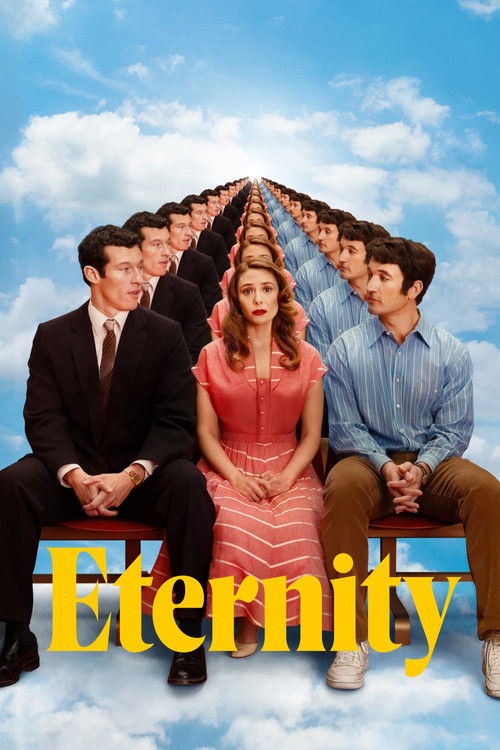
Eternity
2025 · David Freyne
For a date night or a cozy evening when you want a romance with actual stakes — you'll laugh, but come prepared to think about your own person. Comfort viewing with a lump in its throat.
What it's about
Joan dies in old age and arrives at a bustling afterlife way-station where every soul gets about a week to pick the eternity they'll live in forever. Waiting for her is Larry, the husband she shared a whole life with — and Luke, her first husband, killed young in a war, who has spent decades in this limbo refusing to move on until she arrived. One week, one choice, two men, forever.
The experience
Sweet and funny on the surface with a real ache underneath — the bureaucratic afterlife gags keep it buoyant while the triangle slowly turns into a genuine question about what a life adds up to. It's the kind of romcom that sneaks up on you and leaves you a little misty.
Performances
Elizabeth Olsen anchors it as a woman weighing two versions of her own heart, with Miles Teller as the husband of a lifetime and Callum Turner as the first love who never stopped waiting — the triangle works because all three make their claim feel legitimate.
The craft
The fun is in the world-building: an afterlife run like a slightly overwhelmed travel agency, where eternity comes in packages you have to commit to. David Freyne keeps the high concept in service of the emotion rather than the other way around, letting the comedy set up a surprisingly sincere meditation on marriage and memory.
Why it matters
A 2025 entry in the long tradition of afterlife romances, notable for treating the love triangle not as a gimmick but as an honest question about whether we love the person or the life we built with them.
Snapshot
Eternity is a high-concept afterlife romance built on a bureaucratic premise: the newly dead arrive at a way-station and are given roughly one week to choose the single memory, world, or configuration of eternity in which they will spend forever. Its dramatic engine is a love triangle stretched across the boundary of death. Joan (Elizabeth Olsen) has just died in old age after a long marriage to Larry (Miles Teller); she arrives to find that Luke (Callum Turner), her first husband, killed young in war, has been waiting decades for her in this limbo, having refused to move on. The film asks what it means to choose a person when a whole shared life pulls one way and an idealized, interrupted first love pulls the other. It belongs to a recognizable lineage of "afterlife-as-institution" comedies but folds that machinery around a serious meditation on marriage, memory, and the moral weight of choice. The tone is bittersweet romantic comedy-drama rather than farce. Because the film is very recent, the durable scholarly and archival record around it is still thin; several production and craft specifics below are flagged where the reliable public record is limited.
Industry & production
Eternity was produced within the American independent-studio ecosystem and, by the available record, distributed by A24, a company whose brand identity rests on elevated genre and auteur-adjacent work — a fit for a film that dresses a commercial romantic-comedy premise in a more melancholy, idea-driven register. The screenplay is credited to Patrick ("Pat") Cunnane, whose earlier public profile was as a political speechwriter (he worked in the Obama White House and authored a memoir about that experience). That background is worth noting because Eternity's script had circulated as an admired unproduced screenplay before reaching the screen — the kind of "package with heat" that attracts A-list casting — though I would treat the precise industry-tracking details (Black List year, exact development timeline) as uncertain rather than assert them.
The casting is the film's principal commercial asset: Elizabeth Olsen, Miles Teller, and Callum Turner are all bankable leads with crossover appeal between franchise work and prestige drama, and the ensemble reportedly extends to comic character players including Da'Vine Joy Randolph and John Early in roles tied to the afterlife's "management." The film had its premiere on the fall-festival circuit in 2025 (Toronto is the commonly cited launch), positioning it as an autumn adult-audience release rather than a summer tentpole. Beyond these broad strokes — mid-budget, star-driven, festival-launched, specialty-distributed — granular figures such as the production budget and box-office gross are not something I can state reliably, and I will not invent them.
Technology
The film is, on its face, a dialogue-and-performance piece rather than an effects showcase, and its speculative setting is achieved more through production design and framing than through heavy digital spectacle. The "Junction"/way-station conceit invites a controlled, largely built-environment approach — sets and locations dressed to feel like a slightly unreal transit hub or hotel outside time — with visual effects used selectively for transitions between worlds and for the uncanny presentation of eternity's "options." I do not have confirmed technical documentation on the camera systems, capture format, or VFX vendors, so I will refrain from specifying them; the honest position is that the film's technological signature appears deliberately restrained, prioritizing a legible, warm, character-forward image over conspicuous world-building hardware. This restraint is itself a choice with lineage: the strongest afterlife films in this tradition (see below) have almost always achieved strangeness through design and rule-making rather than through spectacle.
Technique
Cinematography
The visual grammar the premise demands is one of contained, humane observation: the drama lives in faces weighing an impossible decision, so the camera's first job is to hold performers in sustained, readable space. A way-station setting typically encourages a palette that is clean and a touch timeless — neither aggressively futuristic nor period-specific — so that the afterlife reads as adjacent to our world rather than wholly other. I do not have a verified cinematographer credit to attribute here and will not guess a name; what can be said on the basis of the film's design is that the cinematography's task is to make an abstract, rule-bound space feel emotionally inhabited, and to visually distinguish the "eternity options" from the neutral limbo where the choosing happens.
Editing
Structurally the film runs on a countdown — the one-week deadline — which is a gift to an editor: it supplies built-in escalation and a natural rhythm of scenes that alternate between the two suitors and the ticking administrative clock. The love-triangle architecture also invites parallel construction, cross-cutting between the claims of the long marriage and the claims of the first love, and likely leans on memory or flashback material to give Joan's shared history with each man dramatic weight. As with several craft roles, I don't have a confirmed editor credit and won't fabricate one.
Mise-en-scène / staging
Production design is arguably the film's most important below-the-line department, because the afterlife's "world" must communicate its rules at a glance — the bureaucratic architecture of choice, the waiting rooms, the brochureable eternities. The staging challenge is to keep a metaphysical conceit from turning cold or purely clever; warmth has to be designed in. The love triangle also makes blocking meaningful: who stands with whom, who waits, who is left in the frame's negative space, all carry thematic freight in a story literally about which relationship one steps toward.
Sound
No reliable score or sound-team credit is available to me, so I will not attribute the music. Functionally, a film of this kind depends on a score to carry its bittersweet tone — to keep the comedy from tipping into glibness and the romance from tipping into sentimentality — and on sound design to make an impossible place feel plausibly ordinary. The genre's best examples treat the afterlife with a matter-of-fact soundscape, and Eternity appears to work in that vein.
Performance
Performance is where the film most clearly stakes its claim. The premise only works if the audience genuinely cannot dismiss either man, which asks Olsen to play ambivalence as an active, dignified state rather than mere indecision, and asks Teller and Turner to embody two different kinds of love — the accumulated, tested intimacy of a whole life versus the frozen, idealized ardor of youth cut short. Turner's role carries a particular pathos: a man who has waited, unaging, while the woman he loved lived an entire other life. The supporting comic performances (the afterlife's functionaries) supply the tonal ballast that keeps the concept buoyant.
Narrative & dramatic mode
The dominant mode is romantic melodrama organized as a deadline-driven decision, laced with dry institutional comedy. Its nearest structural relative is the "trial" or "processing" narrative — the dead person who must account for a life or make a binding choice within a fixed window. The love triangle supplies classical romantic-comedy machinery (two rivals, a wavering center, a countdown), but the stakes are inverted from the usual genre: instead of "will they end up together," the question is "which togetherness, and at what cost to the other." That inversion pushes the film toward tragedy's neighborhood — any choice is also a renunciation — which is the source of its dramatic seriousness.
Genre & cycle
Eternity sits squarely in the afterlife-bureaucracy cycle: comedies and romances that imagine death as an administered process with rules, forms, and functionaries. The touchstones are unusually clear. Albert Brooks's Defending Your Life (1991) established the modern American template — the recently dead in a pleasant limbo, judged and processed, with romance blooming in the waiting. Powell and Pressburger's A Matter of Life and Death (1946) supplies the celestial-tribunal-and-true-love architecture. Hirokazu Kore-eda's After Life (1998) is the essential art-house precedent for the specific mechanic of choosing a single eternity, in that case one memory to keep forever. Ernst Lubitsch's Heaven Can Wait (1943) and its remakes, and further back the "return from death to settle love" tradition, all feed the stream. On television, the elaborate rule-driven cosmology of The Good Place (2016–2020) revived popular appetite for exactly this comic-metaphysical space, and Pixar's Soul (2020) recently proved its mainstream viability. Eternity distinguishes itself within the cycle by centering not the trial or the reckoning but the romantic choice, and by making the "waiting" a decades-long act of devotion.
Authorship & method
The clearest authorial signal available is director David Freyne, an Irish filmmaker whose prior features are The Cured (2017), a politically inflected infection/zombie drama, and Dating Amber (2020), a warm, well-received Irish coming-of-age comedy about two closeted teens who fake-date. That pairing is instructive: Freyne has shown both a facility for genre premises used as social/emotional metaphor and a gift for tender, character-first comedy. Eternity reads as a synthesis of those two strengths — a genre-conceit picture whose real subject is intimate feeling. The screenplay by Pat Cunnane brings a writerly, dialogue-driven sensibility (consistent with his speechwriting background) to the high concept. On the other principal collaborators — cinematographer, composer, editor — I do not have verified credits and decline to attribute names rather than risk error; this is a genuine gap in the readily available record for a film this new, and it should be filled from the finished title's credits rather than from inference.
Movement / national cinema
The film resists tidy national-cinema classification. Its director is Irish, but Eternity is an American-set, American-cast, American-distributed production, making it best understood as part of the transatlantic careers now common among Irish and British directors working within the US independent-studio system. If it belongs to a "movement," it is the loose contemporary tendency of specialty distributors (A24 foremost) to back mid-budget, idea-forward, adult-oriented films that use genre scaffolding for emotional or philosophical ends — a commercial-artistic niche rather than a formal school.
Era / period
Eternity is a product of the mid-2020s theatrical landscape, in which the adult romance and the original (non-franchise, non-IP) star vehicle had become relatively scarce and therefore notable. It arrives amid a modest revival of interest in metaphysical and afterlife stories across film and television, and amid an industry search for counter-programming to superhero and legacy-sequel product. Casting leads associated with franchise work (Olsen with Marvel, Teller and Turner with large-scale productions) in an original romantic drama is itself an artifact of this period's economics: star recognition deployed to make an original premise financeable.
Themes
The film's governing theme is the moral weight of choosing one love without erasing another — the idea that a life's meaning may lie less in a single perfect romance than in the accumulated, imperfect substance of a shared history. It sets the idealized against the lived: Luke represents the road not fully traveled, love preserved precisely because it was never tested by decades of ordinary life, while Larry represents the tested, weathered, real thing. Around this sits a cluster of related concerns: the tyranny and mercy of finitude (eternity paradoxically makes choice harder, not easier); devotion as an act of waiting; grief and memory as the raw material of identity; and a gently satirical view of institutions that try to administer the ineffable. Underlying it all is a quietly humanist proposition — that to love completely is also to lose, and that the refusal to choose is itself a choice.
Reception, canon & influence
As a 2025 release, Eternity's critical reception and canonical standing are still forming, and I will not manufacture review quotations, scores, or box-office figures I cannot verify. What can be said responsibly is that it was positioned as a fall-festival prestige-adjacent title with strong star wattage, and that its reception will most plausibly turn on the tonal tightrope such films must walk — whether the comedy and the metaphysical machinery deepen the romance or dilute it.
Its influences run backward to a well-established genealogy: A Matter of Life and Death (1946) for the celestial-court-and-true-love architecture; Heaven Can Wait (1943) and the "second chance at love after death" tradition; Defending Your Life (1991) for the modern American afterlife-processing comedy; Kore-eda's After Life (1998) for the specific and profound mechanic of selecting one's eternity; and the popular cosmologies of The Good Place and Soul for proving contemporary appetite. Within director David Freyne's own filmography, it extends the metaphor-through-genre method of The Cured and the tender comedy of Dating Amber.
Its forward legacy cannot yet be assessed with any authority — that is simply too soon to judge honestly. What the film contributes to the ongoing cycle, if it endures, is the reframing of the afterlife-bureaucracy story around the romantic choice between two loves rather than the moral trial of one life — a variation that, should it resonate, may prove the most imitable thing about it. Any firmer claim about influence would be speculation, and the responsible dossier entry leaves it open.
Reception
An A24 Thanksgiving 2025 release that critics received with mixed-to-warm reviews but audiences turned into a word-of-mouth date-movie hit — roughly $35M worldwide on a $12M budget. Less than a year out, it's already better remembered for the arguments it started than the reviews it got.
How Eternity was received, from release to now →
How to watch Eternity: what to notice on a first viewing
- Notice the one week countdown the afterlife imposes on Joan. Joan arrives newly dead with roughly seven days to choose the single eternity she'll spend forever, and the film tracks the days ticking down toward that deadline. A limit this hard turns every conversation into a decision with a clock running under it.
- Watch who stands beside Joan, and who waits at a distance. The film blocks scenes so that Larry and Luke are rarely both close to Joan at once; where each man stands relative to her marks the pull of the moment. Blocking becomes the film's real ballot; you can read Joan's pull toward one man before she says a word.
- Notice the afterlife's brochure style displays for each possible eternity. The way station's design has to sell each version of forever at a glance, so its production design leans warm and inviting rather than cold or clinical. A metaphysical bureaucracy is dressed to feel like a choice you'd actually want, not a punishment.
- Watch Elizabeth Olsen hold two feelings on her face at once. Olsen has to play genuine ambivalence, not indecision, so her reactions to Larry and to Luke carry equal, competing weight throughout. The film only works if you cannot root for either man over the other; her face is where that balance lives.
- Notice that Luke hasn't aged a single day since he died. Callum Turner plays Luke as a man frozen at the age he died, decades younger in feeling than the wife who lived a full life without him. Waiting unaging while someone else grows old is its own kind of devotion, and its own kind of loss.
The whole guide to watching Eternity, with the keys for a rewatch →
Influences: the films it descends from and the films it influenced
- A Matter of Life and Death (1946) — Supplies the celestial-tribunal-adjudicating-true-love architecture and the staged appeal-under-deadline, where a case for a romance must be argued before an afterlife court — the exact bureaucratic scaffold Eternity's love case inherits.
- Here Comes Mr. Jordan (1941) — Establishes the clerical-error-in-heaven premise and the caseworker/escort figure who ushers the newly dead through afterlife procedure, the guided-processing template Eternity's handlers descend from.
- Heaven Can Wait (1943) — Structures a whole life's romantic history as testimony delivered in the afterlife's antechamber, applying a light comedy-of-manners register to eschatology rather than solemnity.
- Defending Your Life (1991) — Models the mundane-corporate afterlife — Judgment City's hotels, cafeterias and courtrooms — and lets romance bloom during a processing limbo, the deadpan admin-of-the-beyond comedy Eternity revives.
- After Life (1998) — Provides the selection-of-a-single-eternity mechanic plus a documentary-realist, contained-observation staging of a modestly designed afterlife way-station, favoring caseworker interviews over spectacle.
- Beetlejuice (1988) — Renders afterlife bureaucracy — handbooks for the recently deceased, waiting rooms, exasperated caseworkers — through tactile practical production design instead of VFX, the restrained-worldbuilding approach Eternity favors.
- Wristcutters: A Love Story (2006) — Builds a deadpan afterlife-limbo romance on lo-fi practical sets standing in for the beyond, pairing bittersweet comedy with a love pursued inside a bounded metaphysical way-station.
- The Good Place (2016) — Extends the afterlife-bureaucracy comedy through elaborate procedural worldbuilding — architects, points systems, case managers — proving the contemporary appetite for eschatology-as-office-comedy Eternity taps.
- Soul (2020) — Stages an administrative pre/after-life (the You Seminar and Great Beyond) as softly designed, restrained metaphysical bureaucracy that weighs the worth of a lived life against an idealized one.
- Nine Days (2020) — Its closest formal sibling: souls are interviewed and selected for existence within a single contained location, an existential-selection mechanic and chamber-piece production design mirroring Eternity's processing station.
- Palm Springs (2020) — Inverts the romcom by trapping love inside a metaphysical structural constraint, using the conceit — not incident — to interrogate commitment, the same inverted-romcom engine Eternity runs.
- About Time (2013) — Deploys a time-mechanic romance whose real argument is idealized-versus-lived love, ultimately choosing the ordinary present — the thematic pivot Eternity reframes as a choice between two loves.
- The Discovery (2017) — An indie metaphysical romance premised on a proven afterlife, reframing love as a choice made against cosmological machinery, with restrained VFX and a contained, observational register.
- Past Lives (2023) — Renders the choice-between-two-loves and idealized-vs-lived-love structure through restrained, contained-observation cinematography and performances of active ambivalence rather than melodrama.
- Materialists (2025) — A love-triangle romance that inverts romcom convention to weigh two partners as near-literal life-choices, using cool, restrained staging to dramatize deliberation over sentiment.
Similar films
- Palm Springs (2020) — influence & lineage · same viewing thread
- Past Lives (2023) — influence & lineage · often watched together
- About Time (2013) — influence & lineage
- Materialists (2025) — influence & lineage
- We Live in Time (2024) — often watched together
- People We Meet on Vacation (2026) — often watched together
- Everything Everywhere All at Once (2022) — often watched together
- After Life (1999) — shared sensibility
All the films related to Eternity →
Watch it with: curated runs of related films
- When Love Gets High-Concept — Watch these when you want a love story with a speculative or absurdist hook — an AI girlfriend, an afterlife way-station, a reanimated corpse, a marriage under siege — comedies that use a wild premise to say something real about coupling.