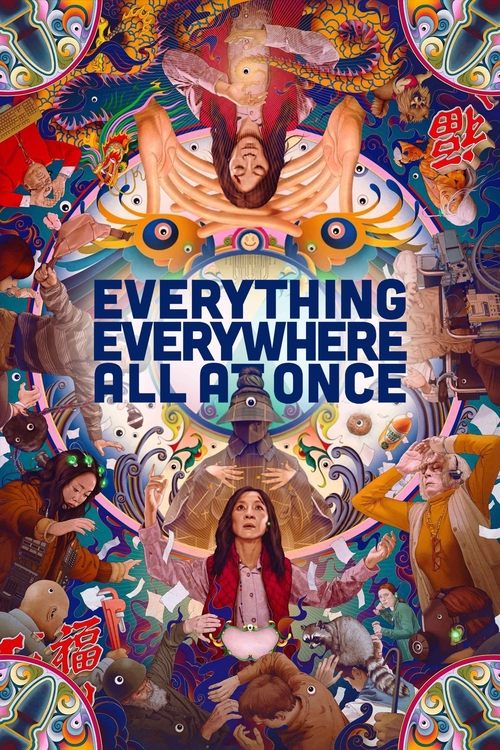
Everything Everywhere All at Once
2022 · Daniel Scheinert
The internet's movie: a multiverse indie that swept the Oscars on pure fan momentum, produced historic wins (Yeoh, Quan), then spawned an inevitable backlash cycle about whether "the Letterboxd choice" deserved seven statues.
For when you want to feel everything at once — to laugh at something gloriously stupid and then find yourself crying about your mother twenty minutes later. Maximal, chaotic, and ultimately deeply comforting.
What it's about
Evelyn Wang runs a failing laundromat, faces a hostile tax audit, and can't talk to her husband or her daughter without something breaking. Mid-audit, she learns she's the one person who can access the lives she might have led in countless other universes — and that all of them are threatened by something that has her daughter's face. A midlife crisis becomes a martial-arts multiverse adventure that is really, underneath everything, about a mother and daughter trying to reach each other.
The experience
Overwhelming in the best way: anarchic, laugh-out-loud absurd, and dizzyingly fast, then suddenly, sneakily devastating. It throws everything at you and somehow every piece lands on the heart.
Performances
Michelle Yeoh carries dozens of versions of one woman and makes each feel lived-in, in the role of her career. Ke Huy Quan's tender, shape-shifting turn as her husband is one of the great comeback performances, and Stephanie Hsu and Jamie Lee Curtis both swing between cartoon and heartbreak without missing.
The craft
Made for a fraction of a blockbuster budget, it packs in inventive fight choreography, whiplash editing that hops universes mid-gesture, and handmade visual effects from a tiny team — resourcefulness as style. The genre-hopping (kung fu, romance, absurdist comedy) is stitched together with real precision, and it rewards a big screen and full attention.
Why it matters
A word-of-mouth phenomenon that became one of A24's biggest hits and swept the Oscars, including Best Picture — a landmark for Asian-American representation and proof that wildly original, uncategorizable films could still win everything.
Snapshot
Everything Everywhere All at Once is a multiverse action-comedy-drama directed by Daniel Kwan and Daniel Scheinert — collectively credited as "the Daniels" — produced and distributed by A24, and released in limited engagement on March 25, 2022, before expanding to wide release in April. The film centers on Evelyn Wang (Michelle Yeoh), a Chinese-American laundromat owner overwhelmed by a tax audit, a failing marriage, and estrangement from her daughter Joy (Stephanie Hsu), who is swept into a struggle for meaning across alternate universes. Shot on a reported budget of approximately $14 million, it became one of the highest-grossing releases in A24's domestic history and swept the 95th Academy Awards with seven wins: Best Picture, Best Director, Best Actress, Best Supporting Actor, Best Supporting Actress, Best Original Screenplay, and Best Film Editing — the most awards for any single film at those ceremonies in decades.
Industry & production
A24 — the New York-based independent distributor and producer that had built a reputation through arthouse genre films (Hereditary, Midsommar, Moonlight, Lady Bird) — produced Everything Everywhere after an extended development period by the Daniels, who had delivered Swiss Army Man (2016) as their previous feature: an absurdist comedy in which a flatulent corpse (Daniel Radcliffe) helps a stranded man (Paul Dano) survive in the wilderness. That film divided critics but established the Daniels as singular provocateurs willing to weaponize silliness in the service of sincere emotional argument.
The Daniels have described the genesis of Everything Everywhere as rooted in a period of personal and creative overwhelm — a film about the paralysis of infinite possibility conceived from within that paralysis. The screenplay, written by the Daniels themselves, developed over several years before landing at A24.
The production worked within significant budget constraints, relying on practical ingenuity: many of the multiverse sequences were filmed on existing locations — laundromat, IRS office, parking garage — reconfigured through costume, prop design, and camera angle rather than elaborate set construction. The visual effects, though numerous, skewed deliberately toward the lo-fi and tactile — googly eyes, absurdist prosthetics, in-camera gags — rather than photorealistic CGI, a choice that was simultaneously economical and philosophically coherent with the film's argument about the handmade and the particular.
Technology
Everything Everywhere was shot digitally. Cinematographer Larkin Seiple worked with RED camera systems, a choice that suited the film's visual demands: rapid reconfiguration between setups, high-sensitivity performance in the fluorescent-lit IRS interiors, and the capacity for high-volume coverage that the film's frenetic editorial pace required.
Visual effects were distributed across multiple vendors and integrated throughout with practical techniques. The verse-jump visualizations — flashes of alternate lives rendered as memory fragments — blend stock-style footage, deliberate lo-fi video texture, and brief digital composites. The everything bagel's black-hole-like rendering is among the film's more fully synthetic images, yet even here the aesthetic tends toward the handmade rather than the polished. The film's deliberate refusal of photorealistic CGI distinguishes it sharply from the contemporary blockbuster multiverse films it exists in implicit dialogue with.
Son Lux — the art-music project of Ryan Lott, Rafiq Bhatia, and Ian Chang — composed the score using an approach that mirrors the film's tonal whiplash: orchestral swell, synth texture, and found-sound collage intercut without conventional buffer, demanding the score inhabit the same anarchic temporal register as the editing.
Technique
Cinematography
Larkin Seiple had worked with the Daniels across music videos and on Swiss Army Man, making him a practiced collaborator for the feature's specific mode. His approach establishes the mundane as a visual baseline — cramped, handheld, fluorescent-lit, close — so that eruptions of kinetic action carry genuine contrast. The cinematography does not aestheticize the laundromat or the IRS office; their visual poverty is the point.
The film's palette shifts with universe: the base reality is desaturated and institutional; the martial-arts universe carries a warm amber glow evoking classic Hong Kong cinema; the "movie star" universe is suffused with the blue-green tones of Wong Kar-wai's In the Mood for Love (2000). These chromatic signatures function as rapid-read cognitive shorthand, allowing the editing to cut between universes at high speed without losing legibility.
Editing
Paul Rogers's editing won the Academy Award for Film Editing, and the craft is central to the film's identity. The verse-jump is not a dissolve or wipe but a collision — a hard cut the viewer must process simultaneously as narrative information and kinetic sensation. In the film's most intense sequences, average shot length drops to near-subliminal durations while remaining legible, a technical achievement that situates itself within the tradition of kinetic action editing (the Bourne films; early Edgar Wright) while exceeding it in thematic integration: here, the cut IS the multiverse.
The film's three-act structure — labeled within the film itself as "Everything," "Everywhere," and "All at Once" — permits Rogers to modulate rhythm. The middle section is the most aggressively cut; the final third opens into longer takes as Evelyn reaches emotional resolution, a classical expansion of temporal grammar that registers as hard-won calm earned by formal exhaustion.
Mise-en-scène / staging
The staging reflects a sustained tension between constraint and explosion. The IRS building — institutional beige, drop ceilings, identical cubicles — is filmed with almost bureaucratic flatness in expository scenes, then transformed into an action arena using the same furniture and spatial logic. This continuity of space is crucial: the surrealism erupts within recognizable geography, not a void.
The martial-arts sequences draw explicitly on Hong Kong choreographic tradition — Michelle Yeoh's own physical vocabulary, developed across decades in Hong Kong cinema, is deployed as institutional memory. The fight choreography is comic and expressionist rather than realistic, echoing Jackie Chan's integration of everyday objects (office supplies, a fanny pack, an oversized trophy) as weapons and props. The everything bagel — a circular portal of consumed meaning representing Joy's nihilism — is staged in the film's climax with figures silhouetted against its surface, employing a visual grammar of the sublime that the film simultaneously invites and deflates through comedy.
Sound
The sound design works in concert with the editing to render the verse-jump as a full sensory event. Each universe carries a distinct sonic signature — ambient texture, musical mode, room tone — and the jump is marked by abrupt environmental shift in sound as much as by image cut, creating a binaural "click" that reinforces the cognitive work of the montage.
Son Lux's score refuses conventional underscore practice. Rather than sustaining emotional continuity across cuts, it participates in the discontinuity — musical phrases are interrupted, textures fragment and reassemble. Its range, from delicate piano figures to dense electronic noise, maps onto the film's own emotional bandwidth.
Performance
Michelle Yeoh delivers a performance of remarkable physical and emotional range, navigating comedy, action, grief, and transcendence within single sequences. Her physicality — the product of decades in Hong Kong action cinema — is deployed with awareness of its own history: the film casts her past screen presence as a kind of alternate-universe haunting of Evelyn, and the implicit intertextuality is built into the role's design.
Ke Huy Quan, absent from acting for roughly two decades following his childhood roles in Indiana Jones and the Temple of Doom (1984) and The Goonies (1985), returns with a performance of astonishing warmth and physical dexterity. His Waymond — meek, loving, quietly visionary — functions as the film's moral center, and his action sequences in alternate-universe mode reactivate the physical grace of his childhood work while layering it with adult weight. His Academy Award for Best Supporting Actor carried a cultural narrative about Hollywood's treatment of Asian-American performers that the industry broadly acknowledged as overdue reckoning.
Jamie Lee Curtis, cast against type as Deirdre the IRS auditor, commits to extreme physical comedy in a deliberately grotesque register — a willingness to disappear into absurdity consistent with her career-long range but novel in specific mode here.
Stephanie Hsu, as Joy and her alternate-universe iteration Jobu Tupaki, bears the film's most formally demanding role: nihilist antagonist, wounded daughter, and philosophical foil to Evelyn's earned optimism. She navigates these registers without ironic distancing, grounding the film's most explicitly allegorical material in recognizable emotion.
James Hong, in his nineties during production and carrying more than seven decades of screen credits, plays Evelyn's father Gong Gong with an authority that is itself a cultural statement — the decades-long exclusion of Chinese-American performers from Hollywood's main channels concentrated in a single presence whose depth the film knows how to use.
Narrative & dramatic mode
The film operates in a mode best described as maximalist tragicomedy: a narrative of genuine emotional weight — immigration, assimilation, intergenerational trauma, the nihilism of limitless possibility — delivered through sustained comic derangement. The structural device of the multiverse functions not primarily as science-fiction worldbuilding but as metaphor for the overwhelming proliferation of selves available to and demanded of the contemporary subject, and particularly of the immigrant subject caught between cultural identities.
The film's central dramatic argument — that love and attention to the particular are adequate responses to the vertigo of infinite possibility — is not reached through rational persuasion but through exhaustion and tenderness. Evelyn does not defeat nihilism with a counter-argument; she overwhelms it with the mundane fact of her care.
The three-part structure follows a classical arc — rupture, chaos, resolution — while subjecting that arc to sustained formal pressure. Comedy is not relief from seriousness but continuous with it; absurdity and grief occupy the same frame throughout.
Genre & cycle
Everything Everywhere arrives at the apex of multiverse cinema's commercial moment. The Marvel Cinematic Universe had normalized the concept across the preceding decade, culminating in Spider-Man: No Way Home (2021) and Doctor Strange in the Multiverse of Madness (2022). The Daniels' film participates in this cycle while fundamentally reorienting it: the multiverse here is not a franchise architecture but an existential condition, and its emotional stakes are domestic rather than civilizational.
The film is also legible within a cycle of Asian and Asian-American mainstream breakthrough: Crazy Rich Asians (2018) and Minari (2020) preceded it in different registers, and the broader moment of critical receptivity following Parasite's Best Picture win at the 92nd Academy Awards (2020) created conditions in which non-white prestige narratives could reach institutional recognition.
As a genre object, Everything Everywhere is hybrid to a degree that strains categorization — action film, family melodrama, science fiction, absurdist comedy, immigrant drama. This hybridity is formally intentional: the genre collisions mirror the thematic argument about identity and multiplicity.
Authorship & method
Daniel Kwan and Daniel Scheinert share directorial and screenwriting credit. They built their reputation through music video work — most notably "Turn Down for What" (2013) for DJ Snake and Lil Jon, notable for its anarchic physical comedy — before Swiss Army Man established them as feature filmmakers. Their method involves extended collaborative writing and a shared directorial sensibility they have described as operating through mutual disagreement toward synthesis: two subjectivities in productive friction.
Larkin Seiple (cinematographer) worked with the Daniels across short-form projects and Swiss Army Man before Everything Everywhere. His aesthetic aligns with the Daniels' preference for practical, grounded visual solutions capable of accommodating formal rupture without breaking legibility.
Paul Rogers (editor) previously edited Swiss Army Man. His Academy Award win for this film represented a significant career arrival, and the collaboration with the Daniels across both features suggests a long-standing editorial relationship central to their formal method.
Son Lux (composers) — Ryan Lott, Rafiq Bhatia, and Ian Chang — brought an experimental art-music sensibility rooted in the ambient and avant-garde. Their score refuses conventional film-music grammar in ways that are integral to, not decorative of, the film's formal argument.
Movement / national cinema
The film occupies a complex position with respect to national cinema categories. It is an American independent film produced within the A24 industrial context, yet its cultural materials — Chinese-American immigration experience, Hong Kong action cinema aesthetics, the moral vocabulary of intergenerational Confucian family obligation — draw from multiple traditions simultaneously.
The film is frequently discussed alongside a loosely defined "Asian-American cinema" moment, though the Daniels are not themselves Asian-American; the film's perspective on the immigrant experience was constructed collaboratively with a predominantly Asian-American cast and informed by extensive creative dialogue with Yeoh, Quan, Hsu, and Hong. This raises questions about authorship and cultural voice that the film's own thematic concerns — about identity, multiplicity, and the constructed self — partially address without fully resolving.
The film's debts to Hong Kong cinema are formal as well as thematic: the choreographic and comedic vocabulary of Stephen Chow (Kung Fu Hustle, 2004), the action grammar of films in the Yuen Woo-ping tradition, and Yeoh's own body of work are absorbed and transformed here, with her physical presence carrying that lineage as lived embodiment rather than quotation.
Era / period
Everything Everywhere is precisely located in the cultural moment of 2022: a post-COVID reckoning with overwhelm, isolation, and the proliferation of possible selves through digital mediation. Its central metaphor — that access to infinite alternate lives paradoxically drains meaning from the actual one — resonates with the specific texture of platform-era existence: the endless scroll, the algorithmic Other Self, the recommendation engine as multiverse. The film's nihilism is digitally inflected in ways that an earlier multiverse narrative could not have been.
The film's theatrical run represents a specific window in the post-pandemic theatrical economy, in which mid-budget films with genuine cultural resonance could still achieve significant theatrical returns — a window that has since narrowed considerably.
Themes
Intergenerational trauma and immigrant identity. The Wang family's experience of displacement, sacrifice, and misrecognition across generations is the film's emotional core. Evelyn's father's disapproval, Evelyn's own sacrifices, and Joy's estrangement form a chain of inherited wound traced with specificity: the particular kind of love that cannot easily name itself, and that can be received as its opposite.
Nihilism as comprehensible response to abundance. Jobu Tupaki's nihilism — the everything bagel as collapsed meaning, the horizon of infinite possibility revealed as horizon of infinite meaninglessness — is presented not as philosophical error but as a temptation the film takes seriously before refusing. The refusal is earned rather than asserted.
Attention and the particular. The film's affirmative argument is articulated through Waymond: that kindness toward the specific — this person, this moment, this rock — is a response adequate to cosmic vertigo. This is philosophical pragmatism rendered in the idiom of action cinema.
The immigrant's double bind. Evelyn is caught between her father's disapproval of her choices and her daughter's estrangement from the world those choices produced. The assimilationist demand — to become successfully American — is shown to be in irresolvable tension with cultural continuity. The multiverse holds multiple versions of Evelyn's life simultaneously without resolving this tension into a lesson.
The mother-daughter relationship. The film ultimately strips back its genre apparatus to locate a mother-daughter love story in which the mother must choose connection over regret, and the daughter must be met rather than corrected. The multiverse scaffolding exists in service of this resolution.
Reception, canon & influence
Critical reception was overwhelmingly positive. The film dominated year-end lists and critical polls for 2022, with dissenting voices noting that its maximalism could overwhelm its emotional core, and that its thematic arguments, when extracted from the formal exuberance, are relatively conventional. The tension between formal ambition and familiar emotional destination is a legitimate critical point that the film's defenders tend to absorb into its argument about the adequacy of the ordinary.
Influences on the film (backward): The film draws from an unusually wide constellation. Hong Kong action cinema — the choreographic and comedic traditions of Jackie Chan, the martial-arts grammar with which Yeoh was deeply familiar — informs the physical vocabulary throughout. Wong Kar-wai's color palette and romantic melancholy are explicitly cited through the movie-star universe, which reproduces the tones and handheld intimacy of In the Mood for Love (2000). Charlie Kaufman's brand of existential surrealism — particularly Eternal Sunshine of the Spotless Mind (2004) and Synecdoche, New York (2008) — haunts the film's concerns with identity, loss, and the self's multiplicity. Stephen Chow's hyper-kinetic comedy, including Kung Fu Hustle (2004), informs the integration of slapstick into genre action. Edgar Wright's montage grammar — from the Cornetto trilogy and Scott Pilgrim vs. the World (2010) — is a legible influence on the editing's comic timing. Pixar's model of emotional devastation delivered through genre convention, specifically Inside Out (2015), informs the affective architecture. The Matrix (1999) haunts the concealed-world narrative and the choreographic grammar of the action sequences.
Legacy and influence (forward): It is too early to fully map Everything Everywhere's downstream influence, but several effects are already legible. Michelle Yeoh's Best Actress win — the first for an Asian woman in Academy Award history — is a historical inflection point, whatever the structural conditions that made it exceptional. Ke Huy Quan's return has already influenced casting conversations around performers previously excluded from Hollywood's primary channels. The film's aesthetic — maximalist, lo-fi, emotionally sincere beneath the surrealism — has been widely imitated, typically without the structural rigor that makes the original cohere. Its use of the multiverse as existential condition rather than franchise device has placed implicit pressure on blockbuster multiverse films that followed, sharpening awareness of their relative emotional poverty. The film is likely to enter the permanent critical canon as a significant formal experiment, a representational breakthrough, and a cultural document of the early 2020s — its specific anxieties and its specific solutions both precisely located in their moment while its emotional argument retains legibility beyond it.
A Deleuzian reading
Open on the rocks.
The full Deleuzian reading of Everything Everywhere All at Once →
Reception
It premiered at SXSW 2022 as a scrappy A24 word-of-mouth hit, then snowballed into a sleeper box-office phenomenon and a historic seven-Oscar sweep — and almost immediately triggered a 'was it over-awarded?' backlash that's still being litigated.
How Everything Everywhere All at Once was received, from release to now →
Influences: the films it descends from and the films it influenced
- In the Mood for Love (2000) — The 'movie-star universe' directly reproduces WKW's specific color palette—saturated emerald greens, warm amber—alongside his handheld slow-motion intimacy and shallow-focus framing as an explicit formal citation, treating his visual register as a recognizable cinematic language the audience is meant to identify.
- The Matrix (1999) — The concealed-world narrative architecture—an ordinary person learns reality is layered—and the bullet-time / freeze-frame multi-angle choreographic grammar are the genre conventions EEAAO consciously inherits, subverts, and emotionally recharges by redirecting their logic toward immigrant interiority.
- Eternal Sunshine of the Spotless Mind (2004) — The lo-fi in-camera and practical VFX method of externalizing subjective mental states—degrading environments, objects erased in real time—provides the template for EEAAO's universe-switching as tangible perceptual experience rather than CGI spectacle.
- Kung Fu Hustle (2004) — The formal integration of Looney Tunes–inflected slapstick physics with wirework martial arts—comedy and combat choreography operating in the same escalating tonal register—is the direct precursor to EEAAO's fanny-pack fights and trophy-based combat sequences.
- Police Story (1985) — The choreographic grammar of Hong Kong action-comedy that treats institutional and commercial spaces as canvases for physical sequences—architecture as prop, everyday objects as improvised weapons—underlies EEAAO's laundromat and IRS office action staging.
- Adaptation (2002) — The recursively self-aware screenplay structure—identity multiplication, formal self-reference, failure as subject—establishes meta-commentary as a mode of emotional argument that EEAAO absorbs through the Kaufman tradition Jonze helped make cinematically legible.
- Synecdoche, New York (2008) — Treating an ordinary person's middle-aged consciousness—its proliferating self-versions, paralytic awareness of mortality and inadequacy—as the legitimate site of cosmic-scale existential drama is the Kaufman operation EEAAO directly inherits and applies to immigrant interiority.
- Scott Pilgrim vs. the World (2010) — Wright's systematic subliminal hard-cut inserts, diegetic sound-effect punctuation, and rhythmic editing that treats musical timing and action cutting as a unified formal unit are absorbed directly into EEAAO's editing language, particularly its comic verse-jump sequences.
- Crouching Tiger, Hidden Dragon (2000) — Casting Michelle Yeoh activates her martial-arts persona established here as a layer of meaning—EEAAO's action sequences work partly because they play against and within Yeoh's established physical register, making her character's competence intertextually legible from the first fight.
- Inside Out (2015) — The structural model of constructing genre-fantasy world-building infrastructure as delivery mechanism for a sincere, emotionally devastating parent-child argument—entertainment armature bearing genuine emotional weight—is the direct affective architecture EEAAO inherits and scales to a live-action register.
- Swiss Army Man (2016) — The Daniels' debut establishes their core authorial method—maximalist absurdist premise (a flatulent corpse as survival tool) resolving into sincere emotional argument, with lo-fi practical effects and Paul Rogers' rhythmically precise editing as the formal engine—EEAAO scales this template without transforming it.
- Inception (2010) — The Daniels deploy nested diegetic levels across multiverse registers as a formal vehicle for grief-guilt projection, borrowing Inception's structural grammar of simultaneous action across ontologically distinct levels converging at a single body; the film's commercial viability at studio-adjacent scale is a direct market consequence of Inception's validation of complex-structure spectacle.
- Spider-Man: Across the Spider-Verse (2023) — Extends the universe-specific visual and chromatic signature vocabulary while explicitly theorizing the multiverse as identity crisis—the tension between predetermined narrative and individual agency—in terms EEAAO made available to mainstream genre filmmaking and that Across the Spider-Verse pushes to formal extremity.
- Thunderbolts* (2025) — Son Lux's simultaneously maximalist-and-intimate scoring method — and its treatment of effects as externalized emotional architecture — is the composers' proof-of-concept for scoring the Void as a psychological state.
- Sorry to Bother You (2018) — Maximalist surrealist escalation—a realist social-comedy that breaks genre mid-film to accommodate its political argument—with lo-fi visual imagination and a willingness to sacrifice tonal consistency for formal ambition operates in the same mode as EEAAO's genre-breach strategy.
- Spider-Man: Into the Spider-Verse (2018) — Concurrent development of the universe-specific formal signature—each dimension has a distinct chromatic palette, visual style, and sonic register—as the expressive grammar of multiverse storytelling, with lo-fi aesthetic choices (halftone dots, misregistered color) treated as deliberate artistic register rather than budgetary constraint.
- Palm Springs (2020) — The existential loop premise deployed as vehicle for sincere emotional argument about identity, stasis, and acceptance—comedy as delivery mechanism for what is structurally a tragicomedy about exhaustion—operates in directly adjacent formal and tonal territory to EEAAO's narrative/exhaustion-as-resolution strategy.
- The Farewell (2019) — Casts a comic-energy performer against a Chinese-immigrant family melodrama and mines the mother/elder generational rift — the same tonal move as putting Awkwafina in a grief register, though pushed into maximalism.
- Spider-Man: No Way Home (2021) — Extends the multiverse-as-emotional-therapy structure, staging verse-jumping variants of one person meeting to resolve a familial wound rather than merely fight.
- I Love Boosters (2026) — Maximalist absurdist sci-fi assembled from DIY practical gags and prop-based surrealism, rooted in working-class debt and labor anxiety.
- Doctor Strange (2016) — Independently pushes the folding/recursive-reality and rapid multiverse-hopping montage into maximalist absurdism, a parallel evolution of the same 'consciousness flung across impossible spaces' visual craft.
- Doctor Strange in the Multiverse of Madness (2022) — Sibling exploring the multiverse-as-road-not-taken through a grieving mother's fractured selves, using rapid-fire reality-hopping and compositing spectacle to externalize maternal loss — the same thematic-formal problem in an indie register.
- Deadpool & Wolverine (2024) — Deployed the interstitial void-space and absurdist cross-reality jumping as a formal device, a parallel exploration of the multiverse-as-editing-logic.
- The Joy Luck Club (1993) — Descendant that inverts the mother-daughter generational-inheritance melodrama into genre spectacle while keeping its emotional core — the immigrant mother reconciling with a daughter across a memory-fractured structure.
- Good Luck, Have Fun, Don't Die (2026) — The contemporary proof that a VFX-dense original can be executed off-tentpole by contracting a small boutique house and shooting practical reference for every digital element — the same production architecture this film uses to land blockbuster instincts on a $20m negative.
Similar films
- Spider-Man: Across the Spider-Verse (2023) — influence & lineage
- Spider-Man: Into the Spider-Verse (2018) — influence & lineage
- How to Make Millions Before Grandma Dies (2024) — same viewing thread
- The Worst Person in the World (2021) — same viewing thread
- Minari (2021) — shared sensibility
- Parasite (2019) — shared sensibility
- Ne Zha 2 (2025) — shared sensibility
- A Sun (2019) — shared sensibility
All the films related to Everything Everywhere All at Once →
Watch it with: curated runs of related films
- Funny Because It Aches — A run of tender, deadpan dramedies where love, grief, and the panic of becoming yourself all get metabolized through jokes — watch these when you want to laugh and cry in the same scene.