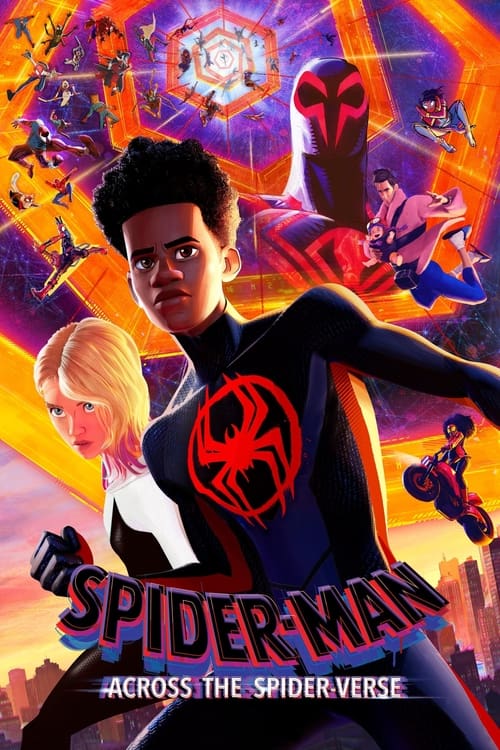
Spider-Man: Across the Spider-Verse
2023 · Kemp Powers
For a big-screen spectacle night when you want to be genuinely wowed — great with a crowd, great with the volume up, and rich enough to rewatch frame by frame.
What it's about
Miles Morales, Brooklyn's teenage Spider-Man, is pulled out of his own world and into a sprawling multiverse policed by the Spider Society — an entire organization of Spider-People. When they clash over how to handle a new threat, Miles finds himself at odds with every other Spider there is, forced to fight for the right to write his own story.
The experience
Overwhelming in the best way — every parallel world has its own art style, and the film moves at a sprint — yet the emotional core, a kid pushing back against everyone telling him who he's allowed to be, lands hard and clean. It's dazzling and sincere at once.
Performances
Shameik Moore gives Miles real stubborn heart, and Hailee Steinfeld makes Gwen Stacy's storyline — rendered in watercolors that shift with her moods — the film's secret emotional anchor.
The craft
Hundreds of artists sustain a half-dozen incompatible visual idioms, often inside a single frame: Gwen's world bleeds like wet watercolor, Mumbattan crackles like hand-inked comic pages, one villain looks scribbled in ballpoint. It's one of the most visually ambitious studio films ever made and demands the biggest screen and best sound you can find.
Why it matters
It proved the first film's revolution was a floor, not a ceiling, pushing mainstream animation even further from one-house-style uniformity and raising the bar for what a blockbuster sequel can attempt.
The rare sequel that treats its predecessor's revolution as a floor, not a ceiling. Miles Morales is pulled out of Brooklyn and into a sprawl of parallel worlds, each rendered in its own idiom — Gwen Stacy's universe washes itself in watercolor that bleeds with her moods, Mumbattan crackles like hand-inked comics pages, and one antagonist looks torn from a ballpoint sketchbook, unfinished lines quivering. Directors Kemp Powers, Justin K. Thompson, and Joaquim Dos Santos coordinate hundreds of artists across what amounts to a half-dozen incompatible aesthetics inside single frames, and the miracle is that the emotional throughline — a teenager insisting on authoring his own story against an institution that calls his life a fixed narrative — never gets lost in the spectacle. It is also, unapologetically, half a film, ending mid-breath in the tradition of The Empire Strikes Back. The canon-versus-anomaly conflict doubles as the movie's own artistic manifesto: the belief that a story can break its prescribed pattern and survive.
A Deleuzian reading
Gwen Stacy's world is made of wet paper.
The full Deleuzian reading of Spider-Man: Across the Spider-Verse →
Reception
It landed in June 2023 as that rare sequel greeted as an instant classic — rocketing into Letterboxd's all-time Top 250 within days — though the glow has since been complicated by reports of a brutally grueling production and grumbles about that to-be-continued ending.
How Spider-Man: Across the Spider-Verse was received, from release to now →
Influences: the films it descends from and the films it influenced
- Spider-Man: Into the Spider-Verse (2018) — Established the entire pipeline the sequel extends: printed-comic Ben-Day/halftone dots, deliberate chromatic-aberration mis-registration, hand-inked contour lines, and characters animated 'on twos/threes' at split frame-rates to read as illustration rather than smooth CG.
- The Empire Strikes Back (1980) — The middle-chapter template it explicitly cites: a darker second act that fractures the ensemble, delivers a hero-crushing revelation, and ends on an unresolved cliffhanger rather than a self-contained arc.
- The LEGO Movie (2014) — Lord & Miller's authorial signature — CG engineered to counterfeit a physical medium (brick stop-motion) plus a meta, self-referential narration about who controls the story — is the DNA of Spider-Verse's medium-mimicry and its 'author your own canon' thesis.
- Paperman (2012) — Pioneered the Meander hybrid of expressive hand-drawn 2D lines layered over 3D CG geometry, the exact 'ink-line on a dimensional model' problem Spider-Verse solved at feature scale.
- Yellow Submarine (1968) — Early proof that a single film can weld incompatible visual idioms — pop-art collage, rotoscope, flat graphic cutouts — into one heterogeneous composited space, the principle Spider-Verse pushes to per-character rendering styles.
- Speed Racer (2008) — Translated comic-book grammar to the screen with layered multi-plane compositing, split-panel simultaneity, and wipe transitions that behave like turning a comics page — a live-action rehearsal for Spider-Verse's panel logic.
- Everything Everywhere All at Once (2022) — Builds a multiverse where each parallel world carries its own visual register and montage rhythm, using rapid heterogeneous cutting between idioms to dramatize identity and self-authorship.
- Puss in Boots: The Last Wish (2022) — Directly adopts Spider-Verse's toolkit — reduced/variable frame rate, visible ink outlines, and painterly storybook brushstrokes over CG — to break DreamWorks house realism into stylized illustration.
- A-ha: Take On Me (1985) — The foundational pencil-sketch/rotoscope aesthetic — animated graphite line-art intercut and morphing with photographed reality — that Spider-Verse revives for its ballpoint and unfinished-drawing characters like The Spot.
- Spider-Man: No Way Home (2021) — Escalates the multi-Spider convergence into a 'canon event' thesis, turning the shared-trauma origin comparison into the film's structuring narrative rule.
- Teenage Mutant Ninja Turtles: Mutant Mayhem (2023) — Extends the ballpoint-sketch idiom Spider-Verse used for Miles's world into a whole film, rendering everything in visible pencil hatching and teenage-notebook doodle texture with fingerprint smudges left in.
- KPop Demon Hunters (2025) — Pushed the modal-stylization technique of assigning each world/character its own rendering style, which KDH echoes by shifting palette and shading register between its demon-realm, idol-stage, and comic-gag modes within one film.
- Loving Vincent (2017) — Renders every frame as a visible brushed painting, treating painterly texture and stroke as the animation's core language — the same conviction behind Gwen's dissolving watercolor world.
- Scott Pilgrim vs. the World (2010) — Embeds native comics devices — onomatopoeia lettering, gutter panels, and graphic sound-effect overlays — directly into the live-action frame as diegetic visual language, the same fusion of print and motion Spider-Verse formalizes.
- Sin City (2005) — Reproduces a graphic novel's ink-black high-contrast panels and spot-color literally, insisting the source's drawn aesthetic survive intact on screen rather than being naturalized.
- Arcane (2021) — Hand-paints texture and brushwork directly onto 3D models so CG reads as moving illustration, and stages editing as multi-artist authored surface — the painterly-over-dimensional approach Spider-Verse shares.
- The Mitchells vs. the Machines (2021) — From the same Lord/Miller–Sony Imageworks lineage, it overlays hand-drawn doodles, emoji, and sketch glyphs onto CG characters as expressive 2D annotation on a 3D base.
- Klaus (2019) — Reintroduced volumetric painted lighting and shadow onto hand-drawn 2D so flat animation gains dimensional form, the inverse-direction experiment (depth into 2D) that parallels Spider-Verse's illustration-into-3D.
- Entergalactic (2022) — Pushes the NPR argument further by giving each world its own illustrative idiom, confirming the same post-Spider-Verse principle Entergalactic leans on: rendering as a stylistic choice, not a realism default.
- Toy Story 5 (2026) — Pushed graphic 2D language — halftone, hand-drawn line, on-screen text and interface panels — into fully dimensional space as lit, camera-aware elements rather than composited overlays, the same problem as rendering flat UI convincingly inside a 3D shot.
Similar films
- Spider-Man: Into the Spider-Verse (2018) — influence & lineage · same viewing thread
- Teenage Mutant Ninja Turtles: Mutant Mayhem (2023) — influence & lineage · same viewing thread
- The Lego Movie (2014) — influence & lineage
- Everything Everywhere All at Once (2022) — influence & lineage
- Spider-Man: No Way Home (2021) — same viewing thread
- Spider-Man: Brand New Day (2026) — same viewing thread
- Spider-Man: Far From Home (2019) — same viewing thread
- The Amazing Spider-Man 2 (2014) — same viewing thread
All the films related to Spider-Man: Across the Spider-Verse →
Watch it with: curated runs of related films
- Anyone Can Wear the Mask — A run of every screen Spider-Man — from Raimi's earnest Queens kid to the multiverse's infinite web-slingers — where the rival reboots stop competing and start rhyming into one myth retold.