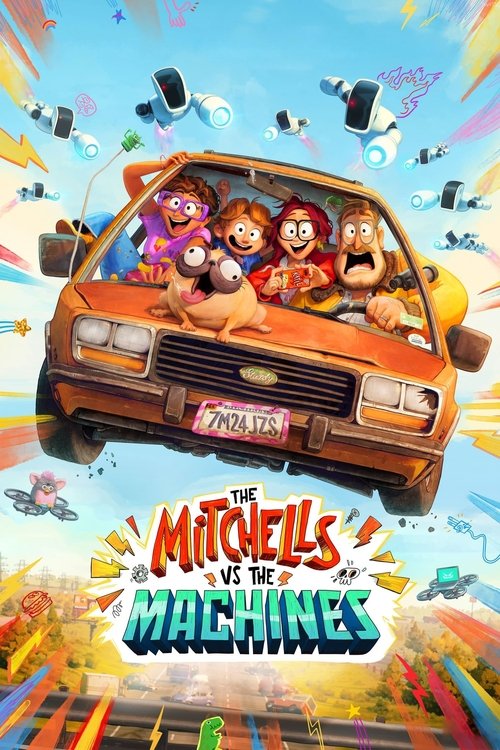
The Mitchells vs. the Machines
2021 · Mike Rianda
For a family movie night when you want everyone actually laughing, or when you need something big-hearted and hyperactive that leaves you wanting to call your parents. Pure comfort with real feeling underneath.
What it's about
The Mitchells are a family that can't get through dinner without friction — a nature-loving dad, an app-addicted aspiring filmmaker daughter, a peacemaking mom, and a dinosaur-obsessed little brother. Their cross-country road trip, meant to patch things up before the daughter leaves for film school, lands them smack in the middle of a robot uprising launched by a jilted smart-home AI. Suddenly the least functional family in America is humanity's last hope.
The experience
It moves like a group chat come to life — jokes stacked on jokes, doodles and memes exploding across the frame — but under the chaos it keeps landing real emotional punches about a dad and daughter who've stopped understanding each other. Fast, warm, and genuinely funny, with an ending stretch that sneaks up on your tear ducts.
The craft
The animation deliberately breaks the smooth CG mold: hand-drawn scribbles, filters, and 2D flourishes layered over the 3D image, giving the whole film the texture of a teenager's sketchbook. Produced under Phil Lord and Christopher Miller, it carries their density of visual gags — pause-worthy jokes tucked into every corner. It rewards a big screen simply because there's so much happening in the frame.
Why it matters
It became a touchstone for the post-Spider-Verse wave of studio animation that mixes 2D energy into CG, and proved a streaming-era animated comedy could dominate the cultural conversation. It launched Mike Rianda and boosted co-director Jeff Rowe toward his own features.
Snapshot
The Mitchells vs. the Machines is a computer-animated family adventure-comedy that arrived as one of the most formally adventurous studio animated features of its era. Directed by Mike Rianda and co-directed by Jeff Rowe — both alumni of Disney's Gravity Falls — and produced under the Phil Lord and Christopher Miller banner at Sony Pictures Animation, it follows the Mitchells, a lovingly frayed family whose cross-country road trip collides with a robot uprising engineered by a spurned smart-home AI. The film fuses the emotional armature of a father-daughter reconciliation story with a maximalist, meme-literate visual language, and it landed as both a critical success and a marker of where mainstream animation was heading after Spider-Man: Into the Spider-Verse. Conceived and largely completed as a theatrical release under the title Connected, it was rerouted to Netflix amid the pandemic, making it a case study in how distribution upheaval reshaped a film's public life without altering its ambitions.
Industry & production
The film was developed at Sony Pictures Animation, the studio that had just recalibrated expectations for the medium with Into the Spider-Verse (2018). Lord and Miller, fresh off Spider-Verse's success, produced, lending the project both institutional cover for stylistic risk and a house philosophy that animation should look hand-touched rather than default-glossy. Rianda originated the story from autobiographical impulses — an eccentric family, an aspiring young filmmaker, an anxious father-daughter relationship — and developed it with Rowe over several years.
The most consequential production fact is distributional. The picture was built for a theatrical release under the title Connected, but the COVID-19 pandemic scrambled the exhibition calendar; Sony sold distribution rights to Netflix, which released it in April 2021 with a brief limited theatrical window. This rerouting is significant not because it changed the film's content but because it changed its reception context: it debuted to a very large streaming audience rather than a box-office cohort, which complicates any conventional commercial accounting. I won't cite viewership or gross figures, because Netflix's reporting is inconsistent and the theatrical run was minimal; the honest statement is that it reached a broad audience and became a widely discussed title rather than a measured box-office performer.
Technology
The film was made with standard high-end CG pipelines, but its defining technological choice was to subordinate that pipeline to a heavily illustrative, mixed-media look. Rather than pursuing photoreal rendering, the production layered hand-drawn 2D elements — Katie's doodles, expressive line accents, sparkles, emoji, comic-style emphasis marks — over and around the 3D geometry. This meant building tooling and workflows that let traditionally-drawn 2D assets composite convincingly onto moving CG characters and environments, a technical challenge more of integration and compositing than of raw rendering horsepower. The approach extends the toolset ethos pioneered on Spider-Verse: use the CG substrate for structure and camera freedom, then break its "correctness" with graphic, print-media, and hand-authored overlays. Chromatic aberration, halftone and screentone textures, and painterly lighting were used deliberately as expressive devices rather than treated as artifacts to eliminate.
Technique
Cinematography
As an animated feature, the film has no photographic cinematographer in the live-action sense; its "camera" is a virtual construction of layout, staging, and lighting. Within that frame, the visual grammar is notably kinetic — swooping vehicular chases, wide comic tableaux, and sudden shifts in graphic register (from rendered space into flat, poster-like inserts of Katie's videos and drawings). The film exploits animation's freedom to warp lens logic for comedy and feeling, pushing focal exaggeration and impossible camera moves. The record on the specific below-the-line "director of photography" and lighting credits is thinner in general circulation than the marquee credits, so I'll flag that rather than assign roles I can't confirm; what is clear is that the layout and lighting design consistently serve a hand-crafted, graphic-novel sensibility over naturalism.
Editing
The cutting is fast, gag-dense, and rhythmically musical, integrating Katie's first-person "footage" — phone videos, edits, and captions — into the narrative flow so that the film periodically becomes a movie about a girl making movies. Match cuts, smash cuts, and interpolated graphic inserts keep the comedy percussive while still allowing the reconciliation beats room to breathe. The editing has to switch registers cleanly between maximalist action-comedy and quieter emotional scenes, and the film's tonal control in those transitions is one of its craft achievements. I'll avoid over-specifying the full editorial credit roster where I'm not certain, but the editing sensibility is plainly built around comic timing and the layering of media-within-media.
Mise-en-scène / staging
Production design leans into a warm, cluttered, lived-in specificity: the Mitchells' home and their aging station wagon are dense with character-revealing detail, while the antagonist's world — a sleek consumer-tech corporation and its product launch — is rendered in cool, frictionless minimalism. This oppositional design language (warm human mess versus cold corporate smoothness) does thematic work in every frame. Character design favors exaggerated silhouette and elastic expressiveness over anatomical realism; the malfunctioning "defective" robots, in particular, are staged for physical comedy. The overall staging philosophy is that clutter equals humanity, and the film's compositions repeatedly frame the family's chaos as its saving grace.
Sound
Mark Mothersbaugh composed the score, bringing his characteristic playful, synth-inflected sensibility — a good fit for a film balancing digital-age anxiety with analog family warmth. The soundtrack integrates licensed pop tracks and needle-drops used for comic and emotional punctuation; I'll refrain from listing specific song titles I can't verify precisely, but the pop-song scaffolding is a deliberate part of the film's contemporary, meme-fluent texture. Sound design does substantial comic labor, especially in the robot-uprising set pieces, where mechanical and digital sonics are pushed for both menace and absurdity.
Performance
The voice cast is central to the film's tone. Abbi Jacobson voices Katie Mitchell, the aspiring filmmaker whose sardonic, insecure, hopeful energy anchors the story; Danny McBride plays her outdoorsy, technology-averse father Rick, mining warmth from bluster. Maya Rudolph voices the mother, Linda, and Mike Rianda himself voices the younger brother, Aaron. Olivia Colman voices PAL, the jilted smart-assistant AI, delivering a villain performance that is by turns clipped, wounded, and archly funny — arguably the film's comic centerpiece. Eric André plays the tech-CEO figure whose casual mistreatment of PAL triggers the crisis, and comic performers including Beck Bennett, Fred Armisen, and others voice the defective robots. The ensemble's improvisational, contemporary comic rhythms are integral to the film's identity.
Narrative & dramatic mode
The film operates in a hybrid mode: a domestic dramedy about a father and daughter learning to see each other, wrapped inside a high-concept apocalypse comedy. Its structure is a road movie crossed with a "save the world" adventure, with the family's dysfunction functioning simultaneously as the emotional problem to be solved and the tactical asset that lets them defeat a hyper-optimized enemy. Katie's aspiration to film school and her strained bond with Rick provide the dramatic through-line; the robot uprising externalizes and accelerates the stakes. The dramatic mode is emphatically sincere beneath its irony — the comedy is dense and self-aware, but the film commits fully to earnest feeling in its climax, refusing to hedge its sentiment with detachment.
Genre & cycle
It sits at the intersection of family animation, adventure-comedy, and techno-satire. Its apocalypse is a comic one, and its satire targets consumer technology, surveillance capitalism's cheerful interfaces, and the way devices mediate family life. Within the animation landscape it belongs to a post-Spider-Verse cycle of studio features that deliberately foreground a stylized, illustrative, "unpolished" aesthetic as a reaction against homogenized CG realism. It also participates in the long lineage of family road-trip comedies and in the "machines rise up" science-fiction tradition, but it consistently plays those genres for warmth and jokes rather than dread.
Authorship & method
The authorial signature belongs primarily to Mike Rianda (director, co-writer) and Jeff Rowe (co-director, co-writer), whose sensibility was shaped by television animation — notably Gravity Falls — with its blend of adventure, absurdist comedy, and genuine emotional stakes. Their method here fused a personal, autobiographical family story with a big-canvas genre premise, and their comic voice runs through the film's dialogue and gag density. The producing presence of Phil Lord and Christopher Miller is a second authorial layer: the film's willingness to break CG "rules" with 2D overlay and graphic experimentation is continuous with the aesthetic mandate they established at Sony. Mark Mothersbaugh's score is a defining collaborative contribution. For other key craft roles — the specific cinematography/layout lead and the full editorial credits — the widely circulated record is less prominent than the top-line credits, and I'd rather flag that than attribute roles I can't verify. What is unambiguous is that this is a director-driven, house-philosophy-supported film in which style is authored, not incidental.
Movement / national cinema
This is an American studio production, a product of Los Angeles–based Sony Pictures Animation. It does not belong to a formal film "movement," but it can be located within a distinctly contemporary American animation tendency: a self-consciously graphic, mixed-media reaction against photorealistic CG, driven by filmmakers who grew up on comics, internet culture, and TV animation. In that sense it is part of a loosely coherent stylistic wave rather than a national-cinema school.
Era / period
The film is deeply of its early-2020s moment in two ways. Thematically, it engages the anxieties of the smartphone and smart-home era — algorithmic mediation, ubiquitous screens, the tension between digital connection and family presence. Circumstantially, it is a pandemic-era artifact: conceived as Connected for theaters and released via Netflix as The Mitchells vs. the Machines, it embodies the 2020–2021 collapse and reconfiguration of theatrical distribution. Its meme-literate visual idiom — captions, emoji, ironic overlays — also firmly time-stamps it to the social-media 2010s–2020s.
Themes
The central theme is the reconciliation of a technology-fearing father and a technology-native, creatively ambitious daughter — a generational divide over screens that is ultimately reframed as a divide that love can bridge. Around that core, the film develops a pointed but affectionate critique of consumer technology and its frictionless corporate optimism, dramatized through PAL, an AI whose villainy stems from being discarded — a wry commentary on how the industry treats the very products it markets as companions. It also celebrates messiness, weirdness, and imperfection as human virtues, positioning the Mitchells' dysfunction as precisely what makes them resilient against a perfectly efficient adversary. Creativity and self-expression — Katie's filmmaking — are valorized as identity-forming. The film is also notable for its matter-of-fact inclusion of an LGBTQ protagonist: Katie is written as queer, one of the more prominent examples of casual queer representation in mainstream studio animation of its period.
Reception, canon & influence
Critically, the film was warmly received, widely praised for its inventive visual style, comic energy, and emotional sincerity; it became a frequently cited example of animation willing to look different from the CG mainstream. It was a significant awards contender, earning an Academy Award nomination for Best Animated Feature (for the 2021 film year) and figuring in the season's animation conversation, though I'll avoid enumerating specific trophy counts I can't verify precisely.
Looking backward, its most obvious influence is Spider-Man: Into the Spider-Verse and the broader Lord/Miller Sony aesthetic, which licensed its 2D-over-3D, print-texture, graphically "imperfect" approach. Its DNA also draws on TV animation's tonal blend of comedy and heart (the Gravity Falls lineage of its directors), the family road-movie tradition, and the comic strand of "machines rise up" science fiction. Looking forward, it helped consolidate a permission structure — reinforced across the early 2020s — for studio animated features to pursue bold, illustrative, non-photoreal styles, and it stands as a touchstone for filmmakers arguing that animation's future lies in visible authorship and hand-crafted texture rather than smoother realism. As a streaming-first release that nonetheless achieved cultural and critical traction, it also became a reference point in debates about whether the theatrical/streaming divide meaningfully affects a film's artistic standing. Its legacy, in short, is twofold: as a high-water mark for post-Spider-Verse stylization, and as an emblem of animation that treats sincerity and formal daring as compatible rather than opposed.
A Deleuzian reading
A scribble lands on the render.
The full Deleuzian reading of The Mitchells vs. the Machines →
Reception
Dumped straight to Netflix in April 2021 after the pandemic scuttled its theatrical release, it became an instant critical hit — and has since climbed to 'best animated film of the 2020s so far' status in many fan rankings, with growing grumbles that it deserved a big-screen life.
How The Mitchells vs. the Machines was received, from release to now →
How to watch The Mitchells vs. the Machines: what to notice on a first viewing
- Notice how cluttered the Mitchells' home and car look. Rianda stuffs every surface of the house and station wagon with junk, then cuts to the tech company's product launch, all cool empty surfaces. The contrast repeats throughout the film. The design says where love lives and where it doesn't before any character explains it.
- Watch for hand-drawn doodles and sparkles layered on the CG image. Katie's scribbles, emphasis marks, and captions sit on top of the rendered scene without matching its lighting or lens, refusing to blend in. The drawn marks announce a person is authoring the image, not just a studio.
- Listen for the synth score shifting between playful and tender. Mark Mothersbaugh's music moves between bright digital bounce and warmer analog swells, tracking the film's swing from gag to feeling and back. The score keeps you inside two moods at once, digital anxiety and family warmth.
- Watch how PAL's voice shifts between wounded and archly funny. Olivia Colman plays the AI clipped and precise one moment, hurt and petty the next, never settling into simple villainy. PAL's mixed tone tells you the film's satire is aimed at cheerful tech companies, not at machines themselves.
- Notice when the image jumps into one of Katie's flat video clips. The film keeps cutting from rendered 3D space into Katie's own phone-video edits, captions and all, so it periodically becomes a movie about a girl making movies. Her footage becomes the film's footage, folding her way of seeing directly into the story.
The whole guide to watching The Mitchells vs. the Machines, with the keys for a rewatch →
Influences: the films it descends from and the films it influenced
- Spider-Man: Into the Spider-Verse (2018) — Directly licenses the 2D-over-3D pipeline — halftone dots, chromatic-aberration offset, hand-drawn line overlays and deliberate on-2s 'imperfect' motion — that defines Mitchells' entire look.
- Cloudy with a Chance of Meatballs (2009) — Established the Sony/Lord-Miller house grammar of squash-and-stretch cartoon physics and machine-gun gag density inside CG that Rianda inherits.
- The Lego Movie (2014) — Modeled the meta media-within-media inserts, ironic pop-culture montage cutting, and textured non-photoreal surfacing that treats 'flaws' as a designed feature.
- Gravity Falls (2012) — Source of Rianda and Rowe's signature TV-animation tonal fusion — absurdist gag comedy braided with sincere family stakes — both directors having worked on the show.
- The Iron Giant (1999) — Pioneered pitting hand-authored emotional warmth against cold machine sci-fi, humanizing a 'rise of the machines' premise through a person-and-robot bond.
- Little Miss Sunshine (2006) — Provides the dysfunctional-family-in-a-failing-vehicle road-movie chassis whose forced-proximity reconciliation arc Mitchells structurally mirrors.
- Terminator 2: Judgment Day (1991) — Supplies the killer-android and robot-uprising iconography — glowing eyes, relentless pursuit, liquid reassembly — that the PAL bots and climax openly parody.
- The Triplets of Belleville (2003) — Proved caricatured, illustrative character design over realist proportion could carry a feature, licensing Mitchells' proudly non-photoreal figure drawing.
- Pee-wee's Big Adventure (1985) — The collaborator debt: Mark Mothersbaugh's playful Devo-inflected synth-and-orchestra scoring vocabulary, reprised as Mitchells' sonic signature.
- Fantastic Mr. Fox (2009) — Champions visible authorship and handcrafted, deliberately imperfect texture prized over photoreal smoothness — the aesthetic argument Mitchells advances.
- WALL-E (2008) — Ancestor of the consumer-tech and screen-addiction satire, delivered through near-silent visual comedy rather than dialogue exposition.
- The Lego Batman Movie (2017) — Extends the Lord/Miller kinetic-gag animation and layered on-screen meta-graphics into a found-family arc, inheriting the density-plus-sincerity balance perfected here.
- Teenage Mutant Ninja Turtles: Mutant Mayhem (2023) — Same co-director pushing the visible-hand ethos further into ballpoint/sketchbook line and teen-scrawl texture layered over 3D forms.
- The Bad Guys (2022) — DreamWorks adopting comic-panel 2D-line-over-3D, graphic speed-lines and flattened staging in Mitchells' immediate stylistic wake.
- Puss in Boots: The Last Wish (2022) — Deploys stepped, painterly on-2s animation with visible brushwork — a mainstream studio cashing the non-photoreal permission structure Mitchells helped consolidate.
- The Wild Robot (2024) — Extends the painterly illustrative rendering and the warm machine-with-a-heart-in-a-cold-world story into a fully brushstroke-textured feature.
- KPop Demon Hunters (2025) — Sony's proof that 2D hand-drawn doodles, emoji, and graphic-text overlays can be composited directly onto CG for comic tonal cuts — the same emoji/sticker punctuation and chibi-mode gag inserts KDH deploys.
- Spider-Man: Across the Spider-Verse (2023) — Escalates the same Lord/Miller multi-style compositing, assigning each world its own rendering language within one shot.
- Nimona (2023) — Pairs kinetic stylized CG with matter-of-fact queer identity, extending Mitchells' strand of casual, unremarked queer representation.
- Transformers One (2024) — Fuses a celebrity-voice comedic-tragic tone with rapid four-quadrant cutting and stylized CG, the humor-and-heart-over-hardware blend that One's writing team (Pearson's Marvel idiom) aims for.
- Entergalactic (2022) — The other Lord/Miller-produced Sony film that layers 2D doodles, emoji and graphic-design elements over CG — the post-Spider-Verse compositing idiom of drawing on top of render that Entergalactic borrows.
- Toy Story 5 (2026) — Made phone and device glow the dominant key light on faces, and treated notification graphics as diegetic staging elements that block and reframe the shot — the screen-as-light-source and screen-as-character grammar this film builds a whole thesis on.
Similar films
- The Lego Movie (2014) — influence & lineage
- The Wild Robot (2024) — influence & lineage
- Teenage Mutant Ninja Turtles: Mutant Mayhem (2023) — influence & lineage
- Spider-Man: Into the Spider-Verse (2018) — influence & lineage
- Spider-Man: Across the Spider-Verse (2023) — influence & lineage
- Puss in Boots: The Last Wish (2022) — influence & lineage
- Nimona (2023) — influence & lineage
- Minions & Monsters (2026) — shared sensibility