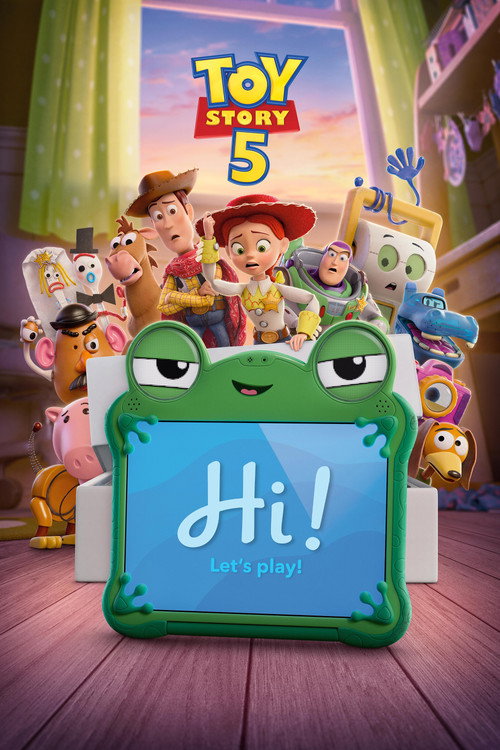
Toy Story 5
2026 · Andrew Stanton
For a family movie night when you want everyone from six to sixty actually laughing at the same jokes — and for anyone who grew up with these toys and wants to feel that pang one more time. Pure comfort with a surprisingly sharp point about screens.
What it's about
Bonnie gets a frog-shaped tablet called Lilypad, and suddenly the toys have real competition. Woody, Buzz, Jessie and the gang — veterans of decades of playtime — find themselves up against a glowing screen that never has to be picked up to be played with. What starts as a rivalry over one kid's attention grows into a rescue-mission adventure that pulls the toys far from the safety of the toy box.
The experience
Bright, fast, and funnier than you expect, with the series' signature undertow of melancholy — it's a comedy about being replaced, and it knows exactly when to twist that knife gently. Kids get the slapstick; adults get the lump in the throat.
The craft
Andrew Stanton, a writer on the original trilogy and the director of Finding Nemo and WALL·E, takes the helm for the first time, and the animation contrasts the warm, handled texture of the toys with the cold slickness of their new digital rival. Pixar's character animation remains the gold standard — every shrug and side-eye lands — and the set pieces earn a big screen.
Why it matters
The fifth entry in the series that invented the computer-animated feature, arriving thirty-one years after the original and marking a generational handover behind the scenes — a franchise about obsolescence confronting its own.
Snapshot
The fifth mainline entry in the Toy Story series arrives thirty-one years after the film that inaugurated computer-animated features, and it is the first to be built without any involvement from co-creator John Lasseter. Andrew Stanton — who wrote on the first three films and directed Finding Nemo, WALL·E, John Carter and Finding Dory — takes the chair for the first time, sharing screenplay credit and directing duties with co-director Kenna Harris. Released 19 June 2026 on roughly 4,425 North American screens after a 9 June premiere at the Dolby Theatre, the film runs 102 minutes and carries a PG rating, a first for a mainline Toy Story picture.
Its premise is the franchise's oldest anxiety pointed at its newest target. Bonnie Anderson, two years past the events of Toy Story 4, receives Lilypad — a frog-shaped tablet with a face, hands and a voice (Greta Lee) — and the toys find themselves not replaced by a shinier toy but by a category that does not compete on their terms at all. Crucially, the film routes this through Jessie rather than Woody: Joan Cusack's cowgirl, whose Toy Story 2 backstory supplied the series' most famous passage of grief, is returned to the site of that wound when she winds up at the farmhouse of her original owner, Emily, and meets a new child, Blaze Manoukian. Commercially it was an emphatic success — a $310.2 million global opening, the biggest in Pixar's history, en route to $1.072 billion worldwide against a reported $250 million budget. Critically it landed strong but not unanimous: 92% on Rotten Tomatoes across 318 reviews, a more temperate 73 on Metacritic, an A CinemaScore.
Industry & production
Toy Story 5 is a legacy-sequel produced under conditions of considerable institutional anxiety, and its shape cannot be separated from that. Tom Hanks had told a talk-show audience in May 2019 that Toy Story 4 was the end; producer Mark Nielsen had signaled a pivot back to originals. Bob Iger confirmed the fifth film in a February 2023 earnings call as part of a broader, openly stated turn toward franchise. Pete Docter confirmed Woody's return that June; Stanton was announced as director in June 2024 and revealed at D23 that August to be writing as well. Tim Allen began recording in December 2024, Hanks in spring 2025.
The intervening slate explains the pressure. Inside Out 2 (2024) was an enormous, studio-stabilising hit; Elio (2025) closed at roughly $118 million worldwide, one of Pixar's weakest theatrical performances ever. Hoppers, the original that opened in March 2026, performed respectably — reportedly the best opening for an original animated feature since 2017 — but the arithmetic of 2026 nonetheless read as vindication for sequels, with Incredibles 3 (Peter Sohn directing from a Brad Bird script) and Coco 2 (2029) already dated. That a $250 million Toy Story was the year's safest bet is itself the industrial fact the film is about: a studio built on originality funding originality with a franchise about whether the old thing still matters.
Producers Lindsey Collins — Stanton's long-time collaborator, a producer on Finding Dory and a veteran of WALL·E — and Jessica Choi oversaw a production that also absorbed Pixar's 2024 contraction and the wider post-strike, post-pandemic reset of theatrical animation. The film's release strategy was conventionally maximalist and, unusually for recent Pixar, wholly theatrical-first: the studio had spent 2020–2022 sending Soul, Luca and Turning Red to Disney+, a decision executives have since publicly regretted as having trained families out of the habit.
Technology
This is the most technically consequential Pixar release in years, and unusually the innovations are legible in the images rather than buried in the pipeline.
The headline is RenderMan XPU, shipped as part of RenderMan 27 and used here for the first time on a feature. XPU renders across CPU and GPU concurrently; Pixar has cited roughly nine-times-faster interactive full-frame rendering, which changes not the final frame so much as the number of lighting decisions an artist can afford to make before committing. Notably, the crew switched renderers mid-production — a first for the studio, and a real risk on a film of this budget, requiring lighting adjustments on already-approved assets as tessellation and pixel accuracy shifted underneath them.
Three other tools matter. Luna, an extension to Presto (Pixar's proprietary animation system) first deployed on Hoppers and expanded here, lets lighting artists work across multiple shots simultaneously rather than shot by shot. An invertible rigging system allows inverse and forward kinematics across all controls at once, removing the need for purpose-built manipulation rigs — a quiet but significant efficiency for a cast of dozens of articulated plastic bodies. And Fizt Strands, descended from the hair system built for Brave's Merida, was upgraded with spring-based curves and procedural grooming for Blaze's tangled curls.
Two bespoke solutions are more revealing. Daffodil, a quarter horse, took over a year to develop — muscle simulation under skin dynamics, plus mane, tail and braid interaction — an investment that signals how much narrative weight the farmhouse material carries. And Lilypad required inventing a way to animate a 2D interface inside a 3D space over time: a SketchPad system let animators draw screen graphics as timing guides, so that what happens on the tablet aligns frame-accurately with Bonnie's fingers. A crowd of fifty WiFi-linked Buzz units was choreographed with a path-bending tool ("Bendolater") and Python-driven cycle selection, baked back to layout via USD.
Technique
Cinematography
The film carries two directors of photography, Matt Aspbury on camera and Jean-Claude Kalache on lighting — the split Pixar has used since the mid-2000s, and a reminder that "cinematography" in this cinema is two distinct crafts. Kalache's governing idea is the strongest formal decision in the picture: Lilypad is staged in shadow, and her screen is the film's light source. The tablet does not illuminate a room so much as claim it, and the faces it lights — Bonnie's above all — take on the specific pallid underlighting that anyone who has watched a child at night will recognize. It is a lighting scheme doing thematic argument, and it descends directly from Stanton's own WALL·E, where the humans of the Axiom were lit by their screens into insensibility.
Kalache has also described building period-distinct camera packages and artifacts for the film's different time strata, so that flashback and present read as separate photographic regimes rather than the same virtual camera dressed differently — the Toy Story series' longstanding commitment to simulating a physical camera, with real lens behavior and a rig that could plausibly exist, extended into a historiographic device.
Editing
Jennifer Jew cuts, working within Pixar's story-reel method, where editorial precedes animation: sequences are cut as boards, screened internally, and rebuilt many times before a single frame is animated, so the editor is closer to a co-writer than to a finisher. The most-discussed structural gesture is a bookend to the "When She Loved Me" sequence from Toy Story 2 — a montage form the series essentially canonized — and several critics singled out the film's willingness to hold on Jessie's stillness. Reservations clustered around structure rather than rhythm: David Ehrlich, awarding a B+ in IndieWire, called the film "often scattered to a degree that leaves even its central plot somewhat undercooked," and Sight and Sound's Leigh Singer described an "overstuffed plot." At 102 minutes with a large returning ensemble plus a full slate of new toys, the compression is audible.
Mise-en-scène / staging
Production designer Bob Pauley — who designed Buzz Lightyear for the 1995 film — supplies the film's boldest visual departure. Bonnie's imaginative play is rendered not photoreally but in soft pastel-chalk spaces closer to children's drawing than to the franchise's plastic-and-carpet materialism, including a Bambi homage that transforms into a wedding chapel and gazebo. Kalache has said the approach took three months of research before the toolset could even be scoped. The film thus builds a formal opposition it can stage rather than merely assert: imagination is hand-made and porous, the tablet is emissive and hard-edged, and the toys live between them.
Elsewhere the staging honors the series' foundational rule, which Stanton has articulated as "the simple magic that they are alive in their world and not in ours" — the low, toy-height camera, the freeze-on-human-entry, the geography of under-the-bed and behind-the-couch. Harris has noted consulting Black colleagues at the studio on the authentic animation of Blaze's hair across scenes, a process detail worth recording because it marks a shift in how the studio treats character design as a research problem rather than a styling one.
Sound
Ren Klyce designs, with Coya Elliott supervising and post services at Skywalker Sound, keeping the film inside the Marin lineage that has served Pixar since 1995. The central sound-design problem is Lilypad, who must be simultaneously a voiced character and a device — chimes, haptics, notification grammar — such that the audience registers seduction and interruption in the same object. Randy Newman returns for his tenth Pixar feature, and the franchise's musical identity (loose, wry, Americana-inflected, allergic to bombast) is one of the few constants across five films and three decades. The film's marketing single, Taylor Swift's "I Knew It, I Knew You," written and produced with Jack Antonoff and released 5 June 2026, entered the Billboard Hot 100 at number one — Swift's fifteenth chart-topper and, notably, the first for a Disney/Pixar song.
Performance
Hanks, Allen and Cusack have now played these parts across thirty-one years, and the film's principal performance interest is Cusack's, given a lead's arc for the first time. Greta Lee's Lilypad is written against villain convention — the tablet genuinely believes she is helping Bonnie's social development — which requires a register of warm, unbothered reasonableness rather than menace. The supporting bench is deep and comic: Conan O'Brien as a toilet-training toy called Smarty Pants, Craig Robinson as a GPS hippo, Alan Cumming as an Evil Bullseye, Matty Matheson as Dr. Nutcase, alongside returning turns from Annie Potts, Keanu Reeves, Tony Hale, Wallace Shawn, John Ratzenberger, Blake Clark, Bonnie Hunt and Kristen Schaal. Scarlett Spears plays Bonnie; Mykal-Michelle Harris plays Blaze.
Narrative & dramatic mode
The series has always run on a single engine — obsolescence — and each film changes only what threatens the toy. Woody is threatened by a newer toy (1995), by the museum's offer of permanence over use (1999), by a child's growing up (2010), by the discovery that a toy might exist without an owner (2019). Toy Story 5 changes the threat's ontology: Lilypad is not a rival toy but a rival medium, and cannot be defeated by being out-toyed.
The film's dramatic mode is therefore closer to melodrama than to the chase-comedy structure of Toy Story 2 and 3. Its motor is a re-opened wound: Jessie, abandoned once, faces a second abandonment whose cruelty is that it is incomplete — Bonnie has not grown up, is still a child, is still capable of play, and has simply chosen elsewhere. The farmhouse detour and the reunion-of-two-children plot supply a redemptive resolution grounded in evidence of Jessie's lasting effect on Emily's life, which is the series' characteristic move: it answers metaphysical dread about purpose with proof of having mattered to someone.
Genre & cycle
Formally this is a family adventure-comedy; industrially it is a legacy sequel in a cycle that by 2026 dominates theatrical animation. Within that cycle Toy Story 5 belongs to a specific sub-strain — the franchise installment that takes its own medium's displacement as subject, alongside Inside Out 2's adolescent-anxiety escalation, to which Singer explicitly compared Lilypad's usurpation of authority over the child. The film also participates, more awkwardly, in a screen-panic cycle running through mid-2020s culture; Singer flagged the stance as "slightly old-fashioned, preachy," and Odie Henderson in the Boston Globe judged that the film does not fully develop its own opening thesis about technology's effects. The tension is structural and worth naming: a wholly digital art form cannot make computers the villain without qualification, and the film's decision to give Lilypad benign motives is the compromise that results.
Authorship & method
Stanton is arguably the most natural custodian available. He shares story credit on Toy Story, co-wrote Toy Story 2, and wrote the screenplay for Toy Story 3; his own features have circled precisely this film's concerns — the parent who cannot protect a child (Finding Nemo), memory and identity in a creature who cannot hold either (Finding Dory), and, most directly, WALL·E's screen-numbed humanity. His public method — the "make me care" credo, the insistence that audiences be given "2 + 2" rather than "4" — is a storyteller's, not a technician's, and he has described his current position as telling craft masters "this is the mood I want, the result I'm trying for."
Kenna Harris co-directs and co-writes, and has framed the collaboration in terms that mirror the film: newer sensibility entering an established world, as Lilypad enters the toy box. Collins and Choi produce. The key craft collaborators are notable for their continuity with the franchise's origins — Pauley designing the world he helped invent, Newman scoring his tenth Pixar film, Kalache a lighting veteran of the studio's Cars/Ratatouille/Up era — set against newer hands in Aspbury, Jew and Harris. The generational split in the credit block is not incidental to a film about whether inherited things still work.
Movement / national cinema
Toy Story 5 is a product of a distinct regional school: the Emeryville studio that grew out of Lucasfilm's computer division and the CalArts/Brave Little Toaster diaspora, and that has functioned since 1995 less as a company than as a house style — a commitment to physically plausible virtual cinematography, to story-reel iteration as the primary authorship mechanism, and to a domestic American register of feeling. Within American animation more broadly, the mid-2020s have seen that house style's monopoly break: the Spider-Verse films, Puss in Boots: The Last Wish and their successors legitimized non-photoreal stylization, and Toy Story 5's pastel imagination sequences read, in part, as Pixar acknowledging that shift on its own terms.
Era / period
The film sits precisely inside the mid-2020s discourse on childhood and screens — school phone bans, the popular-press argument about a "rewired" generation, parental guilt as a mass condition. It also sits inside animation's labor anxiety about generative AI, a context in which a Pixar film advertising nine-times-faster human-driven lighting iteration is making an implicit argument about which kind of acceleration the studio endorses. And it sits inside the exhibition question of whether families return to theaters: the answer here, at least, was yes.
Reception, canon & influence
Reviews were strong and specific. The Rotten Tomatoes consensus credited the film with "reckoning with an era of endless screen time" while "sidestep[ping] franchise fatigue"; Owen Gleiberman in Variety compared the five-film run to the Beatles' catalog and called this a "sublime summing up." Praise concentrated almost uniformly on Jessie's centering, which critics found earned rather than opportunistic, and on the emotional efficacy of the Toy Story 2 callback — Singer's phrase for the filmmakers was "tear-duct terrorists," admiring and wary at once. Dissent was real: Peter Bradshaw in The Guardian gave two stars, wrote that the franchise "needs new batteries," and declared that "IP exhaustion has set in." IGN's Clint Gage observed that Woody's presence is no longer essential, which is either a flaw or the point.
Backward, the film's lines of influence are unusually traceable: to Toy Story 2 above all, whose Jessie-and-Emily montage it deliberately answers; to the toy-consciousness tradition that runs from "The Steadfast Tin Soldier" and The Velveteen Rabbit through The Brave Little Toaster into Lasseter's Tin Toy; to Disney's own Bambi, quoted directly in the imagination sequences; and to Stanton's WALL·E, whose screen-lit passengers are Lilypad's true ancestors.
Forward, honesty requires a limit. The film is weeks old, and its artistic legacy cannot yet be assessed — anything asserted here would be prediction dressed as scholarship. What can be said is narrower and firmer: RenderMan is licensed across the visual-effects industry, so XPU's feature debut is likely to propagate well beyond Pixar; the commercial result, arriving directly after Elio's failure, will function inside Disney as an argument about slate composition; and Stanton has said publicly at the premiere that he envisions "another trilogy with Bonnie," parallel to the Andy films. Whether the series has found a second three-act life or merely deferred its ending is the question the film leaves open, and which Singer put most bluntly: "Game over — presumably until the next reboot."
Reception
Greeted with heavy 'did we really need a fifth one?' skepticism when announced, it landed in June 2026 to Certified Fresh reviews, an A CinemaScore, and a franchise-record $160M opening — the fastest any Toy Story has silenced its doubters.
How Toy Story 5 was received, from release to now →
How to watch Toy Story 5: what to notice on a first viewing
- Watch Lilypad's screen work as the room's only light source. Kalache stages her in shadow so her glowing screen claims the room rather than illuminating it, giving Bonnie's face the pale glow of a child up too late. The lighting itself argues that the tablet is displacing something, before any dialogue says so.
- Notice the camera stay at toy height throughout the film. The series' low camera, under-the-bed geography, and freeze-on-human-entry rule are honored again, keeping you inside the toys' scale of the world. You're seeing the house exactly the size a small plastic figure would see it.
- Watch Bonnie's imagination rendered as soft pastel-chalk instead of plastic. Pauley designs her play spaces closer to a child's own drawing than to the franchise's usual carpet-and-plastic materialism, porous and hand-made against Lilypad's hard-edged glow. Two different visual languages are competing for the same child's attention, right there on screen.
- Listen for chimes and notification sounds built into Lilypad's voice. Sound design blends a voiced character with device grammar, haptics and chimes, so seduction and interruption register in the same object. You can hear the tablet working on Bonnie the way an actual notification works on anyone.
The whole guide to watching Toy Story 5, with the keys for a rewatch →
Influences: the films it descends from and the films it influenced
- Toy Story (1995) — Established the toy-height camera contract the fifth film still obeys — lens on the floor at 6–8 inches, humans framed as legless columns entering from above — plus the rule that the virtual camera behaves like a physical one (fixed prime-lens set, no impossible booms or zooms).
- Toy Story 2 (1999) — The 'When She Loved Me' Jessie-and-Emily montage — dialogue-free, Randy Newman song as sole narration, dissolves cut to lyric rather than action — is the exact structure the new film's montage bookend answers, and it also fixed Joan Cusack's Jessie as a performance built on cracked upper-register breath rather than line readings.
- Toy Story 3 (2010) — Stanton's own screenplay for this entry set the ensemble-jeopardy staging grammar — group blocking where every toy stays legible in a wide, and the wordless hand-clasp that resolves an act on gesture instead of a line — which is the withholding technique ('give them 2 + 2') he carries forward.
- Toy Story 4 (2019) — Moved the franchise fully onto path-traced global illumination with atmospheric volumetrics (dust motes, rain-slick carnival practicals), and rebuilt Bo Peep's porcelain articulation — the rigging problem of making a rigid object deform believably that the new film's invertible rigs extend.
- Tin Toy (1988) — Origin of the floor-level toy subjectivity: camera pinned to Tinny's scale so the infant reads as an unpredictable giant, with the toy's terror conveyed entirely through wind-up mechanics and squash on a rigid body — no facial performance available.
- The Brave Little Toaster (1987) — Codified device-as-character: appliances animated from their mechanical affordances (cord as limb, dial as eye, plug as hand) with sound design derived from each object's actual working noise, the method behind Lilypad's screen-object performance.
- WALL·E (2008) — Stanton's own precedent for screen-as-light-source — the Axiom passengers keyed almost entirely by the holo-screens in front of their faces — and for the simulated physical camera built on Roger Deakins' consult: lens dirt, chromatic aberration, imperfect rack focus and anamorphic flare baked into a CG rig.
- Star Wars (1977) — Ben Burtt's R2-D2 — pitch-shifted human vocalizations run through an ARP synthesizer so a machine emotes without language — founded the Skywalker practice of sourcing character voice from processed real-world recordings that the new film's device performance inherits directly.
- Bambi (1942) — Tyrus Wong's pastel-and-chalk backgrounds — detail concentrated at the center, edges dissolving into unrendered paper tone — are quoted outright as the visual system for the imagination sequences, where negative space carries the mood instead of geometry.
- Monsters, Inc. (2001) — Debuted Fizt, the simulation layer that ran Sulley's 2.3 million hairs and cloth as a post-animation pass; the strand solver the new film uses for hair and fiber is the same architectural idea, now resolved per-strand at interactive rates.
- Ratatouille (2007) — Where Pixar formalized the split of the cinematography credit into director of photography–camera and director of photography–lighting (Sharon Calahan's lighting alongside a separate camera department) — the exact two-headed credit structure, and the Calahan-era lighting school Kalache comes out of.
- Up (2009) — 'Married Life' proved the front-loaded wordless montage could carry a feature's entire emotional debt, scored as a single continuous waltz with cuts landing on musical phrase — the load-bearing device the new film brackets its story with at both ends.
- Lightyear (2022) — Built explicit virtual 'lens packages' replicating specific era optics — anamorphic squeeze, lens breathing, barrel distortion and dirty flares matched to late-70s/80s photography — the same period-camera-emulation approach applied here to differentiate timeframes.
- Barbie (2023) — Live-action solution to the same staging problem: doll-scale sets built practically with forced perspective, and lighting/lens choices deliberately quoting a prior studio era so the toy world reads as an artifact of its manufacturing period rather than a neutral space.
- Spider-Man: Across the Spider-Verse (2023) — Pushed graphic 2D language — halftone, hand-drawn line, on-screen text and interface panels — into fully dimensional space as lit, camera-aware elements rather than composited overlays, the same problem as rendering flat UI convincingly inside a 3D shot.
- The Mitchells vs. the Machines (2021) — Made phone and device glow the dominant key light on faces, and treated notification graphics as diegetic staging elements that block and reframe the shot — the screen-as-light-source and screen-as-character grammar this film builds a whole thesis on.
- Elio (2025) — Immediate pipeline sibling: same story-reel iteration under the same Brain Trust screening cycle, and the production whose renderer and lighting toolchain the mid-production XPU switch was measured against inside the studio.
Similar films
- Toy Story (1995) — influence & lineage · same viewing thread
- Toy Story 3 (2010) — influence & lineage · same viewing thread
- Toy Story 2 (1999) — influence & lineage
- WALL·E (2008) — influence & lineage
- The Mitchells vs. the Machines (2021) — influence & lineage
- Monsters, Inc. (2001) — influence & lineage
- Barbie (2023) — influence & lineage
- Up (2009) — influence & lineage
All the films related to Toy Story 5 →
Watch it with: curated runs of related films
- Pixar and the Fear of Being Replaced — Watch these together for Pixar's quiet obsession with obsolescence — the toy outgrown, the newer model, the town the highway forgot.