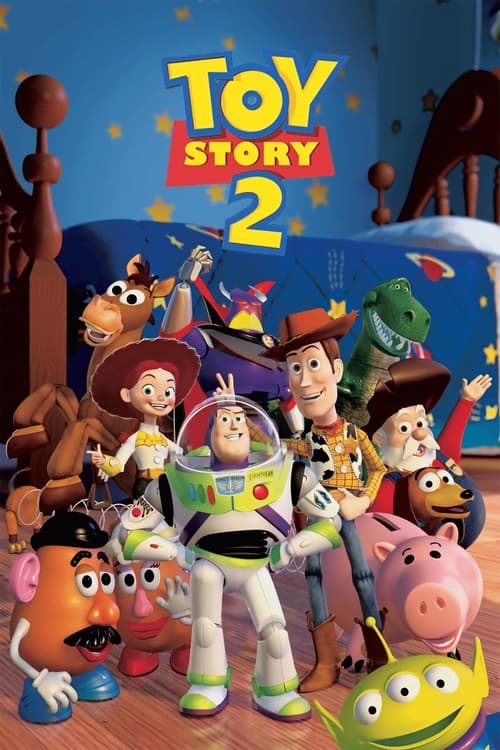
Toy Story 2
1999 · John Lasseter
For a family movie night, or when you want something joyful that still gives you a lump in your throat — pure comfort with an ache in it.
What it's about
With Andy away at Cowboy Camp, Woody is stolen by a greedy toy collector who knows something Woody doesn't: he's a rare collectible from a forgotten 1950s TV show, worth a fortune to a museum. While Buzz leads the other toys on a rescue mission across town, Woody meets the rest of his old ensemble — including a cowgirl named Jessie — and faces a real choice between being preserved forever behind glass and going home to a boy who will one day grow up.
The experience
A fast, funny adventure comedy that keeps sneaking up on you with real feeling — one musical flashback about being outgrown has made generations of adults cry without warning. It's breezy on the surface and quietly devastating underneath.
Performances
Tom Hanks and Tim Allen are in full command of Woody and Buzz by now, and Joan Cusack's Jessie brings a raw, openhearted energy the series hadn't had before.
The craft
Made in a famously compressed production, it pushed 1999 computer animation visibly forward — more expressive faces, busier sets, a toy's-eye action setpiece in an airport. The writing is the real feat: a rescue caper, an identity comedy, and a meditation on being loved and left behind, all in ninety brisk minutes.
Why it matters
Widely cited as one of the rare sequels to equal or surpass its original, it proved Pixar's first film was no fluke and set the emotional template — comedy that earns real grief — the studio has followed ever since.
Snapshot
Toy Story 2 is the rare sequel that has entered film history less for what it added to a franchise than for what it proved about an art form still in its infancy. Released in November 1999, four years after Pixar's epochal Toy Story (1995), it took the premise of toys with inner lives and pushed it toward something close to tragedy: the recognition that to be loved by a child is to be, eventually, outgrown. Where the first film dramatized rivalry and belonging, the sequel dramatizes mortality and obsolescence — Woody's discovery that he is a valuable collectible forces a choice between the deathless preservation of a museum and the finite, perishable love of a single boy. That thematic ambition, achieved within a brisk family comedy, is the reason critics so often cite it among the handful of sequels that equal or surpass their originals. Its production history is equally storied: conceived as a modest direct-to-video release, nearly lost to an accidental server deletion, and salvaged through a punishing nine-month creative overhaul, it became both a commercial triumph and a foundational case study in how Pixar's collaborative method actually worked.
Industry & production
The film's origins lie in the business logic of late-1990s Disney. Sequels to animated hits were, at that moment, the province of the direct-to-video division — cheaper, faster productions designed to monetize beloved properties on home formats. Toy Story 2 was initially developed on that track, with a smaller budget and reduced expectations, and Ash Brannon directing under John Lasseter's supervision. As the work progressed, Disney concluded the material was strong enough to warrant theatrical release, a decision that raised the stakes enormously and, in passing, ignited a contractual dispute between Disney and Pixar over whether a theatrical sequel counted toward the multi-picture deal the two companies had signed — a tension that foreshadowed their later, more public falling-out.
The pivotal episode is the production's near-collapse and rescue. When the existing story reels were screened for Pixar's "brain trust" — Lasseter, Andrew Stanton, Pete Docter, Lee Unkrich and others — the consensus was that the film, as assembled, did not work; it lacked the emotional weight Pixar expected of itself. Rather than ship a serviceable sequel, the studio chose to substantially rebuild the story in roughly nine months ahead of a fixed release date. The resulting crunch is part of Pixar lore: an intense period of overwork that, by multiple accounts, contributed to repetitive-strain injuries among the crew and became a cautionary tale the studio cites when discussing sustainable production. Lasseter took full directorial control, with Brannon and Lee Unkrich credited as co-directors.
The other legendary incident is technical. During production a mistaken command on Pixar's Unix file system began deleting the film's assets; the safety backups proved inadequate. The film was reportedly preserved only because supervising technical director Galyn Susman, who had recently had a baby and was working from home, had a local copy of the files. The story — recounted in the home-video supplements — has become one of the most repeated anecdotes in computer-animation history and a standard parable about data backup. As with several production legends, the precise particulars vary in the retelling, and the version best supported is the one Pixar staff have described in interviews and DVD features.
Commercially, the film was a major success, widely reported to have outperformed the original at the box office and to have ranked among the top earners of its year; it also won the Golden Globe for Best Motion Picture — Musical or Comedy. Specific grosses are reported in many sources, but exact figures should be checked against a reliable database before citation.
Technology
Toy Story 2 was built on RenderMan, Pixar's proprietary rendering software, and represents a clear generational advance over the 1995 original. The most visible gains are in scale and complexity: crowded, prop-dense environments such as Al's Toy Barn and the climactic airport sequence contain orders of magnitude more geometry than anything in the first film, with denser sets, more sophisticated lighting, and far greater control over surface and texture. Improvements in shading and skin and cloth rendering give the human characters — Al, Andy's mother — more convincing presence, mitigating some of the uncanny stiffness that dated the people of Toy Story.
The film also occupies a notable place in the transition to digital exhibition. It is frequently cited as the first feature created, mastered, and exhibited entirely through digital means, and it was among the earliest films shown via digital projection in a small number of theaters during its 1999 run — an early data point in the long migration away from photochemical film that would accelerate over the following decade. The technical pipeline benefited from intervening work on A Bug's Life (1998), and the studio's tools for layout, simulation, and rendering had matured measurably in the four years since the first picture.
Technique
Cinematography
With Sharon Calahan serving as director of photography, the film extends Pixar's project of importing live-action camera and lighting grammar into a wholly synthetic space. The "camera" obeys the logic of real lenses and rigs — the production deliberately constrains itself to moves a physical camera could plausibly execute, lending the images a grounded, photographed quality rather than the weightless omniscience available to animation. Lighting does expressive work throughout: the warm, nostalgic glow of the "Woody's Roundup" flashback material; the cold fluorescent expanse of the toy store; the melancholy dimming of the "When She Loved Me" montage. The result is a visual scheme that treats toys as subjects worthy of dramatic chiaroscuro.
Editing
Editing duties were shared, with Lee Unkrich — soon to become one of Pixar's central directors — among the key figures shaping the cut alongside the editorial team. The film's construction is notable for cross-cutting between two parallel quests (Woody's captivity and the rescue party's expedition) and for its set-piece pacing, which builds toward the airport climax with escalating momentum borrowed from action cinema. The film closes with a now-famous reel of faux "outtakes" — bloopers staged as if the animated characters were live actors flubbing takes — a comic device that became a Pixar signature and that depends entirely on editorial timing for its effect.
Mise-en-scène / staging
The production design — with art direction reflecting the work of Pixar's design leads — is dense with observed detail about the material culture of toys: packaging, collectible-grade boxes, the iconography of a fictional 1950s Western TV show. Staging repeatedly exploits scale, contrasting the smallness of the toys against vast human environments (the store aisles, the airport conveyor systems). The "Woody's Roundup" sequences are a sustained pastiche of mid-century children's television and merchandising, while Al's apartment and store function as a museum of consumer artifacts — settings that literalize the film's argument about objects as either things to be played with or things to be preserved.
Sound
The sound design distinguishes the textures of plastic, cloth, and mechanism, and the film's aural world supports its comedy of scale. The most consequential sound choice is musical (below). Voice performance and sound effect are tightly integrated, particularly in the running gag of "new" Buzz Lightyear, whose factory-fresh delusion is conveyed as much through vocal delivery and the click of his utility belt as through animation.
Performance
Animation here is performance, and the returning ensemble's vocal work anchors it. Tom Hanks gives Woody a deepened interiority — the character's crisis is one of identity and worth — while Tim Allen plays both the familiar Buzz and the comic foil of a second, still-deluded Buzz. The film's emotional discovery is Joan Cusack's Jessie, whose abandonment backstory supplies the picture's most affecting passage. Kelsey Grammer voices Stinky Pete the Prospector, whose genial surface masks a bitterness rooted in never having been bought or loved — a villain motivated by the same longing that drives the heroes. The supporting bench — Don Rickles, Wallace Shawn, John Ratzenberger, Estelle Harris, Annie Potts, Wayne Knight as Al — gives the comedy its texture.
Narrative & dramatic mode
Structurally the film is a rescue narrative threaded through a coming-to-terms story. Its dramatic engine is Woody's dilemma: having learned that he is a rare artifact destined for a Tokyo toy museum, he must weigh immortality-as-exhibit against the certain heartbreak of being a child's toy who will one day be outgrown. This is melodrama in the precise sense — a drama of moral feeling and choice — embedded within fast comedy and action. The screenplay (story by Lasseter, Docter, Brannon and Stanton; screenplay credited to Stanton, Rita Hsiao, Doug Chamberlin and Chris Webb) externalizes the theme through doubling: Jessie embodies the fate Woody fears, the Prospector embodies the resentment that fate can breed, and the second Buzz embodies the danger of a fixed, un-examined identity.
Genre & cycle
The film sits at the intersection of the family-animated feature, the buddy comedy, and the adventure-quest, while functioning as a knowing exercise in pastiche. It absorbs and parodies multiple cycles: the mid-century TV Western and its merchandising; the Star Wars saga, most overtly in the Emperor Zurg confrontation that mirrors the franchise's most famous paternal revelation; and the conventions of the rescue-adventure itself. As the first Pixar sequel, it also helped inaugurate the studio's franchise era and the broader turn-of-the-century shift in which computer animation began displacing hand-drawn features as Hollywood's dominant animated form.
Authorship & method
The film is a clear expression of John Lasseter's authorship — his sincerity about emotional stakes, his affection for toys and Americana, his insistence that technological spectacle serve story. But it is equally a monument to Pixar's collaborative method, in which the "brain trust" subjects films to candid group critique and stories are rebuilt without ego when they fail. The decision to dismantle and reconstruct a nearly finished film is the defining act of that method. Key collaborators include co-directors Ash Brannon and Lee Unkrich; director of photography Sharon Calahan; composer Randy Newman; and the screenwriting team led by Andrew Stanton. Randy Newman's contribution is central: alongside his score, the song "When She Loved Me," performed by Sarah McLachlan over Jessie's flashback, is the film's emotional keystone and earned an Academy Award nomination for Best Original Song. The reprise of "You've Got a Friend in Me" binds the sequel to its predecessor.
Movement / national cinema
The film belongs to American studio animation and, more specifically, to the Pixar-led computer-animation movement that reshaped Hollywood in the late 1990s and 2000s. It is a product of the Disney distribution machine and the Northern California digital-effects culture from which Pixar emerged. While its iconography is steeped in American consumer and television history, its narrative — pointedly turning on a Japanese museum acquisition — registers the globalized collector economy of its moment.
Era / period
Arriving at the close of 1999, the film stands at a hinge point: the last year before the new millennium, the tail end of hand-drawn animation's commercial primacy, and the early dawn of digital cinema. Its preoccupation with obsolescence, preservation, and the passage from one generation to the next reads, in hindsight, as quietly attuned to a transitional cultural moment — and to an industry in the midst of replacing one technology of moving images with another.
Themes
The film's governing theme is mortality and obsolescence: the inevitability that a loved object will be outgrown, and the question of what gives a life — or a thing — its meaning. Against the false immortality of the museum case, the film argues for the worth of being used, loved, and ultimately let go. Related strands include abandonment (Jessie's history, the threat of the yard sale and the broken Wheezy), the opposition between collecting and playing — preservation versus use as rival values — and the construction of identity (the two Buzzes, Woody's discovery of his own history). Underlying all of it is a meditation on love as something valuable precisely because it is finite.
Reception, canon & influence
Critically, Toy Story 2 was received with near-unanimous admiration, frequently praised as a sequel that matched or bettered its origin — Roger Ebert was among its prominent champions — and it won the Golden Globe for Best Motion Picture — Musical or Comedy. Commercially it was a substantial hit, generally reported to have surpassed the original.
Its influences run backward into American popular culture: the singing-cowboy and TV-Western traditions of the 1950s, the merchandising and collectible economies those shows spawned, and the Star Wars mythology it affectionately quotes. Looking forward, the film's legacy is considerable. It cemented Pixar's reputation for emotional depth and helped legitimize the animated sequel as a vehicle for genuine artistic ambition rather than mere brand extension. It established conventions the studio would reuse — the closing outtakes reel chief among them — and its willingness to confront loss and mortality in a family film cleared a path for the studio's later, more openly elegiac work, including Toy Story 3 (2010), directed by Lee Unkrich, whose own development as a filmmaker is visible across this trilogy. Within film history more broadly, it is remembered both as an artistic high-water mark for late-1990s computer animation and as the source of enduring industry lessons — about creative courage in the face of a finished-but-flawed film, and about the perils of inadequate backups.
A Deleuzian reading
A girl's bedroom seen through the same window, the light wheeling from morning to dusk and back, over and over, while a cowgirl doll lies still on the floor where she was dropped.
The full Deleuzian reading of Toy Story 2 →
Reception
Famously started life as a cheap direct-to-video sequel before Pixar upgraded it to a full theatrical release — and it landed as that rarest thing, a sequel critics called equal or better than the original. If anything it's since become the trilogy's middle child, with Toy Story 3 stealing some of its 'best of the series' thunder.
How Toy Story 2 was received, from release to now →
Influences: the films it descends from and the films it influenced
- Toy Story (1995) — Established the toy's-eye staging, the RenderMan plastic-surface pipeline, and the 'You've Got a Friend in Me' theme that TS2 reprises to bind the sequel to the original.
- Luxo Jr. (1986) — Lasseter's breakthrough short that proved squash-and-stretch character animation and convincing weight on a wholly inanimate object — the foundational grammar for animating toys as actors.
- Tin Toy (1988) — First CG short to win the animation Oscar; pioneered the consumer-toy texture rendering and the toy's anxious, low-angle POV that TS2's collector subplot extends.
- Star Wars (1977) — Directly pastiched in the Zurg/'I am your father' gag and the opening Buzz video-game homage, drawing on the same Lucasfilm/Skywalker Sound craft lineage Pixar grew out of.
- Jurassic Park (1993) — ILM's photorealistic CG lighting and surface integration legitimized digital characters sharing a frame with live-action grammar, the rendering bar Sharon Calahan's photography answers to.
- Who Framed Roger Rabbit (1988) — Subordinated cartoon characters to live-action camera moves, lens flares, and motivated lighting — the photographic discipline Calahan imports into a fully synthetic world.
- Snow White and the Seven Dwarfs (1937) — Defined the feature-length animated melodrama in which songs carry genuine pathos and loss, the Disney inheritance Pixar claims with Newman's score and 'When She Loved Me.'
- Imitation of Life (1959) — The maternal-abandonment melodrama and saturated emotional crescendo behind Jessie's flashback — montage and music compressing a lifetime of being loved and discarded.
- Melody Ranch (1940) — A Gene Autry singing-cowboy vehicle of the kind 'Woody's Roundup' lovingly reconstructs, supplying the 1950s TV-Western iconography and merchandising aesthetic the film pastiches.
- A Bug's Life (1998) — Directly continued the closing fake-outtakes / blooper-reel gimmick A Bug's Life popularized, alongside the scaled-up production model it validated.
- Toy Story 3 (2010) — Unkrich, a TS2 co-director, pushes its confrontation with abandonment and mortality to an openly elegiac climax, inheriting the trilogy's willingness to let toys face oblivion.
- Up (2009) — The wordless 'Married Life' montage is the direct heir of Jessie's flashback technique — score plus image compressing an entire life into minutes of melodrama.
- Monsters, Inc. (2001) — Advances the same RenderMan material-texture push (fur and surface detail) and vocal-ensemble buddy dynamic, developed through the identical brain-trust revision method.
- The Lego Movie (2014) — Extends the consumer-artifact mise-en-scène and brand-pastiche staging — playthings as protagonists in a world built entirely from their own commercial design language.
- Toy Story 5 (2026) — The 'When She Loved Me' Jessie-and-Emily montage — dialogue-free, Randy Newman song as sole narration, dissolves cut to lyric rather than action — is the exact structure the new film's montage bookend answers, and it also fixed Joan Cusack's Jessie as a performance built on cracked upper-register breath rather than line readings.
- Finding Nemo (2003) — Stanton, who led TS2's writing team, builds another separation-and-reunion melodrama under brain-trust critique, extending Pixar's loss-driven story architecture.
- The Incredibles (2004) — Turns affectionate genre pastiche — 1960s spy-fi and superhero idiom — into a feature-animation mode the way TS2 pastiches Star Wars and the TV Western.
- Shrek (2001) — DreamWorks' rival pop-culture pastiche feature, lifting TS2's mode of dense cross-referential genre quotation into computer-animated comedy.
- Shrek 2 (2004) — The benchmark 'sequel surpasses original' in CG animation, proving a follow-up could expand the world and out-craft the first — the exact achievement Shrek 2 replicated commercially and formally.
Similar films
- Toy Story (1995) — influence & lineage
- Toy Story 3 (2010) — influence & lineage
- Finding Nemo (2003) — influence & lineage
- Up (2009) — influence & lineage
- Monsters, Inc. (2001) — influence & lineage
- The Lego Movie (2014) — influence & lineage
- The Incredibles (2004) — influence & lineage
- Who Framed Roger Rabbit (1988) — influence & lineage