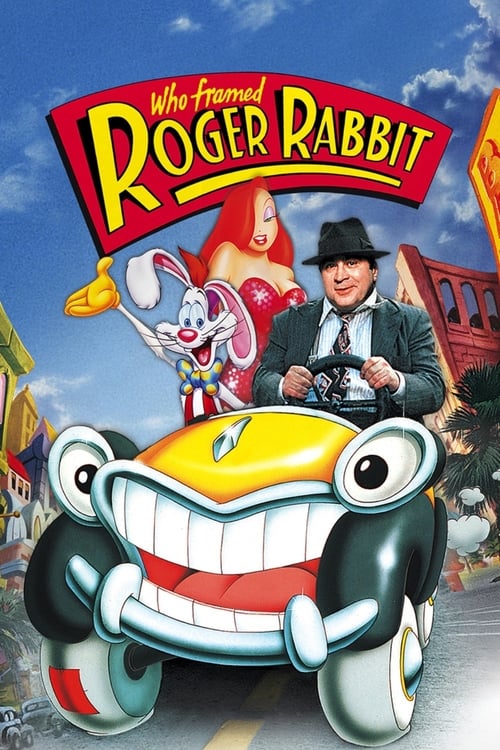
Who Framed Roger Rabbit
1988 · Robert Zemeckis
For when you want pure playful invention — a night where you'd like to be dazzled and cracked up at the same time, and maybe feel a little wistful about old Hollywood. Comfort viewing with more brains than it needs to have.
What it's about
In 1940s Los Angeles, cartoon characters are real — they live among humans, work for the studios, and have their own troubled neighborhood, Toontown. Roger Rabbit, a jittery toon star, fears his wife Jessica is stepping out on him, so the studio hires Eddie Valiant, a rumpled human detective with a grudge against toons, to look into it. When a powerful man turns up dead and Roger becomes the prime suspect, Eddie is dragged into a murder case that runs deeper than anyone wants to admit.
The experience
It plays like a fast, funny noir where the gags never stop but the shadows are real — one minute you're laughing at cartoon slapstick, the next you're genuinely worried for a rabbit. Under the mayhem there's a surprising streak of melancholy about a broken-down man learning to laugh again.
Performances
Bob Hoskins does something quietly heroic: he plays every scene opposite characters who weren't there on set, and makes you believe in them completely — his grumpy, grieving Eddie is the film's anchor. Christopher Lloyd is memorably chilling as the villain.
The craft
The technical feat still astonishes: hand-drawn characters composited into live-action footage with real weight, shadow, and eye-lines, so toons grab real props and bump real furniture. Zemeckis stages it all with genuine noir atmosphere — smoky bars, wet streets — and the seams barely show even today. It rewards a big screen, where the density of visual jokes becomes almost overwhelming.
Why it matters
A landmark of animation-meets-live-action that helped reignite Hollywood's faith in animation itself, and a once-in-history act of studio diplomacy that put Disney and Warner characters in the same frame. Its blend of period noir and cartoon anarchy has been imitated ever since, rarely matched.
Snapshot
Who Framed Roger Rabbit is a live-action/animation hybrid that stages a 1940s film noir inside a world where cartoon characters ("Toons") are a living underclass of the Hollywood labor economy. Directed by Robert Zemeckis and produced under Steven Spielberg's Amblin banner for Disney's Touchstone and Amblin, it followed Zemeckis's breakthrough with Back to the Future (1985) and arrived as one of the most technically ambitious and expensive productions of its moment. Its lasting significance is double: as a feat of optical compositing that gave hand-drawn characters convincing weight, shadow, and presence within photographed space, and as an unprecedented act of studio diplomacy that put Warner Bros. and Disney's flagship characters on screen together. The film was a major commercial success and won multiple Academy Awards, and it is widely credited with helping revive mainstream appetite for animation on the eve of the Disney Renaissance.
Industry & production
The film adapts Gary K. Wolf's 1981 novel Who Censored Roger Rabbit?, though the screenplay by Jeffrey Price and Peter S. Seaman substantially reconceived the material, relocating the mystery into a recognizable noir Los Angeles of 1947 and reworking the central crime. Disney had held rights to the property for years; the project became viable when Spielberg's Amblin Entertainment came aboard, giving it the clout to negotiate one of the production's defining features — the appearance of characters owned by rival studios. The Warner Bros. cameos (Bugs Bunny, Daffy Duck), Paramount/Fleischer's Betty Boop, and others were secured through individual licensing arrangements, reportedly with contractual stipulations about parity of screen time between competing stars (the Bugs–Mickey parachute gag and the dueling-pianos scene with Donald and Daffy are the visible results). Some sought-after characters could not be cleared, and the roster reflects what was legally attainable rather than a free authorial choice.
Production was transatlantic: live action was shot largely in England, while the animation was executed at Richard Williams's London studio, with optical compositing handled by Industrial Light & Magic in California. This division, combined with the labor-intensive frame-by-frame integration, drove a long and costly post-production. The film was released through Touchstone Pictures, Disney's adult-oriented label, which allowed for a more suggestive tone (Jessica Rabbit's design, the noir violence) than the core Disney brand permitted at the time.
Technology
The film's technical reputation rests on making two-dimensional drawn characters appear physically embedded in photographed three-dimensional environments — and, crucially, doing so with a moving camera rather than the locked-off shots that had constrained earlier hybrid films. Live-action plates were photographed first; actors performed opposite empty space, rubber stand-in props, and mechanical rigs. To give the human performers eyelines and physical objects to react to, the production used articulated puppets and rod- or wire-operated props (an approach sometimes described in accounts of the shoot as robotic "puppeteering" of on-set objects), which were later removed or painted out.
The animation was then drawn to match each shot's perspective and camera movement. What distinguished the result from predecessors was the lighting treatment: rather than reading as flat cels laid over film, the Toons received added shadows, highlights, and rim/tone effects — often described as adding "bumps and grinds" or dimensional shading — so they seemed to occupy the same lit space as the actors. This was achieved through multiple optical passes at ILM under visual-effects supervisor Ken Ralston, layering the character artwork with separately generated shadow and highlight elements. The labor cost was extraordinary, with a very high number of individually composited effects frames. The visual-effects work and Richard Williams's animation direction were both recognized by the Academy.
Technique
Cinematography
Dean Cundey, Zemeckis's regular collaborator, shot the film, and his contribution is more than a plate-photographer's: because the animation had to be married to the live footage, the camerawork had to be planned with the compositing in mind while still delivering the mobile, expressive noir look the film wanted. Cundey's lighting leans on the chiaroscuro grammar of 1940s detective pictures — hard shadows, venetian-blind slats, pools of light in dark interiors — which does double duty, evoking noir and providing the dramatic lighting logic that the animators then had to honor on the Toons. The willingness to move the camera through space during Toon interaction was itself a statement of technical confidence.
Editing
Arthur Schmidt, another core Zemeckis collaborator, edited the film and won the Academy Award for Film Editing. The editing challenge was acute: comic timing between human actors and characters who did not physically exist on set had to be built and sustained, and the cutting had to preserve the illusion across shots of wildly different technical origin. The film's rapid gag construction — especially in the frenetic Toontown sequences — depends on editorial precision.
Mise-en-scène / staging
The staging is organized around the collision of two visual regimes: a grimy, period-accurate live-action Los Angeles and the anarchic, elastic physics of Toontown. Sets, props, and blocking had to accommodate absent co-stars, so scenes are choreographed around the eventual insertion of the Toons. The production design pastiches studio-era Hollywood — soundstages, seedy bars, a talent agency economy — grounding the fantasy in a specific industrial milieu.
Sound
Sound design is a major expressive channel, and the film won the Academy Award for Sound Effects Editing. Cartoon violence, physical impact, and the constant business of Toon movement are carried by an elaborate effects track that fuses classic animation sound conventions with the acoustic realism of the live-action world — a sonic bridge between the two orders of reality the film keeps colliding.
Performance
Bob Hoskins anchors the film as detective Eddie Valiant, and his performance is the linchpin of the illusion: for it to work he had to react convincingly to characters who weren't there. Accounts of the production describe the demanding rehearsal and imaginative discipline this required, with Charles Fleischer — who voiced Roger — reportedly performing on set in costume to give Hoskins an eyeline and rhythm to play against. Christopher Lloyd's Judge Doom supplies a coldly menacing human antagonist, his stillness a deliberate counterweight to Toon chaos. Fleischer's vocal work defines Roger's hysteria, and Jessica Rabbit was voiced (uncredited) in speech by Kathleen Turner, with Amy Irving providing the singing.
Narrative & dramatic mode
The film adopts the classical detective-noir structure — a hired investigation that escalates into a murder frame and a wider conspiracy — but plays it in a comic, self-aware register. Eddie Valiant is a burnt-out gumshoe with a Toon-related trauma in his past; the case pulls him from surveillance of Jessica into the killing of Marvin Acme and a scheme to destroy Toontown. The dramatic engine is the noir convention of the ordinary man drawn into forces larger than himself, refracted through slapstick. The dual-mode storytelling — real stakes (murder, mortality, urban destruction) told alongside cartoon gags — is the film's signature narrative gambit, and it depends on the audience accepting Toons as both comic and genuinely killable.
Genre & cycle
The film is best understood as a hybrid: a neo-noir pastiche fused with theatrical animation, sometimes labeled "toon noir." It sits within the 1980s cycle of effects-driven, Amblin-adjacent family event pictures while also participating in the era's broader nostalgia for classic Hollywood. Within the lineage of combined live-action-and-animation films — a tradition running from the Alice Comedies and Song of the South through Mary Poppins and Bedknobs and Broomsticks — Roger Rabbit is the watershed that made the integration feel physically seamless rather than charmingly artificial.
Authorship & method
Robert Zemeckis directs with the meticulous, machine-tooled construction that characterizes his work, and the film reflects his enduring fascination with technology as a storytelling instrument — a preoccupation that would later carry him into performance-capture animation. His key collaborators form a recognizable Zemeckis unit: cinematographer Dean Cundey and editor Arthur Schmidt, both regulars, and composer Alan Silvestri, whose orchestral score supplies the noir gravity and momentum against which the cartoon anarchy plays. The screenplay is by Jeffrey Price and Peter S. Seaman, adapting Wolf. Steven Spielberg's role as producer was decisive, particularly in enabling the cross-studio character rights. And the animation authorship belongs substantially to Richard Williams, whose direction of the animation and creation of the cartoon characters earned him a Special Achievement Academy Award; his sensibility — draughtsmanly, kinetic, steeped in classical animation craft — shapes the film's non-photographic half.
Movement / national cinema
The film is a product of the American studio blockbuster system in its Amblin-inflected 1980s form — the Spielberg/Zemeckis nexus of technically maximal, broadly commercial popular cinema descended from New Hollywood's ambitions but oriented toward spectacle and family audiences. Its animation, however, was made in Britain at Williams's London studio, giving the production a genuinely transatlantic character that pairs Hollywood industrial muscle and setting with British animation craftsmanship.
Era / period
Released in 1988, the film belongs to a specific hinge moment. Disney's live-action arm was reasserting itself through Touchstone, while its animation division stood just before the commercial resurgence of The Little Mermaid (1989) and the Renaissance that followed. Roger Rabbit is frequently cited as a catalyst for renewed cultural and industrial interest in animation, helping set the stage for that revival and for the early-1990s "cartoon boom." Its diegetic period — 1947 Los Angeles — also lets it engage the postwar city at the moment of its automotive transformation.
Themes
Beneath the slapstick, the film is unusually thematically loaded. Mortality is literalized: Toons are effectively immortal except when exposed to "the Dip," a solvent that can erase them, making death an ever-present and genuinely frightening stake in a comic universe. The narrative's conspiracy — a plan to dismantle Toontown and the Red Car streetcar line to build a freeway — evokes the real dismantling of Los Angeles's electric rail system and the automobile's reshaping of the city, giving the fantasy a note of historical grievance about urban planning and corporate power. Toontown itself invites allegorical readings as a segregated, marginalized community whose inhabitants are exploited as entertainers and mistrusted as citizens, though the film holds these readings lightly rather than programmatically. Threaded through it all are the noir staples of jealousy, marriage, and betrayal, and a persistent self-reflexivity about Hollywood as an industry built on manufactured performers.
Reception, canon & influence
Critical reception was strongly favorable, with particular praise for the technical achievement and for the audacity of the studio-crossover conceit; the film was a substantial box-office success and won multiple Academy Awards, including Film Editing, Sound Effects Editing, and Visual Effects, plus the Special Achievement Award to Richard Williams. It has since entered the canon as the definitive live-action/animation hybrid and a landmark of pre-digital effects craft.
Looking backward, the film draws on the classic-Hollywood detective picture and hard-boiled noir for its plot and visual grammar, on the golden-age animation traditions of Disney, Warner Bros., and Fleischer for its characters and gag vocabulary, and on the earlier Disney tradition of combining actors with animation. Looking forward, its influence is broad. It directly spawned a short run of Roger Rabbit theatrical cartoons and is commonly credited as part of the momentum behind animation's early-1990s commercial revival. Its central idea — Toons and humans sharing the screen and the frame — recurs in later hybrids such as Cool World (1992), Space Jam (1996), and Looney Tunes: Back in Action (2003). For Zemeckis specifically, the film's obsession with dissolving the line between the drawn and the photographed prefigures his later, controversial embrace of performance-capture animation. A long-promised sequel never materialized, and the record on exactly why remains partly a matter of industry rumor rather than settled fact — a point worth flagging rather than overstating.
A Deleuzian reading
A rabbit stands in a detective's office in 1947 and the venetian blinds cut him into stripes.
The full Deleuzian reading of Who Framed Roger Rabbit →
Reception
A smash hit in 1988 and a technical marvel even then, it's only grown in stature — now seen as an unrepeatable miracle of studio cooperation and the film that kickstarted the 90s animation renaissance.
How Who Framed Roger Rabbit was received, from release to now →
Influences: the films it descends from and the films it influenced
- Alice's Wonderland (1923) — Founded the core conceit Roger Rabbit inherits — a live-action performer photographed and then composited into a hand-drawn cartoon world sharing the same frame.
- The Three Caballeros (1944) — Pushed the Disney hybrid into sustained integration, with Donald Duck dancing among photographed performers rather than isolated inserts, establishing the toon-as-full-participant staging.
- Anchors Aweigh (1945) — Gene Kelly's dance with Jerry the mouse solved the eyeline-and-contact problem — matching an animated figure's timing to a live performer's touch — the same interaction craft Hoskins and Roger depend on.
- Song of the South (1946) — Uncle Remus strolling and singing beside Br'er Rabbit is the film's most direct model: prolonged live-action/animation coexistence in one continuous shot, not a novelty cutaway.
- Mary Poppins (1964) — Its sodium-vapor traveling-matte process for clean-edged actor/cartoon composites is the pre-digital optical toolkit Roger Rabbit refined and pushed to feature-length scale.
- The Maltese Falcon (1941) — Supplies the hard-boiled private-eye plot architecture and morally shadowed detective grammar that Eddie Valiant's investigation reenacts beat for beat.
- Double Indemnity (1944) — Its venetian-blind chiaroscuro noir lighting is the visual regime Dean Cundey restages for the live-action half, against which the flat cartoon brightness plays.
- Chinatown (1974) — Models the noir detective who uncovers a civic-infrastructure conspiracy — water there, the Red Car and freeway here — the exact urban-planning-grievance engine driving Roger Rabbit's plot.
- Duck Amuck (1953) — Its self-reflexive gag logic — a toon knowingly aware of its own medium and its animator — is the meta-cartoon sensibility Roger and the Toontown rules extend.
- Back to the Future (1985) — Consolidated the Zemeckis/Cundey/Silvestri/Schmidt unit and the machine-tooled effects-comedy construction that Roger Rabbit executes with the same precision timing.
- Cool World (1992) — A direct descendant of the toon/human shared-frame noir premise, applying the same detective-in-a-cartoon-underworld staging with a darker adult register.
- Space Jam (1996) — Extends the feature-length compositing of live-action stars into Looney Tunes space, riding the commercial revival Roger Rabbit's success helped ignite.
- Looney Tunes: Back in Action (2003) — Carries forward the studio-crossover toon/human comedy, mixing rival cartoon rosters with human leads in the same self-aware Hollywood-backlot frame.
- Forrest Gump (1994) — Advances the same seamless-compositing obsession into the digital era, invisibly inserting a photographed performer into archival footage as Roger Rabbit inserted toons into photographed sets.
- The Polar Express (2004) — Represents the endpoint of Zemeckis's drive to dissolve the drawn and the photographed, converting the hybrid impulse into full performance-capture animation.
- Enchanted (2007) — Revives the self-aware hand-drawn-toon-enters-live-action-city device, sending an animated character into a photographed New York with the same fish-out-of-Toontown premise.
- Toy Story 2 (1999) — Subordinated cartoon characters to live-action camera moves, lens flares, and motivated lighting — the photographic discipline Calahan imports into a fully synthetic world.
- The Adventures of Tintin (2011) — Spielberg-produced hybrid that married cartoon physics to a roving, weighty live-action camera language — the precedent for staging exaggerated comic-strip action with photographic camera dynamics.
- Ready Player One (2018) — Spielberg-produced template for cross-studio IP cohabitation in a single frame, pioneering live-action/animated integration that the OASIS's mascot-crowd compositing scales up.
- Monsters, Inc. (2001) — Codified a cartoon dimension existing in parallel to the human world accessed through portals/doors — the exact conceit behind Monstropolis and the closet-door gateway.
- Shrek (2001) — Pioneered the mass cross-property fairy-tale/cartoon ensemble — dozens of licensed and public-domain storybook figures crammed into one frame, the crowd-of-fairy-tale-refugees logic Shrek runs on.
- Shrek 2 (2004) — Pioneered the celebrity-cameo/pop-culture-collision comic universe — a fantasy world stuffed with recognizable references — that Shrek 2's Far Far Away (a fairy-tale Hollywood) elaborates into wall-to-wall showbiz satire.
- The Thief and the Cobbler (1993) — Williams's own animation direction here codified the squash, weight and light-interaction he was simultaneously refining on the Thief — shared authorship, same craft laboratory.
- Aladdin (1992) — Its rubber-hose 'plasmatic' squash-and-stretch, letting a character morph shape at will, is the elastic vocabulary Eric Goldberg deploys for the shape-shifting Genie.
- The Muppet Christmas Carol (1992) — Bob Hoskins's committed straight-faced acting opposite absent co-stars is the same eyeline-and-conviction method Caine uses to make singing puppets read as real scene partners.
- Gremlins 2: The New Batch (1990) — The contemporaneous case for importing Warner cartoon physics wholesale into live-action space and for cross-studio character quotation as a structural principle, where Dante achieves the same collision with puppets, opticals, and one animated Daffy Duck.
Similar films
- Back to the Future (1985) — influence & lineage
- Toy Story (1995) — shared sensibility
- Zootopia (2016) — shared sensibility
- Coyote vs. Acme (2026) — shared sensibility
- Minions & Monsters (2026) — shared sensibility
- Beetlejuice (1988) — shared sensibility
- Tron (1982) — shared sensibility
- Ratatouille (2007) — shared sensibility