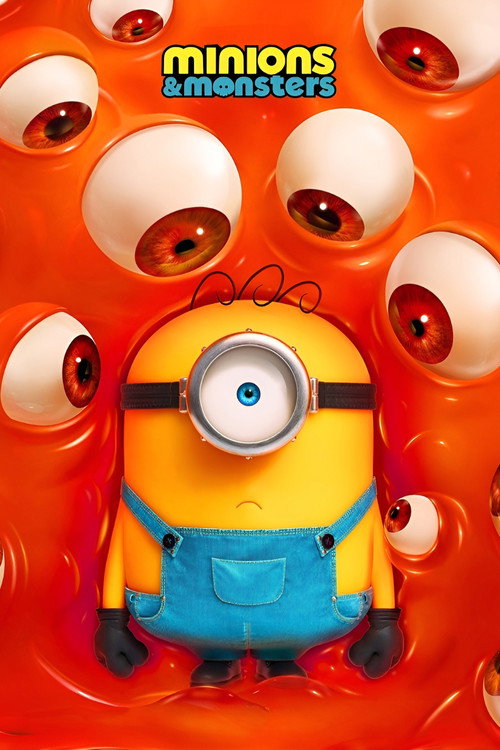
Minions & Monsters
2026 · Pierre Coffin
For family movie night or when you want to switch your brain off and giggle — total comfort viewing that asks nothing of you but a bowl of popcorn.
What it's about
The 'totally true' story of how the Minions took over Hollywood: they become movie stars, lose it all, accidentally unleash actual monsters on the world, and have to band together to clean up their own mess. It's a showbiz rise-and-fall saga told through the little yellow henchmen, complete with winks at silent film and old Hollywood.
The experience
Fast, silly, and joke-dense — slapstick pinballing off movie-history gags, with just enough heart under the chaos. The kids laugh at the pratfalls; adults catch the Hollywood satire flying overhead.
The craft
Pierre Coffin, who has shepherded the Minions from the start (and voices them), builds the comedy on wordless physical timing — gibberish, gesture, and sight gags doing the work dialogue usually does. The old-Hollywood setting gives the animators a playground of period pastiche, from silent-film homage on up.
Why it matters
The Minions are one of animation's biggest global franchises, and this entry extends their run by turning the lens on Hollywood itself — the machine that made them stars.
Snapshot
Minions & Monsters is the latest extension of the most commercially durable animated brand of the twenty-first century: the yellow, gibbering Minions who began as background gag-characters in Despicable Me (2010) and metastasized into a self-sustaining franchise. What distinguishes this entry is its register. Rather than another present-tense chaos machine, Coffin has made a period piece: 1920s Hollywood, where a tribe of Minions accidentally becomes film stars, only to be fired when sound arrives — a predicament one Minion, James, answers by pursuing his dream of making a monster movie. Coffin has described the setup as a Singin' in the Rain situation: the Minions cannot speak English when the talkies come, so the very gibberish that made them silent-comedy naturals becomes their professional undoing. The film premiered at the Annecy animation festival on June 21, 2026, opened in US theaters through Universal on July 1, runs 90 minutes, and became another major commercial success for Illumination, grossing roughly $527 million worldwide against an $85 million budget. Critics received it warmly on the whole — 89% on Rotten Tomatoes across 183 reviews, a Metacritic score of 70, and an A- CinemaScore — while splitting sharply on its second half, which several reviewers found a letdown after an unusually tender and cinephilic first hour.
Industry & production
The Minions belong to Illumination, the animation label founded by Chris Meledandri in 2007 and distributed by Universal Pictures. Illumination's defining industrial characteristic is its cost discipline: the studio has consistently produced features at budgets substantially below those of Pixar or Disney Animation while generating outsized theatrical returns, and the Minions properties have been the cornerstone of that model. Minions & Monsters holds the pattern exactly — an $85 million budget, modest by American studio-animation standards, returning $527 million worldwide, of which $183 million came from the domestic market and $343 million from international territories.
Production was centered, as across the franchise, at Illumination Studios Paris, the operation grown out of the French studio Mac Guff's CG division, which Illumination absorbed. This offshore, tightly managed pipeline is central to Illumination's economics and to the consistency of the Minions' look across films. What is notable here is Meledandri's own framing of the project: speaking to Cartoon Brew, he positioned Minions & Monsters within a deliberate push toward what he characterized as a French tradition and a more auteur-driven direction for the studio — a producer publicly licensing his most bankable brand to behave a little more like a personal film. The screenplay is credited to Pierre Coffin and Brian Lynch, with Gregory Perler editing and John Powell composing.
Technology
The film was animated at Illumination Studios Paris and rendered in the studio's in-house MGLR engine — named for Mac Guff Ligne, the French studio from which Illumination's Paris operation descends — alongside Maya, Nuke, and proprietary tools. The house style persists: clean, rounded, plastic-smooth surfaces; saturated color; and rubbery squash-and-stretch character rigs built to tolerate extreme deformation. The studio's own account of the character work is blunt about the design brief — the Minions are engineered to be squashed, tossed, and shaken in every direction, their comic value inseparable from the elasticity of their rigs. Illumination's rendering has historically prioritized readability and speed over photoreal complexity, a choice that keeps the images legible for young audiences and keeps costs contained; the period setting layers a new demand on that pipeline, since the film must evoke the textures of 1920s Hollywood and early cinema itself within the franchise's bright, legible idiom.
Technique
Cinematography
As an all-CG feature the "camera" is virtual, and the relevant craft is virtual cinematography and layout. The film's most distinctive formal gesture sits here: for its first half, the frame carries a black vignette that echoes the look of early cinema, a device Hunter V Norris of AZ Family singled out as the signal of the film's silent-era homage. Coffin, in interviews around release, described building the picture from sweeping panoramic shots, epic set pieces, and inventive lighting, with the physical comedy drawn consciously from Keaton, Chaplin, and Harold Lloyd. The franchise's established idiom — kinetic, cartoon-logic camera moves and wide compositions that let multiple Minions misbehave across the frame — is here bent toward pastiche: Coffin has said he works by visual cues, and reviewers caught specific compositions nodding to Méliès's A Trip to the Moon, Steamboat Bill, Jr., and Citizen Kane. Sean Tajipour of Nerdtropolis found the film's colorful, fast-moving worlds well suited to IMAX presentation.
Editing
The film was cut by Gregory Perler. Its macro-rhythm drew more comment than any individual cut: reviewers consistently describe a film of two halves, with the gentler, more deliberate silent-era material giving way around the midpoint to something faster and busier. George and Josh Bate of Screen Anarchy located the pivot precisely, writing that the story bifurcates near the middle, and Norris argued that the two halves — each with decent openings and conclusions of its own — never find an emotional bridge between them. Tajipour, more sympathetic, read the same shape as a slow opening that accelerates into the film's strongest stretch. Within scenes, the franchise's percussive setup-and-payoff gag construction remains the engine.
Mise-en-scène / staging
Staging in these films is maximalist and layered — foreground gag, midground reaction, background chaos — and the Hollywood setting supplies the richest arena the franchise has had: soundstages, backlots, and the apparatus of the studio system as comic terrain. Coffin has said the film experiments across the genres the Minions might have stumbled through on those backlots, including westerns, film noir, and biblical epics, and that the homages had to be built into the narrative rather than played as parody, because verbal references simply do not translate through Minionese. The result is a mise-en-scène of reconstruction rather than quotation: early Hollywood staged as a place the Minions inhabit, not a poster wall they point at.
Sound
Sound is, unusually, the film's subject as well as its craft: the plot turns on the arrival of the talkies and on what synchronized dialogue does to performers who speak only gibberish. The score is by John Powell — a departure from the franchise's recurring composer Heitor Pereira — written, per the production's own account, to evoke the atmosphere of 1920s Hollywood. The Minionese vocal texture remains the comic bedrock, and the franchise's exaggerated, cartoon-inflected foley continues to carry the physical comedy.
Performance
The defining performance fact of the franchise holds: Pierre Coffin voices the Minions himself, and here that means a named ensemble — James, Henry, Ed, Dick, and Greg — with the lead trio of James, Henry, and Ed stepping in for the familiar Kevin, Stuart, and Bob. Norris judged Coffin's Minionese work genuinely impressive in how it carves distinct personalities out of near-nonsense. Around the Minions sits a starry human (and monster) cast: Trey Parker as Goomi, Jeff Bridges in the dual roles of Frank and Elwood Bright, Jesse Eisenberg as Dort, Allison Janney as Olivia, and Christoph Waltz. The reception of the name talent was mixed — Norris found Parker's Goomi flatly uninspired — while the most-praised characterization in the reviews is James himself, whom the Bates likened to Sammy Fabelman of Spielberg's The Fabelmans: an aspiring filmmaker rendered with surprising interiority for a creature designed to be thrown across a room.
Narrative & dramatic mode
The dramatic mode is comic-adventure in a fable register, but with a sentimental undertow new to the franchise. The first act is a rise-and-fall in miniature: the Minions blunder into silent stardom, thrive in a medium that asks nothing of their diction, and are discarded the moment sound arrives — at which point James's dream of making a monster movie becomes the narrative spine. Reviewers describe the film as structurally double: a first half in a wistful, movie-about-movies mode, and a second that reverts to the franchise's high-velocity chaos. That tension between modes is the central critical complaint — the Bates and Norris both argue the film loses its identity near the midpoint — but it is also the clearest evidence of ambition. The Minions still function as a hive protagonist, a collective whose loyalty, appetite, and incompetence drive events, but the elevation of James to genuine protagonist with an inner life marks the franchise's furthest step yet toward individuated character drama.
Genre & cycle
The film sits at the intersection of family animation, adventure-comedy, and creature fantasy, filtered through a fourth genre that turns out to dominate: the Hollywood-on-Hollywood picture. It belongs to the broader cycle of brand-extension animated features that rule contemporary studio release calendars, and specifically to the Minions sub-cycle that spun a supporting ensemble into headline stars. Its closest generic kin, though, are the silent-to-sound transition narratives — Singin' in the Rain above all, which Coffin invoked directly as the premise's model — and the affectionate family-monster-comedy tradition the title promises. Tajipour noted one road not taken: distributed by Universal, home of the classic monster cycle of the 1930s, the film passes up the chance to connect its creatures to Frankenstein, Dracula, and their kin — a genre handshake that was sitting on the shelf.
Authorship & method
Pierre Coffin is the franchise's principal auteur-craftsman, and this is his most personal entry. A French-Indonesian animator and director, he co-created the Despicable Me films with Chris Renaud and became the Minions' co-director, lead-animator sensibility, and singular voice; here he also co-writes, with Brian Lynch. His method fuses directing and performing — because he voices the Minions, their comic identity is authored top-down and hand-to-mouth simultaneously. The interviews around release trace the film straight to his biography: Marx Brothers films watched with his parents, Sunday-morning silent comedies, seeing Star Wars as a ten-year-old in Detroit, and a childhood France whose television did not show monster movies, leaving him in awe of a genre he encountered only at a distance. He has said he believes the Minions descend from every one of the geniuses who did slapstick, and the film literalizes that claim by sending them back to the era those geniuses worked in. A character named Max, modeled on émigré directors such as Fritz Lang and Ernst Lubitsch, folds film history into the cast itself. Coffin has framed the whole undertaking as a departure — a period piece, something different for the brand — and Meledandri's auteur-direction framing suggests the studio agrees.
Movement / national cinema
Though a Universal release aimed at the global mass market and unmistakably "Hollywood" in its commercial logic, Minions & Monsters is, in its actual making, substantially a French production: executed in Paris by a studio descended from Mac Guff, rendered in an engine named for Mac Guff Ligne, directed and voiced by a French-Indonesian filmmaker. The hybrid national character the franchise always had is here made explicit and even thematic — Meledandri's talk of steering Illumination toward a French tradition lands on a film in which French craft labor reconstructs American film history, with Europe's émigré directors written into the story. Illumination remains less a movement than an industrial tendency — the lean, franchise-driven, offshore-pipeline model that has reshaped mainstream animation economics — but this entry shows that model flexing toward something closer to personal filmmaking.
Era / period
Minions & Monsters is a mid-2020s franchise release arriving in an era defined by intellectual-property consolidation and theatrical reliance on pre-sold brands — and it answers the staleness problem of a mature franchise not with escalation but with history. The self-referential premise, Minions conquering and being ejected from Hollywood, reads as an era-appropriate wink at the brand-dominance the film exemplifies; the deeper period gesture is its choice to dramatize an earlier moment of technological disruption in the movie business, the coming of sound, from inside a business currently absorbed in disruptions of its own. Its depicted era, 1920s Hollywood at the silent-sound threshold, is rendered with enough specificity — vignetted frames, Méliès and Keaton homages, genre backlots — that critics treated the period craft as the film's chief achievement.
Themes
The film's organizing theme, named by multiple critics, is love of cinema itself — a love letter to moviemaking and to the people who dream of doing it, carried chiefly through James's ambition to make his monster picture. Under the comedy, Tajipour identified a triad of failure, friendship, and the obligation to fix the mess you have made, which keeps the franchise's reliable hubris-and-redemption skeleton intact while giving it a warmer finish. The silent-to-sound premise adds a gentler idea the franchise has never had before: obsolescence — performers rendered unemployable by a technology shift through no fault of their own — played for both farce and genuine pathos. Running beneath everything is the constant Minions theme of loyal collective identity: the tribe as an inseparable, self-sacrificing group whose comedy and feeling both derive from togetherness, even as James's individual dream pulls one Minion slightly, movingly, out of the swarm.
Reception, canon & influence
Reception was strong in aggregate and divided in texture. The film holds 89% on Rotten Tomatoes from 183 critics, a 70 on Metacritic from 30, and an A- CinemaScore, and its $527 million worldwide gross on an $85 million budget makes it a clear commercial win. The critical split runs along the film's own seam. Tajipour rated it 4/5, praising its color and momentum; the Bates, at Screen Anarchy, admired the sentimental first half as a love letter to cinema but found the film going awry in a routine second half; Norris was harsher still at 5.5/10, calling the back stretch an exhausting jumble of noise and color and arguing that the film-history references, however charming, cannot carry the full runtime.
Influences on the film (backward). The lineage is now explicit onscreen rather than implicit in style. Minions & Monsters descends from the Despicable Me / Minions canon — Despicable Me (2010), Minions (2015), Minions: The Rise of Gru (2022) — and openly stages its deeper debts: Chaplin, Keaton, and Lloyd for the slapstick; Méliès for the primal movie-magic imagery; Singin' in the Rain for the premise; Steamboat Bill, Jr. and Citizen Kane for individual homages; the Marx Brothers of Coffin's childhood; and the émigré-director generation of Lang and Lubitsch, honored in the character of Max. Critics added The Fabelmans as the model for its portrait of a young filmmaker's longing.
What it may shape (forward). The franchise's industrial influence — validating the spin-off strategy, the meme-friendly design, the lean Paris pipeline — is long established. What this entry adds to the ledger is a proof of concept: that a maximally commercial animated brand can absorb a period setting, a film-history syllabus, and a more personal authorial voice and still gross half a billion dollars. Meledandri has framed exactly that as Illumination's direction; whether the industry reads Minions & Monsters as license to let franchise animation grow more auteurist, or merely as an exception its grosses excused, is the open question the film leaves behind.
A Deleuzian reading
For the first half of *Minions & Monsters*, the picture sits inside a black vignette.
The full Deleuzian reading of Minions & Monsters →
Reception
It arrived under a cloud of Illumination franchise-fatigue and promptly set a franchise-best Rotten Tomatoes score, with critics calling it the strongest entry since the original Despicable Me — the rare threequel that's a surprise reappraisal of the whole series in real time.
How Minions & Monsters was received, from release to now →
How to watch Minions & Monsters: what to notice on a first viewing
- Notice the dark vignette around the edges of the frame. Coffin carries a black vignette on the image, the look of early cinema, and builds compositions that nod to Méliès's A Trip to the Moon and Keaton's Steamboat Bill, Jr. The big set pieces are staged as sweeping panoramas. The frame itself is in costume: the film dresses as a 1920s picture before any gag makes the joke.
- Look at what the backlot is shooting behind the Minions. Coffin stages early Hollywood as a place the Minions live in, not a poster wall: soundstages and backlots running westerns, film noir and biblical epics, with the homages built into the action because jokes cannot be spoken in Minionese. The references are things to walk through, not name; a child and a film buff see the same gag at different depths.
- Count how often the Minions move as one crowd. The hive floods the frame and reacts as a single mass, foreground gag, midground reaction, background chaos all at once. Then James, the one who wants to make a monster movie, drifts slightly out of the swarm. The crowd is the hero, and the film's new move is letting one Minion step out of it.
- Listen for how each Minion's gibberish sounds different. Coffin voices all of them, James, Henry, Ed, Dick and Greg, and carves distinct personalities out of near-nonsense through cadence alone. The exaggerated cartoon foley carries the slapstick underneath. You read these characters the way you read silent-film actors, by rhythm and gesture, not words.
- Watch James when the other Minions are busy with a gag. Coffin gives James, the Minion who wants to make a monster movie, an inner life the franchise has never allowed; reviewers likened him to Sammy Fabelman in Spielberg's The Fabelmans. One Minion is allowed to want something, and the film's feeling runs through him while the hive runs the jokes.
The whole guide to watching Minions & Monsters, with the keys for a rewatch →
Influences: the films it descends from and the films it influenced
- Despicable Me (2010) — Established Coffin's signature dual authorship — he directs the Minions while voicing them, so their improvised gibberish 'Minionese' is composed hand-to-mouth in the recording booth rather than scripted, a workflow this film inherits wholesale.
- Minions (2015) — Proved a chorus of interchangeable innocents could anchor a feature with almost no intelligible dialogue, forcing the reading of story beats entirely through pantomime blocking and reaction timing — the structural template a monster-ensemble comedy extends.
- Minions: The Rise of Gru (2022) — Refined the franchise's escalating-crowd set-piece grammar, where dozens of near-identical characters are choreographed as a single deformable mass, the crowd-animation approach a monster team-up would scale up.
- The Great Dictator (1940) — Chaplin's mock-Germanic Tomanian rants — nonsense syllables that carry emotional and comic meaning through cadence and mime alone — are the direct precursor to Minionese's invented-language comedy.
- The General (1926) — Keaton's chained mechanical gags, where one physical mishap deterministically triggers the next across a moving set, model the cause-and-effect slapstick architecture the Minions' wordless sequences are built on.
- King-Size Canary (1947) — Avery's escalating scale-and-transformation gag logic — bodies ballooning and warping past physical plausibility for the joke — licenses the elastic, rubber-physics deformation that defines Illumination character animation.
- The 7th Voyage of Sinbad (1958) — Harryhausen's staging of a lone human-scale hero dwarfed by an articulated giant creature established the size-contrast blocking that a Minions-versus-monsters spectacle reuses for comic scale gags.
- Young Frankenstein (1974) — Codified the affectionate monster-comedy register — treating classic movie monsters as sympathetic, bumbling figures of warmth rather than terror — the tonal stance a family monster picture depends on.
- Shrek (2001) — Set the template for anarchic, pop-culture-literate family animation built on ugly-cute creature design and irreverent sidekick energy, the comedic sensibility the Despicable Me line commercialized.
- The Secret Life of Pets (2016) — Applied Illumination's lean, cost-controlled pipeline and ensemble-of-innocents structure to a new set of creatures, extending the production economics the Minions films proved out.
- Trolls (2016) — Built around maximally merchandisable, meme-ready character silhouettes engineered for reaction-GIF virality — the design-for-shareability logic the Minions pioneered as a marketing engine.
- The Super Mario Bros. Movie (2023) — Illumination's later feature carrying forward the same broad, gag-forward, dialogue-light comic staging and cost-disciplined production model refined across the Minions franchise.
- Wallace & Gromit: The Curse of the Were-Rabbit (2005) — Carries a near-wordless loyal sidekick whose entire performance is eyeline and mime, married to an affectionate were-monster plot — the same fusion of silent physical comedy and monster-comedy this film attempts.
- Hotel Transylvania (2012) — Tartakovsky's hyper-elastic, pose-to-pose timing pushed CG monsters into Looney Tunes extremes, the shared squash-and-stretch monster-comedy craft that runs parallel to Illumination's.
- Puss in Boots (2011) — An early test of the spin-a-scene-stealing-supporting-character-into-a-lead strategy that Minions later validated at scale, making it a sibling experiment in franchise-character economics.
Similar films
- The Super Mario Bros. Movie (2023) — influence & lineage · same viewing thread
- Shrek (2001) — influence & lineage
- Wallace & Gromit: The Curse of the Were-Rabbit (2005) — influence & lineage · same viewing thread
- Coyote vs. Acme (2026) — same viewing thread
- A Minecraft Movie (2025) — same viewing thread
- Wallace & Gromit: Vengeance Most Fowl (2024) — same viewing thread
- Toy Story 5 (2026) — shared sensibility
- The Lego Movie (2014) — shared sensibility
All the films related to Minions & Monsters →
Watch it with: curated runs of related films
- Sight Gags and Soft Hearts — Watch these when you want comedy built from movement, timing, and architecture rather than punchlines — a gentle soul politely adrift in a bustling, beautifully machined world.
- Candy-Colored Other Worlds — A run of maximalist, all-ages spectacles where stuck ordinary lives tumble through into a wholly built, saturated wonderland — watch these back to back when you want production design to do the dreaming for you.