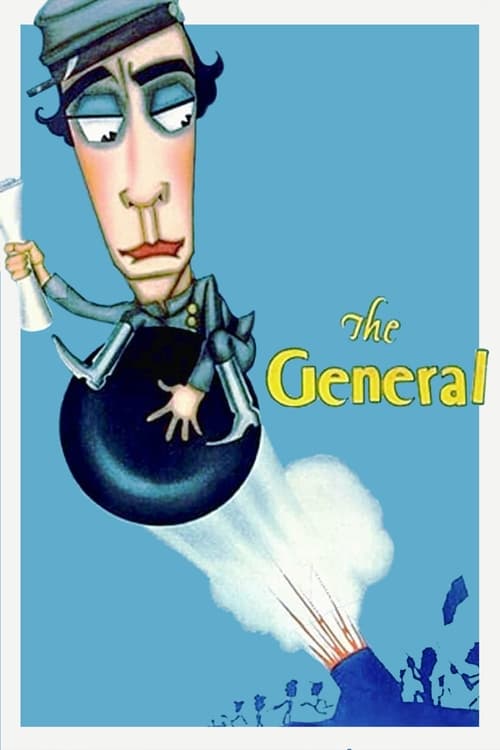
The General
1926 · Clyde Bruckman
For when you want pure, wordless delight — something to grin at for ninety minutes that still leaves your jaw on the floor. Total comfort viewing, and a painless first silent film if you've never tried one.
What it's about
In the middle of the Civil War, a Southern railroad engineer loses the two things he loves most in one stroke: Union spies steal his locomotive, The General, with his sweetheart aboard. He gives chase — one man, one stolen train after another, and miles of hostile track between him and everything he cares about. The whole film is essentially that pursuit north and the desperate run back south.
The experience
It plays like a perfectly wound clock that keeps almost flying apart — you laugh and hold your breath in the same beat, because every gag is also a real stunt on a real moving train. Silent, yes, but never slow; it moves with the momentum of the locomotive itself.
Performances
Buster Keaton, deadpan in the middle of chaos, doing every death-defying stunt himself — climbing over a rolling engine, sitting on the drive rods, dodging cannon fire — without ever cracking his famous stone face. It's physical acting no one has matched since.
The craft
Shot on real locations with real full-size trains, the action is staged with an engineer's precision: you always know exactly where everything is, which is why every near-miss lands. The gags are built like machines, set up and paid off with mathematical timing, and the sheer scale of what gets risked on screen still startles. The bigger the screen, the better.
Why it matters
A flop in 1926, now routinely ranked among the greatest films ever made — the picture that cemented Keaton's reputation and became the template for every action-comedy where the set pieces are the story.
Snapshot
The General is Buster Keaton's Civil War chase comedy, and the film he is most often said to have regarded as his finest. Though the directing card reads Clyde Bruckman, the picture is in every meaningful sense a Keaton work: he co-directed it (uncredited as such in most prints), starred as Confederate railroad engineer Johnnie Gray, devised its gags, and supervised its astonishing real-location stunt work. The film fuses two genres rarely held in the same hand — the precision-engineered slapstick of Keaton's mature shorts and features, and the historical epic — and resolves them through a single, geographically lucid premise: a man chases his stolen locomotive north, then drives it back south, the love of his life and his engine the twin objects of his devotion. Coolly received and commercially underwhelming in 1926, it has since been canonized as one of the supreme achievements of silent cinema and, by some accounts, of the medium altogether.
Industry & production
The General was produced by Buster Keaton Productions, the autonomous unit Keaton operated under the financial umbrella of his brother-in-law Joseph M. Schenck, and released through United Artists in early 1927 (copyright and premiere dates straddle the 1926–27 turn; it is conventionally dated 1926). The production marked a peak of Keaton's creative independence before the catastrophic loss of that independence when he moved to MGM in 1928 — a transition film historians routinely treat as the end of his greatest period.
The film was shot largely on location in Oregon in the summer of 1926, using the narrow-gauge and standard lines around Cottage Grove and the Oregon, Pacific and Eastern Railway, whose period-appropriate rolling stock and unspoiled forested terrain stood in for 1860s Georgia and Tennessee. Shooting on real, functioning railroads — with real locomotives, full-scale trestles, and a genuine river — drove the budget high; The General is consistently described as among the most expensive comedies of its era, and its climactic bridge collapse as the single most costly shot in silent-film history to that point. Exact figures vary across sources and should be treated with caution.
Commercially, the film disappointed. Contemporary reviews were mixed-to-cool, and it did not recoup robustly; this underperformance is frequently cited as a factor in Schenck's decision to fold Keaton's independent operation into the studio system. The gap between the film's tepid reception and its later exalted status is one of the starker reversals in film historiography.
Technology
The General is a silent black-and-white film of the late silent period, made on the eve of synchronized sound — The Jazz Singer arrived the same season. Its "technology" is less about apparatus than about the physical engineering of the gag: Keaton's method depended on real machines operating under real load, photographed without the process shots, miniatures, or optical trickery that would later make such material safe and cheap. The locomotives are full-size and genuinely in motion; the most famous image in the film — the Confederate-pursued engine "Texas" plunging through a burning trestle into the Rock River below — was achieved by actually running a real locomotive off a collapsing bridge into the water in a single take. The wrecked engine reportedly remained in the riverbed for years afterward as a local curiosity before being salvaged for scrap. That commitment to literal, unrepeatable physical events is the film's defining technical signature.
Technique
Cinematography
Photography is credited to Bert Haines and J. Devereaux Jennings, longtime Keaton collaborators. Their work here is notable for its clarity and restraint: deep, legible compositions that keep the geography of the chase continuously readable, and a documentary attentiveness to the landscape — the trains move through real Oregon forests, river valleys, and grades, lending the action a tactile authenticity. The camera favors the full shot that preserves Keaton's whole body and his spatial relationship to the moving machine, the discipline that underlies all his physical comedy. Pictorially, the film also reaches for the iconography of Civil War photography — its troop movements and battle tableaux have frequently been compared to Mathew Brady's images, a resemblance widely noted though the degree of deliberate emulation is hard to establish.
Editing
The film's structure is its most celebrated formal feature: an almost perfect palindrome. Johnnie pursues his stolen engine northward through enemy lines in the first movement; in the second, he drives it back south over the identical terrain, now with the situation and the hazards inverted. This out-and-back symmetry gives the editing an unusual rigor — gags planted on the journey north pay off on the journey south — and it keeps the spatial logic crystalline even at high speed. Keaton's editing throughout privileges geographic coherence over montage excitement: the viewer always knows precisely where Johnnie is relative to his engine, the pursuing trains, and the obstacles ahead. The cutting serves the gag's mechanics rather than imposing rhythm from outside.
Mise-en-scène / staging
Staging is where Keaton's genius is most visible. Gags are built into the moving train and the passing landscape as continuous, often single-take events: Johnnie wrestling a cannon, clearing a railroad tie from the track while seated on the cowcatcher, obliviously chopping wood as armies sweep past behind him. The compositions integrate foreground human action with deep-background military spectacle so that comedy and historical scale occupy the same frame. The period reconstruction — uniforms, trains, a town, a river crossing with massed troops — is staged at genuine scale rather than suggested, a degree of production ambition rare in screen comedy.
Sound
The General is a silent film and carried no synchronized soundtrack on release; it was exhibited with live musical accompaniment guided by cue sheets, as was standard, and had no single authoritative score. In the decades since, numerous composers have written and recorded accompaniments — Carl Davis's orchestral score is among the best known — so the film exists today in many sonic versions, none of them original or definitive. Any claim of a "true" score should be treated skeptically.
Performance
Keaton's performance is the film's anchor: the unsmiling, intensely focused "Great Stone Face," whose comedy arises not from mugging but from absolute physical commitment and the contrast between an impassive countenance and a body in extremis. He performed his own stunts without doubles. Marion Mack plays Annabelle Lee, Johnnie's beloved, and her role is more active than the period's ingénue convention allowed — she is by turns liability and helpmate aboard the recaptured engine, and several of the film's best gags depend on her. The supporting cast plays the historical and military types with a relative naturalism that keeps the spectacle grounded.
Narrative & dramatic mode
The film operates in a sustained chase-comedy mode organized around two loves of equal weight — a woman and a machine — and treats them with deadpan parity, which is itself the central joke. Its dramatic engine is simple and propulsive: theft, pursuit, recovery, return, with a climactic battle and a romantic resolution. Crucially, the comedy is never undercut by jokes that violate the stakes; Keaton plays the danger straight, so that the laughs and the suspense reinforce rather than dilute each other. The narrative is almost entirely externalized — character is revealed through action against the physical world, not dialogue or interiority — which is the essence of Keaton's silent dramaturgy.
Genre & cycle
The General sits at the crossing of several genres: it is at once slapstick comedy, historical war epic, romance, and adventure. It belongs to the cycle of ambitious silent feature comedies that Keaton, Chaplin, and Harold Lloyd produced in the 1920s, when short-form clowning matured into feature-length narrative. Against Chaplin's sentiment and Lloyd's go-getter optimism, Keaton offered a cooler, more architectural comedy of man-versus-machine and man-versus-physics. The film is also a Civil War picture, and notably one told from the Confederate side — Johnnie is a Southern engineer — a choice rooted in its source material that shapes how its history reads.
Authorship & method
The credited director is Clyde Bruckman, a gag writer and longtime Keaton collaborator, but authorship of The General belongs overwhelmingly to Keaton, who co-directed, starred, and controlled the conception and execution of every major sequence; this is the consensus of Keaton scholarship. The screenplay is generally attributed to Keaton and Bruckman, adapting William Pittenger's Civil War memoir of the 1862 "Andrews Raid" (often published as The Great Locomotive Chase), with additional writing associated with Al Boasberg and Charles Smith. Cinematography was by Bert Haines and J. Devereaux Jennings. There was no original composer, the film being silent.
Keaton's method is inseparable from its meaning: build the gag into a real machine in a real place, photograph it whole and clean, and let the audience's knowledge that nothing is faked supply the awe. The refusal of trickery is an authorial principle as much as a technical one.
Movement / national cinema
The film is a product of the American studio-era silent comedy at its height, specifically the independent-producer model that briefly allowed star-comedians to function as their own auteurs within United Artists' distribution. It does not belong to a self-conscious "movement" in the European sense, but its formal rigor — its geometric clarity, its integration of body and machine — has led many critics to read Keaton as a kindred spirit to the modernist sensibilities of the period, and his influence on later film cultures has been international.
Era / period
The General is a late-silent feature made at the very threshold of the sound era, a position that lends it a valedictory quality: it represents the silent visual language at its most accomplished just as that language was about to be supplanted. It looks backward in subject — to the Civil War of the 1860s — and stands at a hinge in film history, the last full flowering of Keaton's independence before sound, the studio consolidation, and his move to MGM closed that chapter.
Themes
The film's governing theme is the bond between a man and his machine, presented with such sincerity that the locomotive becomes a genuine character and the romance with Annabelle is, structurally, its rival. Beneath the comedy runs a meditation on competence and persistence: Johnnie is repeatedly underestimated — rejected for enlistment, mistaken for a coward — and earns his standing through sheer mechanical mastery and dogged action rather than conventional heroics. There are quieter threads of duty, of the individual overwhelmed by and yet navigating vast historical forces, and of order imposed on chaos through skill. The film treats its Civil War setting largely as a stage for physical adventure rather than as moral argument, and its Confederate framing has drawn modern critical attention as a matter worth examining rather than ignoring.
Reception, canon & influence
On release, The General met mixed reviews and modest box office; it was not the triumph its later reputation would suggest, and its commercial shortfall contributed to the end of Keaton's independent production. Its rehabilitation came gradually through the mid-twentieth-century rediscovery of silent comedy and of Keaton in particular, and it now stands among the most exalted films in the medium. It appears regularly on critics' and directors' polls of the greatest films, including the Sight & Sound surveys, and is frequently named the greatest of all film comedies. Orson Welles is widely quoted as having called it perhaps the greatest film ever made; the exact phrasing varies across sources and should be cited with care.
Looking backward, the film draws on Pittenger's Civil War memoir of the Andrews Raid and on the visual memory of Brady-era war photography, channeling both through the conventions of Keaton's own short-comedy apprenticeship at the Comique studio under Roscoe "Fatty" Arbuckle. Looking forward, its influence is immense and diffuse: it set a standard for integrating large-scale, authentically dangerous physical action with character comedy that later action and stunt cinema continually return to. Keaton's deadpan persona and his man-versus-machine choreography have been claimed as ancestors by figures from Jackie Chan to Wes Anderson and beyond, and the bridge-collapse sequence remains a touchstone for the value — and the cost — of capturing a real, irreversible event on film. More than any single image, The General bequeathed a principle: that the most enduring screen spectacle is the one the camera did not fake.
A Deleuzian reading
Picture Johnnie Gray sitting on the cowcatcher of a locomotive already at speed, a heavy railroad tie balanced across his knees.
The full Deleuzian reading of The General →
Reception
A costly flop in 1927 — critics called it tedious and the box office returns helped end Keaton's creative independence — it's now routinely ranked among the greatest films ever made, a textbook case of the canon getting it wrong the first time.
How The General was received, from release to now →
Influences: the films it descends from and the films it influenced
- The Great Train Robbery (1903) — Pioneered the railway chase built on real rolling stock and shot-to-shot geographic continuity, the spatial grammar Keaton later perfects by staging gags along the full length of a moving locomotive.
- The Birth of a Nation (1915) — Reconstructed Civil War battle lines after Brady's war photographs in deep full-shot tableaux, the documentary-historical look Keaton restages from the same Brady visual memory.
- The Butcher Boy (1917) — Keaton's Comique apprenticeship under Arbuckle, where gags were constructed whole within a single sustained full-shot rather than assembled through cutting — the foundation of his single-take method.
- Cops (1922) — The lone-figure chase comedy executed with rigorous geographic coherence, mapping one man's pursuit across clearly legible space before scaling it to a locomotive.
- Our Hospitality (1923) — Period piece running an authentic vintage locomotive on real track, with gags integrated into genuine landscape — the immediate template for The General's machine-in-real-place principle.
- Sherlock Jr. (1924) — Own-stunt man-versus-machine choreography — the driverless motorcycle ride — staged for real and played entirely through the great stone face.
- Steamboat Bill, Jr. (1928) — Extends the practical large-scale catastrophe principle — the falling building facade and a real cyclone's destruction — with the performer standing inside genuine, irreversible danger.
- Modern Times (1936) — Literalizes the man-and-machine choreography, feeding the human body through real mechanical apparatus as the engine of comic and dramatic action.
- Mad Max 2: The Road Warrior (1981) — A feature-length vehicular chase staged with real machines and strict geographic coherence, the action legible precisely because the space and the danger are not faked.
- Project A (1983) — Directly revives the Keaton/Lloyd ethic of real, uninsured stunts — the clock-tower fall — performed by the star and presented in clean full-shot to prove authenticity.
- Police Story (1985) — Uses full-shot framing and own-stunts as proof of authenticity, building spectacle on the visible truth that the camera did not fake the impact.
- The Darjeeling Limited (2007) — Lifts Keaton's frontal, planimetric full-shot staging and deadpan performance, choreographing action across the connected compartments of a real moving train.
- Mission: Impossible – Fallout (2018) — Tom Cruise's insistence on performing real, dangerous stunts captured whole revives Keaton's governing principle that the most enduring screen spectacle is the one the camera did not fake.
- The Blues Brothers (1980) — Originated the chaos-obliviousness-contrast staging principle—stone-faced protagonist executing precise tasks while vehicular destruction unfolds around him—which Landis transplants wholesale into Jake and Elwood's expressionless impassivity amid collapsing city blocks.
- Dr. Strangelove or: How I Learned to Stop Worrying and Love the Bomb (1964) — Keaton's deadpan performance against escalating military machinery — culminating in a spectacular, irreversible bridge collapse — established the structural principle that comedy of catastrophe requires the performer to remain stone-faced as the mechanism runs to its logical conclusion; Kubrick transplants this directly into Slim Pickens riding the nuclear bomb.
- WALL·E (2008) — WALL·E's physical comedy of machine-obstacle navigation — the cause-and-effect gag chain where a mechanical mishap compounds into the next — descends directly from Keaton's one-take stunt choreography; the deadpan held-reaction shot that follows each catastrophe, letting the audience catch up before the next beat, is reproduced in WALL·E's trash-compaction routines without modification.
- Mad Max: Fury Road (2015) — Miller explicitly acknowledged Keaton's influence: the film's linear chase along a single rail axis and the performer's body as the primary practical stunt instrument — Max clinging to the hood-mounted chrome pole is structurally identical to Keaton's locomotive acrobatics, with genuine physical danger as the aesthetic.
- The Grand Budapest Hotel (2014) — Chase sequences constructed as mechanical precision comedy — the physics of vehicles and spaces generating gags with engineering exactness, independent of character psychology; Anderson's alpine ski chase and prison break sequences inherit Keaton's approach of treating physical space as a precision instrument for timed comic effect.
- Safety Last! (1923) — The star performing a genuinely hazardous stunt in unfaked full-shot, drawing its thrill from the audience's certainty that the risk on screen is real and not trick-photographed.
- The Iron Horse (1924) — Railroad-building epic shot on real locations with real trains, marrying historical reconstruction to authentic machinery in the same vein as Keaton's location realism.
- The Gold Rush (1925) — Feature-length silent comedy that integrates sustained physical gag-building with pathos and man-against-environment peril, the contemporary benchmark Keaton was measured against.
Similar films
- Modern Times (1936) — influence & lineage · same viewing thread
- Steamboat Bill, Jr. (1928) — influence & lineage
- Sherlock Jr. (1924) — influence & lineage
- The Birth of a Nation (1915) — influence & lineage
- City Lights (1931) — same viewing thread
- The Circus (1928) — same viewing thread
- The Kid (1921) — same viewing thread
- The Artist (2011) — same viewing thread
All the films related to The General →
Watch it with: curated runs of related films
- The Great Silent Clowns — The masters of physical comedy back to back — watch these to feel the unbroken line from Chaplin's Tramp and Keaton's stone face to Tati's tiptoeing Monsieur Hulot.