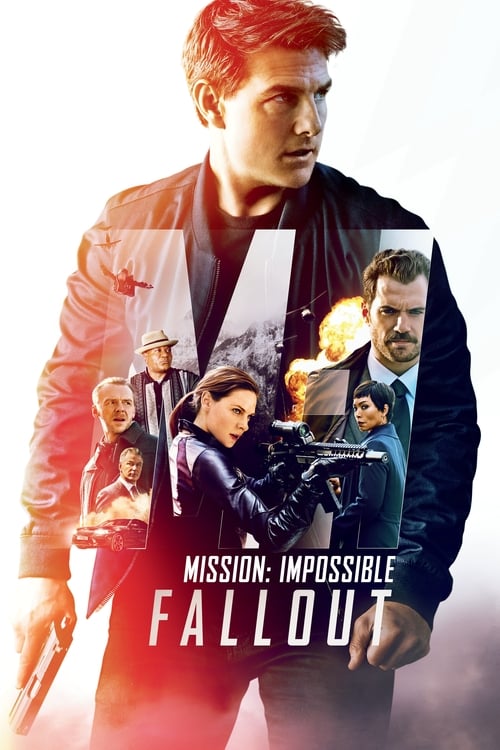
Mission: Impossible - Fallout
2018 · Christopher McQuarrie
For when you want pure adrenaline done right — a big, loud, edge-of-your-seat night where you can trust the movie to deliver. Total comfort viewing for action fans, zero homework required.
What it's about
A recovery of stolen plutonium goes wrong, and IMF agent Ethan Hunt has to make good on the mission he botched before the material ends up armed and detonated. The CIA, no longer sure it trusts him, saddles his team with a watchdog as the chase burns through Paris, London, and the Himalayas, with assassins and old enemies closing in from every side. It's a spy thriller built on a ticking clock: masks, double identities, and one man's stubborn refusal to trade a life for the mission.
The experience
Relentless in the best way — two and a half hours that keep escalating without ever getting numbing, because every chase and fight has clear stakes and real physical weight. You spend long stretches holding your breath, and the plot's double-crosses keep your brain engaged between set-pieces.
Performances
Tom Cruise's physical commitment is the show: he performs the stunts himself — the halo jump, the rooftop sprints, the helicopter flying — and you can feel the difference. Henry Cavill brings a blunt, tank-like menace as the CIA muscle shadowing the team.
The craft
Christopher McQuarrie stages the set-pieces practically and in-camera — real motorcycles against Paris traffic, a real skydive, a real helicopter chase — and shoots them with a clarity that lets you see everything happening. Lorne Balfe's pounding score and the dense sound design make this one of the great big-screen-and-loud-speakers experiences of modern action cinema.
Why it matters
Widely hailed as a high-water mark for the American action blockbuster, it cemented the Cruise–McQuarrie partnership as the franchise's engine and reset expectations for what practical stuntwork could look like in the CGI era.
Snapshot
Mission: Impossible - Fallout is the sixth entry in the espionage-action franchise that Tom Cruise launched with Brian De Palma in 1996, and the first to retain its director from one installment to the next: Christopher McQuarrie, who had made Rogue Nation (2015), returned to write and direct, producing a film conceived explicitly as a direct sequel rather than a standalone reset. Where earlier entries handed the series to a rotating roster of auteurs — De Palma, John Woo, J.J. Abrams, Brad Bird — Fallout consolidated a house style: dense, double-crossing plotting wrapped around a spine of practical, real-world stunt set-pieces performed by Cruise himself. The film follows IMF agent Ethan Hunt as a botched plutonium handoff sends him chasing nuclear cores across Paris, London, and the Himalayas, shadowed by a CIA assassin (Henry Cavill) and the returning anarchist Solomon Lane (Sean Harris). It is widely regarded as the franchise's high-water mark and one of the defining studio action films of the 2010s, distinguished by a HALO parachute jump, a Paris motorcycle chase, a London rooftop pursuit, and a climactic helicopter duel — all built around photographed-in-camera spectacle at a moment when blockbuster cinema had tilted decisively toward digital fabrication.
Industry & production
Fallout was produced by Paramount Pictures with Cruise and McQuarrie among the producers, part of the long-running Cruise/Bad Robot (J.J. Abrams) production architecture that has governed the series since the third film. Its budget is generally reported in the region of $178 million, and it became the highest-grossing film in the franchise to that point, clearing the high-$700-million range worldwide; I flag those figures as the consensus reported numbers rather than audited certainties. The production's defining industrial fact is its scale of practical execution: principal photography ranged across Paris, London, the United Arab Emirates (Abu Dhabi standing in for filming infrastructure), and New Zealand's South Island doubling for Kashmir, with months devoted to specialized stunt training. Cruise reportedly logged a large number of HALO jumps to capture the sequence, and learned to pilot a helicopter for the finale rather than relying on a double or composite work.
The most consequential production incident was Cruise's ankle fracture during the London rooftop jump in 2017, visible in the finished take, which shut down production for roughly six weeks and reshaped the schedule. The film also became an inadvertent case study in cross-studio scheduling conflict: Cavill's contractual mustache, grown for Fallout, could not be shaved for Warner Bros.' Justice League reshoots, producing the much-discussed digital upper-lip removal in that film — a vivid illustration of how a single star's body becomes a contested industrial asset across competing tentpoles.
Technology
Fallout was shot photochemically on 35mm film by cinematographer Rob Hardy, with selected sequences captured on large-format IMAX cameras for theatrical presentation in expanded aspect ratio. The HALO jump in particular relied on IMAX-class capture to register the curvature of the earth and the dusk light at altitude, and on a custom oxygen and camera rig that allowed the operator and Cruise to free-fall together while keeping the actor's face legible. The production leaned on aerial and gyro-stabilized camera systems for the helicopter chase, and on real vehicles and physical environments throughout, reserving digital tools largely for invisible cleanup — wire removal, sky and plate work, geographic stitching — rather than for generating the spectacle itself. The release was mixed in Dolby Atmos. The film thus sits at a deliberate technological crossroads: it adopts the most advanced large-format capture and immersive sound available, while refusing the synthetic-image pipeline that defined its superhero-era contemporaries.
Technique
Cinematography
Rob Hardy, taking over the series' camera after Robert Elswit shot Rogue Nation, brought a harder, more saturated and contrast-heavy palette. His work favors hand-held immediacy in the fight choreography and clean, geographically legible wide shots in the chases, so that the audience always understands spatial relationships — a discipline inherited from the franchise's De Palma origins and sharpened against the disorienting cutting fashionable in post-Bourne action. The Paris night sequences exploit sodium and neon sources for a bruised, metallic look; the New Zealand finale trades that for cold alpine grandeur. The decision to photograph stunts in long, unbroken framings that keep Cruise's face and the real hazard in the same shot is itself a cinematographic thesis: the camera's job is to authenticate rather than to disguise.
Editing
Eddie Hamilton, returning from Rogue Nation, cut the film, and the editing is central to its reputation. Against the prevailing style of fragmented, sub-second action cutting, Hamilton holds shots long enough to establish stakes and geography, then accelerates within sustained spatial logic — the bathroom fight, the motorcycle chase, and the helicopter climax all privilege coherence over chaos. The film also uses cross-cutting in the classic sense, braiding parallel countdowns (defusing, fistfight, romantic-stakes rescue) into a single accelerating climax that openly descends from Griffith-through-De Palma suspense construction. Hamilton has discussed building action from the cleanest possible coverage of real performance, a method legible in the finished rhythm.
Mise-en-scène / staging
Staging is the film's true authorship. McQuarrie composes set-pieces as escalating physical problems with clear rules — get from rooftop to rooftop, keep the helicopter ahead, hold the line in a confined bathroom — and stages them in genuine, recognizable spaces (the Grand Palais, the streets around the Arc de Triomphe, central London skylines). The recurring franchise motif of the latex mask and mistaken identity is staged here as a structural game: the plot repeatedly reveals that what we watched was a controlled deception, and the mise-en-scène is built to support those reversals without cheating the audience.
Sound
Lorne Balfe's score is muscular and propulsive, threading Lalo Schifrin's original 5/4 Mission: Impossible theme through dense, percussive cues that drive the action without overwhelming it. The sound design foregrounds the physical reality of the stunts — wind at altitude, rotor wash, the impact of bodies in the bathroom brawl — using the Atmos field to place hazard around the listener. Balfe's main-title statement and his treatment of Schifrin's theme were widely singled out as a high point of the franchise's musical history.
Performance
Cruise's performance is inseparable from his physical exposure; the film's emotional register depends on the audience's knowledge that the body in danger is his own. Rebecca Ferguson returns as Ilsa Faust, sustaining the series' most fully realized recurring partner-antagonist. Cavill plays August Walker with a blunt, brutal physicality deliberately contrasted against Cruise's agility — the "reloading the fists" beat became iconic shorthand for the film's hard-hitting style. Sean Harris's Solomon Lane provides a whispering, nihilistic menace; Simon Pegg and Ving Rhames supply the series' humane comic ballast; Angela Bassett (CIA director Sloane) and Vanessa Kirby (the White Widow) add institutional and underworld gravity.
Narrative & dramatic mode
Fallout operates in the mode of the high-stakes serial cliffhanger crossed with the labyrinthine spy thriller. Its plot is a chain of double-crosses, fake identities, and contested loyalties organized around a ticking nuclear threat, and it depends on the audience's willingness to be repeatedly fooled and then shown the mechanism of the fooling. Unlike many franchise installments, it foregrounds continuity and consequence: it resurrects the antagonist and the wreckage of Rogue Nation, returns Ethan's estranged wife Julia (Michelle Monaghan), and frames its title around the lingering cost of past choices. The dramatic engine is moral as much as kinetic — the film keeps asking what Ethan will sacrifice and insists that his defining trait is a refusal to trade individual lives for abstract greater goods.
Genre & cycle
The film belongs to the legacy-spy-action cycle that ran through the 2010s alongside the Daniel Craig–era Bond and the Bourne sequels, but it positions itself as a corrective within that cycle. Where much contemporaneous action had migrated toward digitally generated spectacle and superhero spectacle dominated the box office, Fallout doubled down on analog, body-at-risk stunt cinema — a lineage running back through Buster Keaton and Jackie Chan, who similarly built their authority on visibly real physical danger. It is simultaneously a franchise tentpole and a deliberate argument about what that lineage should look like in the blockbuster era.
Authorship & method
McQuarrie's authorship is defined by an unusually integrated writer-director-on-set method: he is known for developing the screenplay during production in close collaboration with Cruise, building the narrative around stunts that are designed first as physical feats and then reverse-engineered into story. This is the opposite of the conventional script-locked tentpole pipeline, and it accounts both for the film's plot density and its occasional structural improvisation. His core collaborators form a repertory company: cinematographer Rob Hardy, editor Eddie Hamilton, composer Lorne Balfe, and above all Cruise as star-producer and physical author of the action. The result blurs the usual division between performer and filmmaker — the stunts are authored by the body executing them as much as by the director framing them.
Movement / national cinema
Fallout is a product of the American studio system and the globalized blockbuster economy rather than of any national-cinema movement; its identity is transnational by design, shot across Europe, the Middle East, and the Pacific for a worldwide audience and a substantial international market. If it belongs to a "movement," it is the auteur-driven tentpole tendency — major studio franchises entrusted to filmmakers with strong personal signatures — and to a particular Cruise-led, practical-stunt school of action filmmaking that has functioned almost as its own production culture.
Era / period
The film is emblematic of the late-2010s studio landscape: the dominance of franchise IP, the rise of streaming as a competitor for attention, and a corresponding premium on theatrical-only spectacle that justified the trip to a large screen. Its insistence on IMAX capture and irreproducible real stunts reads as an argument for theatrical cinema's distinctiveness at the precise moment that argument was becoming urgent. It also reflects a period of franchise self-consciousness, in which long-running series increasingly mined their own histories for emotional continuity.
Themes
The film's governing theme is fallout in the literal and figurative sense — the way past actions detonate into present consequences. Ethan Hunt's central moral axiom, that he will not sacrifice one life he can save even to secure the many, is tested throughout and treated as both his strength and a potential liability that the CIA reads as dangerous sentimentality. Related themes include the instability of identity (masks, doubles, manufactured deceptions), loyalty versus institutional suspicion, and the cost of heroism on personal life, dramatized through the return of Julia. Underneath runs a quieter meta-theme: the value and price of doing things for real — a thematic rhyme with the film's own production ethos.
Reception, canon & influence
Fallout was met with strong critical acclaim, frequently cited on release as the best film in the franchise and among the finest pure action films of its decade, with particular praise for its set-pieces, editing clarity, and Cruise's commitment. Its commercial performance made it, by consensus reporting, the highest-grossing entry in the series to that point.
Backward, the film draws on a deep genealogy: the suspense architecture of Hitchcock and De Palma; the kinetic gunplay grammar of John Woo's franchise entry; the body-on-the-line stunt tradition of Keaton and Jackie Chan; and the immediate continuity of McQuarrie's own Rogue Nation. Its plot mechanics — nested deceptions, the masked double — extend conventions the series established in its first decade.
Forward, Fallout cemented a template that shaped subsequent blockbuster discourse around "practical" filmmaking, becoming a frequent reference point in debates pitting real stunts against digital spectacle. It elevated the cultural mythology of Cruise as a death-defying author of his own action and set the production bar for the franchise's later Dead Reckoning/Final Reckoning installments, which McQuarrie continued to direct and which escalated the real-stunt logic further (notably the motorcycle base-jump). More broadly, it reinforced an industry argument — that irreproducible, theatrically scaled spectacle was the studio's strongest defense against the streaming era — an argument that resonated through the marketing and reception of subsequent event films. Its specific images, especially the HALO jump and Cavill's fist-reload, entered the wider pop-cultural vocabulary as shorthand for a certain uncompromising, analog ideal of the action blockbuster.
A Deleuzian reading
Start with the cut nobody was supposed to keep.
The full Deleuzian reading of Mission: Impossible - Fallout →
Reception
No reappraisal needed — it landed in 2018 as an instant 'best action movie in years' consensus (97% on Rotten Tomatoes, the franchise's box-office peak), and its stock has only risen since, now routinely called the high-water mark of the whole series.
How Mission: Impossible - Fallout was received, from release to now →
Influences: the films it descends from and the films it influenced
- Mission: Impossible (1996) — Establishes the franchise's signature suspended-body, near-silent precision set-piece (the CIA vault drop) that Fallout reverse-engineers into its bathroom-fight and HALO logic — tension built from physical exposure rather than gunfire.
- Where Eagles Dare (1968) — Establishes the labyrinthine double/triple-cross spy plot resolved through physical infiltration and cliff/cable-car peril, a clear forebear of Fallout's nested-deception narrative and alpine finale.
- Mad Max: Fury Road (2015) — Sibling masterclass in practical vehicular stunts cut for absolute spatial coherence — the same 'clarity over chaos' editing principle Eddie Hamilton applies to Fallout's action.
- John Wick (2014) — Sibling in stuntman-authored choreography shot in wide, unbroken takes that respect geography and the performer's whole body — the legible-action aesthetic Fallout's bathroom brawl shares.
- Mission: Impossible III (2006) — Escalates III's practical-stunts-on-35mm ethos and body-as-vulnerability to extremes (HALO jump, real helicopter chase), the through-line of physical sincerity III began.
- Mission: Impossible - Ghost Protocol (2011) — Extends the practical-stunt-headline model with Cruise's actual HALO jump and helicopter chase, shot for the same spatial legibility on large-format cameras.
- Jack Reacher (2012) — Extends Reacher's practical-stunt, real-vehicle chase craft to blockbuster scale — the in-camera car and motorcycle pursuits are the same staging philosophy amplified.
- The General (1926) — Tom Cruise's insistence on performing real, dangerous stunts captured whole revives Keaton's governing principle that the most enduring screen spectacle is the one the camera did not fake.
- Steamboat Bill, Jr. (1928) — Grounds its thrill in star-performed practical stunts where the audience's knowledge that no trickery substitutes for genuine risk is the whole point, the direct inheritance of Keaton's method.
- Police Story 3: Super Cop (1992) — The helicopter climax — star hanging from a real cargo rope beneath a real aircraft, shot wide enough to keep face and ground in frame simultaneously — is the same verification strategy as the rope-ladder sequence, scaled by budget rather than rethought.
- Mission: Impossible - Dead Reckoning Part One (2023) — Direct descendant that escalates Fallout's real-stunt logic to its apex with the in-camera motorcycle base-jump, extending the stunt-first production method and serial continuity.
- Top Gun: Maverick (2022) — Descendant carrying Cruise's analog-spectacle doctrine into aerial filmmaking — real in-cockpit IMAX photography deployed as the streaming era's theatrical defense, the exact argument Fallout crystallized.
- Mission: Impossible - The Final Reckoning (2025) — Refines Eddie Hamilton's cross-cut action grammar across the HALO jump and the dual-helicopter canyon chase, intercutting parallel objectives on a ticking clock — the editorial architecture the Final Reckoning extends to its climactic biplane and submarine cutting.
- Black Widow (2021) — The escalating practical-stunt set-pieces and sustained vehicular pursuit choreography follow the M:I method of stacking real, physically grounded spectacle into one continuous chase, an idiom Black Widow explicitly stages for its Budapest and prison-break sequences.
- Mission: Impossible - Rogue Nation (2015) — McQuarrie's immediate prior entry where he forged the stunt-first, screenplay-during-production method with Cruise (the A400M plane cling), giving Fallout its narrative continuity and reverse-engineered set-piece construction.
- Mission: Impossible 2 (2000) — Imports Woo's balletic, dual-wielding gunplay grammar and slow-motion close-quarters choreography that Fallout's escalating fight beats inherit and discipline into legibility.
- Mission: Impossible (TV series) (1966) — Source of Lalo Schifrin's 5/4 theme and the latex-mask deception/reveal mechanic that Fallout deploys as a recurring narrative rug-pull.
- North by Northwest (1959) — Template for the innocent-man-pursued chase culminating in a vertiginous set-piece on iconic high terrain — Fallout's cliffside helicopter climax descends directly from the Mount Rushmore finale.
- Sherlock Jr. (1924) — Originates the body-on-the-line ethic of the performer executing genuinely dangerous stunts in-frame, the lineage Cruise consciously revives as physical author of his own action.
- Police Story (1985) — Model of the star as practical-stunt author whose real, unfaked physical risk (and visible injury) becomes the film's verifiable spectacle — the ethos behind Cruise's actual ankle-breaking rooftop leap.
- The French Connection (1971) — Pioneers handheld, documentary-immediate chase coverage and ground-level kineticism that Rob Hardy's camera echoes in Fallout's Paris motorcycle and foot pursuits.
- Raiders of the Lost Ark (1981) — Codifies the escalating chain of discrete practical set-pieces strung on a propulsive globe-trotting spine — the structural architecture Fallout follows beat for beat.
- Casino Royale (2006) — Sibling reboot of legacy-spy action toward grounded, weighty physicality (the parkour opening) — sharing Fallout's bet that bruising practical stuntwork outclasses digital spectacle.
- The Raid (2011) — Sibling whose brutal, close-quarters martial combat staged for real impact and continuous readability set the contemporary bar for the bone-crunching legibility Fallout pursues.
- No Time to Die (2021) — Extends the legible, geographically coherent spy-action set piece against contrasting global environments, sharing the patient build-to-spectacle rhythm and serialized-spy melodrama.
Similar films
- Mission: Impossible (1996) — influence & lineage · often watched together
- Top Gun: Maverick (2022) — influence & lineage · often watched together
- Mission: Impossible - Dead Reckoning Part One (2023) — influence & lineage
- Jack Reacher (2012) — same viewing thread · often watched together
- Mission: Impossible - The Final Reckoning (2025) — often watched together
- Sherlock Jr. (1924) — influence & lineage · often watched together
- Mission: Impossible - Ghost Protocol (2011) — often watched together
- Mission: Impossible III (2006) — often watched together
All the films related to Mission: Impossible - Fallout →
Watch it with: curated runs of related films
- The Set-Piece Machine — A run of hard-charging, forward-driving action cinema — watch these back-to-back when you want mission-structured, physical-stakes spectacle built by people who know exactly how to escalate.