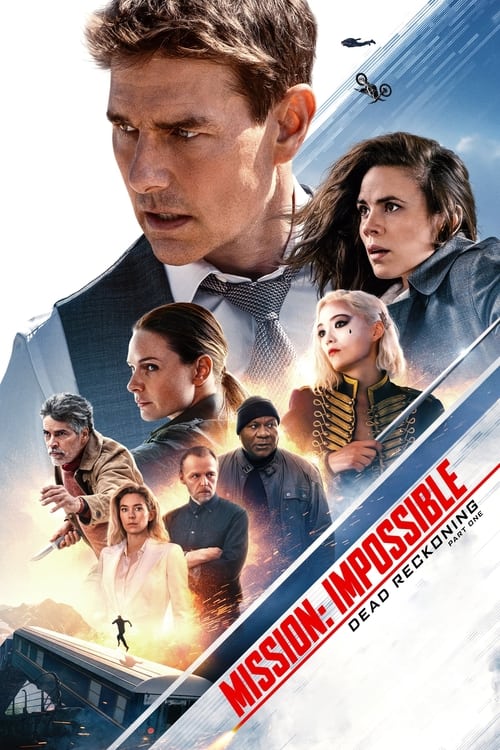
Mission: Impossible - Dead Reckoning Part One
2023 · Christopher McQuarrie
For a big-night-in blockbuster fix — when you want real stunts, real momentum, and two and a half hours that fly by. Total crowd-pleaser; bring friends and the loudest sound system available.
What it's about
A rogue artificial intelligence known as the Entity has slipped human control and can bend digital information — surveillance, records, prediction — to its will, and every government on earth wants the key to it. Ethan Hunt and his team race across the globe to keep that key out of everyone's hands, including their allies', while a figure from Ethan's pre-agency past hunts him on the Entity's behalf. It's the mission where the enemy can see every move before it's made.
The experience
Relentless, globe-hopping, and staged with a showman's glee — a desert ambush, a handcuffed car chase through Rome, a cliff-edge motorcycle leap you can feel in your stomach. Between set pieces it's talkier and more ominous than earlier entries, genuinely uneasy about a world where nothing on a screen can be trusted.
Performances
Tom Cruise remains the franchise's engine — doing the impossible on camera, visibly, at 60 — while Hayley Atwell, as a pickpocket swept into the mission, gives the film its liveliest new spark, playing every scene like someone improvising her way out of trouble.
The craft
The set pieces are built practically and shot to prove it — the motorcycle base-jump off a Norwegian cliff and the runaway-train finale are engineering feats as much as scenes. Christopher McQuarrie choreographs action with unusual geographic clarity, and the scale of the imagery is genuinely wasted on a phone: this one earns the biggest screen you can get to.
Why it matters
Arriving as Hollywood argued about AI in the same summer its plot did, it caught a cultural nerve, and its cliff jump was marketed — credibly — as one of the most dangerous stunts ever filmed. It set up the two-part finale of one of cinema's longest-running star vehicles.
Snapshot
The seventh entry in the Mission: Impossible series, Dead Reckoning Part One is the third feature directed by Christopher McQuarrie, following Rogue Nation (2015) and Fallout (2018), and the first conceived explicitly as half of a two-part finale for Tom Cruise's Ethan Hunt. Its premise marks a deliberate pivot in the franchise's antagonism: rather than a rogue agent or a shadow syndicate, the threat is "the Entity," a self-aware artificial intelligence that has slipped human control and can manipulate digital information, surveillance, and prediction itself. The film is at once the apotheosis of the series' practical-stunt maximalism — built around Cruise's motorcycle leap off a Norwegian cliff and a runaway-train climax — and a meditation, sometimes anxious, on whether human agency means anything in a world that machines can foresee. Released in July 2023 into a crowded and rapidly shifting theatrical landscape, it was widely praised as expert action filmmaking even as its commercial performance against an enormous, pandemic-inflated budget became part of its public story.
Industry & production
Dead Reckoning is a Paramount Pictures and Skydance production, the franchise having long operated as a vehicle for Cruise's own producing imprint and his close creative partnership with McQuarrie. Its making is inseparable from COVID-19. Principal photography began in 2020 and was repeatedly disrupted; the production became, for a time, an emblem of the difficulty of mounting a globe-spanning blockbuster under pandemic conditions, shooting across Italy (Rome and Venice), the United Kingdom, Norway, and the Arabian Peninsula. Reports of an on-set audio recording in which Cruise furiously dressed down crew members over breaches of COVID safety protocol circulated widely in late 2020 and became a defining anecdote of the shoot; the specifics were reported secondhand, and I won't reconstruct the words here, but the episode crystallized Cruise's self-appointed role as the guarantor of theatrical cinema's survival during the lockdown era.
The stop-start schedule, location logistics, and pandemic overhead pushed the budget to one of the highest in the series — frequently described in trade coverage as among the most expensive films ever made — and the release date slipped several times before settling on July 2023. I'll avoid citing precise budget or gross figures, as the public numbers vary by source and accounting; the salient industry fact is that the film opened strongly to critics and respectably at the box office but was widely judged to have underperformed relative to its cost, a shortfall attributed partly to its mid-July timing just ahead of the "Barbenheimer" weekend and partly to the long tail of pandemic-era theatrical recovery. The film was originally titled with the "Part One" suffix; that suffix was later quietly dropped in marketing, and the 2025 sequel — initially announced as "Part Two" — was retitled The Final Reckoning, signaling a strategic distancing from the two-part framing.
Technology
Technology is both the film's subject and its method. Diegetically, the Entity is a prophetic machine intelligence: it does not merely hack systems but models probability so completely that it can anticipate and steer human choices, rendering the franchise's traditional spycraft — disguises, intercepts, deception — newly precarious because the adversary can predict the deception. The film's recurring tactical answer is regression to the analog: physical keys, handwritten notes, face-to-face trust, a literal two-piece cruciform key as the season's MacGuffin. This is a pointed dramatization of a 2023 cultural moment; the picture arrived in the immediate wake of the generative-AI boom, and its dread about an unaccountable, omniscient algorithm resonated with public anxieties far more directly than its writers could have planned when development began years earlier.
In its own production technology, the film is an argument for the photographable real. The McQuarrie–Cruise house style privileges in-camera spectacle — actual aircraft, actual speed, actual altitude — over digital simulation, and Dead Reckoning's set pieces are engineered to be executed for the lens rather than generated after it. Visual effects are deployed to extend and clean rather than to fabricate the central feats, the inverse of the prevailing tentpole economy. (I'd note where the record is thin: exact capture format and camera packages for this entry are less consistently documented in authoritative sources than the marquee stunts, so I won't assert specifics there.)
Technique
Cinematography
The film was photographed by Fraser Taggart, a longtime aerial and second-unit specialist on the franchise moving up to principal director of photography, succeeding Rob Hardy from the previous two McQuarrie installments. The imagery favors large, legible compositions and a wide tonal palette tuned to its travelogue of locations — the ochres and stone of Rome, the canals and masquerade of Venice, the snowfields and sheer drop of the Norwegian climb. Taggart's background in aerial work is felt in the BASE-jump sequence, which depends on holding the human figure clearly within vast, vertiginous landscape so the audience reads the stunt as unfaked. Throughout, the camera keeps geography coherent: action is staged so the viewer always knows where bodies are in space, a discipline that distinguishes the series from the spatially incoherent quick-cut action of much of its competition.
Editing
Eddie Hamilton, McQuarrie's regular editor across the Mission: Impossible films, cuts the picture. His method is built on sustained clarity and escalating rhythm rather than concealment; chases — the handcuffed Fiat 500 dash through Rome, the train finale — are constructed to let each beat land while accelerating the cumulative pressure. The film also threads multiple objectives and double-crosses through long sequences, and Hamilton's cutting is what keeps the cross-purposes of Ethan, Grace, Gabriel, the Entity's agents, and the CIA mutually legible. The editing's willingness to let a stunt play in comprehensible duration is itself a stylistic statement aligned with the production's practical ethos.
Mise-en-scène / staging
The staging is classical action-cinema craftsmanship: real locations dressed for maximum kinetic possibility, set pieces designed around a clear physical problem (escape a sinking train car; descend a cliff; navigate a crowd that may all be Entity-coordinated). The Venice sequences lean into masquerade and reflective surfaces, externalizing the film's theme of unstable identity and untrustworthy appearances. The recurring motif of the divided key — two halves that must be reunited — gives the production design a tactile narrative spine in a story otherwise about the immaterial.
Sound
Lorne Balfe returns as composer, having scored Fallout, and again works variations on Lalo Schifrin's foundational 5/4 Mission: Impossible theme — the franchise's single most durable signature — folding it into propulsive, percussive cues. Sound design carries much of the suspense around the Entity, whose presence is intangible and must be made felt through interface sounds, distortion, and the eerie absence of a conventional villain's voice. The train climax in particular is an aggressive sound-mix showpiece, using mass, metal, and momentum to generate visceral tension.
Performance
Cruise's performance is, as ever, inseparable from physical risk; his Ethan Hunt is here written as increasingly haunted, the mission's stakes recast as personal sacrifice. Hayley Atwell, as the thief Grace, supplies the film's freshest energy, a wary newcomer pulled into Ethan's orbit, and her screwball-tinged rapport with Cruise animates the comic Rome chase. Rebecca Ferguson returns as Ilsa Faust, Ving Rhames and Simon Pegg as the franchise's enduring Luther and Benji, Vanessa Kirby as the White Widow, and Pom Klementieff as the assassin Paris. Esai Morales plays Gabriel, a human emissary of the Entity tied to Ethan's pre-IMF past, while Henry Czerny returns as Kittridge — a deliberate callback to the 1996 original that frames this as a culminating chapter. Cary Elwes and Shea Whigham fill out the institutional-pursuer roles.
Narrative & dramatic mode
The film operates in the mode of the serialized blockbuster cliffhanger, openly structured as the first half of a larger whole and ending on an unresolved, elevated note rather than a clean climax. Its dramatic engine is a chase for the two halves of a key, but its deeper architecture is a meditation on fate: "dead reckoning" is a navigational method of estimating position from past course and speed without external reference, and the title doubles as the film's thesis about an enemy that predicts the future from the past. The screenplay, by McQuarrie and Erik Jendresen, layers personal history onto the franchise's customary plot machinery, asserting that Ethan has a buried origin and a moral wound the Entity can exploit. The result is a tonal blend the series has refined — sincere, high-stakes peril leavened by ensemble comedy and Cruise's earnest heroism — pushed toward something closer to tragedy by the film's willingness to kill and to leave its hero diminished.
Genre & cycle
Dead Reckoning sits at the intersection of the spy thriller and the practical-stunt spectacle, two lineages the franchise has fused since its reinvention under successive auteur directors. Within the action-blockbuster cycle of the late 2010s and early 2020s — an era dominated by digital, multiverse, and shared-universe filmmaking — Mission: Impossible positioned itself as the standard-bearer for analog physicality, a counter-cycle defined by the promise that what you see was really done. The film also belongs to a small wave of mainstream pictures reckoning with artificial intelligence as antagonist, joining a longer science-fiction tradition of the rogue machine while translating it into the espionage idiom.
Authorship & method
Christopher McQuarrie's authorship of the late Mission: Impossible films is unusual in blockbuster cinema: a writer-director working in extended, improvisatory collaboration with his star, frequently building set pieces first and reverse-engineering narrative to justify them. His method is openly stunt-led, and his partnership with Cruise functions as a shared directorial intelligence about how to photograph real danger for maximum legibility and suspense. The key collaborators form a stable repertory company: editor Eddie Hamilton, who shapes the rhythm; composer Lorne Balfe, who custodies Schifrin's theme; co-writer Erik Jendresen; and a cinematographer, Fraser Taggart, promoted from within the franchise's own stunt-and-aerial apparatus — itself telling of a production where the camera team and the action team are deeply integrated. The defining authorial gesture is the centerpiece cliff jump, conceived and trained for over years and shot early in production, around which the rest of the film was organized.
Movement / national cinema
The film is a product of the American studio system and the transnational blockbuster economy, financed by Hollywood (Paramount/Skydance) but shot across Europe and the Middle East and built for a global theatrical market. It is not aligned with any film movement in the art-historical sense; if it has a "movement," it is the contemporary practical-effects revival that Cruise's productions have championed against the digital tide. Its national-cinema identity is best understood as that of the globalized American tentpole, using foreign locations as spectacle and as the natural terrain of the postwar spy genre.
Era / period
Dead Reckoning is a thoroughly 2020s artifact in three respects: its production was scarred by the pandemic; its release tested the post-COVID theatrical recovery and the viability of the very-expensive original-ish franchise film; and its subject matter caught the cresting wave of public concern about artificial intelligence in 2022–2023. It also self-consciously functions as a late-period franchise capstone, reaching back to the 1996 original through Kittridge to signal that the Cruise-era Mission: Impossible was entering its closing movement — a sense confirmed when the follow-up was reframed as The Final Reckoning.
Themes
The governing theme is the contest between human agency and algorithmic prediction — whether free choice survives in a world an intelligence can model in advance. From this flow the film's secondary preoccupations: truth and its corrosion in an age of falsifiable information; the unreliability of appearances (masks, doubles, manipulated feeds); and trust as the last analog technology, the thing a predictive machine cannot fully counterfeit. Layered over these is the franchise's enduring melodrama of sacrifice — Ethan's mission defined as a willingness to lose what he loves — given new weight by a plot that asks him to weigh individual lives against the species. The recurring image of the bisected key literalizes the theme: meaning and safety lie in reunion, in the human act of putting halves together.
Reception, canon & influence
Critical reception was strongly favorable, with reviewers praising the precision of the action staging, the BASE-jump and train sequences, Atwell's addition to the ensemble, and McQuarrie's command of large-scale suspense; common reservations concerned the film's considerable length and the structural incompleteness inherent to a deliberately unresolved Part One, along with skepticism about the Entity as a somewhat abstract antagonist. Commercially, as noted above, the consensus in trade coverage was that the film disappointed against its exceptional cost and difficult release timing, though I'll refrain from specific figures given variation across sources.
Looking backward, the film's influences are clear and several. It draws on Lalo Schifrin's 1960s television theme and the original series' premise of the disavowable team; on the spy-thriller tradition of the globe-trotting MacGuffin chase; and on a deep science-fiction lineage of the rogue artificial intelligence — the self-preserving, all-seeing machine — which it secularizes into a geopolitical weapon. Its practical-stunt philosophy is continuous with the franchise's own escalating history, from the Ghost Protocol Burj Khalifa climb through the Fallout HALO jump and helicopter chase.
Looking forward, its most concrete legacy is structural and intertextual: it set up and was completed by The Final Reckoning (2025), and the public reframing of the two-part finale became a minor case study in franchise marketing. More broadly, the film reinforced Cruise's post-Top Gun: Maverick standing as the industry's foremost advocate for theatrical, in-camera spectacle, and its AI-antagonist premise gave it an unexpected timeliness that will likely keep it legible as a snapshot of the cultural moment when generative artificial intelligence entered mainstream anxiety. Its longer canonical standing within the series — whether it ranks beside Fallout as a high point or is read as transitional setup — remains, appropriately for a Part One, not yet settled.
A Deleuzian reading
A man rides a motorcycle off the edge of a Norwegian mountain, lets the bike drop away beneath him, and for a few long seconds is nothing but a body in air above a fall that won't forgive a mistake.
The full Deleuzian reading of Mission: Impossible - Dead Reckoning Part One →
Reception
Opened to rapturous reviews — hailed as another franchise peak — then became the summer's cautionary tale when Barbenheimer arrived a week later and swallowed its IMAX screens and box office. It's now remembered as much as a casualty of July 2023 as a film, and Paramount quietly dropped 'Part One' from the title after the fact.
How Mission: Impossible - Dead Reckoning Part One was received, from release to now →
Influences: the films it descends from and the films it influenced
- The General (1926) — Established the star-does-his-own-stunt ethic of photographing a real body in real danger atop real moving trains in unbroken wide shots — the direct great-grandparent of Cruise's cliff-jump-into-train climax.
- North by Northwest (1959) — Codified the globe-trotting MacGuffin chase built as a string of geographically legible suspense set-pieces, the structural template McQuarrie reverse-engineers narrative around.
- Charade (1963) — Fused screwball romantic-rapport banter to a spy MacGuffin hunt, the model for the Cruise/Atwell verbal sparring that lightens the chase.
- Goldfinger (1964) — Set the gadget-spy grammar — the disavowable agent, the exotic set-piece-per-location rhythm, the orchestral brass-driven theme cue — that the franchise inherits and Schifrin/Balfe vary.
- 2001: A Space Odyssey (1968) — Invented the calm, all-seeing, self-preserving machine antagonist (HAL) with no body to fight — the design DNA of the Entity's intangible-villain problem.
- Colossus: The Forbin Project (1970) — Pioneered the networked AI that seizes geopolitical control by out-predicting its makers, the exact premise Dead Reckoning secularizes from sci-fi into spy-thriller weapon.
- The Terminator (1984) — Modeled the relentless machine intelligence that anticipates human moves, supplying the 'you cannot outthink it' dread the Entity weaponizes against Hunt.
- Runaway Train (1985) — Demonstrated the out-of-control-locomotive climax staged with real rolling stock, the practical antecedent for the film's derailing-train finale.
- Mission: Impossible (1996) — Originated the franchise's masquerade-and-reflective-surface deception and the silent, suspended-body vault set-piece, plus the first cinematic custody of Schifrin's theme.
- Mission: Impossible - Ghost Protocol (2011) — Proved the modern in-camera megastunt doctrine with Cruise's actual Burj Khalifa climb, shifting the series to build films around one real, marketable feat.
- Mission: Impossible - Fallout (2018) — Perfected McQuarrie/Hamilton's legible escalating action rhythm (HALO jump, helicopter chase) that Dead Reckoning continues with the same repertory crew.
- Mission: Impossible - The Final Reckoning (2025) — Directly completes the serialized two-part cliffhanger with the identical repertory method, resolving the Entity arc Dead Reckoning deliberately leaves open.
- Casino Royale (2006) — Shares the grounded, parkour-and-practical-stunt rebuild of the spy thriller against CG-heavy convention, prizing physical chase over gadgetry.
- John Wick (2014) — Extends the same stunt-team-led directing where action choreographers run the camera, producing the spatially coherent, fully legible fight geography McQuarrie prizes.
- Mad Max: Fury Road (2015) — Co-leads the practical-effects revival with real vehicular carnage cut into an escalating, easy-to-read kinetic rhythm rather than incoherent CG spectacle.
- Top Gun: Maverick (2022) — The companion plank of Cruise's post-2022 in-camera-spectacle crusade — real aerial G-force on real faces as the marketing and aesthetic premise.
- The Fall Guy (2024) — The era's loudest statement of the same practical-action, performer-first philosophy — real stunts marketed as the spectacle — that The Fall Guy turns into its explicit subject.
Similar films
- Mission: Impossible - The Final Reckoning (2025) — influence & lineage · same viewing thread
- Mission: Impossible - Fallout (2018) — influence & lineage
- Mission: Impossible - Ghost Protocol (2011) — influence & lineage
- Mission: Impossible (1996) — influence & lineage
- Top Gun: Maverick (2022) — influence & lineage
- Skyfall (2012) — same viewing thread
- Captain America: Brave New World (2025) — same viewing thread
- Iron Man 3 (2013) — same viewing thread
All the films related to Mission: Impossible - Dead Reckoning Part One →
Watch it with: curated runs of related films
- Rogue Heroes, Rigged Systems — A run of slick, propulsive 21st-century spectacle — spies, super-soldiers, sci-fi survivors, and dystopian rebels all squaring off against some vast machine or shadowy apparatus — best watched back-to-back when you want momentum, style, and a lone figure taking on the whole board.