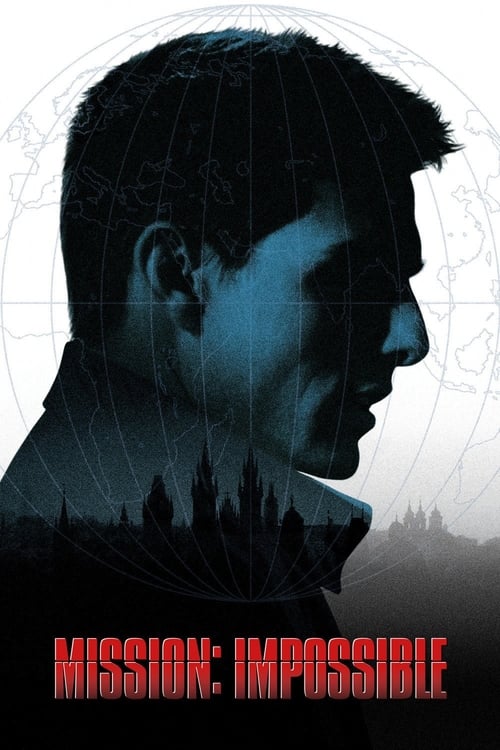
Mission: Impossible
1996 · Brian De Palma
For when you want classy, clockwork tension rather than wall-to-wall explosions — a Friday-night thriller that respects your attention. Pure entertainment, with just enough paranoia to keep your brain in the game.
What it's about
An elite espionage team's operation in Prague goes catastrophically wrong, and Ethan Hunt — the point man left standing — discovers his own agency has pegged him as the traitor responsible. Disavowed and hunted, he has to assemble a crew of untrustworthy castoffs, steal the very secret he's accused of selling, and smoke out the real mole. A spy thriller where the enemy isn't a country but the question of who, in the room, is lying.
The experience
Twisty, sleek, and wound tight — it builds to long, nearly silent set pieces where a single drop of sweat carries more suspense than a gunfight. You spend the whole film second-guessing what you've seen, which is exactly the point.
Performances
Tom Cruise, in the role that redefined his career, sells both the movie-star charisma and the physical precision — most famously suspended inches above a floor he cannot touch.
The craft
Brian De Palma directs a summer blockbuster like a suspense filmmaker: canted angles, elaborate near-wordless sequences, and a deep distrust of what the camera shows you. The break-in to a white, alarm-rigged vault — staged almost without sound — is one of the most imitated sequences in modern cinema, and the film rewards good speakers precisely because of how much it does with silence.
Why it matters
It turned a 1960s TV property into one of the most durable film franchises in existence and set the template for the star-produced action vehicle. Its vault sequence has been quoted and parodied so often it's now shorthand for the heist itself.
Snapshot
Mission: Impossible is the film in which a television property became a movie star's franchise vehicle, and in which one of American cinema's most distinctive stylists was hired to deliver a summer tentpole. Brian De Palma's adaptation of Bruce Geller's 1966–73 espionage series strips the show's ensemble premise down to a single imperiled agent — Tom Cruise's Ethan Hunt — and rebuilds the material as a paranoid thriller about betrayal, disguise, and the unreliability of what one sees. The result is a curious hybrid: a corporate blockbuster, produced by its star, that nonetheless bears the unmistakable fingerprints of De Palma's set-piece suspense, his Hitchcockian distrust of surfaces, and his appetite for elaborate, near-wordless sequences of pure cinematic tension. Two of those sequences — the silent break-in to a CIA vault at Langley and the helicopter-versus-train climax in the Channel Tunnel — became immediately canonical. The film launched a franchise that has run for nearly three decades and reframed Cruise's career around physical spectacle.
Industry & production
The project originated with Cruise's ambition to move into producing. Mission: Impossible was the inaugural production of Cruise/Wagner Productions, the company he formed with his former agent Paula Wagner, and it was developed at Paramount Pictures, which held the rights to Geller's series. That arrangement is central to understanding the film: it is a star-and-producer vehicle in which Cruise held unusual creative authority for a then-thirty-three-year-old actor stepping behind the scenes for the first time. The decision to hire De Palma — a director associated with auteurist thrillers (Carrie, Blow Out, Dressed to Kill) and with the large-scale studio crime film The Untouchables, itself a Paramount property — signaled an attempt to marry commercial scale with a strong directorial sensibility.
The screenplay had a famously troubled, layered development. Credits ultimately went to David Koepp and Robert Towne for the screenplay, with story credit shared by Koepp and Steven Zaillian — an unusually decorated roster (Towne of Chinatown, Zaillian of Schindler's List, Koepp of Jurassic Park) for a film whose plotting was widely criticized as convoluted. Reports of script difficulty and late rewriting during production are well documented in accounts of the film, and the density of the final narrative — competing double-crosses, a stolen "NOC list" of undercover agents, a mole operation built atop a disinformation operation — reflects that patchwork genesis.
Production was international in the De Palma mode: principal photography moved through Prague (standing in partly for itself and for other European locales), London, and Pinewood Studios in England, where the climactic tunnel was built. The film's most consequential creative decision was dramaturgical rather than logistical: the choice to reveal Jim Phelps — the team leader played in the series by Peter Graves and here by Jon Voight — as the traitor. This inversion of the franchise's moral center generated lasting controversy among fans of the original program; Graves and other series alumni publicly objected to the treatment of the character. It is one of the clearest illustrations of how the film treated its source as raw material to be reconfigured rather than honored.
Technology
Mission: Impossible arrived at an inflection point in effects technology, and it sits visibly astride the transition from practical to digital. De Palma was, by temperament and training, a director of in-camera mechanics — physical rigs, optical tricks, staged stunts — and much of the film's tension derives from analog craft: the wire-suspension rig that holds Cruise inches above a pressure-sensitive floor in the Langley vault, the practical water and glass of the Prague aquarium-restaurant explosion. But the film also deploys computer-generated imagery, most conspicuously in the Channel Tunnel finale, where the high-speed train and a pursuing helicopter are integrated through digital compositing. For a mid-1990s studio thriller this was relatively forward-leaning work, produced in the same window in which CGI was rapidly maturing across Hollywood.
The film is also a period document of mid-1990s technological anxiety. Its plot turns on data — a downloadable list of agents' true identities — and on networked communication, exploding email, and the vulnerability of secure computer systems to human infiltration. The fetish objects of the story are laptops, modems, and the famous self-destructing message. This places the film squarely within a 1990s cinema preoccupied with the dawning networked world, even as its signature suspense sequence (the vault) is resolutely about physical intrusion rather than hacking.
Technique
Cinematography
Stephen H. Burum, De Palma's most frequent cinematographer, shot the film, and the photography is among its most identifiably authored elements. Burum and De Palma deploy the director's habitual canted, "Dutch" angles to convey unease and instability — the tilted frame recurs whenever Hunt's world is coming apart — and they make extensive use of the split-diopter shot, the device that holds both a foreground and a deep-background plane in simultaneous sharp focus. The split diopter is more than a flourish here: in a film about watching, being watched, and the gap between what is shown and what is true, the technique literalizes the idea of two competing planes of attention within a single image. The visual scheme moves between cool, controlled interiors and the high-contrast, near-monochrome restraint of the vault sequence.
Editing
Paul Hirsch, a longtime De Palma collaborator (and an Oscar winner for Star Wars), edited the film, and the editing carries much of its reputation. The Langley vault break-in is, above all, an editing achievement: a sustained, dialogue-free passage built on the accumulation of small physical threats — a bead of sweat, a rising drop, a fluctuation in temperature — in which cutting rhythm substitutes entirely for spoken stakes. The sequence is a textbook demonstration of suspense constructed through montage, withholding and releasing tension across discrete, legible beats. Elsewhere the film's reputation for narrative opacity is partly an editing-and-script problem: the rapid relay of exposition, double-cross, and flashback (including the staged "what really happened" reconstructions of the opening operation) demands close attention and does not always reward it.
Mise-en-scène / staging
De Palma stages the film as a series of discrete suspense set pieces connected by exposition, a structure consistent with his career-long method of building a film around two or three bravura sequences. The recurring motif of the mask — the latex disguises inherited from the television series, peeled away to reveal an unexpected face — is both a plot device and a thematic emblem of the film's concern with hidden identity. Staging repeatedly foregrounds screens, monitors, reflections, and surveillance feeds, so that characters (and the audience) are forever watching mediated images whose truth is suspect. The opening sequence is itself a staged deception within the fiction — a sting dressed as reality — which announces the film's governing distrust of appearances before the title sequence ends.
Sound
Sound design is integral, never more so than in the vault sequence, whose entire premise is a room so acoustically sensitive that the smallest noise triggers alarm. The scene weaponizes silence: ambient near-quiet makes every incidental sound — breath, a dropped object, the strain of a cable — a potential catastrophe, and the audience is tuned to listen as anxiously as the characters. Across the film, sound is bound up with surveillance and interception, with bugged rooms and monitored lines, reinforcing the theme of compromised communication.
Performance
Cruise anchors the film with the controlled intensity that would define his action persona, and Mission: Impossible is an early and decisive step in his transformation into a star associated with physical performance and on-screen risk. Jon Voight plays Jim Phelps with avuncular gravity that the film exploits for its central betrayal. The supporting ensemble is deep and largely European-inflected: Emmanuelle Béart as Claire, Jean Reno as the pilot Krieger, Ving Rhames as the hacker Luther Stickell (the one team member to recur across the franchise), Henry Czerny as the IMF handler Kittridge, Kristin Scott Thomas in an early role, and Vanessa Redgrave as the arms dealer Max, who brings a theatrical relish to her scenes. Emilio Estevez appears, uncredited, as a doomed team member.
Narrative & dramatic mode
The film operates in the paranoid-thriller register: its protagonist is wrongly suspected, isolated from his institution, and forced to operate against the very agency that trained him in order to expose the real traitor. This "wronged man clears his name" architecture is fundamentally Hitchcockian, and De Palma — long the most overt of Hitchcock's American disciples — leans into it. The dramatic mode privileges sustained suspense (the audience often knowing more, or differently, than the characters) over mystery, even as the plot withholds the identity and logic of the conspiracy until late. The narrative's notorious complexity — its nested operations and reversals — is the film's chief structural liability and, for some viewers, part of its texture: a story about disinformation that is itself difficult to verify.
Genre & cycle
Mission: Impossible belongs to the post–Cold War spy cycle, in which the espionage film, deprived of its stable Soviet antagonist, turned inward toward institutional corruption, rogue insiders, and information as the prize. Released in the mid-1990s, it sits alongside the contemporaneous resurgence of the spy blockbuster — most visibly the Bond series' own reinvention in the same period — and it helped establish the template of the espionage franchise built around elaborate, escalating set pieces and a recurring lead. It is also a paradigmatic example of the 1990s trend of adapting nostalgic television properties into theatrical event films, a cycle in which Mission: Impossible stands out as one of the most commercially and creatively durable.
Authorship & method
The film is a genuine case study in the tension between auteur and franchise. De Palma brought his entire signature apparatus — Burum's split diopters and Dutch tilts, Hirsch's suspense montage, the set-piece-centric construction, the Hitchcockian distrust of vision and the doubling/masking motifs that run through his body of work. In that sense Mission: Impossible is recognizably "a Brian De Palma film." Yet it is also unmistakably a Tom Cruise production, shaped by a star-producer's priorities and by the demands of launching a sustainable property; De Palma did not return for the sequel, and each subsequent installment was handed to a different director, making the series an unusual experiment in franchise-as-anthology of directorial styles.
Among collaborators, the key figures are Burum (cinematography), Hirsch (editing), and on the screenplay Towne, Koepp, and Zaillian. Musically, the film rests on two pillars. Danny Elfman composed the score, working in and around Lalo Schifrin's instantly recognizable 5/4 television theme — one of the most famous pieces of TV music ever written — which the film preserves as a cultural touchstone. Separately, U2's Adam Clayton and Larry Mullen Jr. recorded a contemporary electronic/rock arrangement of the Schifrin theme that became a hit single and tied the film to mid-1990s pop culture. The interplay of Schifrin's original, Elfman's score, and the Clayton/Mullen single is itself a small lesson in how a franchise both honors and updates its inherited identity.
Movement / national cinema
The film is a product of the American studio system — specifically the Hollywood blockbuster apparatus of the mid-1990s — but it is stylistically inflected by De Palma's lifelong engagement with European and classical cinema, above all the Hitchcock tradition. Its production was substantially European in location and crew, and its casting (Béart, Reno, Redgrave, Scott Thomas) gives it a continental flavor unusual for an American action tentpole. It does not belong to a national "movement" in the art-cinema sense; rather, it represents Hollywood absorbing an auteur's cinephile sensibility into a commercial framework.
Era / period
Mission: Impossible is a quintessential mid-1990s artifact. It reflects that decade's emerging fascination with computers, networks, and data security; its post–Cold War reframing of espionage as internal betrayal rather than ideological combat; and the era's industrial strategy of mining nostalgic intellectual property for franchise potential. It also marks a specific moment in effects history, straddling practical and digital techniques, and a specific moment in Cruise's career, as he assumed control of his own image as producer and action lead.
Themes
The film's deepest preoccupations are De Palma's own: the unreliability of images and surfaces, the gap between appearance and reality, voyeurism and surveillance, and betrayal within a surrogate family. The mask — a face that can be peeled away to reveal another — is the organizing metaphor: identity is performable, and trust is perpetually misplaced. The plot's engine is disinformation, the deliberate manufacture of false realities, which rhymes with the medium itself. The most resonant thematic stroke is the corruption of the father figure: making Jim Phelps, the moral anchor of the original series, the traitor turns the film into a story about the betrayal of an inherited institution by the very man who embodied its integrity — a meta-commentary, intended or not, on the film's own relationship to its source.
Reception, canon & influence
Critically, Mission: Impossible drew a divided but largely respectful response. Reviewers widely praised its suspense set pieces — especially the Langley vault sequence — and De Palma's command of pure cinematic tension, while frequently faulting the plot as needlessly convoluted and emotionally cool. Among devotees of the television series, the reinvention of Phelps provoked genuine anger, a reception story that has become inseparable from the film's legacy. Commercially it was one of the major hits of 1996 and among the year's top-grossing films worldwide, a success decisive enough to spawn an enduring franchise; precise figures vary across sources, so they are best stated in those qualitative terms here.
The influences on the film run backward to Hitchcock above all — the wrong-man structure, the suspense-over-surprise dramaturgy, the eroticized danger — filtered through De Palma's decades of homage, and of course to Bruce Geller's series, whose masks, self-destructing briefings, ensemble heists, and Schifrin theme the film inherits and reworks. Burum and Hirsch carried over the visual and editorial grammar of De Palma's earlier thrillers.
Its influence forward is substantial. It established a franchise that has become one of the most successful and longest-running in American cinema, and one organized around an unusual principle: a rotating roster of directors, each imprinting a personal style on the series. It cemented Cruise's reinvention as an action star defined by physical spectacle and, increasingly, by real stunt work — a trajectory the franchise pushed to ever greater extremes in later installments. The Langley vault break-in entered the broader culture as a reference point and a frequently parodied template for the high-tech, silence-dependent heist. And the film stands as a key example of how a strongly authored, set-piece-driven approach to suspense could be successfully scaled to the summer blockbuster, helping to model the modern action franchise built around standout sequences rather than continuous spectacle.
A Deleuzian reading
Start with the drop of sweat.
The full Deleuzian reading of Mission: Impossible →
Reception
A big summer hit in 1996 but divisive on arrival — fans of the TV series felt betrayed and critics called the plot impenetrable. Nearly three decades on, it's been reappraised as the franchise's most stylish, purely cinematic entry, and for many cinephiles the best of the series.
How Mission: Impossible was received, from release to now →
Influences: the films it descends from and the films it influenced
- Notorious (1946) — De Palma inherits Hitchcock's suspense-over-surprise contract — the wine-cellar party built on the audience knowing the danger the heroes don't — recast as the rooftop and vault sequences where tension comes from privileged information, not revelation.
- Vertigo (1958) — The eroticized distrust of vision and the betrayed-identity reveal underpin De Palma's masking motif and Phelps's double-cross, where the camera's POV is itself the trap.
- North by Northwest (1959) — The wrong-man-on-the-run dramaturgy and the franchise-able set-piece-as-attraction (crop duster, Rushmore) is the structural template De Palma scales to blockbuster size.
- Rififi (1955) — The half-hour wordless heist — suspense carried entirely by silence and procedural detail — is the direct grammar of the Langley vault break-in's weaponized quiet.
- Topkapi (1964) — The thief lowered by rope into a pressure/sound-sensitive room he must not touch is the literal blueprint De Palma re-stages with Cruise suspended above the vault floor.
- The Conversation (1974) — Its surveillance-as-paranoia and sound-mix-as-plot established the post-Watergate spy-tech anxiety De Palma updates into mid-1990s data dread (the NOC list, the CIA Langley mainframe).
- Sisters (1972) — De Palma's own split-diopter and split-screen apparatus, carried by Burum's deep-focus compositions, is first weaponized here and recurs as M:I's signature optical doubling.
- Blow Out (1981) — The paranoid-thriller protagonist who reconstructs reality from recorded media, plus the betrayed-trust structure, is the De Palma self-quotation M:I rebuilds around evidence and erased identities.
- Dressed to Kill (1980) — The dialogue-free, pure-image suspense set piece (the museum stalk) is the editorial method Paul Hirsch carries directly into M:I's montage-driven sequences.
- The Untouchables (1987) — De Palma's prior big-budget proof that Hitchcockian set-piece construction (the Union Station staircase) could anchor a studio spectacle is the bridge from auteur thriller to blockbuster he refines in M:I.
- How to Steal a Million (1966) — The Langley vault sequence runs the Rififi/Topkapi silent-theft protocol at blockbuster scale — no dialogue, no score, tension generated purely from environmental variables (pressure plates, sound thresholds, temperature) and the suspended body.
- Mission: Impossible 2 (2000) — The franchise-as-anthology principle launches here — Woo replaces De Palma's surveillance suspense with balletic gun-fu and doves, proving the series' rotating-auteur DNA.
- Mission: Impossible – Ghost Protocol (2011) — Extends M:I's set-piece-over-continuous-spectacle model and Cruise's real-stunt trajectory to its logical extreme with the practically-shot Burj Khalifa climb.
- Mission: Impossible – Fallout (2018) — Pushes the physical-star principle M:I established — Cruise performing the danger in-camera (HALO jump, helicopter chase) — into the franchise's purest expression of analog-stunt authenticity.
- Mission: Impossible II (2000) — Established the franchise's impossible-disguise mechanics and Hitchcockian identity-paranoia architecture that MI:II inherits as narrative scaffolding, while deliberately dismantling De Palma's cerebral suspense register and replacing it with Woo's melodrama-action mode.
- Mission: Impossible III (2006) — Supplies the franchise's core grammar that III rebuilds — the silent process-suspense of the Langley vault break-in, the agency-mole reveal structure, and Schifrin's 5/4 theme as recurring sonic signature.
- Mission: Impossible - Dead Reckoning Part One (2023) — Originated the franchise's masquerade-and-reflective-surface deception and the silent, suspended-body vault set-piece, plus the first cinematic custody of Schifrin's theme.
- Mission: Impossible - The Final Reckoning (2025) — Establishes the franchise's signature suspended-body set piece — Cruise lowered on wires into the Langley vault, sweat-bead tension cross-cut against an unaware guard — and the split-diopter deep-focus tableau that the McQuarrie films inherit as their grammar of spatial dread; The Final Reckoning's valedictory callbacks quote this sequence's iconography directly.
- The Bourne Identity (2002) — Shares M:I's post-Cold-War spy-paranoia and amnesiac-betrayal structure, but answers De Palma's classical suspense staging with handheld immediacy — a deliberate counter-grammar to the same genre problem.
- Inception (2010) — Inherits the high-tech ensemble-heist-as-architecture and the silence-dependent infiltration, scaling M:I's set-piece-engineering logic into nested, rules-based suspense machines.
- Ocean's Eleven (2001) — Extends the ensemble-heist craft — masks, role specialization, the choreographed-team vault job — that M:I revived from Geller's TV series for a new blockbuster generation.
Similar films
- Mission: Impossible - Fallout (2018) — influence & lineage · often watched together
- Mission: Impossible - Ghost Protocol (2011) — influence & lineage · often watched together
- The Conversation (1974) — influence & lineage · same viewing thread · often watched together
- The Bourne Identity (2002) — influence & lineage
- Inception (2010) — influence & lineage
- North by Northwest (1959) — influence & lineage
- The Untouchables (1987) — influence & lineage
- Blow Out (1981) — influence & lineage · same viewing thread
All the films related to Mission: Impossible →
Watch it with: curated runs of related films
- The Paranoid and the Obsessed — A run of stylish thrillers about lone men consumed by a hidden pattern, a betrayal, or a truth they can't stop chasing — each staged with more virtuosity than the plot strictly needs.