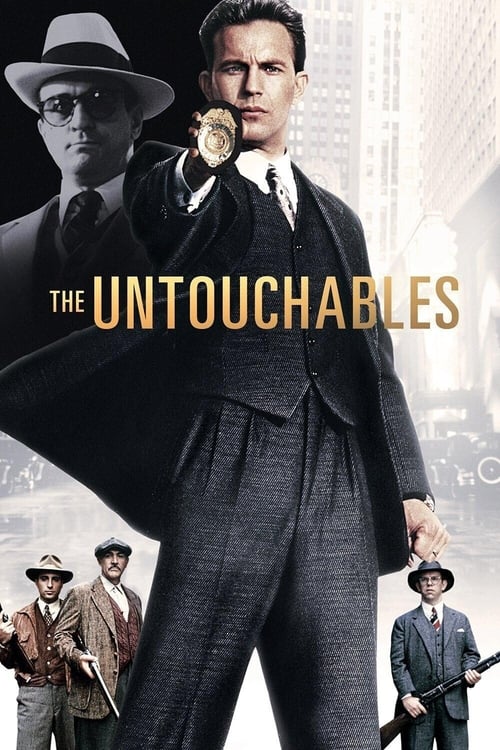
The Untouchables
1987 · Brian De Palma
For a Friday night when you want a big, handsome, quotable crime picture — good guys, bad guys, and zero homework. Pure comfort for anyone who loves gangster movies.
What it's about
Prohibition-era Chicago belongs to Al Capone, and treasury agent Eliot Ness arrives with a mandate to bring him down and no idea how dirty the city really is. He builds a tiny squad of men who can't be bought — an aging Irish beat cop, a sharpshooting rookie, a nebbishy accountant — and goes to war over bootleg whiskey and a tax ledger. It's the lawman myth told big: white hats, tommy guns, and a city where the fix is always in.
The experience
Operatic and propulsive — snappy dialogue, sudden violence, and set pieces staged like arias, including a train-station sequence that will have you holding your breath. It's a crowd-pleaser with a body count, more rousing than gritty.
Performances
Sean Connery won an Oscar as Malone, the streetwise cop who teaches Ness 'the Chicago way,' and he gives the film its soul and its best lines. Robert De Niro plays Capone as a preening showman whose charm can flip to savagery mid-sentence.
The craft
David Mamet's screenplay is lean and endlessly quotable, Ennio Morricone's score swings from menace to soaring heroism, and Brian De Palma stages the violence with baroque, slow-motion bravado. The period Chicago production design is lavish — this one rewards a big screen and loud speakers.
Why it matters
A defining prestige hit of the late 1980s, it fixed the Ness-versus-Capone legend in the popular imagination and proved De Palma's flamboyant style could power a mainstream studio blockbuster.
Snapshot
Brian De Palma's The Untouchables is an operatic period crime film built on the myth of Prohibition-era lawman Eliot Ness and his campaign to prosecute Al Capone in 1930s Chicago. Working from a screenplay by David Mamet and photographed by Stephen H. Burum, with a score by Ennio Morricone, the film achieves a peculiar double register: it is at once a tautly written genre exercise and a showcase for De Palma's most formally elaborate set-piece filmmaking. The result was one of the defining prestige Hollywood releases of its decade — commercially successful, critically well-received, and the occasion of Sean Connery's Academy Award for Best Supporting Actor. It occupies a pivotal position in De Palma's filmography, marking the moment when his baroque formal instincts were applied to a major studio production with a mainstream dramatic core, rather than to the more transgressive genre material of his preceding decade.
Industry & production
The project had long roots in popular culture. Eliot Ness co-wrote a memoir with Oscar Fraley, published in 1957, which was itself partly mythologized; the memoir became the basis for the television series The Untouchables (ABC, 1959–63), produced by Desi Arnaz and starring Robert Stack, which played fast and loose with historical record but lodged the Ness legend firmly in American consciousness. Paramount Pictures acquired the screen rights and attached De Palma as director, with Art Linson producing. David Mamet was brought in to write the screenplay — an unusual pairing, given Mamet's reputation as a stage dramatist and his idiosyncratic relationship with Hollywood. The project was positioned as prestige event filmmaking, with a substantial budget and a cast assembled from multiple registers of stardom: Kevin Costner as Ness, then riding momentum from Silverado and No Way Out; Robert De Niro as Capone, freshly committed to full physical transformation; and Connery as veteran beat cop Jim Malone. Principal photography took place largely in Chicago, exploiting the city's surviving Beaux-Arts and Romanesque architecture to anchor the period setting, supplemented by location work in Montana for the Canadian border sequence. Production designer Patrizia von Brandenstein, fresh from Amadeus, delivered environments of imposing physical solidity.
Technology
The film works within mainstream 1980s Hollywood production technology — 35mm anamorphic photography, Steadicam, optical slow motion — without departing into experiment. Burum and De Palma used the anamorphic frame's width to compose deep, architecturally structured shots that emphasize the institutional spaces of Capone's Chicago: courtrooms, hotel lobbies, the train station. The Steadicam is deployed not to produce the kinetic urgency associated with it in action cinema but to execute De Palma's characteristic slow, predatory glides through space, building dread rather than excitement. Optical slow motion — a technique De Palma had refined through earlier films — becomes the grammar of the film's climactic sequences, elongating action to the threshold of abstraction. No notable technological innovations distinguish the production, but Burum's command of available tools is sophisticated; the quality of light in interiors, the hard-edged chiaroscuro of night exteriors, reflects extended collaboration between a director and cinematographer who had developed a precise shared visual language.
Technique
Cinematography
Burum's lighting regime draws on classical Hollywood noir without slavishly reproducing it. Interiors are often built around high-contrast pools of light against deep shadow, invoking the 1930s without becoming pastiche. The film's color palette — amber, gray-brown, cold blue in night exteriors — anchors the period and distinguishes it from the brightly saturated 1980s commercial norm. Key sequences are composed with an almost theatrical attention to the frame as picture: the opening shot of Capone receiving a shave while conducting business, the overhead shot of Malone's bullet-riddled body, the extended Union Station set piece. De Palma and Burum repeatedly use low angles to inflate the grandeur of institutional architecture and isolate figures against coffered ceilings, reinforcing the mythic scale the film aspires to. Depth of field is used to hold foreground and background simultaneously in focus, enabling De Palma's interest in dramatic ironies played across the Z-axis — a compositional strategy recalling the deep-focus aesthetics of Welles and Toland.
Editing
The film was edited by Jerry Greenberg and Bill Pankow. Its pacing is distinctive in Hollywood terms: large stretches of relatively unhurried scene construction, followed by set pieces of formally orchestrated, operatic duration. The Union Station sequence — the film's formal peak — is built through sustained cross-cutting between multiple lines of action unfolding simultaneously, with optical slow motion prolonging individual actions across dozens of cuts. The editing here is indebted to Eisenstein's theory of montage as collision and to the Odessa Steps sequence in Battleship Potemkin (1925) specifically, which De Palma quotes and extends. The baby carriage tumbling down the station stairs in slow motion, while a gunfight erupts around a mother too terrified to move, is among the most discussed set pieces in 1980s Hollywood cinema precisely because it is so overtly a citation — a piece of formal scholarship in genre clothes. Elsewhere, the editing maintains a measured, almost theatrical rhythm that reflects Mamet's scene-by-scene construction.
Mise-en-scène / staging
De Palma's staging is the film's most distinctive formal register. His characteristic overhead shots — looking straight down on characters from an extreme height — appear at several junctures, transforming the figure into a geometric element within a flat pictorial composition. The film favors long, slow approach shots, often tracking through corridors or lobbies with an almost predatory deliberateness before arriving at the scene's dramatic center. The staging of the Capone scenes is pointedly theatrical: De Niro's Capone occupies spaces as if performing for an audience — the hotel suite, the opera house, the courtroom — and the camera frames him accordingly. The Canadian border sequence, shot in widescreen against the vast Montana landscape, imports the grammar of the Western into the gangster film, an generic infiltration the screenplay makes explicit in Malone's comparison of Ness to a frontier lawman.
Sound
Morricone's score is the most immediately striking sonic element. The composer, whose international reputation had been built on Sergio Leone's Westerns and a vast catalog of Italian genre films, delivers here a score of operatic breadth: propulsive, trumpet-led themes for the set pieces, a lyrical motif associated with Ness's family, and textures of mounting dread for the film's most violent passages. The score's operatic character aligns with De Palma's staging rather than contradicting it — both are committed to an aesthetic of amplitude. Morricone's nomination for the Academy Award for Best Original Score reflected critical recognition of the score's ambition. Sound design reinforces the period through the specific textures of machine-gun fire, automobile engines, and stone-floored institutional spaces, though no documentary evidence of an unusual approach to the sound design has surfaced in the critical record.
Performance
The performances are stylistically heterogeneous, which the film largely absorbs. Costner plays Ness as a figure of earnest moral certainty — he is given little interiority by Mamet's script and performs with a rectitude that functions as period idealization rather than psychological realism. Connery's Malone is the film's emotional center: gruff, funny, practically wise, and ultimately tragic. The performance has the quality of a star operating at a late-career peak, fully inhabited, entirely without vanity, and Connery's Academy Award was widely regarded as recognition of a sustained body of work as much as the specific role. De Niro's Capone is a calculated theatrical performance, operatic and consciously artificial — the baseball-bat scene in particular is staged as pure spectacle of violence, a set piece of actorly display. Andy Garcia and Charles Martin Smith provide functional support. The tonal variance between Connery's naturalism, Costner's iconic blankness, and De Niro's baroque theatrics is handled by the film's mythic register, which accommodates multiple scales of reality simultaneously.
Narrative & dramatic mode
Mamet's screenplay strips the historical record down to a structure of elemental moral confrontation: good (Ness, the Untouchables) versus evil (Capone, institutional corruption), with the question of means — how far a just man may go to defeat an unjust opponent — providing the dramatic engine. The film works within a binary moral universe characteristic of classical Hollywood and the Western tradition rather than the ambiguous moral landscape of film noir or the later American crime film. Mamet's dialogue, normally dense with subtext and competitive evasion, is here relatively legible — the film demands clarity of motivation as a condition of its mythic mode. The narrative arc follows a classical three-act structure: Ness's early failures, the formation of the team and gradual pressure on Capone's operation, and the climactic legal victory. The film's departures from historical record — most significantly, Ness and his team had little direct role in Capone's tax-evasion conviction, which was largely the work of IRS investigators — are structural necessities of the mythologizing project rather than oversights.
Genre & cycle
The Untouchables belongs to the American gangster film, a genre extending from The Public Enemy (1931) and Scarface (1932) through the reinvention conducted by The Godfather (1972). Within the gangster tradition, however, it occupies an unusual position: its protagonist is the lawman rather than the criminal, which aligns it as much with the Western and the police procedural as with the classic gangster narrative. The film participates in the prestige Hollywood crime-film cycle of the 1980s, a period that included Once Upon a Time in America (Leone, 1984) and would extend through L.A. Confidential (Hanson, 1997): large-budget, period-set, auteur-driven productions that mobilized nostalgia for the pre-television crime film alongside contemporary production values and star power. De Palma's formal interventions — most notably the Eisenstein quotation — mark the film as also belonging to the self-conscious, cinephilic mode of Hollywood filmmaking associated with the generation that emerged from film schools and film culture in the 1970s.
Authorship & method
De Palma had by 1987 established a reputation as a formally adventurous, sometimes transgressive filmmaker whose relationship to genre was explicitly citational. His 1970s and early 1980s work — Sisters (1972), Obsession (1976), Dressed to Kill (1980), Blow Out (1981) — drew heavily and openly on Hitchcock, raising questions about the line between homage and derivation that De Palma consistently framed as deliberate critique and formal inquiry rather than imitation. Scarface (1983), a remake with a screenplay by Oliver Stone, had demonstrated his ability to operate at larger commercial scales. The Untouchables represented a consolidation and partial mainstreaming of these methods: the Eisenstein citation is legible without prior film knowledge, the narrative is more conventionally accessible than Blow Out or Body Double, and the film's violence, while stylized, operates within genre norms. Stephen H. Burum, who became De Palma's regular cinematographer from Body Double (1984) onward and shot Casualties of War (1989), The Bonfire of the Vanities (1990), and Carlito's Way (1993) as well, is essential to the visual grammar; the two developed a shared vocabulary of slow, architectural camera movement and high-contrast period light. Mamet's contribution is substantial on the sentence level — the film's economy of dialogue, its refusal of psychological elaboration — even if the screenplay is not his most characteristically layered work. Morricone's score is a genuine creative collaboration rather than scoring-to-picture; the decision to commission an Italian genre composer associated with Leone introduced a continental operatic sensibility that inflects the entire register of the film.
Movement / national cinema
The film is mainstream American commercial cinema, but its coordinates are partly European. The Leone connection — mediated through Morricone — aligns it with the Italian genre tradition that fed back into American film during the 1970s and 1980s. De Palma's citational method has more in common with the European auteur tradition's self-consciousness about film history than with classical Hollywood transparency. The film's investment in Chicago's architectural legacy, combined with its period mythology, positions it within a strand of American filmmaking concerned with recovering a usable past — a concern that had particular resonance in the mid-1980s cultural climate.
Era / period
The Untouchables arrives at a moment when the New Hollywood generation of directors was negotiating between personal filmmaking and the demands of the blockbuster era inaugurated by Spielberg and Lucas. De Palma's choice of a pre-sold property with a TV legacy and a mythic American subject represents a bid for mainstream legitimacy that neither repudiates his formal ambitions nor simply indulges them. The mid-1980s also saw a renewed interest in period Americana — in recovering and aestheticizing a pre-modern American landscape of institutional grandeur and moral clarity — that the film's production design and narrative structure serve directly. The film's portrait of uncorrupted federal agents fighting institutional corruption carried implicit resonances in the Reagan era, though any direct allegorical intention on Mamet's or De Palma's part is not documented in the critical record.
Themes
The film's primary thematic concern is the problem of means and ends in the service of justice: Jim Malone's question to Ness — how far are you prepared to go? — establishes an ethical line the film then traces across multiple acts of violence. The film does not fully resolve this tension; Ness crosses several of the lines Malone articulates and the film neither endorses nor condemns him without ambiguity. Institutional corruption and the permeability of the law to criminal money constitute a second thematic layer, reflected in the recurring discovery that Ness can trust virtually no one outside his small team. The father-and-family motif — Ness's wife and infant daughter, the paternal mentorship of Malone — functions as the moral anchor against which the film measures the costs of the campaign. There is also a persistent elegiac note: the film is conscious that the world it depicts, of individual moral clarity and institutional heroism, is irrecoverable, and the period setting enables a nostalgia for ethical simplicity that the contemporary world is assumed to lack.
Reception, canon & influence
Influences on the film. The Odessa Steps sequence from Eisenstein's Battleship Potemkin (1925) is the film's most explicit cited influence, reproduced and extended in the Union Station sequence. The classical American gangster film — Hawks's Scarface (1932), Wellman's The Public Enemy (1931) — provides the genre template, while Leone's Once Upon a Time in America (1984) offers the immediate precedent for the operatic American crime epic with a European sensibility. The Western, particularly its lone-lawman-against-corruption variants, is structurally present throughout. Mamet's theatrical background informs the scene construction and dialogue. The TV series (The Untouchables, 1959–63) and Ness's memoir are the narrative source material.
Critical reception. The film was received positively on release, with particular attention paid to Connery's performance, Morricone's score, and the Union Station sequence. Critics divided somewhat on Costner's performance and on whether the film's formal ambition was in productive tension with or in contradiction to Mamet's stripped-down narrative. Roger Ebert praised the film enthusiastically, and it ranked prominently in year-end lists. The Academy Award for Best Supporting Actor was the film's most durable institutional recognition; the Morricone score received a nomination, and the film was recognized in additional craft categories. Its commercial performance was strong, establishing it as one of Paramount's major successes of 1987, though specific grosses should be verified against studio records rather than taken from secondary sources that have not always been consistent.
Legacy and forward influence. The Untouchables consolidated the template for the prestige Hollywood period crime film that would continue through L.A. Confidential (1997) and Road to Perdition (2002): large budgets, meticulous period production design, auteur direction, and the recuperation of the classical Hollywood crime film through contemporary production values. The Union Station set piece became a touchstone reference point in discussions of classical film technique applied to contemporary genre filmmaking — a demonstration that formally ambitious citation of film history could function within a mainstream commercial context. For De Palma specifically, the film confirmed his ability to operate at studio scale without abandoning his formal signature; it remains one of the works most commonly cited when his career is assessed as a whole. Within the Connery filmography, the Oscar reinforced a late-career resurgence — he had appeared in The Name of the Rose the previous year — that extended through the early 1990s. The film's influence on subsequent depictions of Prohibition and Capone in American popular culture has been pervasive if difficult to fully delineate, since it substantially determined the visual and dramatic grammar through which that period is now commonly imagined.
A Deleuzian reading
Watch the pram.
The full Deleuzian reading of The Untouchables →
Reception
A big summer hit in 1987 that won Sean Connery his only Oscar, it's since settled into a curious spot: the most mainstream, crowd-pleasing film of De Palma's career — which is exactly why some De Palma diehards rank it lower than his weirder work.
How The Untouchables was received, from release to now →
Influences: the films it descends from and the films it influenced
- Battleship Potemkin (1925) — The Union Station baby-carriage sequence is a structural and visual citation of the Odessa Steps: De Palma replicates the tumbling carriage in optical slow motion as an explicit homage to Eisenstein's montage-as-collision principle, sustaining the set piece across dozens of cuts to produce the same agonized duration.
- Citizen Kane (1941) — Burum's anamorphic deep-focus compositions and low-angle shots inflating institutional architecture directly quote Gregg Toland's visual grammar; De Palma's overhead shots that flatten characters into geometric elements extend Welles's treatment of the frame as pictorial architecture staging moral geometry.
- Scarface (1932) — De Palma's film revisits the same Capone-era Chicago milieu and inherits Hawks's foundational genre convention: mythologizing the historical gangster through a tightly coded lawman-versus-criminal binary, with theatrical set-piece violence serving as operatic moral punctuation.
- Touch of Evil (1958) — Welles's long takes through corrupt institutional spaces — the camera as autonomous predatory observer of moral rot — directly anticipate De Palma's Steadicam glides; the film's hard-edged chiaroscuro in crime-world architecture is an immediate precursor to Burum's period lighting grammar.
- Once Upon a Time in the West (1968) — Morricone developed his operatic scoring methodology here — leitmotifs as character armor, brass-and-choir climaxes synchronized to violence — which he transplanted wholesale into The Untouchables, applying the same mythic register to Capone's rise that he had used for Frank's villainy.
- The Wild Bunch (1969) — Peckinpah codified slow-motion gunfire as a formal device — death elongated to the threshold of abstraction — which De Palma directly applies in the Malone murder and Union Station climax, using optical slow motion to produce the same aestheticized beauty-violence tension.
- The Godfather (1972) — Gordon Willis's chiaroscuro period lighting — amber pools against deep shadow, faces half-swallowed by darkness — established the visual grammar of prestige gangster cinema that Burum's cinematography for The Untouchables directly extends into the 1980s mainstream.
- Once Upon a Time in America (1984) — Leone's film occupies the same formal territory simultaneously: Morricone scoring a mythologized Prohibition-era gangster saga with operatic elaboration, slow-motion violence as elegiac abstraction, and extreme compositional formalism — the two films are parallel crystallizations of the same aesthetic mode.
- The Man Who Knew Too Much (1956) — The Union Station staircase sequence explicitly borrows the Albert Hall's formal mechanics — a prolonged cross-cutting passage synchronized to an Ennio Morricone orchestral cue, held in near-real-time while an innocent bystander (the baby carriage) is endangered — transposing the 1956 film's concert hall suspense grammar into a gangster-film set piece with the cantata replaced by Morricone's period pastiche.
- Scarface (1983) — De Palma returns to the gangster genre carrying Scarface's method forward: the meticulously orchestrated showpiece (the Union Station staircase shootout) as the film's formal centerpiece.
- Sabotage (1937) — The Union Station staircase shootout is an explicit revival of the Eisenstein-via-Sabotage suspense montage, cutting a runaway pram against gunfire in the ancestral cross-cut-rescue idiom.
- Casualties of War (1989) — The direct continuation of the De Palma–Burum visual partnership, applying the same anamorphic depth, predatory tracking shots, and operatically elongated violence set pieces to Vietnam War material, demonstrating that their collaborative syntax was a transferable formal system rather than genre-specific.
- GoodFellas (1990) — Scorsese appropriates the gangster mythologizing and operatic violence register The Untouchables normalized for prestige Hollywood, while replacing De Palma's geometric formalism with kinetic handheld fluidity; the tonal heterogeneity — comedy coexisting with sudden brutality — extends the performance mode Connery and De Niro established.
- Carlito's Way (1993) — De Palma and Burum return to gangster material, deploying the extended slow-motion terminal set piece and predatory tracking shot — here the Grand Central Station finale — as an explicit formal rhyme with The Untouchables' Union Station sequence, the two films bookending the partnership's gangster period.
- L.A. Confidential (1997) — Hanson crystallizes the prestige period crime paradigm The Untouchables helped establish: Dante Spinotti's chiaroscuro period lighting, the lawman-criminal binary corroded by institutional corruption, and a literary-grade screenplay functioning as the structural equivalent of Mamet's contribution.
- Road to Perdition (2002) — Conrad Hall's anamorphic deep-focus compositions and near-monochrome chiaroscuro period lighting extend the Burum approach: the gangster-era frame as pictorial architecture, with overhead shots and low angles inflating moral geometry into physical space in a direct lineage from The Untouchables' visual method.
- Mission: Impossible (1996) — De Palma's prior big-budget proof that Hitchcockian set-piece construction (the Union Station staircase) could anchor a studio spectacle is the bridge from auteur thriller to blockbuster he refines in M:I.
- Body Double (1984) — The immediate preceding De Palma–Burum collaboration where they refined the predatory Steadicam glide as formal grammar: the slow tracking movement through architectural space as surveilling menace, which The Untouchables repurposes from erotic suspense into institutional dread.
- Miller's Crossing (1990) — The Coens' citational gangster film works the same prestige period crime territory — overhead compositions, theatrically staged violence, binary moral structure undermined by ambiguity — while substituting Dashiell Hammett's literary architecture for De Palma's Eisenstein-derived set-piece formalism.
- Bugsy (1991) — Contemporary prestige-gangster picture pairing a Morricone score with operatic period staging and glamour, the same gloss-over-brutality formula Bugsy runs.
- The Outsiders (1983) — Extends Burum's painterly, classically-composed widescreen photography from this early feature into the De Palma partnership, carrying forward the same grand pictorial scheme.
Similar films
- GoodFellas (1990) — influence & lineage
- Carlito's Way (1993) — influence & lineage
- Once Upon a Time in America (1984) — influence & lineage
- The Godfather (1972) — influence & lineage
- Scarface (1932) — influence & lineage
- L.A. Confidential (1997) — influence & lineage
- The Departed (2006) — same viewing thread
- The French Connection (1971) — same viewing thread
All the films related to The Untouchables →
Watch it with: curated runs of related films
- Undercover and Underworld — A run of cops, criminals, and the moles planted between them — watch these back-to-back for how loyalty curdles into betrayal across one corrupt city after another, from the Boston docks to Hong Kong to Marseille-by-way-of-New-York.