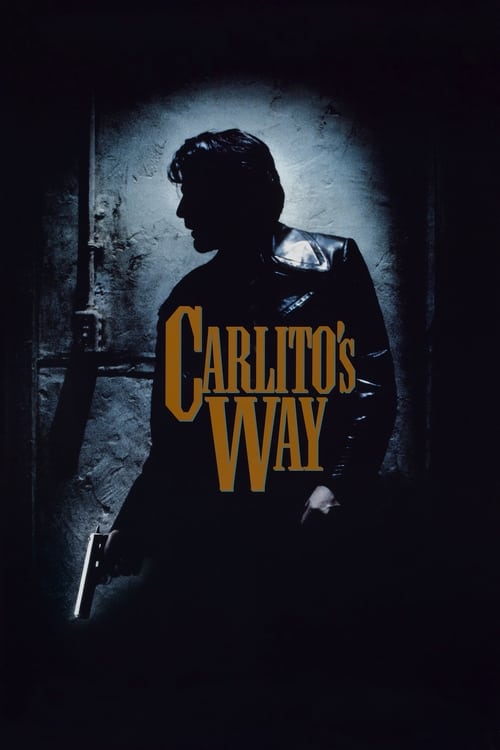
Carlito's Way
1993 · Brian De Palma
For when you want a crime saga with a soul — a long, immersive evening picture for when gangster-movie style should come with real heartbreak. Meatier and sadder than a popcorn thriller; settle in.
What it's about
After years in prison, a Puerto Rican former drug kingpin walks free into 1970s New York swearing he's done with the life — he just needs to run a nightclub, save some money, and get out clean with the woman he loves. But the neighborhood remembers who he was, his loose-cannon lawyer keeps pulling him toward trouble, and every favor he owes has interest. It's the story of a man trying to outrun his own reputation.
The experience
A slow-burn tragedy that erupts into some of the most heart-stopping suspense sequences ever staged — you spend the film dreading what you sense is coming and gripping the armrest when it does. Romantic, mournful, and electric all at once.
Performances
Al Pacino gives one of his most soulful performances, playing Carlito's weariness and code of honor rather than volume; Sean Penn, nearly unrecognizable in a frizzy perm, is spectacular as the coked-up, corrupt lawyer dragging him under. Penn's transformation alone is worth the watch.
The craft
Brian De Palma directs at full command: long, swooping camera moves, meticulously built set pieces, and a climactic chase through Grand Central that's a masterclass in sustained suspense. The 1970s New York of nightclubs, neon, and salsa is rendered with intoxicating detail — a film that rewards the biggest screen you have.
Why it matters
Underrated on release in the shadow of the era's other crime epics, it has been steadily re-appraised as one of De Palma's finest films and one of the great American crime tragedies of the 1990s.
Snapshot
Brian De Palma's Carlito's Way is a tragic crime film in the classical mold: a man tries to outrun the gravity of his own history and fails, and the audience watches this failure from the first frame. Set in the mid-to-late 1970s in a New York still gritty enough to feel like a moral ecosystem, the film follows Carlito Brigante — Puerto Rican ex-con, former drug lord, reluctant idealist — as he attempts to earn his way out of the underworld only to be destroyed by the one loyalty he cannot shed. Released in November 1993, it arrived in the middle of a remarkable cycle of American crime cinema and was initially underestimated. Time has since made the case clearly: this is De Palma at full command, a film of sustained operatic intelligence that ranks among the director's finest and among the great American crime tragedies of the post-New Hollywood era.
Industry & production
The film is an adaptation of two novels by Edwin Torres — Carlito's Way (1975) and After Hours (1979) — synthesized into a single screenplay by David Koepp. Torres's credentials lent the source material unusual authority: he served as a New York State Supreme Court judge and drew on direct knowledge of the Puerto Rican street world in the city's boroughs, giving the novels a sociological texture that elevates them above genre entertainment. Koepp, whose Jurassic Park screenplay appeared the same year, compressed and reconciled the two books into one coherent arc, preserving Torres's fatalistic voice while tightening the dramatic machinery considerably.
The project reunited De Palma with Al Pacino a decade after Scarface (1983), and that prior collaboration hung productively over the production — the audience and, in a sense, the filmmakers were consciously working against the Tony Montana template. Where Montana was appetite and explosion, Carlito Brigante is reflection and restraint, a man who has learned the cost of what he once was. Universal Pictures and Epic Productions backed the film with a significant budget; De Palma was given the resources to reconstruct 1970s New York in considerable detail.
The production design by Richard Sylbert — a major Hollywood figure whose career extended back to The Manchurian Candidate (1962) and Who's Afraid of Virginia Woolf? (1966) — is meticulous in its period recreation: the nightclub El Paraiso, the grimed-out tenement blocks, the leisure-suit wardrobes and amber-lit bars. The physical world of the film is fully inhabited, never merely costumed.
Technology
Carlito's Way was shot on 35mm by Stephen H. Burum, De Palma's cinematographer through much of the late 1980s and early 1990s. The production did not pioneer any particular new technology, but it deployed the tools of the period — anamorphic lenses, Steadicam rigs, crane and dolly work — at a level of craft that rewards close attention. The Steadicam sequences in the nightclub environment are technically exacting, threading through crowds and staging in single uninterrupted takes. The film predates digital intermediate color grading; its palette was achieved photochemically, and the warm amber-and-shadow look of the period interiors owes much to traditional lighting design rather than post-production manipulation.
Technique
Cinematography
Burum and De Palma work in a register of controlled expressionism. The camera is rarely neutral — it tilts to suggest instability, tracks in to isolate Carlito in his fatalism, pulls back to show him hemmed in by space and circumstance. De Palma's trademark split-screen and split-diopter compositions appear, though more selectively here than in his earlier work: the split-diopter shots that keep both foreground and background in simultaneous sharp focus serve a specific dramatic purpose, forcing the viewer to hold two focal points in attention, as Carlito must. The pool hall sequence early in the film — a prolonged, escalating scene of violence — is shot with a patient, circling geometry that makes the space feel like an arena.
The film's most celebrated technical passage is the climactic chase through a New York train terminal, a sequence that draws on the full grammar of De Palma's cinema: overhead shots, slow-motion intercut with real-time, tracking shots that press forward even as the narrative logic tells us the outcome is already determined. The escalator — Carlito ascending toward a life that recedes above him, his pursuers closing below — is staged with a precision that makes the machinery of cinema visible without sacrificing emotional force.
Editing
Bill Pankow, De Palma's regular collaborator, co-edited the film with Kristina Boden. The editing structure is bracingly confident. The film opens with Carlito already shot, his voice-over beginning over what will turn out to be the final scene — this forces the audience into a posture of retrospective attention for every subsequent sequence. We watch knowing the ending; the question is not what happens but why, and the editing never lets that dramatic irony collapse into mere suspense management. The pacing is deliberately longer than the crime films being made contemporaneously: De Palma and Pankow hold scenes past the moment most editors would cut, allowing performances to breathe and atmosphere to accumulate.
Mise-en-scène / staging
De Palma's staging throughout the film reflects his affinities with classical Hollywood and with Hitchcock in particular. The nightclub scenes are choreographed so that the camera's movement through the space rhymes with the social dynamics being depicted — observation, surveillance, desire. Carlito perpetually watches and is watched; the camera formalizes this condition. The recurring image of staircases and escalators — vertical movement associated with aspiration and danger — is introduced early and paid off in the finale, a visual motif that belongs to the film's deepest organizing logic. The staging of two-person scenes, particularly between Pacino and Sean Penn as the corrupt lawyer Dave Kleinfeld, creates an uncomfortable physical proximity that makes the relationship's toxicity tangible.
Sound
Patrick Doyle's orchestral score weaves between melancholy and dread, incorporating the rhythms of Latin music — salsa, son — into a more conventionally dramatic orchestral framework in a way that roots the film in Carlito's cultural identity while serving the thriller register. The sound design is particularly effective in the nightclub sequences, where the throb of period disco and Latin music functions as environmental pressure rather than mere set-dressing. The balance between Pacino's voice-over narration, which is ruminative and literary, and the score is carefully calibrated: the narration often enters in relative silence, as if spoken from the interior life rather than from the film's ambient world.
Performance
Al Pacino delivers one of his most precisely controlled performances. After a run in the late 1980s and early 1990s of increasingly large-scale acting, his Carlito Brigante is characterized by stillness and watchfulness — a man who has learned to contain himself because expression has cost him too much. The Puerto Rican accent and cadence are handled with care, though the film makes no claim to documentary naturalism; this is stylized genre acting in the best sense. Sean Penn, wearing prosthetic teeth and a greasy haircut, plays Kleinfeld as a man in the last stages of self-destruction: venal, paranoid, pathetically dependent on the very code of loyalty he constantly violates. It is a fearless physical and psychological transformation. Penelope Ann Miller's Gail is the film's romantic center, given somewhat less to work with by the script, though her scenes with Pacino have genuine warmth. John Leguizamo, in an early career-defining role, plays Benny Blanco from the Bronx with a coiled, almost comic intensity that makes the character both threatening and absurd.
Narrative & dramatic mode
The film operates as Greek tragedy in a crime-film shell. The prologue establishes the ending — Carlito shot, ambulance-bound — and the entire subsequent narrative is retrospective, a dying man's accounting. This structure, which owes a clear debt to Double Indemnity (1944) and Sunset Boulevard (1950), produces a specific form of dramatic irony: the audience knows the destination and watches the protagonist make each choice that leads there with growing sorrow rather than suspense. The voice-over narration, drawn in spirit from Torres's first-person prose, carries a quality of elegy — Carlito is already reflecting on a life as it concludes.
The central dramatic conflict is not between Carlito and his enemies but between Carlito and the loyalty he cannot revoke. His ruination comes not from moral weakness or lack of will but from the code of the streets, which demands that he not abandon Kleinfeld even as Kleinfeld accelerates toward catastrophe. This makes the film far more philosophically serious than its genre surface suggests: fate here is not abstract but sociological, encoded in the ethics of a world Carlito cannot fully leave even after he has intellectually rejected it.
Genre & cycle
Carlito's Way belongs to a resurgent cycle of American crime films in the early 1990s: GoodFellas (1990), Boyz n the Hood (1991), The Silence of the Lambs (1991), Reservoir Dogs (1992), and Pulp Fiction (1994) constitute its immediate context. Within this cycle, De Palma's film is the most formally traditional — it has no interest in postmodern irony or generic self-consciousness. It takes the conventions of the gangster tragedy and the film noir entirely at face value, as vehicles adequate to serious dramatic purpose. This made it seem slightly out of step with the moment at release; in retrospect it reads as the most classical of the cycle's members, closer to The Godfather (1972) in its tragic ambitions than to the playful genre revisionism around it.
The film also belongs to a specific sub-tradition: the "exit narrative" crime film, in which a criminal attempts legitimate escape and is prevented. Out of the Past (1947) and Force of Evil (1948) are among its ancestors; the tradition continues in films from Heat (1995) forward.
Authorship & method
De Palma's cinema is organized around the primacy of the image and the extended sequence rather than the individual scene. He builds toward set-pieces — long, elaborately choreographed passages that bear the emotional and thematic weight of the narrative — and Carlito's Way is structured with this method fully deployed. The director's acknowledged debts to Hitchcock are operative here: the organization of suspense around spatial geometry, the use of point-of-view to create dread, the implication that vision and knowledge are always incomplete.
Stephen H. Burum had been De Palma's cinematographer since The Untouchables (1987) and they shared a vocabulary of high-contrast lighting, sweeping crane work, and the patience to sustain a single complex shot. Patrick Doyle brought a more classical European sensibility to the scoring than De Palma's earlier collaborations with Pino Donaggio, and this contributes to the film's elegiac rather than visceral emotional register. David Koepp's adaptation is credited with considerable structural economy; the narrative compression from two novels to one film did not sacrifice thematic density.
Movement / national cinema
The film is squarely in the American studio tradition as filtered through the auteurist values of the New Hollywood generation. De Palma came of age alongside Scorsese, Coppola, and Spielberg, and shares with them a formation in both European art cinema and American genre film. Carlito's Way is a work of that synthesis: formally sophisticated (the influence of the French New Wave's long takes and tracking shots, filtered through Hitchcock) but narratively committed to genre satisfactions rather than modernist fragmentation.
There is also a dimension worth noting regarding the representation of the Puerto Rican community in New York, which the film handles with more complexity than most crime films of its era. Edwin Torres's authorship of the source material grounds this in insider knowledge, and the film is unusual for its period in centering a Latino protagonist in a major studio crime film with genuine dramatic interiority rather than as a type.
Era / period
The production appeared in the cultural moment of early-1990s Hollywood when crime and violence were the dominant genres of prestige filmmaking, and studios were willing to back adult-oriented films with significant budgets. This window — roughly 1990–1996 — gave directors of De Palma's generation an unusual freedom to work within genre at a scale that would not recur for some time. The film's setting in the 1970s added a layer of retrospective melancholy: the period of New York's fiscal crisis and maximum urban grime, recovered in 1993 at a historical remove that allowed it to be aestheticized without entirely glamorizing its dangers.
Themes
The film's central thematic preoccupation is the impossibility of self-revision under structural conditions that resist it. Carlito's stated desire — to earn enough money to buy into a car rental business in the Bahamas, to get out with Gail, to be a different person — is entirely sincere. His failure is not moral hypocrisy but structural inevitability: the networks of obligation, visibility, and violence in which he is embedded cannot be simply exited. The film treats this with unusual seriousness, refusing to make Carlito's destruction a punishment for arrogance or denial.
Complementing this is the theme of friendship and betrayal. Kleinfeld is the instrument of Carlito's destruction, and their relationship embodies a code of loyalty that functions as both virtue and trap. De Palma is interested in the honor that exists within criminal culture not to romanticize it but to show how it can be weaponized against the person who holds to it most sincerely.
Romantic love figures as a counterweight — Carlito's relationship with Gail is the film's most tender vein, and it is this tenderness, more than anything else, that makes his death genuinely tragic rather than merely inevitable. The American Dream inflection — the immigrant's child who cannot access legitimate channels toward the life he can imagine — runs throughout without being labored.
Reception, canon & influence
Backward (influences on the film): The film draws directly on the Hollywood gangster tradition from Scarface (1932) and White Heat (1949) through The Godfather (1972) and Mean Streets (1973). The noir structure — retrospective narration, doom-loaded opening — descends specifically from Double Indemnity and Sunset Boulevard. Hitchcock is present throughout: the staircase imagery resonates with Vertigo (1958), and De Palma's spatial organization of suspense is inconceivable without that precursor. Edwin Torres's novels, with their embedded social realism about 1970s New York Puerto Rican life, provided a source with documentary roots that the film's generic ambitions do not entirely absorb but are enriched by.
Reception: At the time of release, the film received respectful but not overwhelming critical attention. It was positioned in the shadow of Scarface and evaluated against that film to its detriment, a comparison that missed what Carlito's Way was actually doing. Commercially, it performed modestly rather than strongly. Sean Penn's performance was widely noted as a highlight. Over subsequent years, reassessment has been consistent and favorable; the film is now routinely cited as among De Palma's best work and as an unjustly overlooked entry in the early-1990s crime cycle.
Forward (what it shaped): The influence of the film's train-terminal finale — its orchestration of space, slow motion, and foreknown doom — is difficult to trace with precision but has clearly permeated the grammar of American action-thriller filmmaking. The film's elegiac treatment of the "exit narrative" crime genre was absorbed into the cycle of films that followed: one can feel its emotional temperature in Michael Mann's Heat, which appeared two years later. The performance model Pacino developed here — contained, retrospective, playing against flamboyance — influenced subsequent iterations of the aging-criminal archetype. The film has also been repeatedly cited in conversations about Latino representation in American cinema, for the complexity and dignity with which it renders Carlito's interiority.
A Deleuzian reading
Carlito Brigante is on a gurney before he is anything else.
The full Deleuzian reading of Carlito's Way →
Reception
In 1993 it was shrugged off as Pacino and De Palma retreading Scarface and did modest box office; it's since been reappraised as one of De Palma's finest, famously crowned the best film of the 1990s by Cahiers du Cinéma.
How Carlito's Way was received, from release to now →
Influences: the films it descends from and the films it influenced
- Double Indemnity (1944) — Invents the retrospective voiceover in which a doomed speaker narrates completed events from the endpoint of his own destruction — Carlito's opening gunshot and present-tense narration are structurally identical to Neff's Dictaphone confession, establishing the confessional register of the already-lost.
- Sunset Boulevard (1950) — Establishes the proleptic editing structure — opening on the protagonist already dead, then narrating retrospectively toward that known conclusion — that Carlito's Way adopts precisely: the film's first image is Carlito already shot, his voiceover explaining how we arrived at the frame we are watching.
- White Heat (1949) — Proves that Greek tragedy mechanics work inside the American gangster genre: the protagonist's single inalienable loyalty becomes the exact mechanism of self-destruction, converting genre film into classical tragedy — the structural template that Carlito's Way's Kleinfeld plot inherits directly.
- Touch of Evil (1958) — The opening crane shot establishes the unbroken tracking move through complex physical space as a grammar of directorial fatalism and spatial inevitability — the precursor grammar that Carlito's Way's Steadicam passages through El Paraiso and the terminal directly inherit.
- Vertigo (1958) — The vertical staircase as the spatial encoding of fate — Scottie climbing toward doom above him — is the direct architectural ancestor of Carlito's escalator finale, where upward movement is simultaneously aspiration and terminus; De Palma also inherits the subjective surveillance camera that makes the audience complicit in watching.
- Mean Streets (1973) — Develops the Steadicam tracking shot through nightclub space as an immersive grammar for moving through criminal social environments — Carlito's Way's El Paraiso sequences extend this technique while integrating Latin music diegetically to make cultural milieu a moral pressure field rather than mere period decoration.
- The Godfather Part II (1974) — Establishes the exit-narrative impossibility as formal genre logic — Michael's failed attempt at legitimacy is the structural template Carlito revises — while its extended scene duration, holding guilt and grief past the moment conventional editing would cut, is the pacing model De Palma and Pankow follow in the courtroom and apartment sequences.
- Blow Out (1981) — De Palma's own development of split-diopter compositions — holding foreground and deep background simultaneously in sharp focus to build suspense across two planes of action — reaches formal maturity here, before Carlito's Way deploys the technique in precise narrative service to keep Carlito and his pursuers in simultaneous, implacable focus.
- Scarface (1983) — Same director, cinematographic toolkit (split-diopter, Steadicam, overhead), and star generate two dialectically opposed gangster tragedies: Scarface is maximalist performance and explosive staging, Carlito's Way is contraction and restraint — Pacino's stillness is a deliberate formal inversion of Tony Montana, the shared vocabulary deployed toward opposite dramatic ends.
- The Untouchables (1987) — De Palma develops his set-piece-as-choreographic-formalism grammar in the Union Station sequence — overhead shots, slow-motion intercut with real-time, spatial geometry elevated to ballet — establishing the visual logic that Carlito's Way's train terminal finale refines into its fullest and most emotionally grounded expression.
- King of New York (1990) — The tragic-ironic gangster who dreams of going straight and dispensing benevolence yet is dragged to a fated death, scored and shot in lush neon-noir New York — the same doomed-king arc as Frank White.
- Heat (1995) — Extends De Palma's technique of extended scene duration into a full formal strategy of atmospheric patience — holding the diner confrontation and tactical sequences past the point conventional crime editing would cut — while inheriting the exit-narrative structural logic of men who know they cannot leave and choose loyalty over survival.
- Boogie Nights (1997) — PTA directly cites and inherits De Palma's split-diopter compositions and Steadicam long-takes through period entertainment environments — the Boogie Nights opening shot is an acknowledged extension of the De Palma grammar developed across Scarface and Carlito's Way, including the overhead choreography of group performance spaces.
- Before the Devil Knows You're Dead (2007) — Radicalizes the proleptic editing structure into fully non-linear form — opening on the crime's aftermath and revisiting the same events from multiple temporal vantage points — extending the retrospective-voiceover device Carlito's Way inherits from noir and deploys in classical form into a fractured, multi-perspectival version of structural inevitability.
- No Country for Old Men (2007) — Sheriff Bell's opening voiceover monologue places the audience in exactly the posture of prospective doom that Carlito's prologue creates — structural inevitability established before the narrative begins — and pursues the Greek tragedy logic of a protagonist whose intelligence makes him more fully conscious of his own inescapability.
- A Prophet (2009) — Transplants the Carlito's Way Greek tragedy arc into a French arthouse register: the protagonist's single formative loyalty becomes the mechanism of entrapment, his growing intelligence makes his circumstances more legible and more inescapable simultaneously, and the staging consistently uses surveillance geometries and spatial choreography to formalize the prison-of-circumstance logic.
- 25th Hour (2002) — The doomed ex-con-going-straight in New York, narrated under a fate the audience knows is already sealed and framed by flashback, prefigures Monty's countdown told as elegy for a freedom already lost.
- GoodFellas (1990) — Both films pair retrospective voiceover narration with Steadicam tracking as the dominant grammar for entering criminal social space, but GoodFellas uses acceleration and fragmentation to produce exhilaration while Carlito's Way uses deceleration and extended duration to produce dread — two dialectically opposed formal solutions to the same problem of narrating a life you already know ends in ruin.
Similar films
- Heat (1995) — influence & lineage · same viewing thread
- Mean Streets (1973) — influence & lineage · same viewing thread
- Scarface (1983) — influence & lineage
- GoodFellas (1990) — influence & lineage
- The Godfather Part II (1974) — influence & lineage
- The Untouchables (1987) — influence & lineage
- A Bronx Tale (1993) — same viewing thread
- Raging Bull (1980) — same viewing thread
All the films related to Carlito's Way →
Watch it with: curated runs of related films
- American Crime, Long Memory — A run of mob epics, noir, and neighborhood tragedies that all circle the same wound — loyalty, masculine violence, and the past that never lets go — so watch them close together and let the decades and cities blur into one long American story.