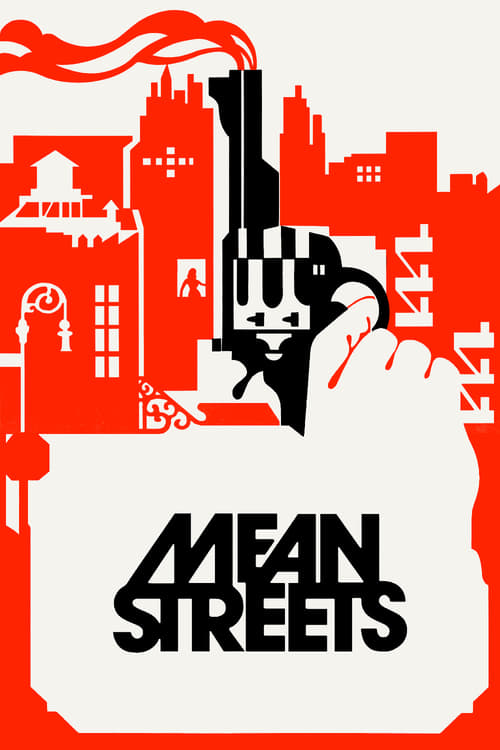
Mean Streets
1973 · Martin Scorsese
His "Marvel isn't cinema" comments spawned a years-long culture war about what cinema even is; Killers of the Flower Moon added runtime discourse and questions about centering white perspectives in Osage history. Also beloved as a TikTok dad and Letterboxd's patron saint.
For when you want gritty, electric filmmaking with real danger in it — a hangout movie that keeps threatening to explode. Not a comfort watch, but a thrilling one, especially if you want to see where modern American crime cinema was born.
What it's about
In Manhattan's Little Italy, Charlie is a small-time hood trying to rise in his uncle's mob orbit while privately doing penance for his sins — chiefly his loyalty to Johnny Boy, a reckless friend who owes money all over the neighborhood and can't stop lighting fuses. Caught between a secret love, the Church, and the street, Charlie keeps trying to save a man who may not want saving.
The experience
Raw, jittery, and alive — bar-room camaraderie that turns violent in a heartbeat, scored to jukebox rock and roll. It feels less like a plotted crime movie than like being trapped in a neighborhood with these guys, funny and volatile in equal measure.
Performances
Robert De Niro's Johnny Boy is a live wire — charming, infuriating, genuinely unpredictable — and it announced him to the world; Harvey Keitel matches him as Charlie, all guilt and hedged loyalties, a man negotiating with God in bars.
The craft
Scorsese's handheld camera prowls pool halls and tenement streets with an intimacy that was startling in 1973, and his use of pop songs as score — not decoration — rewrote the rulebook. Shot fast and cheap, it turns rough edges into style: improvised-feeling scenes, saturated red barlight, violence that erupts mid-conversation.
Why it matters
This is where Scorsese found his voice, and its language — rock scoring, handheld energy, street-level Catholicism and crime — shaped American movies for the next fifty years.
Snapshot
Mean Streets is the film in which Martin Scorsese found his voice — a raw, propulsive portrait of young men trapped between Catholic guilt and street-level violence in Manhattan's Little Italy. Shot on a shoestring across Los Angeles locations standing in for New York, with brief authentic footage in the neighborhood itself, the film introduced the world to Robert De Niro's volcanic screen presence and announced Scorsese as the most formally restless director of the American New Wave. More than fifty years on, it remains the originating document of a cinematic language — handheld intimacy, wall-of-rock-and-roll scoring, improvisational performance — that would define American crime cinema for decades.
Industry & Production
The film grew directly out of Scorsese's unproduced personal projects and his semi-autobiographical earlier feature Who's That Knocking at My Door (1967), which starred Harvey Keitel in a spiritually related role and was made in a similar milieu. Producer Jonathan Taplin — best known at the time as road manager for The Band — brought the project to fruition on a budget of approximately $480,000, an exceptionally modest figure even by early-1970s independent standards. Warner Bros. acquired domestic distribution rights, providing the film its theatrical platform without having financed it, a structure that preserved considerable creative independence for Scorsese.
Principal photography took place largely on studio facilities associated with Roger Corman's production apparatus in Los Angeles, which could be dressed and redressed to simulate Little Italy interiors. A limited location shoot in the actual neighborhood — Mulberry Street, the feast of San Gennaro — supplies the film's most documentary passages. This production geography creates an interesting tension: the world depicted is ferociously specific, yet much of it was manufactured several thousand miles away from its subject.
The film premiered at the New York Film Festival in October 1973 before entering wide release. Its fortunes at the box office were modest; the film's significance was recognized critically rather than commercially, and it built its reputation through repertory circulation, word of mouth, and the retroactive prestige conferred by Scorsese's subsequent career.
Technology
Mean Streets deploys 35mm as its primary format, but the opening home-movie passages — Charlie's waking nightmare in bed, the fragments of street life — incorporate 16mm footage, giving them a grainy, archival quality that distinguishes memory and interiority from present-tense drama. This deliberate texture manipulation would become a recurring strategy in Scorsese's work. The camera package was relatively light and mobile, consistent with the handheld aesthetic that dominates the film's kinetic sequences. Available-light and mixed-light shooting in actual locations, alongside the deliberately low-key interior lighting of the Red Tavern sequences, give the film its characteristic underlit density.
Technique
Cinematography
Kent Wakeford served as cinematographer, and the film's visual grammar is among the most influential of its decade. The handheld camera does not merely observe but participates — lurching, swaying, tracking its subjects at close quarters in a way that implicates the viewer in the film's moral atmosphere. The famous slow-motion entrance of Johnny Boy into the bar, lit in blood-red neon while The Rolling Stones thunder on the soundtrack, is among the most formally distinctive images in American cinema: the camera tilts up from feet to face in a movement that declares a character rather than simply introducing him. The Red Tavern scenes are lit largely in reds and ambers, creating an infernal palette that literalises Charlie's Catholic conception of hell — a place he explicitly associates with fire, the body, and the flesh he cannot escape.
Editing
Sidney Levin edited the film, working from material that was partly scripted and partly shaped by improvisation on set. The editing rhythmically integrates the diegetic and non-diegetic music in ways that were largely unprecedented: cuts fall on downbeats, music shapes the pacing of scenes rather than merely underscoring them. The climactic car sequence — the sudden, violent collapse of everything — is edited with a disorienting abruptness that refuses catharsis. Throughout, the film exploits jump-cutting and ellipsis to render its world as episodic and accumulative rather than causally driven.
Mise-en-scène / Staging
Scorsese stages his actors in tight, cramped spaces — pool rooms, bars, narrow staircases — that amplify the physical and psychological pressure his characters are under. Bodies crowd the frame. The staging of the bar sequences in particular owes something to Cassavetes: actors overlap, interrupt, speak past each other. The feast-of-San-Gennaro exteriors introduce a carnivalesque counter-reality, the neighborhood's official self-display setting against the private desperation inside. Charlie's church sequences are staged with near-liturgical formality — a deliberate tonal shift that maps the film's central tension between sacred aspiration and profane circumstance.
Sound
The film's sound design is dominated by its wall-to-wall music licensing: The Ronettes' "Be My Baby" opens over the first title card and immediately establishes the film's sensory register. The Miracles, The Rolling Stones, Eric Clapton, and other artists appear throughout, often non-diegetically, often at a volume that competes with dialogue. This was not standard practice in 1973 American cinema, and its commercial music approach anticipates what would later become a signature across New Hollywood and beyond. The music is rarely used for ambient effect; it is actively interpretive, even editorial — Johnny Boy's entrance to "Jumpin' Jack Flash" is not background; it is argument. The dialogue audio is often rough and naturalistic, with the unpolished grain of location sound.
Performance
Harvey Keitel's Charlie is the film's moral and emotional center, an internalized performance of Catholic self-examination and suppressed violence that Keitel sustains in nearly every scene. Robert De Niro's Johnny Boy is the more celebrated turn — explosive, unpredictable, comic and menacing by turns — and represents an early demonstration of the transformation-through-immersion approach De Niro would develop further with Scorsese across their subsequent collaborations. Amy Robinson as Teresa and David Proval as Tony provide crucial texture; Richard Romanus as Michael registers genuine menace in a largely reactive role. Scorsese himself appears in a brief, unsettling cameo as a hitman in the film's final sequence.
Narrative & Dramatic Mode
The film is structurally episodic, less interested in forward momentum than in accumulation of texture, incident, and character. Its plot — Charlie is responsible for the debts of his self-destructive friend Johnny Boy; the situation will inevitably turn violent — is not hidden, but it advances slowly, almost unwillingly. The narrative mode is closer to Cassavetes than to classical Hollywood genre: we live with these characters between events, not only during them. Charlie's voiceover is confessional in register, drawn from Catholic idiom, and it frames the film as an examination of conscience rather than a thriller. The collision of sincerity and brutality in that framework gives the film its distinctive tonal temperature.
Genre & Cycle
Mean Streets belongs to the cycle of New Hollywood crime films that emerged between roughly 1967 and 1976 and collectively renegotiated the terms of American genre cinema. It participates in the gangster tradition — the Italian-American neighborhood, the codes of loyalty and omertà, the violent masculine economy — while deliberately stripping away the glamour and large-scale plotting that characterized classical examples of the form. Its world is low-rent, small-scale, and unglamorous in ways that The Godfather (1972), released the previous year, conspicuously was not. Mean Streets is interested in the texture of street-level criminality rather than its hierarchies and mythologies. It belongs equally to the American independent tradition, sharing formal DNA with Cassavetes' Shadows (1958) and Faces (1968) in its commitment to improvisation, naturalistic performance, and narrative looseness.
Authorship & Method
The screenplay was written by Scorsese and Mardik Martin, drawn extensively from Scorsese's own experience growing up in Little Italy — Charlie is a self-portrait with displacement. Scorsese's directorial method on the film was notably collaborative and improvisational: actors were encouraged to find dialogue and moments within scripted frameworks, and much of the film's texture derives from De Niro and Keitel's ability to inhabit rather than merely perform their characters.
Kent Wakeford's contribution as cinematographer, while sometimes underacknowledged relative to Scorsese's later collaborations with Michael Chapman and Gordon Willis, established the visual vocabulary the director would refine across the decade. The editorial partnership with Sidney Levin shaped the rhythmically aggressive grammar that became Scorsese's signature. Jonathan Taplin's production role was foundational; without his capacity to assemble the necessary resources, the film would not have been made.
Movement / National Cinema
Mean Streets is a central text of the American New Wave — the loosely affiliated movement of directors who emerged from the late 1960s and early 1970s to challenge classical Hollywood conventions in subject matter, form, and production method. Alongside Bonnie and Clyde (1967), Easy Rider (1969), The Last Picture Show (1971), and Five Easy Pieces (1970), it helped define a cinema in which the countercultural moment's disillusionment found formal expression: fragmentary narratives, ambiguous endings, morally compromised protagonists, resistance to uplift. The film also carries a distinct Italian-American cultural identity that registers as something closer to a national cinema within a national cinema — a set of images, idioms, and social textures drawn from a specific immigrant experience that Scorsese treats as universal precisely by rendering it with specificity.
Era / Period
Mean Streets belongs to the early 1970s ferment that produced what is sometimes called Hollywood's second golden age — the period from approximately 1969 to 1979 in which studios, newly uncertain about audience preferences following the collapse of the old production system, gave unusual creative latitude to young directors. The film was made at the moment of maximum New Hollywood confidence and contributed to the argument, then being assembled film by film, that American commercial cinema could sustain the formal and thematic ambitions associated with European art cinema.
Themes
Guilt and moral accounting dominate the film. Charlie's Catholicism is not merely decorative: his tortured negotiations with sin, penance, and responsibility structure the entire dramatic arc. His relationship with the Church and with his uncle's underworld world cannot be reconciled, and the film does not pretend otherwise. Loyalty is simultaneously the film's highest value and its trap — Charlie's devotion to Johnny Boy ensures both his own moral seriousness and his eventual destruction. The impossibility of escape from neighborhood, family, and social role is articulated with particular precision: Charlie's fantasies of advancement are always and immediately foreclosed by the obligations that define him. Violence in Mean Streets is not thrilling; it is abrupt, unglamorous, and slightly sickening — a formal argument about the nature of screen violence that Scorsese would continue to develop.
Reception, Canon & Influence
Influences on the film: Scorsese has consistently cited Roberto Rossellini and the Italian neorealists as formative — their insistence on location shooting and non-professional texture informs the film's documentary-adjacent aesthetic. Jean-Luc Godard's aggressive editing and his willingness to disrupt narrative flow for formal effect is visible throughout. Most directly acknowledged by Scorsese himself is John Cassavetes, whose Shadows and Faces demonstrated that American independent cinema could pursue a cinema of faces and unresolved situations without concession to genre satisfaction. Roger Corman's production school, in which Scorsese served as both editor and director on various projects, contributed pragmatic discipline about working fast with limited resources.
Critical reception: The film was recognized by critics from its New York Film Festival premiere as exceptional. Its critical reputation established Scorsese immediately as a major talent, and it was championed by influential voices in American film journalism. It did not, however, achieve significant commercial success on initial release; its cultural standing accumulated over years rather than arriving fully formed.
Legacy and forward influence: The film's most measurable forward influence is on the American crime film. Quentin Tarantino has cited it among his most formative experiences of cinema; the structural looseness, the music deployment, the sudden lurches between comedy and violence in Reservoir Dogs and Pulp Fiction are inconceivable without Mean Streets as precedent. James Gray's Little Odessa and other street-level crime films of the 1990s descend directly from it. The Scorsese-De Niro collaboration it inaugurated produced Taxi Driver, Raging Bull, and The King of Comedy — a run of films that collectively constitute one of the most significant director-actor partnerships in cinema history. The film was selected for preservation in the United States National Film Registry by the Library of Congress in 1997, a recognition of its canonical status. Its influence on television drama — in particular the aesthetics of serious crime and character-driven prestige television — is substantial, if harder to trace with precision. It remains, above all, the film in which American cinema learned it could place a camera inside a world rather than merely in front of it.
A Deleuzian reading
The camera finds his feet first.
The full Deleuzian reading of Mean Streets →
Reception
Championed from day one — Pauline Kael hailed it as 'a true original' after its 1973 New York Film Festival premiere — but it was only a modest earner; decades on, it's canonized as the big bang of Scorsese's whole universe.
How Mean Streets was received, from release to now →
Influences: the films it descends from and the films it influenced
- Shadows (1959) — Cassavetes's handheld camera moving with actors through cramped New York interiors and his insistence on overlapping, spontaneous dialogue directly established the participatory camera grammar and immersive performance mode Scorsese adopted wholesale for Mean Streets.
- Breathless (1960) — Godard's jump-cut editing that treats ellipsis as moral stance — refusing narrative continuity to mirror characters' refusal of convention — gave Scorsese the template for episodic, non-causal structure and the principle that a cut can be editorial argument rather than invisible suture.
- Who's That Knocking at My Door (1967) — Scorsese's own proto-Mean Streets shares Harvey Keitel, the Little Italy setting, the confessional Catholic voiceover structure, and the handheld home-movie aesthetic, functioning as the unrevised first draft of Mean Streets' entire formal grammar.
- Faces (1968) — Cassavetes's technique of staging actors in suffocating close-quarters rooms and letting improvisation shape scene duration gave Scorsese the specific model for the Red Tavern sequences, where the camera occupies the same social claustrophobia as the characters.
- Easy Rider (1969) — Hopper's use of licensed rock tracks (Steppenwolf, The Byrds, Hendrix) as structural and tonal architecture rather than ambient score established the industrial precedent — and audience expectation — for non-scored music as editorial voice, which Scorsese radicalized with 'Be My Baby' and 'Jumpin' Jack Flash.'
- The Wild Bunch (1969) — Peckinpah's slow-motion technique that aestheticizes violence into balletic temporality, and his intercutting between multiple camera speeds within a single action beat, gave Scorsese the formal vocabulary for Johnny Boy's iconic slow-motion bar entrance lit in blood-red neon.
- Medium Cool (1969) — Wexler's deliberate mixing of 16mm documentary footage with 35mm fictional material to differentiate registers of reality directly prefigures Scorsese's use of grainy 16mm for Charlie's waking-nightmare prologue against the 35mm present-tense drama.
- On the Waterfront (1954) — Scorsese fuses Waterfront's Catholic moral frame — Charlie's guilt and his obligation to Johnny Boy paralleling Terry's responsibility to Joey Doyle — with location shooting in actual Little Italy streets and a sound design that foregrounds diegetic ambient noise against scored music, inheriting Waterfront's sonic hierarchy.
- Band of Outsiders (1964) — Scorsese absorbed Godard's available-light location shooting and deploys pop-music dance sequences as formal punctuation within a crime film, replicating the structural move Band of Outsiders crystallized with the Madison sequence.
- Midnight Cowboy (1969) — Extends the unglamorous, location-shot vision of grimy New York street life and the doomed intimate male friendship as the organizing relationship of an urban drama.
- I Vitelloni (1953) — Scorsese repeatedly cites Vitelloni as a model: an ensemble of aimless neighborhood men, a first-person voice-over conscience, and a hangout structure built from drifting episodes rather than plot.
- Pickup on South Street (1953) — Scorsese, an avowed Fuller admirer, channels the pulp kineticism and morally compromised small-time outsiders moving through cramped, tactile urban spaces.
- Taxi Driver (1976) — Bernard Herrmann's score is deployed with the editorial intensity Scorsese developed in Mean Streets — music dictating scene rhythm rather than underscoring it — and De Niro's immersive physical self-construction as Travis Bickle directly extends the improvisational total-commitment method cultivated as Johnny Boy.
- Raging Bull (1980) — De Niro's total-immersion body performance — gaining 60 pounds, training professionally — amplifies the physical character truth he established as Johnny Boy; the slow-motion aestheticization of the boxing ring also extends Mean Streets' Peckinpah-derived temporal expansion of violence.
- Do the Right Thing (1989) — Lee absorbed Mean Streets' strategy of deploying a single licensed track as structural refrain and moral announcement — Public Enemy's 'Fight the Power' functions exactly as 'Be My Baby' does — and applies it to a similarly cramped, neighborhood-specific mise-en-scène where community space is both arena and cage.
- GoodFellas (1990) — The Copacabana oner and the cocaine-fueled third act directly scale up Mean Streets' music-driven editing: licensed tracks (Layla, Sunshine of Your Love) dictate cut rhythm and emotional argument across entire sequences, while the episodic accumulation of criminal incident without causal propulsion reproduces Mean Streets' narrative logic at studio scale.
- Bad Lieutenant (1992) — Ferrara replicates the Catholic guilt / criminal transgression dialectic in a New York handheld register, using a confessional structure in which the protagonist's self-flagellating breakdown — like Charlie's voiceover — exposes the unbridgeable gap between spiritual aspiration and bodily compulsion.
- Reservoir Dogs (1992) — Tarantino deploys licensed tracks — Stealers Wheel's 'Stuck in the Middle with You' during the ear-cutting — as editorial argument rather than ambient score, directly applying Mean Streets' principle that pop music carries moral weight in violent contexts; the single-location claustrophobic staging of criminals escalating toward catastrophe also extends Mean Streets' cramped-space blocking.
- Pulp Fiction (1994) — The episodic accumulation narrative — vignettes that resist causal hierarchy and deny propulsive resolution — and the use of genre-specific pop music (surf rock, soul) as character-defining rather than scene-setting directly extend Mean Streets' non-causal structure and music-as-argument principle at feature scale.
- Boogie Nights (1997) — Anderson's long tracking shots propelled by period soul and rock tracks — the pool-party opener, the New Year's Eve sequence — reproduce Mean Streets' technique of using the camera's physical momentum and the music's rhythmic energy as mutually reinforcing editorial forces; the ensemble episodic accumulation of a milieu's rise and fall reproduces its narrative architecture.
- City of God (2002) — Meirelles and Lund's deliberate variation of film stock texture and handheld register to differentiate temporal layers — childhood rendered softer, present-tense violence more abrasive — directly extends Scorsese's 16mm/35mm format mixing; the episodic accumulation of a criminal community's history without single-protagonist causality reproduces Mean Streets' narrative logic at larger scale.
- Marty Supreme (2025) — Model for restless handheld immersion inside a specific New York subculture, riding diegetic needle-drops and amateur-grade faces for documentary friction.
- Rumble Fish (1983) — Establishes the grammar of treating street-gang youth culture as mythic material through diegetically integrated popular music and wide-angle photography of claustrophobic male spaces, which Rumble Fish absorbs and formalizes into pure Expressionism.
- The Godfather Part II (1974) — De Niro's physicalized, dialect-rooted, improvisationally textured performance here led directly to his casting as Vito; Coppola extended Scorsese's method-inflected Italian-American performance grammar into a more rigorous linguistic program, requiring months of Sicilian dialect immersion.
- The Godfather (1972) — Scorsese and Coppola simultaneously mapped Italian-American organized crime through Method performance and ethnic community texture, but where Coppola uses controlled classical staging, Scorsese's handheld restlessness and direct-address voiceover propose an alternative formal grammar for identical subject matter.
- The Friends of Eddie Coyle (1973) — Renders petty criminals almost entirely through their overlapping, profane, hyper-specific shop talk on real neighborhood locations — the same dialogue-as-action method.
- American Graffiti (1973) — Released the same year, it deploys wall-to-wall diegetic pop records as character interiority and milieu rather than mood-painting, the parallel codification of the needle-drop soundtrack.
- The Funeral (1996) — Embeds Catholic guilt and the sacramental fear of damnation inside low-level street crime, carried by ensemble naturalism and improvisatory low-key texture — Ferrara's closest American kin.
- Gloria (1980) — The gritty New York location-realist crime film built on behavioral performance over plot mechanics, the immediate environment Gloria's gangster world emerges from.
- The Last Temptation of Christ (1988) — Establishes the Catholic guilt-and-penance engine ('you don't make up for your sins in church') and handheld, mobile camerawork that Last Temptation makes explicit doctrine.
- Rocky (1976) — Shares the New Hollywood mode of ethnic working-class location energy and loose, behavioral hangout scenes among small-time neighborhood men — the same milieu Rocky renders with warmth rather than menace.
- Husbands (1970) — Sibling that explicitly cites Cassavetes — improvised, overlapping-dialogue scenes of male friendship and drunken bravado shot loose and close, drama emerging from horsing-around that curdles.
- The Killing of a Chinese Bookie (1976) — Shoots marginal nightlife handheld with improvised, overlapping dialogue and diegetic source music — a method Cassavetes personally encouraged Scorsese to pursue over studio assignment.
- Mikey and Nicky (1976) — Sibling in handheld immediacy and improvised-feeling male banter, dramatizing loyalty curdling into betrayal among small-time men whose masculinity is a running performance.
- The Panic in Needle Park (1971) — Location-shot behavioral realism of a street subculture, letting handheld immediacy and actor behavior carry a plotless drift.
Similar films
- Raging Bull (1980) — influence & lineage · same viewing thread
- GoodFellas (1990) — influence & lineage
- Taxi Driver (1976) — influence & lineage
- A Bronx Tale (1993) — same viewing thread
- The Killing of a Chinese Bookie (1976) — same viewing thread
- Casino (1995) — same viewing thread
- Mikey and Nicky (1976) — same viewing thread
- Carlito's Way (1993) — same viewing thread
All the films related to Mean Streets →
Watch it with: curated runs of related films
- American Crime, Long Memory — A run of mob epics, noir, and neighborhood tragedies that all circle the same wound — loyalty, masculine violence, and the past that never lets go — so watch them close together and let the decades and cities blur into one long American story.
Film essays and courses that include it
- Martin Scorsese
- Blood, Myth, and Grammar: The Gangster Film's Century
- American Cinema Breaks Open: New Hollywood 1967–1980
- What We Owe Each Other: Friendship Under Pressure
- The Family Business: Ten Films That Built the Mob Movie
- The City as Pressure: New York Cinema, 1948–2008
- Drop the Needle: Pop Music as Cinema's Beating Heart
- The Ten Years the Directors Won
- The Camera That Loves the Sin
- The Panic Attack as a Film