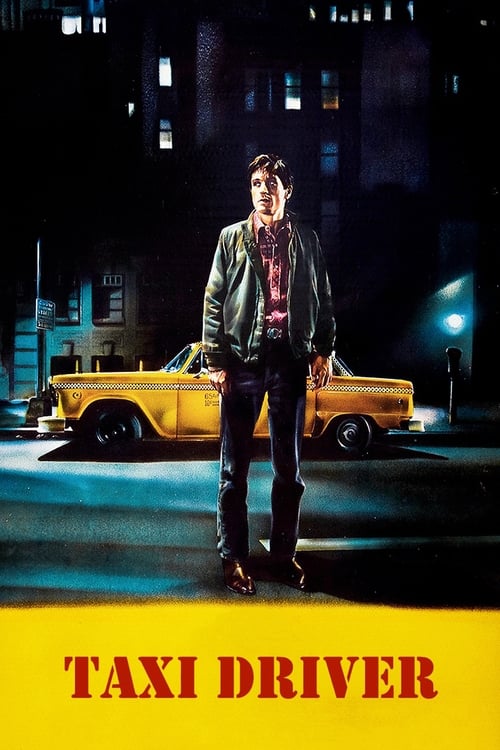
Taxi Driver
1976 · Martin Scorsese
His "Marvel isn't cinema" comments spawned a years-long culture war about what cinema even is; Killers of the Flower Moon added runtime discourse and questions about centering white perspectives in Osage history. Also beloved as a TikTok dad and Letterboxd's patron saint.
When you want to stare into the dark — a challenging, under-your-skin classic for a late night, not a comfort watch. Reach for it when you're ready to feel implicated, not reassured.
What it's about
A sleepless Vietnam veteran takes a night-shift cab job in mid-1970s New York and drifts through its neon and steam, growing more isolated with every mile. He fixates on a poised political campaign worker he can't reach, then on a teenage prostitute he decides to save, while his diary curdles into a fantasy of cleansing the city by force. It's a crime drama that lives entirely inside one warping mind.
The experience
Queasy, mesmerizing and slow-burning — you're locked in the cab with Travis, half-seduced by his voice and half-repelled by where it's going. The tension builds like a fever, and the film never lets you feel safe about your own sympathy.
Performances
Robert De Niro's Travis Bickle is one of the defining screen performances — charming, pitiable and terrifying in the same breath — and a very young Jodie Foster is unnervingly good as the girl he fixates on rescuing.
The craft
Scorsese shoots New York as a hellish light-show of steam vents and taxi-window reflections, and Bernard Herrmann's final score — all brooding brass and one lonely saxophone — is half the film's spell. Paul Schrader's diary-voiced script keeps you trapped in Travis's head from first frame to last.
Why it matters
It crystallized the paranoid loner as a screen archetype, won the Palme d'Or, cemented the Scorsese–De Niro partnership, and its DNA is in nearly every urban-alienation story since.
Snapshot
A Vietnam veteran in his late twenties, sleepless and spiritually hollowed, drives a cab through the nocturnal underworld of mid-1970s New York City. He cultivates a fantasy of purgative violence, attaches himself to a cool campaign worker he cannot hold, and transfers his messianic rage onto rescuing a teenage prostitute from her handlers. The finale is a blood-soaked massacre that the film treats, with queasy irony, as heroic. Paul Schrader's script and Scorsese's direction conspire to never stabilize the distance between us and Travis Bickle: his narration seduces, his worldview repels, and the film's final frames—an unearned newspaper-headline redemption and a paranoid rearview glance—refuse to resolve which emotional register was real. Taxi Driver is at once a genre film, a psychological study, a piece of city portraiture, and one of the defining documents of American cinema's most productive period of crisis.
Industry & production
Columbia Pictures financed the film through a relatively modest budget; specific figures in circulation vary across sources and should be taken as approximate, but the production was lean even by the standards of New Hollywood. Producers Michael and Julia Phillips—fresh from The Sting (1973) and working at the height of their influence—championed the project after Schrader's screenplay circulated widely through Hollywood and attracted serious attention without immediately finding a home. Schrader had written the script in a burst during a period of personal crisis in the early 1970s, reportedly completing a first draft in two weeks while living out of his car and sleeping in Los Angeles all-night porno theaters—an autobiographical proximity to Travis's isolation that charged the material with unusual authenticity.
The film was shot almost entirely on location in New York City during the summer of 1975, a period when the city was at a nadir of fiscal insolvency, street crime, and civic decay. The production benefited from the genuine griminess of Times Square and the West Side without the need for extensive dressing; the city was its own mise-en-scène. This was consistent with a broader New Hollywood tendency toward location-based, quasi-documentary authenticity, though Taxi Driver pushes that tendency toward expressionism rather than neo-realism.
The film received an X rating from the MPAA in its initial cut due to the graphic violence of the climactic massacre. Scorsese chose to desaturate the color palette of those sequences—shifting the blood to a darker, more muted register—rather than cut the material. This adjustment secured an R rating. The compromise became artistically significant: the deliberately off-register color in those frames contributes to the sequence's nightmare quality and has been read by critics as a visual correlate for Travis's dissociative state.
Technology
Taxi Driver was photographed on 35mm using anamorphic lenses, which give the frame its characteristic wide, slightly compressed look and produce the distinctive bokeh and lens flares visible throughout the night sequences. Cinematographer Michael Chapman made extensive use of available and augmented practical light—the neon signage, headlights, and sodium-vapor streetlamps of New York—supplemented by additional lighting rigs to control contrast ratios on location. The steam rising from the city's streets and subway grates, already a feature of Manhattan nights, was amplified by fog machines to create an enveloping, sulfurous atmosphere that has become one of the film's most imitated visual signatures.
Slow-motion photography, achieved through overcranking the camera, is deployed selectively but with decisive effect: most prominently in the massacre sequence, where the slowing of action produces a liturgical solemnity that implicates the viewer in a visually aestheticized violence. Scorsese has cited Sam Peckinpah's use of slow-motion as a reference point for this technique, though the deployment here is far less extended than Peckinpah's signature montage passages.
Bernard Herrmann's score was recorded in sessions completed in December 1975, making it among the earliest feature-length scores recorded with the then-emerging expanded use of jazz brass and woodwinds in mainstream film music. No unusual recording technology distinguishes the sessions, but Herrmann's orchestration—particularly his use of solo soprano saxophone—sits slightly outside the conventions of either jazz or classical film scoring, producing a sound that remains peculiar and unmistakable.
Technique
Cinematography
Michael Chapman, who would go on to shoot Raging Bull (1980) with Scorsese, here develops what might be called an aesthetics of contamination: the camera inhabits Travis's point of view closely enough to infect the viewer without fully surrendering the critical distance necessary to judge him. Subjective shots from the cab—windshields fogged and streaked, pedestrians caught in headlight beams—alternate with objective setups that observe Travis from outside, occasionally from above. The overhead crane shot that surveys the aftermath of the massacre is the most discussed: Scorsese has described it as a godlike or bird's-eye view that he associated with the sudden distancing that follows intense trauma or crisis, though it also carries an ambiguity he has not resolved—it may be Travis's own fantasy of being watched and redeemed.
The film's color palette is dominated by deep reds, sickly yellows, and pools of neon-soaked shadow. Chapman's lighting constructs Times Square not as a place but as an internal landscape, an externalizing of Travis's saturated, barely-suppressed desire and disgust.
Editing
The editing (the film's editorial credits have been variably documented across sources; the principal credit belongs to Tom Rold) works largely through Travis's distorted temporal perception. Scenes are constructed to honor the rhythms of his obsessive, circular thinking: conversations stop and restart; close-ups hold longer than comfort allows; the intercutting during the climax between Travis's preparations and his target's location is crisp and propulsive, deliberately genre-coded in a way that the rest of the film refuses. The tonal dissonance between those sequences and the drifting, impressionistic passages elsewhere is not accidental—it traps the viewer into rooting for Travis's violence within the grammar of the thriller while the broader film maintains a more troubled relationship to that rooting.
Mise-en-scène / staging
Travis's apartment is a staging ground for his interiority: bare walls, junk food, guns laid out on a table as if for inspection. Scorsese and production designer Charles Rosen constructed spaces that mirror states of mind without the heavy-handedness of expressionist sets—they could be real apartments, real cabs, real diners. The campaign office where Betsy works is staged with a clinical brightness that makes Travis's intrusion into it viscerally uncomfortable. The choreography of the massacre sequence—bodies in cramped tenement corridors, Travis moving through doorways with quasi-balletic precision—was reportedly rehearsed extensively with De Niro.
The famous mirror scene, in which Travis rehearses a confrontation with his reflected self ("You talkin' to me?"), is often described as improvised by De Niro. The scene is essentially scripted in Schrader's text as a stage direction—Travis practices drawing his gun in the mirror—but the specific monologue was De Niro's invention, drawing in part on his preparation process and his observation of street bravado. It has become one of the most replicated and parodied moments in the history of American cinema.
Sound
Bernard Herrmann's score, his final work before his death on December 24, 1975—the morning after completing the recording sessions—is scored primarily for jazz ensemble with prominent saxophone, piano, and brass, but Herrmann inflects the idiom with the harmonic dissonance and brooding chromaticism of his classical training. The main theme, a slow, loping piece in a minor mode, creates an atmosphere of erotic melancholy that sits perfectly on the film's edge between longing and menace. Herrmann had been largely marginalized from Hollywood work for several years following his acrimonious split with Hitchcock (who dismissed Herrmann's rejected score for Torn Curtain in 1966); his return through Taxi Driver was, tragically, his final statement.
The film also deploys source music to locate Travis in specific cultural moments: rock radio, AM pop. Sound design emphasizes the ambient noise of New York—sirens, traffic, the mechanical protests of cab doors—as an oppressive, unceasing presence. Silence is used sparingly and strategically, most effectively in the stillness before violence.
Performance
Robert De Niro's Travis Bickle is one of the signal performances of American cinema. De Niro reportedly drove a cab in New York during preparation, absorbing the rhythms of the work and the city, and studied the diaries of Arthur Bremer (the man who shot and paralyzed George Wallace in 1972) as a character reference. His work in the film operates through withholding: Travis is most frightening when he is most still, most ingratiating, most apparently earnest. The performance refuses to make Travis's interiority fully legible, which is what separates it from mere villain work.
Jodie Foster, thirteen during filming, brings an unsettling matter-of-factness to Iris that prevents the film from sliding into simple victimhood: her Iris is street-smart, wary, and weirdly at peace with her situation in ways that Travis—and the film—can neither accept nor fully understand. Harvey Keitel as the pimp Sport and Cybill Shepherd as Betsy complete a triptych of desire and projection around which Travis orbits.
Narrative & dramatic mode
Taxi Driver is a first-person narration film structured as a journal—Travis's voice-over provides entry into his consciousness while the images periodically exceed what that consciousness can honestly report. The text belongs to a tradition of literary unreliable narration; Schrader has cited Dostoevsky's Notes from Underground and Sartre's Nausea as models for the script's register of alienated, self-dramatizing male inwardness. The film's dramatic tension is not between Travis and any exterior antagonist but between Travis and his own unrealized fantasy of himself: the mission to save Iris is, from a structural standpoint, a displacement of the failed fantasy of Betsy, which was itself a fantasy of legibility and belonging.
The ending is deliberately destabilized. The newspaper coverage presents Travis as a hero; his conversation with Betsy suggests a possible return to normalcy; but the final shot—the rearview mirror, the paranoid glance, Herrmann's theme swelling ominously—refuses closure. Scorsese and Schrader have both spoken to the ambiguity of whether Travis's post-massacre existence is fantasy, the ironic observation of a society that celebrates the wrong things, or simply the continuation of a cycle with no redemptive terminus. The film does not choose.
Genre & cycle
Taxi Driver operates in dialogue with multiple genre formations simultaneously. It is nominally a vigilante film, a cycle energized in the early 1970s by Dirty Harry (1971) and Death Wish (1974), but it refuses that cycle's ideological comfort: there is no legitimate crime to solve, the rescued girl does not want to be rescued, and the hero is visibly unstable. It is also a film noir in its atmospheric register—night city, femme, alienation, doom—transposed into a present-tense New York rather than a mythologized past. And it belongs to the cycle of Vietnam veteran films, though it predates the explicit veteran cycle (Coming Home, The Deer Hunter) by two years; Travis's military service is mentioned but not dramatized, functioning as a biographical explanation for his rupture with civilian reality.
Within the context of 1970s urban films, it sits alongside Mean Streets (1973), Midnight Cowboy (1969), and Dog Day Afternoon (1975) as part of a loose genre of New York City in crisis—films that used the city's visible dysfunction as both subject and atmosphere.
Authorship & method
Martin Scorsese brings to Taxi Driver the Catholic sensibility—guilt, redemption, the possibility of grace in violence—that runs through his body of work, as well as the street-level intimacy with New York Italian-American life developed in Who's That Knocking at My Door (1967) and Mean Streets. The film represents his first fully realized synthesis of European art cinema influences (Bresson, Godard) with American genre energy. His collaboration with De Niro, which had begun with Mean Streets, is at its most concentrated here: Scorsese has described their working method as deeply collaborative, with the director trusting De Niro's preparation while shaping the performance through the staging and cutting.
Paul Schrader, as screenwriter, is the film's other major authorial presence. His script is a disciplined piece of construction that channels his personal crisis (unemployed, isolated, recently through a difficult period in Los Angeles) into a genre vehicle. Schrader brought a film-school education (he had studied under Pauline Kael at Columbia) and a critical framework: his academic work on transcendental style in Bresson and Ozu directly informed how he structured Travis's isolation and the flat, journalistic affect of the voice-over. The relationship between director and writer is productively tensioned—Schrader has noted that Scorsese's Catholicism and visual expressionism pushed the material toward more operatic territory than his script anticipated.
Michael Chapman's cinematography and Bernard Herrmann's score are indispensable to the film's effect; both men brought established bodies of work that gave the film an artistic gravity beyond its budget.
Movement / national cinema
Taxi Driver is a central text of New Hollywood, the movement roughly dated from Bonnie and Clyde (1967) and The Graduate (1967) to the commercial recalibration following Star Wars (1977) and Jaws (1975). New Hollywood was characterized by auteur-director primacy, mature and often transgressive content enabled by the collapse of the Production Code and the adoption of the MPAA ratings system, location shooting, and an engagement with European art cinema (particularly French New Wave and Italian neo-realism) as a legitimate formal vocabulary for American commercial filmmaking. Taxi Driver expresses all these tendencies. Its Palme d'Or at Cannes in 1976 was a moment of institutional validation for American art cinema by the European critical establishment, and it arrived at the precise historical hinge: the year before Star Wars reoriented the industry toward high-concept spectacle.
Era / period
The film is saturated with the specific historical texture of mid-1970s New York City at its worst—the fiscal crisis of 1975, the highest crime rates in the city's modern history, the Times Square sex trade, the burned-out tenements of the South Bronx visible from the elevated subway. Beyond the local, the film registers the post-Vietnam cultural trauma: the difficulty of national self-narration following defeat, the return of veterans to a society with no framework for their experience, and the specific male psychic crisis of that moment. The Watergate scandal (1972–74) had deepened a widespread sense of institutional illegitimacy; Taxi Driver is partly an artifact of that disillusionment, in which the state has abdicated and individual violence fills the vacuum. Its release in 1976—the American bicentennial year—gives the vigilante fantasy an additional ironic charge.
Themes
Alienation and urban anomie are the film's primary architecture: Travis cannot read the social codes of the city he inhabits, cannot distinguish between genuine human contact and transaction, cannot locate himself in any community or set of shared values. His loneliness is not romantic but pathological.
The masculinity of violence is both subject and mode: Travis's fantasy is insistently gendered, his self-narrative organized around failed sexual approaches (to Betsy), displaced aggression, and the resolution of social humiliation through physical force. The film neither condemns nor endorses this fantasy but anatomizes it with uncomfortable precision.
The unreliability of redemption—or the culture's willing embrace of vigilante mythology—is the film's most politically charged concern. That Travis is celebrated as a hero in the tabloids after the massacre is Schrader and Scorsese's darkest joke, and their most durable provocation.
Racial anxiety runs through the film at a level the text doesn't fully examine. Travis's contempt for the city's street life is racialized; the film has been criticized, most notably by scholars working in the wake of critical race theory, for aestheticizing a white vigilante gaze without sufficient ironic distance. This remains a live debate in the film's critical literature.
Reception, canon & influence
Influences on the film (backward): Schrader has been explicit about his debts. *Robert Bresson's Pickpocket (1959) is the most direct antecedent: the first-person journal form, the protagonist's spiritual isolation framed through bodily obsession, the abrupt and ambiguous final moment of connection. Schrader's academic work on Bresson gave him a theoretical vocabulary for what he was attempting. John Ford's The Searchers (1956) supplied the deep structural myth: the quest to rescue a woman from degradation by a man who is himself the film's true moral problem. Schrader and Scorsese have both acknowledged the parallel; Travis is Ethan Edwards transposed into urban squalor, his racism and violence equally unresolved. Arthur Bremer's diary (circulated widely after the 1972 Wallace shooting) provided behavioral texture for the voice-over's self-aggrandizing, self-deluding register. Jean-Paul Sartre's Nausea and Dostoevsky's Notes from Underground* are Schrader's literary antecedents for the solipsistic confessional mode.
Critical reception at release was serious and admiring: the Palme d'Or at Cannes announced the film's status, and American critics—including Pauline Kael in a notably ambivalent review that grasped both its power and its troubling self-regard—engaged it as a major work. The Academy nominated it for four Oscars (Best Picture, Best Actor, Best Supporting Actress for Foster, Best Original Score) but awarded none; the awards season was dominated by Rocky and Network.
John Hinckley Jr.'s attempted assassination of Ronald Reagan in March 1981—a direct imitation of Taxi Driver scenes, driven by an obsession with Jodie Foster—created a real-world feedback loop that permanently complicated the film's cultural afterlife. Foster and Scorsese have both spoken about the experience; the incident raised, with terrible clarity, the question of what it means to aestheticize a violent male loner's fantasy.
The film's forward influence is enormous and still ramifying. Drive (Nicolas Winding Refn, 2011) is the clearest formal descendant: lone male driver, urban night, a violence that arrives in concentrated bursts after long atmospheric silences, an unrealized romantic attachment. Joker (Todd Phillips, 2019) reworks the Bickle template with deliberate citation, updating the period and franchise context while inheriting both the film's psychological framework and its ideological ambiguity. Nightcrawler (Dan Gilroy, 2014) and Falling Down (Joel Schumacher, 1993) are further nodes in the genealogy. Scorsese himself returned to the Travis Bickle register in The King of Comedy (1982), which is in some ways a companion piece: the same pathology, redirected toward celebrity rather than violence, with a darker ironic undertow.
The "you talkin' to me?" scene entered the general culture almost immediately after release and has been reproduced, parodied, and cited more than almost any other moment in American cinema. It functions now as a kind of cultural shorthand for self-deluding masculine menace. That it was improvised—or at least elaborated—by De Niro rather than scripted has made it a touchstone in discussions of collaborative authorship and the relationship between performance and text.
Taxi Driver sits near the top of most canonical rankings of American cinema: it regularly appears on critical best-of lists alongside Vertigo, Citizen Kane, and 2001: A Space Odyssey. Its position is secure, and the debates it generates—about the ethics of identification, the aestheticization of violence, the politics of the vigilante fantasy—have not grown quieter with time.
A Deleuzian reading
Open on the windshield.
The full Deleuzian reading of Taxi Driver →
Reception
It won the Palme d'Or in 1976 amid boos and hand-wringing over its violence, and its shadow only grew darker after John Hinckley Jr. cited it in his 1981 attempt on Reagan's life — yet it climbed from lightning-rod to unassailable canon, now a fixture of greatest-films lists.
How Taxi Driver was received, from release to now →
Influences: the films it descends from and the films it influenced
- Diary of a Country Priest (1951) — Schrader directly adapted Bresson's structural device of a written diary read aloud as voiceover while images run parallel or contrapuntal, creating a first-person narrative that simultaneously confesses and conceals its protagonist's interior state — the formal template for Travis's journal narration.
- Pickpocket (1959) — Schrader, who theorized Bresson's archetype in 'Transcendental Style in Film' before writing Travis Bickle, derived the spiritually isolated urban transgressor who reaches paradoxical grace through transgressive action directly from Bresson's Michel, including the structure of false or ironic redemption.
- The Searchers (1956) — Schrader consciously transplanted Ford's narrative architecture — an obsessive male protagonist on a morally compromised rescue mission that is as much about projection as protection — into the urban vigilante genre, making Travis a structural descendant of Ethan Edwards.
- The Wild Bunch (1969) — Scorsese explicitly adapted Peckinpah's technique of overcranking the camera during violence to produce slow-motion aestheticization of killing, deploying it in the massacre sequence to create a liturgical solemnity that implicates the viewer in the spectacle rather than distancing them from it.
- Vertigo (1958) — Bernard Herrmann, composing his final complete score for Taxi Driver, recycled and extended his method of scoring male obsessional projection with unresolved chromatic orchestration — here reconfigured from strings into jazz brass and solo soprano saxophone for an urban register.
- Repulsion (1965) — Scorsese adopted Polanski's technique of externalizing psychological deterioration through the transformation of inhabited space — the way a room warps to reflect its occupant's inner state — transposing it from Carole's apartment walls to Travis's cab windshield and the streets he drives.
- Point Blank (1967) — Boorman's strategy of fracturing chronological editing so that the film's temporal structure becomes subjective — events ordered by psychological association rather than clock time — directly anticipates Taxi Driver's editing of Travis's journal entries and fragmented nocturnal perceptions.
- Dirty Harry (1971) — Siegel's film crystallized the vigilante genre conventions — the lone male enforcer whose violence exceeds institutional sanction, the vulnerable victim as catalyst — that Schrader and Scorsese then critically recoded with psychological unreliability and formal irony, making Travis a self-aware distortion of Callahan.
- Mean Streets (1973) — Bernard Herrmann's score is deployed with the editorial intensity Scorsese developed in Mean Streets — music dictating scene rhythm rather than underscoring it — and De Niro's immersive physical self-construction as Travis Bickle directly extends the improvisational total-commitment method cultivated as Johnny Boy.
- The French Connection (1971) — Michael Chapman's handheld night photography on actual New York streets — steam vents, rain-slicked asphalt, ambient neon — directly extends Roizman's verité urban palette; Scorsese's commitment to the city as an unreconstructed location, shot without traffic control or crowd management, maintains the Friedkin production model.
- The Long Goodbye (1973) — Bernard Herrmann's jazz-inflected score — his last — operates like John Williams's Long Goodbye theme: a single melodic cell that returns across the city in variations, functioning as a haunted memory of moral order that no longer applies; both films use a repeating musical phrase to measure the gap between the protagonist's code and the world he inhabits.
- Sweet Smell of Success (1957) — Neon-soaked, steam-and-rain nocturnal Manhattan scored by a jazz-sax theme (Herrmann), descending directly from the film's nightclub-jazz nightscape.
- Raging Bull (1980) — Cinematographer Michael Chapman extended the anamorphic practical-light language he developed on Taxi Driver while De Niro's total physical and psychological method transformation for LaMotta directly elaborated the immersive preparation approach he had pioneered as Travis Bickle.
- The King of Comedy (1982) — Scorsese and De Niro examined the same delusional male outsider psyche as Travis through Rupert Pupkin's parasocial celebrity obsession, sharing Taxi Driver's strategy of immersing the viewer in the protagonist's fantasy without ever breaking the ironic frame.
- Ms. 45 (1981) — Ferrara, shooting on a minimal budget in New York's actual streets, extended Taxi Driver's vigilante genre while inverting its gender — the victimized woman who becomes the avenger — using the same practical available-light location approach Chapman had systematized, and the same Times Square geography.
- You Were Never Really Here (2017) — Ramsay adapted the traumatized male rescuer of an exploited girl premise while replacing Taxi Driver's expressionist cinematography with Jonny Greenwood's fractured, elliptical sound design as the primary vehicle for psychological interiority — extending Schrader's method into the sonic register.
- Drive (2011) — Refn built the film's neon-soaked urban nightscape directly from Chapman's Taxi Driver palette — practical sodium-vapor and neon sources, available-light night interiors — while replicating Scorsese's strategy of slow-motion overcranking to aestheticize the silent driver-protagonist's sudden violent eruptions.
- Joker (2019) — Phillips explicitly used Taxi Driver as structural template — the journal voiceover narrating urban alienation, the ambiguous redemption-by-violence finale — while casting De Niro as Murray Franklin to meta-textually annotate the citation within the diegesis itself.
- La Haine (1995) — Vinz's direct quotation of Travis Bickle's mirror monologue makes the craft debt literal — both films use cinema-borrowed aggression as the formal symptom of alienation, and both stage the city as a space that produces violence in men who have no other language for their dispossession.
- Fight Club (1999) — Scorsese's deployment of voiceover as unreliable interiority — the systematic gap between what the narrator claims and what the images reveal constituting the film's meaning — is the direct formal ancestor of Fight Club's first-person narration that deceives protagonist and viewer simultaneously.
- American Psycho (2000) — Bernard Herrmann's dissonant sparse scoring of an unreliable first-person male voiceover narrator, combined with Scorsese's static compositions rendering the urban consumer landscape as a projection of a violent male psyche, establishes the formal template Harron adapts.
- Primal Fear (1996) — Chapman, director of photography on both films, develops his institutional cool palette here — the civic stonework of urban America rendered in blue-gray, the city as functional backdrop rather than lyrical subject — which he transposes directly to Primal Fear's Chicago cathedral facades, courtroom columns, and police precincts.
- Collateral (2004) — Pioneered the moving vehicle as a confined frame gliding through a neon-and-sodium nocturnal city, with windshield and window reflections layering the alienated rider against the streetscape — the exact visual grammar of the cab interiors here.
- Mona Lisa (1986) — Models the lonely, deluded male consciousness who casts himself as rescuer of a woman in the underworld, the narrative bound to his unreliable idealization until violence erupts from it.
- Hardcore (1979) — Schrader, directing from his own screenplay, recycled the central narrative architecture he had written for Taxi Driver — an outsider male pursuing a young female through an underworld of sexual exploitation — transposing it from New York's streets to the Los Angeles pornography industry.
- Bringing Out the Dead (1999) — The Scorsese–Schrader reunion produced a film structurally mirroring Taxi Driver: nocturnal New York streets, an unreliable first-person voiceover from a male protagonist in psychological crisis, and practical night-location lighting that renders the city as hallucinatory purgatory.
- Apocalypse Now (1979) — Bernard Herrmann's score functions simultaneously as Travis's diegetic interior world and as orchestral commentary—a sonic duality that Murch extended into a systematic philosophy of diegetic/non-diegetic blur across Apocalypse Now's entire acoustic architecture.
- Born on the Fourth of July (1989) — Models the psychically wounded returning Vietnam vet rendered through aggressively subjective POV, licensing Stone's first-person, Kovic's-eye camera and his treatment of male trauma as interiorized derangement.
- Man on Fire (2004) — Establishes the template Creasy inherits: the damaged loner who launders self-disgust into a redemptive bloodbath to rescue an innocent girl, with the climactic carnage staged as quasi-religious expiation rather than genre payoff.
- Cape Fear (1991) — Herrmann's final score and De Niro's self-appointed avenger establish the Scorsese-Herrmann-De Niro persecution figure that Cady reprises in pulpier form.
- Deep Cover (1992) — Supplies the first-person confessional voiceover of a lone man narrating his own moral descent through a neon-slicked city — the narrative/voiceover + undercover-descent scaffolding Fishburne's Russell Stevens runs on.
- The Wrong Man (1956) — Direct legatee via Scorsese's stated debt — location-shot New York menace and immigrant-Catholic guilt made atmospheric; the queasy subjective camera prowling the city descends from Burks's claustrophobic cell-spin.
- Sisters (1973) — The other half of the Herrmann late period that Sisters restarted — the same composer's final scores, both built on a repeating low-register ostinato that scores watching rather than action, and both climaxing in overhead-and-fragment coverage of a killing.
Similar films
- Raging Bull (1980) — influence & lineage · often watched together
- Drive (2011) — influence & lineage · often watched together
- The King of Comedy (1982) — influence & lineage · same viewing thread
- GoodFellas (1990) — often watched together
- Casino (1995) — often watched together
- The Conversation (1974) — often watched together
- The Departed (2006) — often watched together
- After Hours (1985) — often watched together
All the films related to Taxi Driver →
Watch it with: curated runs of related films
- The American Male Comes Apart — A run of self-made men — brokers, founders, dealers, drifters — hollowed out by the very thing they chase, each film pressing the same nerve where ambition curdles into alienation and violence.
Film essays and courses that include it
- The Unreliable Eye: Cinema's First Person
- Martin Scorsese
- Guilty by Design: The Art and Architecture of Film Noir
- American Cinema Breaks Open: New Hollywood 1967–1980
- The Hand That Punishes: Vigilante Justice in Cinema
- The Lying Eye: A Century of the Unreliable Narrator
- The Disappearing Self: A Cinema of Estrangement
- The City as Pressure: New York Cinema, 1948–2008
- The Glass Between Us
- Naked: A Viewer's Guide
- The Ten Years the Directors Won
- The Camera That Loves the Sin
- The Sound of the Inside
- The Perfect Protagonist
- The Organism Made of Strangers
- Alone in the Crowd
- The Most Lucid Man in London