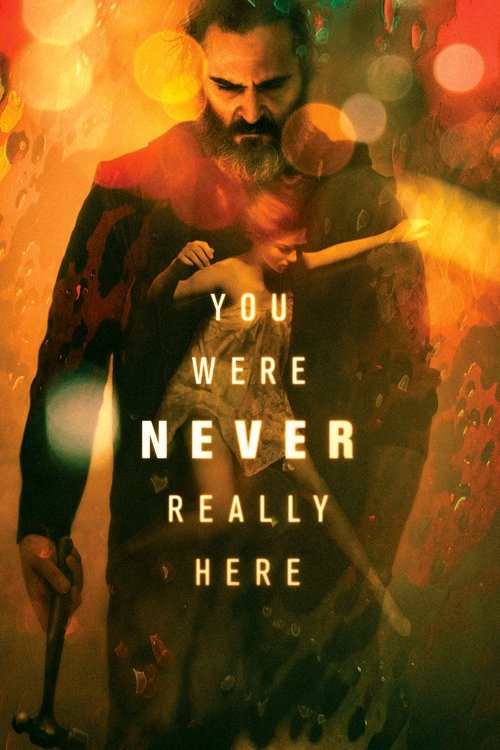
You Were Never Really Here
2017 · Lynne Ramsay
When you want a film to chew on for days and don't mind being shaken up — this is challenge viewing, short but heavy, for a night when you're ready to feel something raw.
What it's about
Joe is a traumatized veteran who makes his living off the books, tracking down trafficked girls and bringing them home by any means necessary — his tool of choice is a hardware-store hammer. Hired to recover a politician's teenage daughter in New York, he takes what looks like a routine job, and it comes apart around him while his own nightmares close in.
The experience
Less a thriller than a fever you catch — 89 minutes inside a damaged man's head, where sudden violence, childhood flashbacks, and moments of unbearable tenderness bleed into each other. It's tense, disorienting, and strangely beautiful, and it stays with you.
Performances
Joaquin Phoenix, hulking and hollow-eyed, gives one of his great performances — it won him Best Actor at Cannes — playing brutality and gentleness as the same wound. He barely speaks, and you can't look away.
The craft
Lynne Ramsay strips the vigilante story down to sensation: the violence happens off-screen or in fragments, the editing splinters time the way trauma does, and Jonny Greenwood's score throbs and shrieks under everything. Watch it loud — the sound design is half the film.
Why it matters
It announced Ramsay's return after six years away with Cannes prizes for screenplay and lead actor, and became a touchstone for how a genre film can run almost entirely on interiority.
Snapshot
Lynne Ramsay's fourth feature is an 89-minute compression of the vigilante thriller into something closer to a fever dream — a film so committed to subjective interiority that its plot mechanics feel almost beside the point. Joaquin Phoenix plays Joe, a hammer-wielding contract operative who rescues girls from trafficking networks, a man so thoroughly colonized by trauma that violence and tenderness occupy the same hollow space inside him. Based on Jonathan Ames' 2013 novella, the film won the Best Screenplay and Best Actor prizes at Cannes in 2017, announcing Ramsay — after a six-year absence from features — as one of contemporary cinema's most uncompromising formal intelligences. It is at once a genre film and a systematic dismantling of genre, a work that knows the conventions of the vigilante picture well enough to refuse nearly all of them.
Industry & production
The production history of You Were Never Really Here is inseparable from its director's difficult relationship with Hollywood's machinery. After the Scottish filmmaker's departure from Jane Got a Gun in 2013 — she did not appear on the first day of principal photography, leading to a lawsuit that was eventually settled — Ramsay returned to smaller, more controllable structures. The film was financed through a European co-production arrangement, with Film4 and the BFI among the key backers, alongside the French company Why Not Productions and Amazon Studios, which acquired North American distribution rights following the Cannes premiere.
The project originated with producer James Wilson, who had worked with Ramsay on earlier films, optioning Ames' novella — a spare, hallucinatory text published by Mulholland Books in 2013, written by Jonathan Ames, better known in America for creating the HBO comedy Bored to Death. Ramsay wrote her own screenplay adaptation, departing significantly from the novella's first-person narration while preserving its impressionistic compression. The adaptation discards conventional exposition; what in the source text is accessible through interior monologue becomes, on screen, a problem of pure cinema — how to render a disintegrating consciousness through image and sound alone.
Principal photography took place primarily in New York City, which serves not as glamorized backdrop but as a gray labyrinth of hotel corridors, parking structures, and dingy apartments. The film's budget was modest by American standards, a constraint that likely reinforced Ramsay's preference for restraint over spectacle. Joaquin Phoenix was attached early and remained central to the project's financing, his participation lending the production a commercial viability that counterbalanced its formal austerity.
Technology
The film was shot on 35mm film stock, a deliberate choice that gives You Were Never Really Here a granular, slightly degraded texture out of step with the sleek digitalism dominant in contemporary cinema. This material grain feels morally appropriate — it codes the image as evidence, as damaged record, as something retrieved rather than manufactured. The decision also connects the film to the mid-to-late 1970s American cinema it anatomizes and reworks: the grain of Taxi Driver and Apocalypse Now is embedded in its visual DNA.
Jonny Greenwood composed the score, recording with a chamber ensemble, and the film's sound architecture — mixing Greenwood's dissonant, percussive cues with carefully chosen diegetic sound — was constructed with exceptional precision in post-production. The integration of score and ambient sound is so seamless that the boundary between underscoring and room tone frequently dissolves, a technique that externalizes Joe's inability to distinguish between inner and outer experience.
Technique
Cinematography
Thomas Townend shot the film, and his collaboration with Ramsay produces one of the decade's most formally disciplined visual strategies. The camera rarely settles into the neutral observational position that genre convention would supply. Instead, it operates in extremes: extreme close-ups of hands, eyes, or surfaces that fill the frame with partial information; wide shots that place Joe at an uncomfortable distance, the city pressing in around him. Handheld shooting is used selectively rather than reflexively — Ramsay and Townend understand that movement must be earned, that a restless camera can as easily signal anxiety as it can produce it.
The film's most celebrated set piece — the sequence in which Joe navigates a brothel while Ramsay cuts between his forward movement and the fragmentary images of security cameras monitoring the corridor — exemplifies the film's visual logic. The CCTV footage presents violence at one remove, drained of immediacy, the bodies on screen reduced to pixelated shapes. This is not the aestheticized violence of the action film; it is bureaucratic, cold, almost abstract. By making this footage the primary visual register for the film's most physically intense sequence, Ramsay refuses to let the audience occupy the conventional position of kinetic engagement.
Editing
Joe Bini, who had worked extensively with Werner Herzog across a range of documentaries and fiction features, edited the film. His collaboration with Ramsay produced a cut that operates by radical ellipsis: entire scenes, entire narrative developments, are excised or compressed to a single image. The film opens in medias res with Joe cleaning up after a job already completed; backstory arrives in fragmented flashback — a child's hand reaching through a grate, a woman's shoes, a soldier's feet — without chronological anchor or explanatory context. These shards do not accumulate into a coherent trauma narrative so much as they establish a texture of persisting wound.
The editing rhythm alternates between compression and sudden dilation. Scenes that might conventionally occupy ten minutes are rendered in thirty seconds; a moment of near-suicide is extended into an almost intolerable duration. This asymmetry is not arbitrary: it maps the affective logic of PTSD, where certain memories refuse to release and others are blacked out entirely.
Mise-en-scène / staging
Ramsay's mise-en-scène inherits from Robert Bresson a rigorous attention to what is excluded from the frame. Violence, when it occurs, is regularly displaced — we see its approach, or its aftermath, or its reflection. Joe attacking men with a hammer is shown in close fragments; the connective tissue of the action is withheld. This is not squeamishness but ethics: to show the violence in full would be to aestheticize it, to make it pleasurable in the way the vigilante film has historically made it pleasurable.
The staging of Joe's domestic life — his care for his ailing mother (Judith Roberts), the strange tenderness of their rituals — operates in precise counterpoint to the operational sequences. Their scenes together have a quality of exhausted gentleness, small acts of maintenance and attention that exist in a different temporal register from the film's violence. Roberts' performance, and Phoenix's responsiveness to it, grounds the film in a specific, unglamourized embodiment of damage and attachment.
Sound
The film's sound design deserves separate treatment as a primary expressive instrument. Ramsay has described working with the sound team as a compositional process equivalent to the visual editing, and the result is a film in which no element of the audio register is neutral. Greenwood's score is built from prepared piano, abrasive strings, and sudden silences; it frequently bleeds into environmental sound without announcing itself as score. A radio playing in an adjacent room, the ambient noise of a city, the static between television channels — these are used with the same intentionality as any composed cue.
Particularly striking is the use of songs with a deliberate incongruity. Charlene's 1977 recording of "I've Never Been to Me" appears in a sequence that is almost unbearably sad, its cheery easy-listening surface rubbing against the images in a way that amplifies rather than deflects the scene's emotional weight. This strategy of tonal displacement through music — familiar from Jonathan Demme and the Coen Brothers, though applied here with different ends — is one of the film's most distinctive signatures.
Performance
Joaquin Phoenix inhabited the role with a physical totality that has become his method signature. He gained substantial weight for the part, and his body carries the film's themes as literally as its narrative: Joe is a man for whom flesh is primarily a site of pain and its management. Phoenix communicates interiority almost entirely through physical behavior — the way he holds his hands, the quality of his stillness, the timing of his breathing. Dialogue is sparse; the film trusts Phoenix to carry scenes of near-silence, and he does.
Ekaterina Samsonov, as Nina, the senator's daughter Joe is hired to extract from a trafficking operation, delivers a performance of careful, watchful opacity. The character is not sentimentalized, not made into a vehicle for the film's emotional catharsis in the way rescued girls typically function in the vigilante genre. Her arc — which culminates in an act of violence she initiates — represents the film's most pointed subversion of genre expectation.
Narrative & dramatic mode
You Were Never Really Here operates in the mode of subjective realism shading into hallucination. The film's plot — Joe is hired by a New York senator to retrieve his daughter from a trafficking ring; the job unravels into a conspiracy; Joe comes to the edge of suicide and perhaps beyond — is legible in outline but deliberately obscured in execution. Cause and effect are regularly severed; we are given results without processes, states without transitions.
This is not puzzle cinema of the Nolan variety, where obscurity is eventually resolved. Ramsay's ellipses are permanent: the film does not explain itself in the final reel. What we are given instead is phenomenological access to a consciousness that cannot organize its experience into coherent sequence — a damaged perception rendered as narrative form. The film's final image, Joe and Nina sitting in a diner in apparent safety, refuses to adjudicate between fantasy and fact. Whether this is arrival or wish-fulfillment is not the film's concern.
Genre & cycle
The film belongs to a tradition of the traumatized male vigilante that runs from the 1970s American cycle — Taxi Driver (1976), Rolling Thunder (1977), The Exterminator (1980) — through the European hitman pictures of Jean-Pierre Melville and into the 2000s wave of serious genre revisionism that includes A History of Violence (2005) and the work of Nicolas Winding Refn. It specifically engages with and complicates the rescue narrative — the specific fantasy of the damaged man who finds purpose in protecting the vulnerable — that Taken (2008) had by 2017 helped industrialize into a global franchise paradigm.
What Ramsay does to the genre is to honor its emotional logic — the need for purpose, the sublimation of self-destruction into protective violence — while refusing its cathartic payoffs. There is no triumphant release in the action sequences; there is no cleansing through violence. The conspiracy plot, which in a conventional thriller would organize the narrative toward revelation and confrontation, is allowed to collapse without full resolution. The film's place in a broader cycle of art-house crime pictures — alongside films like No Country for Old Men (2007), Drive (2011), and Ramsay's own tonal antecedent Morvern Callar (2002) — is secure, though it pushes further than most toward the dissolution of genre architecture.
Authorship & method
Ramsay has made four features across a twenty-year career: Ratcatcher (1999), Morvern Callar (2002), We Need to Talk About Kevin (2011), and You Were Never Really Here. The consistency of her preoccupations across these films — trauma, fractured subjectivity, the persistence of violence in the body and in memory, the inadequacy of conventional narrative to render psychological extremity — marks her as one of British cinema's most coherent auteurs, in the strict sense that her work forms a recognizable corpus of concerns and strategies regardless of source material.
Her method of adaptation is systematic transformation: she acquires texts — Lionel Shriver's novel for Kevin, Ames' novella here — and uses them as raw material for essentially original filmmaking. The screenplay she wrote for You Were Never Really Here departs from the novella in significant structural ways, not because the source is weak but because Ramsay's cinema requires a different kind of architecture.
Townend's cinematography and Bini's editing are collaborative extensions of this authorial sensibility, each bringing expertise that complements Ramsay's visual instincts. Greenwood's score is the most prominent external contribution; his capacity for dissonance without chaos, and for emotional ambiguity in musical register, makes him a natural collaborator for a director working in similar territory in the image.
Movement / national cinema
Ramsay is Scottish, trained at the National Film and Television School in London, and her cinema emerges from the tradition of British social realism — the Glasgow working-class landscapes of Ratcatcher, the grim textures of industrial poverty — while consistently transcending or departing from that tradition's documentary-adjacent conventions. You Were Never Really Here is set in America, largely financed through European mechanisms, and stylistically indebted as much to French and Italian art cinema as to any British precedent.
It might be most accurately located within a transnational European art cinema that uses American genre forms as material for psychological and formal exploration — a mode that includes Michael Haneke's use of thriller mechanics, Andrea Arnold's use of social realism, and Ramsay's own consistent practice of importing the emotional logics of genre into a cinema of pure subjectivity. The BFI and Film4's involvement connects the film institutionally to a British tradition of quality independent production, but the film's cultural register exceeds any national frame.
Era / period
The film emerged at a specific historical moment: a post-2008 art cinema that had absorbed the lessons of the 2000s genre revival, the influence of world cinema on the festival circuit, and the institutional changes wrought by streaming platforms entering the independent film market. Amazon's acquisition of distribution rights for You Were Never Really Here placed it in an early wave of prestige-adjacent art cinema that major streaming services were beginning to fund and distribute as cultural capital.
It is also a film that arrives in a cultural moment saturated with the language of trauma, PTSD, and male psychological damage — the long aftermath of wars in Iraq and Afghanistan, the proliferation of trauma as both clinical category and narrative device. Ramsay's film is one of the most rigorous formal treatments of this material, refusing the redemption arcs and therapeutic frameworks that make the trauma narrative commercially legible.
Themes
The film's central thematic concern is the way violence colonizes the body and the mind — not as dramatic event but as persisting condition. Joe is not a man who committed violence in the past; he is a man who is violence, for whom it is the only mode of engagement with the world that feels real. The film traces the paradox of this: the tenderness he shows his mother, his refusal to leave her, his genuine care for Nina, exist alongside and within the same person who deploys savage force as professional method.
The mother-son dyad is quietly central. Joe's care for his ailing mother — cooking, bathing, managing her medication — is rendered without sentimentality but with genuine attention, and their scenes together reveal a man capable of profound attachment who has nonetheless been destroyed by experience. The film suggests, without reducing this to thesis, that the domestic and the violent are not opposites in Joe's psychology but aspects of a single overwhelming need for some form of contact that the world outside these rooms does not provide.
The rescue fantasy — the idea that a damaged man can be redeemed through the protection of the vulnerable — is examined with unusual honesty. The film does not condemn it, but it does not validate it either. Nina survives, but Joe's rescue of her is entangled in conspiracy and failure; and Nina's own act of violence at the film's end makes her not a recipient of male protective action but an agent in her own right, returning the film's moral complexity to her as much as to Joe.
Reception, canon & influence
The film's reception at Cannes was exceptional: the dual prize (Best Screenplay and Best Actor for Phoenix) from a jury presided over by Pedro Almodóvar certified it as the competition's most formally radical offering. Critical reception was uniformly strong in English-language markets, with particular attention to Phoenix's performance and Ramsay's refusal of conventional thriller satisfaction. The film appeared on a significant number of year-end critical lists for 2017 and subsequently in the increasingly common "best films of the 2010s" surveys that followed at the decade's end.
The influences on the film are traceable with reasonable confidence. Taxi Driver is the most obvious precursor — the traumatized urban loner, the rescue of a girl from sexual exploitation, the New York streets as psychological landscape — but Ramsay's engagement with Scorsese's film is critical rather than reverential: where Taxi Driver aestheticizes its vigilante violence and offers its protagonist a kind of grotesque apotheosis, You Were Never Really Here withholds both. Robert Bresson's influence on Ramsay's cinema has been frequently discussed; the elliptical construction, the refusal of explanation, the spiritual weight given to small physical gestures all have Bressonian precedent. The British tradition of Alan Clarke — the confrontational directness of films like Scum (1979) and Elephant (1989) — is a plausible lineage for the film's treatment of violence as structural rather than spectacular.
The film's forward influence is harder to measure definitively at close range. It has become a touchstone for discussions of art-cinema genre revisionism, and Ramsay's approach to representing trauma has been cited in discussions of subsequent films attempting similar territory. Greenwood's continued presence in prestige cinema as a composer — following his work on Paul Thomas Anderson's films through Phantom Thread (2017, the same year) and beyond — means that the sonic texture of You Were Never Really Here exists in an ongoing conversation about the uses of composed dissonance in literary genre cinema. As a model of what the vigilante picture might be when stripped of its cathartic machinery and forced to confront the psychology it conventionally exploits, the film remains one of the 2010s' most bracing demonstrations of formal intelligence in service of moral seriousness.
A Deleuzian reading
A child's hand reaching through a grate.
The full Deleuzian reading of You Were Never Really Here →
Reception
It stunned Cannes 2017 in a famously unfinished cut and took two prizes, then slipped through its small 2018 release barely noticed at the box office — since then it's steadily climbed into 'best of the 2010s' conversations and become a fixture of Letterboxd canon.
How You Were Never Really Here was received, from release to now →
Influences: the films it descends from and the films it influenced
- Taxi Driver (1976) — Scorsese's Herrmann-scored diegetic/non-diegetic bleed, slow-motion fragmented POV, and psychological mapping of Manhattan as traumatized-veteran interiority constitute the formal inheritance Ramsay accepts and then critiques: she borrows the architecture while systematically withholding the cathartic vigilante apotheosis Scorsese constructs for Travis Bickle.
- Pickpocket (1959) — Bresson's subordination of the face to hands in extreme close-up as the primary expressive register, combined with elliptical editing that omits psychologically explanatory scenes and trusts inferred interiority from physical behavior alone, is the structural grammar Ramsay applies to Joe's hammer-work and bodily routine.
- L'Argent (1983) — Bresson places violence offscreen and renders it through material aftermath — a door, a body, an object — while elliptical causation makes action feel overdetermined yet morally inexplicable; Ramsay applies this logic to the hotel-room sequences and the structural withholding of Joe's childhood trauma.
- Elephant (1989) — Clarke's unbroken tracking shots follow bodies through institutional space toward violence staged without motivation, psychological context, or cathartic release, treating violence as an impersonal structural fact rather than a dramatic spectacle — the ethical template for Ramsay's offscreen-violence staging.
- Repulsion (1965) — Polanski's technique of externalizing a protagonist's psychological fracture through warped mise-en-scène — hallucinated assaults rendered at the same visual register as present-tense reality, indistinguishable until the collapse — is the formal precedent for Ramsay's hallucination mode and her PTSD-vision grammar.
- Hiroshima Mon Amour (1959) — Resnais's structuring of a present-tense narrative through involuntary traumatic flashback — memory as unwanted intrusion, fragmented and temporally non-linear, whose timing is beyond the character's control — establishes the fragmented-flashback architecture Ramsay applies to Joe's war and childhood memories.
- The Conversation (1974) — Coppola's use of sound design to render a solitary man's paranoid interiority — the misheard audio loop that retroactively restructures all prior narrative meaning — and the surveillance apparatus as a projection of psychological rather than simply professional anxiety prefigure Ramsay's sound/score-diegetic bleed and CCTV-surveillance aesthetics.
- Caché (2005) — Haneke's formal insertion of surveillance-video footage — technically indistinguishable from the film's own image quality — as a destabilizing device that undermines the viewer's trust in what constitutes observed versus mediated reality is the direct precursor to Ramsay's use of CCTV footage as both plot mechanism and ontological disturbance.
- Morvern Callar (2002) — Ramsay's own prior film established the tonal-displacement-through-song device reprised here: pop songs inserted via the protagonist's Walkman as emotional distance mechanisms over scenes of crisis, with Samantha Morton's dissociated performance mode and fragmented structure as grief-processing architecture.
- We Need to Talk About Kevin (2011) — Ramsay's direct formal predecessor: the non-linear fragmented flashback structure organized around a traumatic act that cannot be narratively processed, color saturation functioning as emotional register rather than narrative information, and the systemic refusal to provide psychological explanation for violence.
- The Son (2002) — The Dardennes press the camera to the protagonist's body — following rather than observing, registering physical tension as emotional information — and their elliptical construction withholds the explanatory context for the central relationship until the audience feels it corporeally; this body-as-primary-register method is a sibling approach to Ramsay's extreme-close-up regime.
- Punch-Drunk Love (2002) — Ramsay's systematic technique of withholding violence at the moment of physical impact and cutting immediately to aftermath — the film almost never shows the act itself — is a direct amplification of Anderson's withheld-violence editing principle from PDL, extended here into a complete formal grammar.
- Saint Maud (2019) — Glass inherits Ramsay's hallucination-mode grammar — the protagonist's subjective visions rendered at the same visual register as present-tense reality, undifferentiated until collapse — and applies it to a female protagonist's spiritual dissociation within a British genre context, extending Ramsay's use of the body as site of psychological crisis.
- Possessor (2020) — Cronenberg extends Ramsay's formal rendering of dissociation from one's own violent acts — the editing gap between intention and action as the primary site of horror — into literal loss of bodily agency, taking the asymmetric-duration device to an extreme where violence is experienced by both perpetrator and audience as fully alienated.
- The Zone of Interest (2023) — Glazer extends Ramsay's offscreen-violence staging and sound/score-diegetic-bleed into a sustained ethical position: the film withholds its central atrocity entirely from the image while the soundtrack carries its full horror, developing the principle that sound can bear what the image must refuse to show.
- First Reformed (2017) — Schrader — who theorized Bressonian transcendental style in print and wrote Taxi Driver — applies the same rigorously elliptical formal asceticism to a traumatized male protagonist in the identical release year, making both films simultaneous demonstrations of what art cinema can do with male-violence genre stripped of its cathartic machinery.
- Funny Games (1997) — Haneke's systematic refusal to grant the thriller audience its cathartic violence — cutting away at the moment of spectacle, staging brutal acts offscreen — and his metacritical stance toward viewer desire for violent satisfaction constitute a parallel ethical project to Ramsay's treatment of Joe's hammer work.
- Eddington (2025) — Phoenix's pathos-and-menace-in-one-register performance mode, scored by Bobby Krlic, whose abrasive-textural music method Aster reuses in the Eddington soundscape.
- If I Had Legs I'd Kick You (2025) — Pushes violence and event into off-screen space and substitutes a tactile, subjective sound design for coverage — the off-screen-audio device the seed leans on.
- Citizen Vigilante (2026) — Reworks the vigilante-avenger through elliptical, fragmented editing and interiorized sound design — a formal counter-model against which Boll's blunt directness reads.
Similar films
- Taxi Driver (1976) — influence & lineage
- We Need to Talk About Kevin (2011) — influence & lineage
- Joker (2019) — shared sensibility
- The Master (2012) — shared sensibility
- Warfare (2025) — shared sensibility
- Sicario (2015) — shared sensibility
- It Was Just an Accident (2025) — shared sensibility
- Inherent Vice (2014) — shared sensibility
All the films related to You Were Never Really Here →