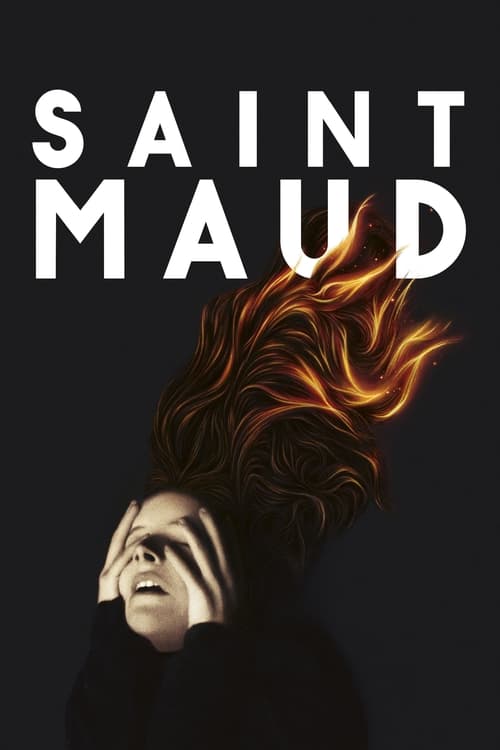
Saint Maud
2020 · Rose Glass
Saint Maud then Love Lies Bleeding made her the "sweaty lesbian pulp" auteur of A24's stable; Kristen Stewart discourse and gym-noir aesthetics gave her instant Letterboxd canonization.
For when you're craving a real scare with a brain — a one-sitting, lights-off watch for a night you want to be disturbed rather than merely startled. Challenge viewing, not comfort; it gets under the skin and stays.
What it's about
Maud, a young private nurse and fervent recent convert to Catholicism, arrives at a faded seaside town to care for Amanda, a once-celebrated dancer dying of illness and determined to keep living loudly. Maud decides God has sent her to save Amanda's soul — and her devotion, fed by loneliness and hints of a troubled past, begins to tip into something frightening.
The experience
Tense, intimate, and genuinely unnerving — horror built from psychology rather than jump scares, though when it strikes, it strikes hard. At a lean 84 minutes it coils steadily tighter and ends with an image you won't shake for days.
Performances
Morfydd Clark is extraordinary as Maud — pious, pitiable, and terrifying by turns, often within one scene — and Jennifer Ehle gives Amanda a worldly, cruel-tender wit that makes their duet crackle.
The craft
Rose Glass's debut is startlingly controlled: queasy sound design and a body-shuddering score put you inside Maud's rapture, and the camera treats her visions with a seriousness that makes them impossible to dismiss. It looks and sounds remarkable for its scale — worth a dark room and good speakers.
Why it matters
One of the most acclaimed horror debuts of its era, it announced Rose Glass as a major new British director and became a touchstone of the late-2010s wave of psychologically serious arthouse horror.
Snapshot
Saint Maud is the debut feature of British writer-director Rose Glass: a compact, hallucinatory chamber-horror about a hospice nurse whose private religious ecstasy curdles into delusion and atrocity. Maud (Morfydd Clark), a recent and fervent convert to Catholicism, is assigned to the palliative care of Amanda (Jennifer Ehle), a once-celebrated dancer and choreographer now dying of lymphoma in a faded seaside town. Maud reads her vocation as a divine mission to save Amanda's soul; what begins as devotional tenderness escalates, through humiliation and self-mortification, toward a horrifying conclusion. The film belongs to a strain of "elevated" or arthouse horror that flourished in the late 2010s, but its real lineage runs back through religious-crisis cinema and the psychological-breakdown film. At roughly 84 minutes it is unusually disciplined, and it announced Glass as a major new voice in British genre filmmaking. It premiered at the Toronto International Film Festival in September 2019 and reached audiences in 2020–21, its rollout scrambled by the COVID-19 pandemic.
Industry & production
Saint Maud is a product of the British public-private film ecosystem that has incubated much of the country's auteur-driven work. It was financed and produced with backing from Film4 and the BFI (drawing on National Lottery funds), produced by Andrea Cornwell and Oliver Kassman through Escape Plan Productions. StudioCanal handled UK distribution, and A24 acquired North American rights — an alignment that placed the film squarely within the company's brand of director-forward genre cinema alongside Hereditary, The Witch, and Midsommar.
The project grew out of Glass's development work after film school (she trained at the National Film and Television School), and the film carries the marks of a debut made on a modest budget: a small cast, a handful of locations, and a tightly bounded story world. The precise budget is not something I can state with confidence from the public record, but the production's scale — essentially a two-hander shot largely in domestic and small-town coastal settings — is evident on screen.
Its release history is itself a small case study in pandemic-era distribution. After the 2019 Toronto premiere and a festival run (including the BFI London Film Festival), theatrical plans were repeatedly disrupted. The UK release came in October 2020, between lockdowns; the long-delayed US release ultimately arrived in early 2021, where — with cinemas constrained — A24 routed it to the Epix streaming platform. The film's strong critical reception, rather than a conventional box-office trajectory, drove its reputation.
Technology
Saint Maud was shot digitally, in a manner that prioritizes texture and control over spectacle. The aesthetic leans on the capacities of modern digital sensors to hold detail in very low light and to render the sickly, lurid color of artificial sources — sodium streetlights, the cold institutional glow of interiors, the warm and clammy lamplight of Amanda's house. The film's most overt technological gesture is its manipulation of the frame itself: orientation is destabilized through inversions and slow rotations so that Maud's subjective states are encoded in the very stability of the image. These are achieved through camera mounting and controlled rigging rather than heavy digital intervention, keeping the effects tactile. Visual effects are used sparingly and pointedly — most famously in the film's climactic image — where restraint makes the eventual rupture land harder. The overall technical signature is one of precision and economy rather than maximalist toolkitry.
Technique
Cinematography
Ben Fordesman's photography is central to the film's effect. The visual scheme yokes claustrophobic interiors to a wider, indifferent world: tight framings on Maud's face and hands in Amanda's house give way to desolate exteriors of the English seaside town in its off-season melancholy. Fordesman uses shallow focus and close, almost intrusive proximity to lock the viewer into Maud's perspective, then exploits negative space and emptiness to register her isolation. Light is moral and physiological at once — divine "presences" arrive as warmth and glow, while the secular world is rendered in cold, dingy tones. The camera's recurring inversions and tilts make subjectivity into a formal principle: when Maud feels God, the world literally turns. This consistency of optical strategy — image instability as the grammar of belief — is one of the film's signal achievements.
Editing
Edited by Mark Towns, the film is built for compression and dread. Its short runtime is not a limitation but a structural choice: scenes are clipped to their essential beats, ellipses do heavy narrative work, and the cutting withholds reassuring establishing context to keep the viewer inside Maud's unreliable frame. The editing modulates tempo with care — long, becalmed passages of routine and devotion are punctured by sudden, jarring intrusions (a self-flagellating ritual, a violent vision) so that rhythm itself produces unease. The film's final movement accelerates into delusion, and the cutting is engineered so that the audience's understanding lags fractionally behind the catastrophe, the gap between what Maud sees and what is real collapsing only at the very end.
Mise-en-scène / staging
The production design opposes two interiors. Amanda's house is plush, decaying glamour — art, books, drink, the residue of a worldly artistic life — while Maud's bedsit is bare, penitential, a cell. Costume reinforces the split: Maud's drab, buttoned-up uniform of self-denial against Amanda's silks and indulgence. Staging frequently isolates Maud within the frame, small against architecture and sea, and the recurring motif of kneeling, prayer, and physical self-punishment grounds the abstraction of faith in the body. Props carry weight — the rosary, the inserted-tacks shoes, the cigarette and drink that mark Amanda's hedonism. The seaside town, with its tired amusements and gray light, functions as a moral landscape: a place at the edge of things, fitting for a story about the boundary between sanctity and madness.
Sound
Adam Janota Bzowski's score is one of the film's most distinctive elements — a dense, drone-laden, often abrasive soundscape that blurs the line between music and ambient noise. Low frequencies and metallic textures generate physical unease; moments of "grace" are scored with an almost rapturous swell that the film then undercuts. Sound design works hand-in-glove with the score: the amplified intimacy of breath, footsteps, and bodily sounds intensifies the subjective lock on Maud, while distortions of the soundtrack signal the porousness of her perception. Voice-over — Maud's prayerful, second-person address to God — runs throughout, giving us privileged access to a consciousness whose authority we increasingly distrust.
Performance
The film rests on two performances. Morfydd Clark's Maud is a study in suppression and intensity: a quiet, downcast surface over a furnace of need, the performance calibrated so that piety and pathology are never cleanly separable. Clark renders the longing for significance — to matter, to be chosen — that drives Maud's zealotry, and her physical commitment to the role's rituals of mortification is unflinching. Jennifer Ehle's Amanda is the necessary counterweight: worldly, mordant, alternately cruel and tender, a dying artist who toys with Maud's devotion and briefly, devastatingly, seems to reciprocate it. The dynamic between caregiver and patient — its shifting power, its erotic and spiritual charge — is the engine of the drama, and both actresses calibrate it precisely.
Narrative & dramatic mode
The film operates in the mode of the unreliable subjective character study, closely allied to the psychological-horror tradition in which we cannot finally distinguish the supernatural from the pathological. Its structure is essentially a two-act arc with a coda: the period of service in Amanda's house, the rupture and Maud's descent after she is dismissed, and the final ecstatic catastrophe. Throughout, the narration privileges Maud's interiority — her voice-over prayers, her visions, the destabilized images — so that the film withholds an external, objective vantage and forces the viewer to inhabit a deteriorating mind. This is dramatic irony of a particular kind: we suspect long before Maud does that her "calling" is delusion, yet the film's formal sympathy keeps us tethered to her, which makes the ending both inevitable and shattering. The much-discussed final shot performs a brutal perceptual switch — collapsing Maud's transcendent self-image into the horror of the literal — and retroactively reorganizes everything that came before.
Genre & cycle
Saint Maud arrived at the crest of the 2010s arthouse-horror cycle, often labeled "elevated horror," associated with A24 and with films such as The Witch (2015), Hereditary (2018), The Babadook (2014), and Saint Maud's nearer cousins in religious and psychological terror. Within that cycle it sits at the more austere, character-driven end: less reliant on jump-scare mechanics than on slow dread, ambiguity, and bodily discomfort. It is simultaneously a religious-horror film — joining a long line of works about faith, possession, and the divine that runs from The Exorcist (1973) backward to the chamber dramas of spiritual crisis — and a psychological-breakdown film about loneliness and the hunger for meaning. It also reads as a contribution to a contemporary strand of British genre cinema and to a wave of women-directed horror reframing the genre's interest in the female body, desire, and madness.
Authorship & method
Saint Maud is a strikingly unified authorial statement for a first feature, with Glass both writing and directing. Her method here is one of rigorous formal control in service of a single, escalating subjectivity: every department — camera orientation, color, score, sound design, performance — is bent toward dramatizing Maud's inner state rather than describing an objective world. Glass has spoken in interviews about her interest in religious experience, loneliness, and the slippage between ecstasy and delusion, and about wanting the film to keep faith and pathology genuinely undecidable; I'd characterize the through-line of her approach as treating belief as a formal problem to be staged rather than a theme to be discussed.
Her key collaborators are integral to that vision. Cinematographer Ben Fordesman built the optical grammar of subjectivity. Composer Adam Janota Bzowski supplied the drone-based score that fuses with the sound design to produce the film's distinctive physical dread. Editor Mark Towns shaped its compression and withholding rhythm. And the two leads — Morfydd Clark and Jennifer Ehle — translate the conceptual architecture into lived, ambivalent human drama. The collaboration is notable for its coherence: this is a film in which no element works against the central design.
Movement / national cinema
The film belongs to contemporary British cinema and specifically to the auteur-genre wing nurtured by Film4 and the BFI — institutions that have repeatedly enabled distinctive, director-led debuts. It also slots into a recognizable lineage of British horror that mines landscape, isolation, and provincial decay (the seaside-town setting carries echoes of a national melancholy familiar from much British realist and genre work). At the same time, it is legible as part of a transnational arthouse-horror movement defined more by distribution brand and sensibility (A24, the festival circuit) than by nation. Its relationship to the British social-realist tradition is oblique but real: the gray, economically tired town and the precarity of Maud's life ground the metaphysical horror in a recognizable material world.
Era / period
Saint Maud is very much a film of its late-2010s/early-2020s moment. It reflects a period in which horror had regained critical prestige and was being used as a vehicle for serious treatments of grief, mental illness, faith, and gender. Its preoccupations — loneliness, the search for meaning and significance, the seductions of certainty — resonate with a cultural moment of atomization. The circumstances of its release also stamp it as a pandemic-era film: a 2019 festival premiere followed by a fractured 2020–21 rollout that pushed it, in the US, onto streaming. That arc is emblematic of how the pandemic reshaped the theatrical fortunes of mid-budget specialty films.
Themes
At its core the film is about the longing to matter — to be singled out, chosen, made significant — and the way that longing can attach itself to religion and curdle into delusion and violence. It stages faith as genuinely double-edged: a source of meaning and comfort for the lonely, and a structure that can rationalize cruelty (to others and to oneself). Self-mortification and the body recur insistently: pain as proof of devotion, the flesh as the site where the spiritual is tested. The film also probes loneliness and the hunger for connection — Maud's devotion to Amanda is shot through with need, care, and suppressed desire, so that the spiritual and the erotic are never fully separable. Class and care labor hover in the background: the intimate, asymmetrical relationship between a working nurse and a wealthy patient, the dignity and invisibility of caregiving. And running through all of it is the irresolvable ambiguity between transcendence and madness — the film refuses to tell us whether Maud's God is real, and that refusal is its deepest theme.
Reception, canon & influence
Critically, Saint Maud was widely and warmly received as one of the strongest horror debuts of its era. Reviewers singled out Glass's assurance and control, Morfydd Clark's central performance, and the film's refusal of easy resolution; it was frequently grouped with the most respected titles of the contemporary arthouse-horror cycle. It accumulated significant awards-season attention in the UK, including recognition at the BAFTAs and British Independent Film Awards (Clark's performance and Glass's direction/screenwriting were focal points of that praise). Its commercial profile was modest and complicated by the pandemic, so its standing rests on critical esteem rather than box office.
The influences ON the film (backward) are several and well-aligned with its concerns. Critics repeatedly invoked Paul Schrader's preoccupation with isolated, self-destroying spiritual obsessives — Taxi Driver's diary-keeping loner and First Reformed's tormented pastor are natural touchstones — and the transcendental and religious-crisis cinema that Schrader theorized (Bresson, Dreyer, and the broader tradition of films about faith and mortification). The psychological-horror lineage of women undone in claustrophobic spaces — Polanski's "apartment" films, Repulsion above all, and Bergman's chamber studies of identity and breakdown such as Persona — is also strongly present in the film's subjective camera, its two-woman dynamic, and its collapse of the boundary between self and other. The religious-horror tradition descending from The Exorcist and Carrie provides the genre frame.
Its legacy (forward) is still consolidating, as is appropriate for a recent film, but the most concrete outcome is what it did for its maker and star: Saint Maud established Rose Glass as a significant directorial voice — confirmed by her acclaimed, tonally very different follow-up Love Lies Bleeding (2024) — and raised Morfydd Clark's profile considerably (she went on to a leading role in Amazon's The Lord of the Rings: The Rings of Power). More broadly, the film became a frequently cited reference point in discussions of late-2010s "elevated" and women-directed horror, an exemplar of how to wed festival-arthouse seriousness to genre intensity on a small budget. Claims about its specific influence on subsequent individual films should be made cautiously given how recent it is; what can be said firmly is that it entered the working canon of contemporary religious and psychological horror almost immediately, and that its central image and final reveal became among the most-discussed in recent genre cinema.
A Deleuzian reading
The first time God arrives, the room tips over.
The full Deleuzian reading of Saint Maud →
Reception
A Midnight Madness sensation at TIFF 2019, it then spent a year in pandemic limbo — A24 kept delaying the US release until it became 'the great horror film nobody could see' — before landing in 2021 as one of the defining debuts of the elevated-horror era.
How Saint Maud was received, from release to now →
Influences: the films it descends from and the films it influenced
- Repulsion (1965) — The template for the solitary woman dissolving inside a claustrophobic flat, with the camera locked to her warping perception so the apartment itself becomes an instrument of her psychosis — Glass borrows its subjective spatial horror wholesale.
- Persona (1966) — Bergman's chamber two-hander of a nurse and her charge, where the boundary between self and other collapses through merged faces and shared subjectivity, supplies the Maud/Amanda dynamic and its identity-bleed.
- The Passion of Joan of Arc (1928) — Dreyer's relentless close-ups on a woman's face in ecstatic religious suffering — faith rendered purely as facial event — is the formal ancestor of Glass's tight framing of Clark in rapture and torment.
- Diary of a Country Priest (1951) — Bresson's first-person diaristic voiceover of a sickly cleric narrating his own mortification establishes the confessional address-to-God narration Maud speaks throughout.
- Taxi Driver (1976) — Schrader's diary-keeping, self-mythologizing loner whose voiceover frames a delusional sense of divine mission is the direct model for Maud's narrated, escalating sense of being chosen.
- First Reformed (2017) — Schrader's transcendental-style study of a self-destroying spiritual obsessive — ascetic withholding, mortification of the flesh, faith left genuinely undecidable from pathology — is Maud's closest modern touchstone.
- The Exorcist (1973) — Provides the religious-horror genre frame in which Catholic ritual, the body as battleground, and the literal/clinical ambiguity of possession give Glass her generic vocabulary.
- Carrie (1976) — De Palma's fusion of fanatical religiosity, a repressed young woman, and an ecstatic immolating climax prefigures Maud's final fiery transfiguration staged as both martyrdom and horror payoff.
- Black Narcissus (1947) — The British tradition of expressionist religious repression — heightened color, charged interiors, eroticized faith curdling into breakdown — is the native lineage Glass's British auteur-genre work extends.
- Possession (1981) — Żuławski's hysterical fusion of a woman's spiritual crisis with bodily contortion and a literalized demonic delusion underwrites Maud's convulsive physical performance of ecstasy.
- Through a Glass Darkly (1961) — Bergman's chamber study of a woman who believes she perceives God while descending into psychosis is the precise dramatization of faith-as-madness left formally unresolved that Glass adopts.
- The Babadook (2014) — A woman-directed psychological horror that externalizes an interior crisis as a possibly-real entity, pioneering the festival-arthouse-meets-genre register and subjective-camera grammar Saint Maud works in.
- Love Lies Bleeding (2024) — Glass's own follow-up extends her authorial method — every department bent toward one character's heightened, possibly-delusional subjectivity, with bodily transfiguration literalized in the climax — onto new genre terrain.
- The Witch (2015) — The A24 austere-religious-horror sibling: period faith taken seriously, low-key natural light, a drone-heavy score, and a final embrace of the supernatural staged as deliverance rather than defeat.
- Hagazussa (2017) — A near-contemporary of pious dread built on drone soundscape, glacial elliptical pacing, and a woman's solitary slide into a sacred/psychotic state — the same sound-as-physical-dread method as Bzowski's score.
- Relic (2020) — A pandemic-era women-directed elevated horror centered on two women in opposed interiors and a body in decay, sharing Saint Maud's shallow-focus intimacy and refusal of clean resolution.
- Nosferatu (2024) — Fuses psychosexual-religious obsession with somatic interiority in a female protagonist whose ecstatic, self-destructive devotion is staged as bodily horror — the modern art-horror sibling of Ellen's affliction.
- Oddity (2024) — A small, restraint-driven slow burn that extracts fear from stillness and silence and a near-single performer, part of the same early-2020s atmosphere-over-spectacle movement Oddity belongs to.
- The Lighthouse (2019) — A24-era elevated horror staged inside a single deluded consciousness, where mythic/religious scaffolding and unreliable perception collapse the line between vision and madness.
- Titane (2021) — Shares the fable-register ambiguity and a near-wordless physical performance in which bodily mortification and transcendence carry a withheld, unexplained interior drive.
- If I Had Legs I'd Kick You (2025) — Claustrophobic proximity to a single woman's unraveling psyche, using optical and aural restriction to keep us trapped inside her deteriorating reality.
- Leviticus (2026) — Catholic guilt staged as body horror: internalized shame escalating toward ecstatic self-destruction, with a condemning divine voice heard as intimate address.
- I Saw the TV Glow (2024) — A neighboring A24-era 'elevated' horror built on withheld interiority and an anti-cathartic ending, using genre imagery to externalize a private, unspeakable identity-crisis without ever explaining it.
- Raw (2017) — Cold controlled interiors and a static camera on a woman's body remaking itself, closing on a final image that retroactively reframes everything prior — the same withhold-then-restructure ending logic as Raw.
Similar films
- Repulsion (1965) — influence & lineage
- The Babadook (2014) — influence & lineage
- Die My Love (2025) — influence & lineage
- Smile (2022) — shared sensibility
- The Invisible Man (2020) — shared sensibility
- Heretic (2024) — shared sensibility
- Misericordia (2024) — shared sensibility
- Sundays (2025) — shared sensibility