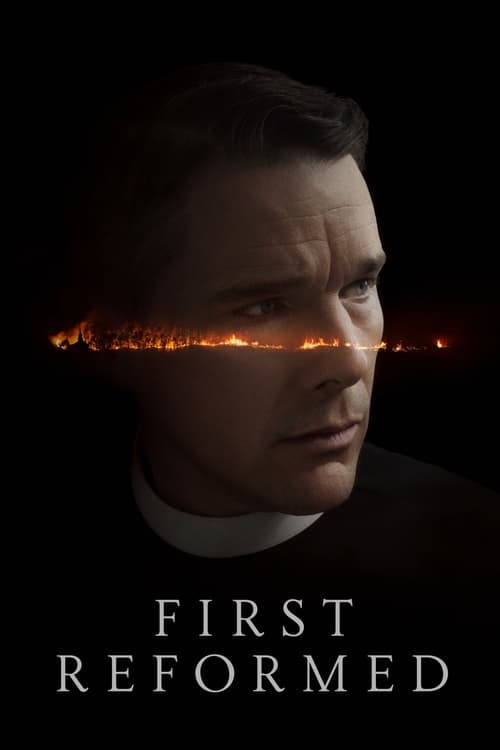
First Reformed
2018 · Paul Schrader
For when you want a film to wrestle with — something serious about faith, despair, and what one person owes a burning world. Demanding, not depressing exactly, but definitely a challenge night, and one of the most rewarding you can pick.
What it's about
A former military chaplain now tends a tiny historic church in upstate New York, more tourist stop than congregation, propped up by a slick megachurch nearby. When a pregnant parishioner asks him to counsel her husband — an environmental activist paralyzed by dread about the planet's future — the conversation shakes something loose in him. Sick, drinking, and keeping a confessional diary he plans to destroy, the reverend begins a spiral that fuses faith, grief, and rage.
The experience
Stark, quiet, and gripping — the stillness keeps ratcheting the tension until the calm itself feels dangerous. It's a slow burn that gets inside your head, and it leaves you rattled and arguing with it long after the credits.
Performances
Ethan Hawke gives arguably the finest performance of his career — coiled, ravaged, achingly restrained — and Amanda Seyfried brings unexpected warmth and steel as the widow who reaches him.
The craft
Schrader shoots in a boxy, near-square frame with a locked-down camera and almost no music, an austerity that makes every small movement feel seismic — then breaks his own rules at precisely chosen moments. The whispered diary narration and wintry light give it the texture of a confession. It rewards a quiet room and zero distractions.
Why it matters
A late-career triumph for Paul Schrader that earned him his first Oscar nomination for the screenplay, and one of the first major American dramas to take climate dread seriously as a spiritual crisis.
Snapshot
First Reformed is Paul Schrader's late-career masterwork, a spare and harrowing study of a Protestant minister whose faith curdles into despair as he confronts ecological catastrophe, terminal illness, and his own complicity in a compromised church. Ethan Hawke plays Reverend Ernst Toller, pastor of a small, historic Dutch Reformed church in upstate New York that survives mostly as a tourist relic and gift shop, kept afloat by the nearby Abundant Life megachurch. After a young environmental activist, Michael (Philip Ettinger), asks Toller to counsel him through his terror at bringing a child into a dying world, the minister begins a downward spiral — recorded in a handwritten journal he vows to keep for one year and then destroy. The film consummates a project Schrader had nursed for nearly five decades: to make a film in the "transcendental style" he had theorized as a young critic in 1972. Austere, almost square in frame, withholding and ascetic in its means, it is at once a character study, a spiritual crisis narrative, and a slow-burn moral thriller. It earned Schrader his first Academy Award nomination, for Best Original Screenplay, and is widely regarded as the strongest film of his directing career.
Industry & production
First Reformed was produced by Christine Vachon's Killer Films in association with Omeira Studio Partners and Arclight Films, with Schrader working from his own screenplay. It was a low-budget independent production — reportedly made for a modest sum on a compressed shooting schedule of roughly three weeks in and around the New York metropolitan area — and it bears the marks of that economy in the best way: confined locations, a small cast, and a refusal of spectacle. The film premiered at the Venice International Film Festival in the late summer of 2017 and was subsequently acquired and distributed in the United States by A24, which gave it a platform release in spring 2018. Commercially it performed as a respected arthouse title rather than a breakout, but its critical standing was immediate and durable. Schrader, then in his early seventies and decades removed from his commercial peak as the writer of Taxi Driver and Raging Bull, framed the film publicly as a kind of reckoning — a return to the spiritual cinema he had written about but spent a career avoiding. The Killer Films partnership was apt: Vachon's company had long specialized in director-driven, formally rigorous independent work, and the production model gave Schrader the autonomy to make an uncommercial film on his own terms.
Technology
The film was shot digitally and finished as a digital intermediate, but its most conspicuous technological choice is regressive by design: it is composed in the Academy ratio of 1.37:1, the boxy, near-square frame that predates widescreen. The narrow aspect ratio is a deliberate constraint, hemming the characters into vertical, claustrophobic compositions and evoking the formal vocabulary of mid-century European art cinema. The digital capture is kept cool and undemonstrative, with a desaturated palette and controlled, often flat lighting that resists the gloss of contemporary prestige drama. There are no visual-effects set pieces in the conventional sense; the one overtly fantastical sequence — a levitation reverie — is achieved through relatively simple in-camera and compositing means rather than elaborate digital spectacle, keeping faith with the film's general principle that technique should be felt as restraint rather than display.
Technique
Cinematography
Alexander Dynan's cinematography is the film's formal signature. The camera is overwhelmingly static, locked off in head-on, frontal compositions that frame Toller and his interlocutors with an almost liturgical symmetry. Movement is rationed to the point of becoming an event: when the camera finally moves, it carries weight precisely because stillness has been the rule. The lighting is austere and naturalistic, the color cold and drained, the church interiors rendered as bare white rectangles. This is cinematography as subtraction — the withholding of coverage, reverse shots, and reaction inserts forces the viewer into sustained, uncomfortable contemplation of the frame. The approach is consciously indebted to Bresson, Dreyer, and Ozu, whose work Schrader had anatomized as a critic; Dynan executes it with discipline rather than pastiche.
Editing
Benjamin Rodriguez Jr.'s editing follows the same ascetic logic. Scenes are built from long, patient takes that refuse the rhythmic acceleration of conventional drama; the cutting withholds the relief of the reverse shot and lets tension accumulate in real time. Schrader has described his method here in terms drawn from his own critical writing — the deliberate building of "the form" through delay, redundancy, and withholding, so that emotional and spiritual climaxes arrive as ruptures rather than payoffs. The pacing is slow by design, an act of attrition that primes the viewer for the film's eruptions.
Mise-en-scène / staging
The staging is sculptural and frontal. Characters are arranged in stark, frieze-like configurations within bare rooms — Toller's nearly empty rectory, the church's white sanctuary, the counseling sessions shot as two figures in a fixed two-shot or in alternating frontal singles. Grace Yun's production design realizes the film's central contrast: the historic First Reformed church as a museum piece, scrubbed of life, against the carpeted, fluorescent, corporate vitality of the Abundant Life megachurch. The emptiness of Toller's domestic space — a bed, a desk, a bottle — externalizes his interior desolation. The mise-en-scène's refusal of decorative clutter is itself an argument about grace and abjection.
Sound
The soundtrack is dominated by silence, broken by the dark-ambient drone of Brian Williams, who records under the name Lustmord. Rather than a melodic score, Williams supplies low, subterranean tones that surface at moments of dread, lending the film an atmosphere of metaphysical unease. Ambient sound is otherwise sparse and clean, foregrounding the scratch of Toller's pen, the quiet of empty rooms, and the spoken word. The result is an acoustic austerity that matches the image: sound used as pressure and absence rather than as continuous emotional underscoring.
Performance
Ethan Hawke's performance as Toller is the film's center of gravity and one of his career's high points — interiorized, contained, physically diminished. He plays a man holding himself rigidly together while being eaten alive, by illness and by doubt, and the performance lives in restraint: a clenched stillness that lets the rare breaks register as catastrophe. Amanda Seyfried brings a grave tenderness to Mary, the pregnant widow whose openness becomes Toller's last tether to the human. Cedric the Entertainer (credited as Cedric Kyles), cast against type as the pragmatic megachurch pastor Joel Jeffers, supplies a grounded, unsentimental counterweight, while Philip Ettinger's brief turn as the despairing activist Michael delivers the philosophical detonation that sets the plot in motion. The acting is uniformly pitched to the film's frontal, undemonstrative key.
Narrative & dramatic mode
The film's narrative engine is the journal. Toller's voiceover — read from the diary he keeps for a self-imposed year — structures the film as confession and self-surveillance, a man narrating his own dissolution. This is the "man in a room" architecture Schrader has used throughout his career: the alienated protagonist who writes, observes, and slowly arms himself, his private monologue running beneath a world he cannot abide. The drama proceeds through counseling sessions, theological argument, and escalating moral provocation rather than through action, until despair hardens into the possibility of violence. The mode is interior and ascetic for most of its length, with the dramatic stakes lodged in argument and conscience; only late does the film tighten into something like a thriller, and even then it withholds resolution. The famously ambiguous ending — an embrace, a circling camera, an abrupt cut — refuses to confirm whether what we see is real, fantasized, or transfigured, leaving the question of grace deliberately open.
Genre & cycle
First Reformed sits at the intersection of several traditions: the priest-in-crisis spiritual drama, the character study of an alienated man, and the slow-burn moral thriller, with a thread of ecological dread running through it. Its most direct generic lineage is the cinema of clerical doubt — Bresson's Diary of a Country Priest and Bergman's Winter Light above all — to which Schrader adds a contemporary American anxiety about environmental apocalypse and corporate complicity. The eco-political dimension grafts the existential thriller's grammar of the suicide vest and the avenging conscience onto a fundamentally interior, theological story. It belongs, too, to Schrader's own genre: the cycle of solitary, self-narrating protagonists that runs from Travis Bickle onward.
Authorship & method
First Reformed is the fullest realization of Paul Schrader's lifelong preoccupations. As a young critic he wrote Transcendental Style in Film: Ozu, Bresson, Dreyer (1972), arguing that certain filmmakers used sparseness, withholding, and "the decisive moment" to express the spiritual or the holy; in 2018 he reissued the book with a long new introduction reckoning with how its ideas had migrated into "slow cinema." For decades Schrader had insisted he could not, or would not, make a transcendental film of his own — his sensibility ran too hot, too violent, too psychological. First Reformed is his late capitulation, and the film consciously deploys the techniques his younger self had cataloged.
The screenplay reprises the structure of his most famous work: a tormented loner who keeps a journal, narrates his estrangement, and arms himself against a corrupt world — the template he set with Taxi Driver. Toller is a spiritual cousin of Travis Bickle and of the protagonists of American Gigolo, Light Sleeper, and The Walker, all variations on what Schrader has called "the man in the room."
Among collaborators, cinematographer Alexander Dynan executes the frontal, static visual program; editor Benjamin Rodriguez Jr. realizes the withholding rhythm; production designer Grace Yun builds the contrast of austere church and corporate megachurch; and composer Brian Williams, as Lustmord, supplies the dark-ambient drone that stands in for a conventional score. The casting of Ethan Hawke as Toller proved decisive — a long-form collaboration of actor and material that anchors the film's interiority.
Movement / national cinema
Though an American independent film, First Reformed is in dialogue with European art cinema far more than with its national context. Its formal lineage is the postwar spiritual cinema of France (Bresson), Sweden (Bergman), Denmark (Dreyer), and Japan (Ozu), filtered through Schrader's critical theory and the later tradition of international "slow cinema." Within American filmmaking it stands somewhat apart — an austere, religiously serious work in a national cinema that rarely sustains such registers — and it is best understood as a transposition of a European art-film tradition onto specifically American materials: evangelical megachurches, corporate environmental malfeasance, and the Protestant conscience.
Era / period
The film is unmistakably a product of the late 2010s. Its ecological despair — the unanswerable question of whether one is morally entitled to bring a child into a warming, dying world — channels the climate anxiety of the moment, and its critique of a church entangled with a polluting industrialist speaks to contemporary debates about faith, money, and political complicity. It also belongs to a late-career renaissance for Schrader and to A24's cultivation of formally adventurous, auteur-driven American cinema in that period. Stylistically, its embrace of the Academy ratio and static long takes places it within a broader 2010s art-cinema vogue for the boxy frame and durational form.
Themes
The film's governing themes are despair and grace, and the narrow distance between them. Toller is consumed by what the tradition calls the sin of despair — a loss of hope that shades into self-destruction — and the film stages his agony as a genuinely theological problem rather than a psychological symptom. Ecological catastrophe functions both literally and as a vehicle for older questions: stewardship of creation, divine justice, and "Will God forgive us for what we've done to His world?" Bodily decay is everywhere — Toller's untreated illness, his self-medication, his physical mortification — figuring the corruption of spirit as the corruption of flesh. The compromise of institutional religion, its dependence on the very industrial wealth that despoils creation, supplies the social critique. And running through all of it is the question of whether transcendence is possible — whether grace can break into a world this fallen, or whether the longing for it is only another form of self-annihilation.
Reception, canon & influence
First Reformed was met with strong critical acclaim on its festival premiere and theatrical release, frequently cited as among the best American films of its year and as the finest of Schrader's directorial career. Ethan Hawke's performance drew particular praise and was widely regarded as a significant awards omission. Schrader received his first Academy Award nomination, for Best Original Screenplay, a long-delayed institutional recognition for one of American cinema's most important writer-directors, and the film accumulated numerous critics'-group honors.
Its influences run backward to a precise and openly acknowledged set of sources: Bresson's Diary of a Country Priest, whose diary structure and ambiguous benediction it closely mirrors, and Pickpocket; Bergman's Winter Light, its most direct dramatic model in the figure of a doubting pastor; Dreyer's Ordet, with its miracle and its faith in the irruption of the divine; Tarkovsky, whose imagery shadows the levitation reverie; and Ozu, the patron of the static frame. Schrader's own earlier screenwriting — above all Taxi Driver, with its journal-keeping loner — is a further, internal source. The 2018 reissue of his theoretical book makes these debts explicit; the film is, in effect, the practical demonstration of a half-century-old thesis.
Forward, the film inaugurated what Schrader and critics came to call his late "man in a room" sequence, continued in The Card Counter (2021) and Master Gardener (2022) — three films sharing the structure of a disciplined, journal-keeping, traumatized loner moving toward violence or grace. More broadly, First Reformed reasserted the viability of a rigorous, religiously serious art cinema within the American independent landscape and helped cement Schrader's late-career reputation. Its critical canonization was rapid; it is now routinely treated as a key American film of its decade and as a culminating statement by one of the defining figures of the New Hollywood generation.
A Deleuzian reading
A man sits at a bare desk and writes by hand in a notebook he has sworn to burn in a year.
The full Deleuzian reading of First Reformed →
Reception
Hailed on arrival as the late-career masterpiece of a 71-year-old written off by many, it went from festival buzz at Venice 2017 to instant-canon status — the rare case where 'best film of his career since Taxi Driver' talk actually stuck.
How First Reformed was received, from release to now →
Influences: the films it descends from and the films it influenced
- Diary of a Country Priest (1951) — Supplies the diary/voiceover-journal architecture and the dying priest's ambiguous final benediction that Schrader's structure mirrors almost beat for beat.
- Pickpocket (1959) — Models the first-person journal narration of an isolated man and the abrupt grace-through-physical-touch ending that Toller's redemptive embrace reprises.
- Winter Light (1963) — The doubting Lutheran pastor losing faith while a parishioner spirals into despair is the film's most direct dramatic template.
- Ordet (1955) — Provides the literal irruption of the miraculous and the slow, frontal staging that withholds reaction shots to force contemplation.
- Tokyo Story (1953) — The low, static, frontal frame held past the action's end—the 'pillow shot' of withholding—is the compositional grammar Schrader inherits.
- Mirror (1975) — Its levitation/floating-body reverie is the direct visual source for the magic-carpet hovering sequence.
- Taxi Driver (1976) — Schrader's own founding template: the journal-keeping loner narrating his estrangement and arming himself against a corrupt world.
- American Gigolo (1980) — Establishes Schrader's 'man in the room'—a controlled professional in ascetic interiors with voiceover self-accounting—that Toller extends.
- Light Sleeper (1992) — Earlier journal-keeping insomniac drifting toward violence, the transitional variation of the same diaristic loner structure.
- Ida (2013) — Frames a religious vocation in crisis through academy-ratio, desaturated, static frontal compositions—the same transcendental withholding grammar.
- The Passion of Joan of Arc (1928) — Schrader, who analyzed Dreyer's formal method in his 1972 monograph 'Transcendental Style in Film,' applies Joan of Arc's hagiographic structure and single-location compression to a contemporary narrative of spiritual persecution, using Dreyer's close-up grammar of a solitary figure's face in institutional crisis as the explicit methodological template.
- Mouchette (1967) — Schrader directly applies his own 'transcendental style' theory — static framing, withheld emotion, spiritual crisis ending in a suspended gesture — that he built on Bresson's 1960s films.
- The Card Counter (2021) — Second of the late 'man in a room' cycle: a disciplined, journal-keeping trauma survivor moving toward violence in the same austere frontal style.
- Master Gardener (2022) — Closes the trilogy by replicating the journal voiceover and the loner-toward-grace-or-violence structure inaugurated here.
- Saint Maud (2020) — Schrader's transcendental-style study of a self-destroying spiritual obsessive — ascetic withholding, mortification of the flesh, faith left genuinely undecidable from pathology — is Maud's closest modern touchstone.
- Silent Light (2007) — Openly reworks Dreyer's Ordet resurrection within rigorous transcendental-style long takes, the same lineage Schrader theorized and practices.
- Of Gods and Men (2010) — Dramatizes faith under mortal threat through monastic austerity, liturgical rhythm, and frontal communal staging that withholds spectacle.
- A Hidden Life (2019) — A contemporaneous religiously-serious art film structured on whispered prayer-as-voiceover addressed to God and on spiritual endurance over plot.
- Calvary (2014) — A priest-in-crisis drama built on a condemned-man countdown and frontal confessional framing, testing grace against a corrupt parish.
- The Testament of Ann Lee (2025) — Applies transcendental-style austerity — withheld camera, plain mise-en-scène, sparseness as spiritual pressure — to channel an interior crisis of faith.
- You Were Never Really Here (2017) — Schrader — who theorized Bressonian transcendental style in print and wrote Taxi Driver — applies the same rigorously elliptical formal asceticism to a traumatized male protagonist in the identical release year, making both films simultaneous demonstrations of what art cinema can do with male-violence genre stripped of its cathartic machinery.
- Burning (2018) — Schrader pairs blocked-affect male performance with a minimal electronic score deployed as negative space — Mark Isham's restrained cues withhold emotional confirmation the same way Mowg's score does in Burning — to render spiritual and economic dissociation in a male protagonist whose controlled surface conceals the possibility of political violence.
- The Power of the Dog (2021) — Schrader explicitly deploys Bressonian performance — Hawke suppressing all demonstrative affect so spiritual dissolution is inferred rather than displayed — within a retrograde thriller structure where the inner crisis is the mystery being solved; the cold visual grammar and strategic silences share the Bresson-through-Haneke lineage that Campion also inhabits.
- The Banshees of Inisherin (2022) — Still-camera framing with deliberate negative space left around the figure; held reaction shots as the primary performance register, exposing interior crisis through external stillness; theatrical patience in editing — scenes permitted to accumulate duration past comfort until the underlying violence finally surfaces.
- TÁR (2022) — Schrader's deployment of a formally austere European art-film grammar — static framing, durational middle sections, withheld catharsis — to depict an American institution's moral collapse occupies the same American-European hybrid mode TÁR inhabits; both films use Bressonian restraint to sustain moral ambiguity that a conventionally structured narrative would resolve.
- Small Things Like These (2024) — Transcendental-style austerity — static framing, sparse score, an internalized man's faith-crisis withheld until a single moral choice — sharing Small Things' ascetic visual discipline and conscience-in-extremis structure.
- The Master (2012) — Frontal, static, austere composition and a charismatic-religion crisis told through withheld resolution — ambiguity prized over catharsis, the same refusal-of-closure that defines The Master's form.
Similar films
- The Testament of Ann Lee (2025) — influence & lineage · often watched together
- Winter Light (1963) — influence & lineage
- A Hidden Life (2019) — influence & lineage
- Ordet (1955) — influence & lineage
- Diary of a Country Priest (1951) — influence & lineage
- The Last Temptation of Christ (1988) — often watched together
- Doubt (2008) — often watched together
- Synecdoche, New York (2008) — shared sensibility
All the films related to First Reformed →