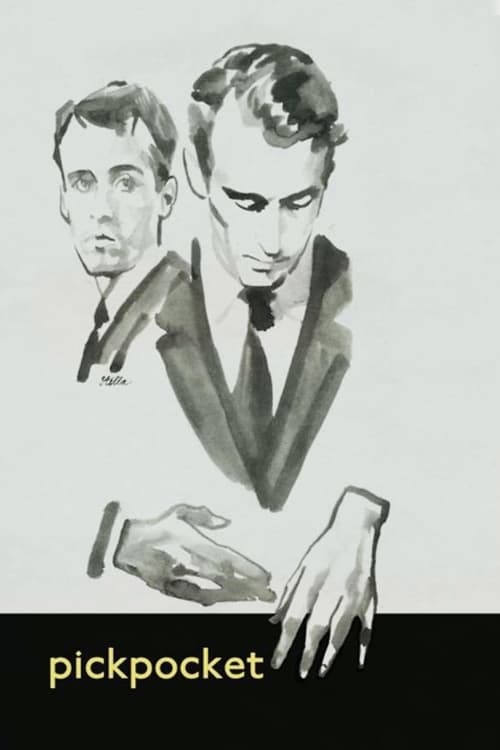
Pickpocket
1959 · Robert Bresson
For when you want something short, strange, and concentrated — a film that asks a little patience up front and repays it with a feeling that sneaks up on you. More a quiet spell than an entertainment; not for a rowdy night.
What it's about
A young Parisian drifts into pickpocketing almost on a whim, gets caught, and instead of quitting turns theft into a discipline — practicing sleights, falling in with seasoned thieves, working crowded metros and racetracks. Around him orbit a mother he avoids, a loyal friend, a young woman named Jeanne who sees more in him than he'll admit, and a police inspector who seems to be waiting him out. It's a crime story where the real question isn't whether he'll be caught but why he can't stop.
The experience
Cool, hushed, and hypnotic — barely seventy-five minutes, told in clipped scenes with flat voices and no wasted motion. The theft sequences play like choreography, all hands and glances, and they're weirdly thrilling; the rest sits in a strange calm that pays off with an ending of real, earned emotion.
The craft
Bresson strips out everything a crime movie usually runs on — suspense music, psychology, star acting — and builds the film from close-ups of hands, doorways, and exchanged looks. The pickpocketing set pieces are edited with a precision that turns stealing into ballet, wallets passing between bodies in unbroken flows. Stark black-and-white and near-silence make each small sound and gesture land hard.
Why it matters
A foundational film for the spare, stripped-down strain of art cinema, and a direct ancestor of the lonely-man character studies that ran through American movies of the 1970s and beyond. Filmmakers have been quoting its final scene ever since.
Snapshot
Pickpocket is Robert Bresson's seventh feature and arguably the purest distillation of his mature method: a seventy-five-minute study of a young Parisian, Michel, who drifts into theft, refines it into a vocation, and discovers love only after imprisonment forces him to stop. Adapted loosely from the moral architecture of Dostoevsky's Crime and Punishment, the film strips crime drama of suspense, psychology, and spectacle, replacing them with a rigorous attention to hands, glances, and the ritual choreography of stealing. It is one of the foundational texts of what Paul Schrader would later name "transcendental style," and its influence runs directly through the New Hollywood of the 1970s and the international art cinema that followed. Compact, austere, and quietly devotional, it remains the film most often cited to explain what "Bressonian" means.
Industry & production
Pickpocket was produced in France at the end of the 1950s, the moment when the Cahiers du Cinéma critics were becoming the directors of the Nouvelle Vague. Bresson, already a generation older and established, occupied an oblique position relative to that movement: revered by the young critics (André Bazin and the Cahiers writers championed him) but never of their cohort. The film was an independent, low-budget production shot on Parisian locations, made on the modest scale that characterized Bresson's career — he worked slowly, infrequently, and outside the commercial machinery of the French industry, which gave him an unusual degree of control over casting, editing, and final form.
Precise production budget and box-office figures are not part of the well-documented record, and I will not invent them; what is established is that the film was made economically, with a small non-professional cast and real Paris settings rather than studio reconstruction. Bresson had come off A Man Escaped (1956), a critical success, and Pickpocket extended the same working method into new material. The film's commercial reception on first release was muted relative to its later canonical stature — it was the kind of work that accrued reputation slowly through critics, retrospectives, and the writings of filmmakers it influenced, rather than through immediate popular success.
Technology
Technologically, Pickpocket is conventional for its time and place: 35mm black-and-white photography, standard Academy framing, monaural optical sound, location shooting in Paris with available and supplemented light. Bresson was not a technical innovator in the sense of new equipment or processes; his radicalism lay entirely in how ordinary tools were used. The film's most consequential "technology" is arguably human: the participation of Henri Kassagi, a professional magician and sleight-of-hand artist, who choreographed and in some accounts performed the intricate pickpocketing manipulations. The verisimilitude of the theft sequences depends on this craft expertise rather than on optical trickery — the camera records real manual dexterity rather than faking it through editing alone, though Bresson's cutting then abstracts and rhythmically organizes those movements.
Technique
Cinematography
Léonce-Henri Burel, who had photographed Diary of a Country Priest and A Man Escaped for Bresson, shot Pickpocket in black and white. The cinematography is deliberately undramatic: even, frontal, often shot at close range on hands and faces, avoiding expressive chiaroscuro or virtuoso camera movement. Bresson's framing fragments the body — a wrist, a pocket, an exchanged wallet — so that the act of theft becomes a montage of partial gestures rather than a legible spatial event. The camera tends to hold at a fixed, sober distance, refusing the angles and emphases that conventional crime cinema uses to generate tension. The visual register is one of restraint and flatness, a refusal of pictorialism that throws all attention onto behavior and detail.
Editing
Editing, credited to Raymond Lamy, is where Pickpocket most clearly achieves its effects. The theft sequences are constructed from short, precisely matched shots of hands, pockets, and faces, cut to a rhythm that is closer to musical phrasing than to suspense-building. Bresson's celebrated theory of the "cinematograph" — articulated in his Notes on the Cinematographer — held that meaning arises not within the individual image but in the collision and relation between images. The pickpocketing set pieces, especially the bravura ensemble sequence at the Gare de Lyon train station, are textbook demonstrations: a ballet of hands passing wallets among a team of thieves, abstracted into pure rhythmic movement. The editing also governs the film's overall ellipsis — Bresson cuts away from dramatic peaks (the mother's death, the arrest) rather than dwelling on them, so that emotion is displaced and felt obliquely.
Mise-en-scène / staging
Bresson's staging is anti-theatrical by design. Actors move with a flattened, de-dramatized economy; gestures are pared to essentials. Locations are real and unembellished — Michel's cramped garret, café exteriors, the racetrack at Longchamp, the Métro and railway stations. Objects carry enormous weight: the wallet, the rolled banknotes, the newspaper used as concealment, the cell door. Bresson treats these as near-sacramental, holding on them so that the material world acquires a charged significance. The staging deliberately withholds the expressive cues — reaction shots, emphatic blocking — that conventional drama relies on, forcing the viewer to read the surface and infer the interior.
Sound
The soundtrack is sparse and concrete. Bresson scored the film with excerpts of music by the Baroque composer Jean-Baptiste Lully, deployed sparingly to lend certain passages a liturgical gravity that contrasts with the squalor of the action. Otherwise the film foregrounds isolated, amplified everyday sounds — footsteps, the rustle of fabric, the click of a clasp, the ambient noise of stations and streets. Bresson believed sound could replace image and often preferred it to do expressive work the picture withheld. Michel's first-person voice-over, drawn from his diary, runs throughout, but it is famously affectless and frequently redundant with what we see, refusing to explain motive and instead deepening the sense of opacity.
Performance
Bresson did not use actors in the conventional sense; he used what he called modèles — non-professionals directed to suppress expression, interpretation, and "performance" entirely. Martin LaSalle, in his debut, plays Michel with a blank, inward affect, his face withholding the psychology a trained actor would supply. Marika Green plays Jeanne, the neighbor; Pierre Leymarie plays the friend Jacques; Jean Pélégri plays the police inspector; and Kassagi appears as the master thief who tutors Michel. Bresson's method involved drilling his models through many repetitions until self-consciousness and "acting" drained away, leaving a flat, automatic delivery. The result is performances that read as documentary surfaces — bodies and voices presented rather than dramatized — which is precisely the estranged, depsychologized texture Bresson sought.
Narrative & dramatic mode
The narrative is elliptical, first-person, and anti-suspenseful. Structured around Michel's diary, the film proceeds through compressed episodes: a first impulsive theft at the racetrack, arrest and release, his mother's death, his apprenticeship under Kassagi, escalating thefts, the inspector's circling surveillance, flight, return, capture, and the final prison-cell reconciliation with Jeanne. Crucially, Bresson refuses the mechanics of the heist genre — there is little tension about whether Michel will be caught, because the film is uninterested in outcome and wholly interested in compulsion and grace. The dramatic mode is confessional and spiritual rather than psychological: Michel's motives are never fully explained (he flirts with a Nietzschean "superior man" rationalization in a conversation with the inspector, but the film does not endorse it). The famous closing line — Michel addressing Jeanne through the prison bars, marveling at the strange path he had to take to reach her — reframes the entire film retrospectively as a story of conversion through fall, the criminal vocation revealed as a detour toward love and grace.
Genre & cycle
Nominally a crime drama, Pickpocket belongs more truthfully to a personal genre Bresson largely invented: the spiritual procedural. It shares DNA with his prison film A Man Escaped — both fixate on process, hands, and the patient accumulation of small physical acts — but redirects that method from escape to theft and from heroism to compulsion. Within crime cinema it is an anti-thriller, deliberately voiding the suspense, glamour, and moral resolution of the form. Its kinship with Dostoevsky places it in a lineage of crime-as-spiritual-crisis fiction rather than the procedural or noir traditions it superficially resembles. It does not belong to a commercial cycle so much as it stands as a node in Bresson's own evolving body of work and in the broader European art cinema of moral inquiry.
Authorship & method
Pickpocket is a near-total expression of Bresson's authorship; he wrote the original screenplay and directed it according to the aesthetic theory he would codify in Notes on the Cinematographer. That theory distinguished sharply between "cinema" (filmed theater, dependent on actors and conventional drama) and "cinematography" (a true film language built from the relation of images and sounds, using models rather than actors). Key collaborators served that vision: cinematographer Léonce-Henri Burel, a long-standing Bresson partner whose restrained black-and-white work suited the program; editor Raymond Lamy, who realized the rhythmic montage of the theft sequences; and Kassagi, whose sleight-of-hand expertise grounded the film's central craft. The "score" was assembled from Lully rather than newly composed, consistent with Bresson's preference for borrowed Baroque music as a counterpoint of grace. The unifying authorial method is subtraction — removing performance, music, suspense, and explanation until what remains is gesture, object, and the implication of an interior life that the surface deliberately withholds.
Movement / national cinema
The film is French and emerged at the height of the Nouvelle Vague, but Bresson is best understood as adjacent to rather than within that movement. The Cahiers critics revered him as an auteur avant la lettre and an exemplar of personal cinema, and his influence on the New Wave's freedoms (location shooting, non-professional casting, rejection of the polished "tradition of quality") was real. Yet his ascetic rigor and metaphysical preoccupations set him apart from the New Wave's youthful, allusive, often playful sensibility. He is more accurately placed in a transnational tradition of spiritual cinema — alongside Carl Theodor Dreyer and Yasujirō Ozu, the three filmmakers Paul Schrader would group under "transcendental style." Pickpocket is thus a French film of the New Wave era that belongs, in its deepest affinities, to a small international current of contemplative, religiously inflected modernism.
Era / period
Made in 1959, Pickpocket sits at a hinge in film history: the postwar European art cinema is consolidating its prestige, the auteur theory is being formulated, and the New Wave is breaking. The film reflects its late-1950s Paris setting in documentary terms — the streets, cafés, Métro, and stations are recorded with unforced specificity — while remaining timeless in its concerns. It is a product of the moment when serious cinema was claiming the right to interiority, ellipsis, and moral abstraction, and it pushes those ambitions to an extreme that few contemporaries matched. Its brevity and economy are also of their period, predating the expansive durations some later art films would adopt.
Themes
The film's governing themes are compulsion and grace. Michel's theft is figured less as criminality than as a vocation, even an addiction — an activity he cannot resist and cannot fully explain. Around this Bresson arranges his recurring preoccupations: the relation between freedom and predestination; pride and the "superior man" fantasy that would exempt the exceptional individual from common morality; isolation and the refusal of human contact; and redemption arriving from outside, unearned, through love and confinement. The hands that steal are also, in the film's economy, the hands reaching toward another person; the prison that ends Michel's freedom is what finally opens him to Jeanne. The Dostoevskian inheritance is explicit in this structure of crime, punishment, and spiritual awakening. Throughout, the material world — money, objects, the body — is charged with a significance that points beyond itself, the hallmark of Bresson's sacramental materialism.
Reception, canon & influence
Critically, Pickpocket was admired by Bresson's existing partisans and grew steadily in stature to become widely regarded as one of his supreme achievements and one of the essential films of its era; it is a fixture of serious canon-formation and retrospectives. Its first-run popular reception was modest, in keeping with Bresson's austere reputation, but its critical standing has only risen.
Looking backward, the decisive influence on the film is literary: Dostoevsky's Crime and Punishment supplies the moral architecture of crime, pride, surveillance, and redemption through a woman's love. Bresson's own earlier films, especially A Man Escaped, provided the methodological template of the spiritual procedural. The Catholic and Jansenist intellectual currents often associated with Bresson inform its theology of grace, though the film wears this lightly.
Looking forward, the legacy is large and traceable. Paul Schrader analyzed Bresson at length in his 1972 study Transcendental Style in Film: Ozu, Bresson, Dreyer, and then channeled Pickpocket directly into his own screenwriting and direction: the diaristic, alienated protagonist of Taxi Driver and, most explicitly, the structure and famous prison-glass ending of American Gigolo (and later Light Sleeper and First Reformed) are openly indebted to it. The film's choreography of hands and its de-dramatized treatment of process influenced a wide range of filmmakers committed to physical specificity and spiritual minimalism. Its method of non-professional "models," ascetic sound design, ellipsis, and contemplative pacing became part of the shared vocabulary of subsequent art cinema worldwide. More than six decades on, Pickpocket functions as a kind of grammar book for a whole tradition of cinema that seeks the transcendent in the strict observation of the ordinary.
A Deleuzian reading
Start with the hand.
The full Deleuzian reading of Pickpocket →
Reception
Parisian critics were split in 1959 — many found its blank acting and 75-minute austerity baffling — but the New Wave generation championed it, and it's since become the consensus pick for Bresson's masterpiece, a fixture of greatest-films polls.
How Pickpocket was received, from release to now →
Influences: the films it descends from and the films it influenced
- The Passion of Joan of Arc (1928) — Dreyer's fragmenting of the body and face into isolated close-ups stripped of establishing geography is the framing grammar Bresson adopts to render hands and gestures as autonomous spiritual events.
- Ordet (1955) — Its flat, frontal staging and refusal of expressive acting toward a sacramental finale models the 'transcendental style' of withholding dramatic affect until grace erupts from austerity.
- Late Spring (1949) — Ozu's depsychologized, low-flat compositions and contemplative empty shots form the third pillar of Schrader's transcendental triad, supplying Bresson's restrained-flat framing and anti-dramatic pacing.
- Umberto D. (1952) — De Sica's casting of non-professionals and patient observation of de-dramatized everyday process (the maid grinding coffee) prefigures Bresson's 'models' and his procedural attention to mundane gesture.
- Diary of a Country Priest (1951) — Establishes Bresson's voice-over-diary structure in which whispered first-person narration runs in counterpoint to image, the exact narrative device carried into Pickpocket's journal.
- A Man Escaped (1956) — The direct methodological template: a spiritual procedural built from the choreography of hands performing a craft, ascetic concrete sound, and a depsychologized model narrating his own labor.
- Pickup on South Street (1953) — Extends the choreographed close-up montage of pickpocketing hands in public transit into a feature-length craft ballet, isolating gesture over dialogue exactly as Fuller's wordless opening does.
- Au Hasard Balthazar (1966) — Extends the model-as-blank-surface method and elliptical editing, letting grace register through impassive faces and abrupt cuts rather than through performed emotion.
- Mouchette (1967) — Carries forward the rhythmic montage of small concrete actions and the anti-suspense treatment of a downward fate, where montage of objects substitutes for psychological explanation.
- Une femme douce (1969) — Reapplies the Dostoevsky-derived architecture of pride and a woman's redemptive love to a non-professional model, continuing the depsychologized adaptation method Pickpocket pioneered.
- L'Argent (1983) — The final distillation of Pickpocket's hand-and-money fragmentation: theft and exchange shown through tightly framed gestures and objects, cause and consequence linked by elliptical cuts.
- Taxi Driver (1976) — Schrader's screenplay transposes Pickpocket's diaristic, alienated loner whose voice-over journal narrates a spiritual sickness, importing the confessional-diary protagonist wholesale.
- American Gigolo (1980) — Openly reconstructs Pickpocket's plot scaffold and lifts its closing prison-glass redemption shot, the woman's love reaching the imprisoned man through a barrier.
- Light Sleeper (1992) — Reprises the diaristic narration and procedural attention to a solitary man's trade as a vehicle for delayed grace, a direct iteration of Bresson's spiritual-procedural form.
- First Reformed (2017) — The fullest application of Schrader's own transcendental-style theory: a written-journal voice-over, restrained Academy-ratio flat framing, and withheld affect resolving in an ecstatic rupture.
- Le Fils (2002) — The Dardennes' fixation on hands measuring, gripping, and laboring, with emotion suppressed beneath physical process, secularizes Bresson's choreography-of-gesture as a route to moral grace.
- Xiao Wu (1997) — A non-professional-cast portrait of a pickpocket observed through patient, undramatized framing of his trade, transposing Bresson's sleight-of-hand procedural into documentary-inflected realism.
- Young Mothers (2025) — The camera's fixation on hands performing furtive actions and on the face under moral strain, with 'models' directed toward gesture rather than acted emotion — the Bressonian grammar the Dardennes secularized.
- The Mastermind (2025) — Theft rendered as restrained behavioral process — craft shown through minimal gesture and affectless performance — the originating method behind O'Connor's behavioral understatement and the film's process-observational gaze.
- The Magician (1958) — A near-contemporary that reaches analogous formal conclusions by independent means: Bresson's performer who cannot authentically communicate, the institutional interrogation as spiritual duel, and the reduction of gesture to minimum necessary expressiveness parallel Bergman's enforced-silence and face-as-concealment experiments without any documented influence in either direction.
- Elephant (2003) — Ancestor of the flat, affectless performance method — non-actor 'models' delivering undramatized behavior, with emotional climax deliberately suppressed (the refusal of catharsis Elephant inherits).
- The Man Without a Past (2002) — The affectless 'model' performance style — actors emptied of psychology, delivering lines in flat monotone with attention drawn to gesture and hand — is the direct source of Markku Peltola's blank, un-emoting protagonist.
- Le Trou (1960) — Bresson's reduction of drama to the precise gestures of trained hands and flatly-cast non-professional 'models' is a sibling of Le Trou's insistence on physical action over psychology.
- The Man Who Sleeps (1974) — Provides the near-mute 'model' performance and the first-person diary voiceover laid over an impassive body moving through Paris — the anti-psychological, blank-faced protagonist Spiesser directly extends.
Similar films
- The Mastermind (2025) — influence & lineage · same viewing thread
- L'Argent (1983) — influence & lineage
- A Man Escaped (1956) — influence & lineage
- Mouchette (1967) — influence & lineage
- Au Hasard Balthazar (1966) — influence & lineage
- Diary of a Country Priest (1951) — influence & lineage
- Le Cercle Rouge (1970) — same viewing thread
- Rififi (1955) — same viewing thread
All the films related to Pickpocket →
Watch it with: curated runs of related films
- Cells, Vaults, and Codes of Honor — A run of methodical men — safecrackers, escapees, informers, resistants — filmed as pure process, where the suspense is less whether the job or the escape works than who honors the code and who breaks it first.