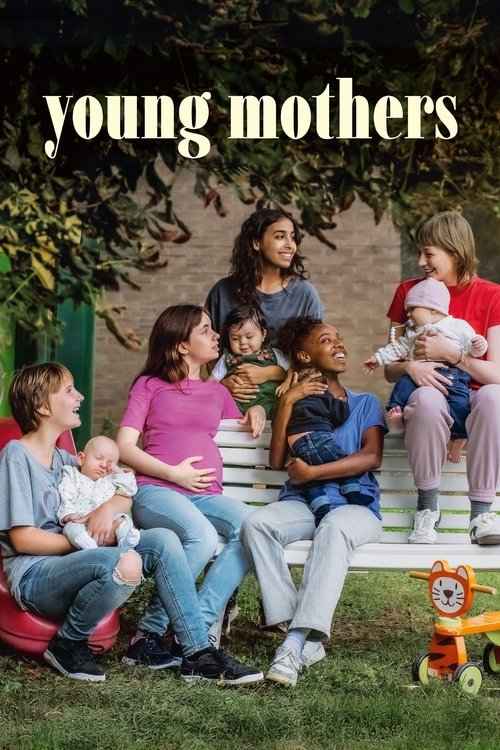
Young Mothers
2025 · Luc Dardenne
When you want your faith in people restored the honest way — through hard circumstances met with grit and grace, not uplift music. Emotionally direct enough for a good cry, gentle enough not to wreck you.
What it's about
In a residential shelter near Liège, five young women — Jessica, Perla, Julia, Ariane, and Naïma — are learning to raise their babies while barely out of childhood themselves, most carrying damage from the families that failed them. The film follows their tangled, parallel efforts to secure something better: housing, work, reconciliation, or simply the strength to make an impossible choice. No villains, no speeches — just five lives at a hinge point.
The experience
Urgent and deeply humane — shot close and handheld, it feels less like watching a drama than standing in the room while real decisions get made. It's quietly devastating in places, but the overall current is stubborn hope.
The craft
The Dardenne brothers work in their signature mode — observational realism, handheld camera, no cushioning score — but weave it across five interlocking stories instead of their usual single protagonist, and the screenplay's quiet architecture won them Best Screenplay at Cannes. Every scene is built from precise, lived-in behavior; nothing feels written even though everything is.
Why it matters
It extended one of the most decorated runs in Cannes history for the Belgian brothers, and showed their method could expand to an ensemble without losing an ounce of intimacy.
Snapshot
Young Mothers (French: Jeunes Mères) is the latest feature from the Belgian filmmaking partnership of Jean-Pierre and Luc Dardenne — and a note on attribution is owed at the outset: although this dossier is filed under Luc Dardenne, every narrative feature the brothers have made since La Promesse (1996) has been co-written and co-directed by the two of them, and Young Mothers is no exception. The film premiered in competition at the 78th Cannes Film Festival in May 2025, where the brothers won the award for Best Screenplay, extending one of the most decorated runs in the festival's history. It is set, as nearly all their work is, in and around Liège in francophone Wallonia, and it observes five young women — Jessica, Perla, Julia, Ariane, and Naïma — living in a maison maternelle, a residential shelter that houses adolescent and young-adult mothers and helps them prepare to raise their children or to make the wrenching decisions that surround that prospect. The ensemble structure is somewhat unusual for the Dardennes, whose films typically pursue a single protagonist; here the home itself becomes the organizing frame, and the camera moves among several intertwined stories of poverty, abandonment, addiction, and the fierce, fragile work of trying to break an inherited cycle. The result is recognizably Dardenne cinema: handheld, unscored, morally exacting, and rooted in the textures of working-class Belgian life.
Industry & production
Young Mothers was produced through Les Films du Fleuve, the production company the Dardenne brothers founded and have used as the engine for their own films and as a vehicle for younger filmmakers across European art cinema. Their production model is by now well established: modest budgets by international standards, extensive rehearsal, on-location shooting in the Liège–Seraing industrial corridor, and financing assembled from Belgian and French sources together with European co-production support, typically with backing from the Center du Cinéma et de l'Audiovisuel of the Fédération Wallonie-Bruxelles and partners in France. The precise financing breakdown and budget for Young Mothers are not something I can state with confidence, and the detailed deal-by-deal record for this specific title is thin enough that I will not invent figures.
What can be said with assurance is institutional. The Dardennes are festival filmmakers in the structural sense: Cannes is their home, the launch platform that confers visibility and underwrites international distribution. They are two-time Palme d'Or winners — for Rosetta (1999) and L'Enfant (2005) — and have collected a Grand Prix, directing and screenplay prizes, and acting awards for their performers across two and a half decades. A Best Screenplay win at Cannes 2025 places Young Mothers squarely within that lineage and all but guaranteed the kind of arthouse theatrical rollout and festival circulation their work reliably receives. Distribution typically runs through specialist labels devoted to auteur cinema, with the brothers' name itself functioning as the principal marketing asset.
Technology
The Dardennes have, since the late 1990s, built an aesthetic out of deliberately unobtrusive technology, and Young Mothers sits within that tradition. Their signature is the handheld camera operated in close, mobile proximity to the actors, prioritizing responsiveness over polish. Over the course of their career the brothers moved from photochemical capture to digital, and their recent features have been shot digitally; I would expect Young Mothers to have been made on a digital cinema workflow consistent with contemporary European production, though I cannot confirm the specific camera and lens package used on this film and will not guess at model names. Their lighting practice favors available and naturalistic sources, and their sound is captured and constructed for realism rather than spectacle. The throughline is that technology in a Dardenne film is chosen to disappear: the apparatus serves the moral immediacy of the encounter between bodies in a room, never the reverse.
Technique
Cinematography
The Dardenne image is among the most identifiable in contemporary cinema: a restless, breathing handheld frame that follows characters from behind and beside, often fixing on the back of a neck or the side of a face, withholding the conventional establishing geography of a scene so that the viewer is kept inside the character's immediate, anxious present. Their longtime camera collaborators — including Alain Marcoen, who served as director of photography on much of their canonical work, and Benoît Dervaux, the camera operator and cinematographer whose handheld work is inseparable from the brothers' style — have built a visual grammar of pursuit and proximity. I cannot verify with certainty which of their collaborators served as principal cinematographer on Young Mothers, so I will not assert it; what is safe to say is that the film's look belongs to the school those collaborators forged. Expect tight framings, walking-and-talking tracking, natural light, a muted Walloon palette of grays and institutional interiors, and a refusal of the establishing-shot reassurance that would let a viewer feel safely outside the drama.
Editing
Marie-Hélène Dozo has been the Dardennes' editor across the body of their major work, and her cutting is central to their effect: long takes held past the point of comfort, edits motivated by action and gaze rather than by rhythm for its own sake, and a structural austerity that strips away anything decorative. The Dardenne method tends to let scenes run so that moral pressure accumulates in real time. With an ensemble of five young mothers rather than a single protagonist, the editing of Young Mothers faces a structural problem the brothers' single-lead films do not — how to braid parallel stories without dissipating the intensity that comes from sustained attention to one body. The film's reception suggests they solve this by keeping each strand spare and letting the shared space of the home do the connective work, though I should flag that detailed scene-level accounts of the cutting are not something I can reconstruct reliably here.
Mise-en-scène / staging
Dardenne staging is functional and lived-in. Locations are real or convincingly real working environments — here a maternal home with its corridors, shared kitchens, counseling rooms, and bedrooms — and blocking is choreographed around the practical tasks of daily life: feeding an infant, packing a bag, waiting in a hallway, navigating a door that might be locked or open. Props carry moral weight in their cinema (a coat, a key, money, a child's body), and physical thresholds — doorways, gates, vehicles — recur as sites of decision. The institutional setting gives Young Mothers a natural architecture of constraint and possibility, the shelter functioning simultaneously as refuge and as a holding pattern from which the young women must eventually move.
Sound
A defining and consistent feature of Dardenne cinema is the near-total absence of non-diegetic music. Their films are typically scored only by the ambient sound of the world — traffic, footsteps, machinery, voices, the cries of children — and any music that appears tends to be diegetic, motivated by a source within the scene. This austerity is a deliberate ethical position: refusing a score refuses to tell the viewer how to feel, leaving the emotional reading to the spectator. Young Mothers can be assumed to maintain this practice, which means the soundtrack is essentially the documented sound of its environments. There is, in keeping with their method, no composer to credit in the conventional sense.
Performance
Performance is the Dardennes' true subject of craft. They are famous for extensive, weeks-long rehearsal centered on physical action and repetition until behavior becomes automatic and the camera can capture something that reads as lived rather than performed. They have repeatedly drawn extraordinary work from young and first-time or near-first-time actors — Émilie Dequenne in Rosetta, Jérémie Renier across multiple films, Thomas Doret in The Kid with a Bike, the young leads of Tori and Lokita — and Young Mothers, built on an ensemble of young women playing the residents of the home, extends that commitment. The casting of largely young, non-star performers is itself part of the realist contract. I have seen the principal residents attributed to a young ensemble, but I want to be careful not to misattribute specific roles to specific actors where my confidence is incomplete; the safe claim is that the film rests on naturalistic ensemble performance of the kind the brothers have spent their careers cultivating.
Narrative & dramatic mode
The Dardennes work in a mode best described as moral realism: stories stripped to the bone of a concrete ethical predicament, played out in near-real time, in which an ordinary person under economic and emotional pressure must make a choice with consequences for someone vulnerable. Their narratives are usually propulsive despite their austerity, structured like quiet thrillers of conscience. Young Mothers adapts this template to a polyphonic, ensemble shape: rather than one dilemma tracked to its resolution, the film interweaves several young women's situations — a mother negotiating reunion or rupture with her own parent, a young woman weighing whether she can keep her child, another confronting addiction or an unreliable partner. The dramatic engine remains the same: the future of a child hangs on adult decisions made under duress, and the film withholds easy judgment of the people making them. The Dardennes characteristically end not with tidy resolution but with a gesture, a small act of recognition or care that opens rather than closes.
Genre & cycle
The film belongs to the broad category of social-realist drama, and more specifically to the Dardennes' own three-decade cycle of films about precarious lives at the margins of post-industrial Belgium. That cycle has steadily widened its social aperture — from the exploitation of undocumented migrants (La Promesse) and youth unemployment (Rosetta) to grief and forgiveness (The Son), the commodification of a child (L'Enfant), labor and solidarity (Two Days, One Night), radicalization (Young Ahmed), and the trafficking of migrant minors (Tori and Lokita). Young Mothers extends the cycle into the specific terrain of adolescent and young motherhood and the welfare institutions built around it, a subject that gathers up many of their recurring concerns — childhood, parental responsibility, the reproduction of poverty across generations — into a single setting.
Authorship & method
The Dardenne brothers are co-authors in the fullest sense, writing their own screenplays and directing as a unit; the Best Screenplay prize at Cannes 2025 was awarded to them jointly. Their method is unusually consistent and well documented: original scripts developed over long periods, extensive location scouting in their home region, weeks of rehearsal organized around physical action, and a shooting practice built on multiple takes and handheld pursuit. Their key collaborators form a stable repertory company behind the camera as much as in front of it — editor Marie-Hélène Dozo and the cinematographers and operators (Alain Marcoen, Benoît Dervaux) associated with their handheld look — and their refusal of a musical score is itself an authorial signature rather than an absence. Luc Dardenne's published diaries (Au dos de nos images) articulate the ethical philosophy underwriting the work, much of it indebted to the philosopher Emmanuel Levinas and his thinking on the face of the other and responsibility, which maps directly onto the films' fixation on the human face under moral pressure.
Movement / national cinema
The Dardennes are the central figures of contemporary Belgian, and specifically francophone Walloon, cinema, and among the most influential exponents of a broader European social realism that runs from Italian neorealism and Robert Bresson through Ken Loach to the present. Their early documentary work in the Liège–Seraing region grounds the fiction films in a real post-industrial landscape — the closed steelworks and working-class towns of the Meuse valley — that functions almost as a recurring character. Internationally, their handheld observational style helped define an influential strain of 2000s art cinema and gave the term "Dardennian" currency as shorthand for unscored, handheld, ethically serious realism about the poor. Young Mothers is firmly a product of this national and regional cinema, made in their home territory through their own Liège-based company.
Era / period
The film is contemporary, set and made in the mid-2020s, and it reflects the present-day social landscape of the European welfare state under strain: the institutions of child protection and maternal support, the precarity of young people without stable family or economic footing, and the persistence of intergenerational poverty. It arrives at a late and consolidated point in the Dardennes' career, when both brothers are well into their seventies and their style is fully formed; Young Mothers is less a reinvention than a deepening and broadening of an established practice, turning its attention to a population — very young mothers — that gathers together the brothers' lifelong preoccupations with childhood, responsibility, and the chance of breaking a cycle.
Themes
The governing themes are continuous with the Dardenne canon. First, the fate of children and the question of who will take responsibility for the vulnerable — here doubled, since the protagonists are themselves barely past childhood and now responsible for children of their own. Second, the intergenerational transmission of damage: several of the young women contend with their own mothers, and the film asks whether the cycle of neglect can be interrupted. Third, the tension between institutional care and individual agency — the shelter as both lifeline and constraint. Fourth, the Dardennes' enduring Levinasian ethics, the demand that the face of another, especially a child, makes upon us. And finally, the dignity of labor and self-determination: the women's struggle "to obtain a better life," in the synopsis's phrase, is rendered as concrete daily work rather than abstract aspiration. Against these run the brothers' steady motifs of money, work, parents and children, and the small redemptive gesture.
Reception, canon & influence
Critically, Young Mothers was received within the frame of the Dardennes' established stature, and its Best Screenplay award at Cannes 2025 confirmed both the festival's continued embrace of the brothers and the regard for their writing in particular. Detailed critical consensus beyond the festival reception is something I can only characterize cautiously from here, and I will not fabricate specific reviews, ratings, or box-office figures; what is documented is the Cannes competition slot and the screenplay prize.
The influences on the film are the same deep sources that have shaped all the Dardennes' work: Italian neorealism's location shooting and use of non-professionals, Robert Bresson's spiritual austerity and attention to hands and objects, the social cinema of Ken Loach, and the ethical philosophy of Emmanuel Levinas. The influence of the Dardennes runs in the other direction and is substantial: their handheld, unscored realism has shaped a generation of filmmakers working in the register of moral realism across Europe and beyond, and their production company has actively mentored younger directors. Young Mothers is unlikely to be remembered as a stylistic departure; its place in film history will rest on its extension of one of contemporary cinema's most coherent and decorated bodies of work into a new and pointed subject, and on the continued vitality of two filmmakers who, decades on, remain capable of winning the festival that made them.
A Deleuzian reading
Start with the back of a neck.
The full Deleuzian reading of Young Mothers →
Reception
Premiered at Cannes 2025 to a warm reception and the Best Screenplay prize — widely read as late-career Dardennes at their most tender. Too new for a reappraisal arc; the first-wave consensus ('gentle, humane, quietly devastating') is still the reigning take.
How Young Mothers was received, from release to now →
How to watch Young Mothers: what to notice on a first viewing
- Watch how close the camera stays to the back of a neck. The Dardennes follow their subjects from just behind or beside, withholding the wide shot that would let you see a room's whole layout. You stay inside a character's anxious present instead of watching safely from above it.
- Notice that no music tells you how any scene should feel. The soundtrack is only traffic, footsteps, voices, a crying child, whatever the room actually produces, with nothing added to cue your emotion. You are left to decide for yourself what a moment is asking you to feel.
- Watch what happens each time someone stops at a doorway. The Dardennes keep staging their turning points at thresholds, a coat handed over, a key that turns or doesn't, so a whole decision gets compressed into one held body. You can read the choice in the body before anyone explains it in words.
- Watch how automatic ordinary tasks look, feeding, packing, waiting. The Dardennes rehearse for weeks until a daily action stops looking performed, so the camera can catch it as lived behavior instead. Nothing here reads as acting, which is exactly the point of all that rehearsal.
The whole guide to watching Young Mothers, with the keys for a rewatch →
Influences: the films it descends from and the films it influenced
- Bicycle Thieves (1948) — The neorealist template the Dardennes rebuilt: a non-professional cast walking real streets, where the whole drama is a moral economy of poverty staged in actual locations rather than sets.
- Germany, Year Zero (1948) — Places a child in unbearable moral peril and films it on location with available light, blurring documentary and fiction in the way the Dardennes inherited for their imperiled young protagonists.
- Pickpocket (1959) — The camera's fixation on hands performing furtive actions and on the face under moral strain, with 'models' directed toward gesture rather than acted emotion — the Bressonian grammar the Dardennes secularized.
- Mouchette (1967) — The cornered adolescent girl whose dignity is observed without score or sentiment is the direct precursor to the Dardennes' young women filmed under unrelenting moral pressure.
- Au Hasard Balthazar (1966) — Builds an ethical drama of the vulnerable out of restraint, objects, and withheld reaction shots — the austerity Luc Dardenne explicitly threads through Levinas in his diaries.
- Kes (1969) — Location-shot working-class realism carried by a non-professional child, embedding social critique inside patient close observation rather than message-making.
- The Death of Mr. Lazarescu (2005) — Romanian New Wave appropriation of the Dardenne method: a near-real-time handheld follow of a failing body through institutions, with strictly diegetic sound and no establishing relief.
- 4 Months, 3 Weeks and 2 Days (2007) — Long unbroken handheld takes tracking a young woman through a single moral crisis, scoreless and shot in available light — the Dardenne grammar transposed to Ceaușescu's Romania.
- Fish Tank (2009) — Handheld, boxed-in Academy-ratio pursuit of a working-class girl played by a non-professional, in natural light and diegetic sound, directly downstream of Rosetta's chase aesthetic.
- Wendy and Lucy (2008) — American minimalist realism of precarity that strips out non-diegetic music and comforting establishing shots, letting a single act of responsibility carry the whole moral weight.
- Winter's Bone (2010) — Casts regional non-professionals alongside its lead and uses natural-light, location-bound observation to build a young woman's moral quest through intergenerational poverty.
- Capernaum (2018) — Casts a non-professional child drawn from the real poverty it depicts and shoots him handheld through the city, turning a minor's claim on adult responsibility into the film's ethical spine.
- The Rider (2017) — Non-professionals playing versions of themselves in natural light and real locations, an observational moral realism that descends from the neorealist-Dardenne lineage of acting-as-being.
- Rosetta (1999) — The originating engine of the whole method: the handheld camera pinned to the back of a young woman's neck as she scrabbles for survival, refusing establishing shots so geography is only ever discovered by pursuit.
- The Son (2002) — Glues the lens to the protagonist's shoulders and nape, withholding spatial orientation to force a Levinasian face-to-face reckoning between a man and the youth who wronged him.
- L'Enfant (2005) — Pairs young, unready parenthood with the same diegetic-only soundscape and following-from-behind pursuit, making moral responsibility a matter of bodily action through real streets.
- Two Days, One Night (2014) — Structures an entire film as repeated face-to-face moral appeals shot handheld in natural light without score, the door-to-door ethics that Young Mothers extends into its ensemble of women.
- Happy as Lazzaro (2018) — A contemporary Italian revival of neorealism's non-professional casting and location ethics, sharing the Dardennes' fixation on the saintly-vulnerable figure who exposes others' moral failure.
Similar films
- The Child (2005) — influence & lineage
- Rosetta (1999) — influence & lineage
- Two Days, One Night (2014) — influence & lineage
- Love Letters (2025) — same viewing thread
- A Place for Her (2026) — shared sensibility
- La Promesse (1996) — shared sensibility
- The Second Mother (2015) — shared sensibility
- The Kid with a Bike (2011) — shared sensibility
All the films related to Young Mothers →
Watch it with: curated runs of related films
- Families Made and Unmade — A run of intimate domestic portraits — watch these together and feel marriages dissolve, mothers improvise, and love keep redrawing the shape of a family across sixty years.