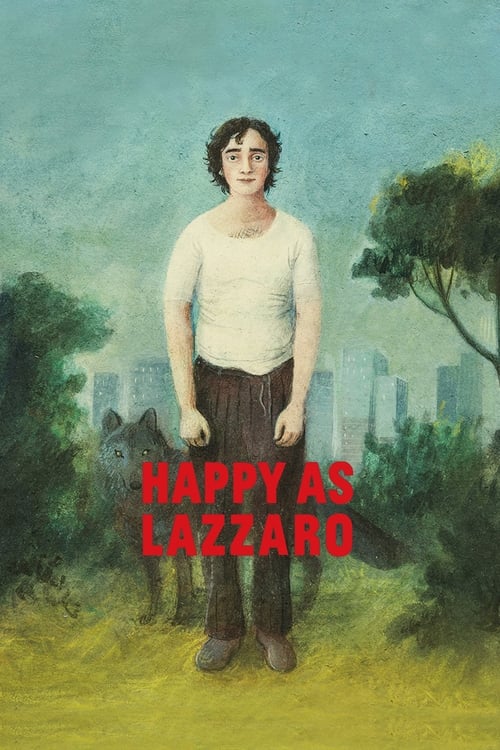
Happy as Lazzaro
2018 · Alice Rohrwacher
When you want a film to chew on for days — something beautiful and mysterious that trusts you to keep up. A challenge in the best sense, though a gentle-hearted one.
What it's about
On the isolated Italian estate of Inviolata, a marchesa keeps her sharecroppers laboring in feudal ignorance — a setup drawn from a real news story — and among them lives Lazzaro, a guileless teenager who serves everyone and suspects no one. His friendship with the marquise's reckless son bends the story, and time itself, into something far stranger than the pastoral it first appears to be.
The experience
It plays like a folk tale told in earnest — sun-drenched, funny, and tender — until a midpoint swerve reorients everything and a deep ache sets in. You come out feeling like you've been told a parable you'll be decoding for a while.
The craft
Hélène Louvart shot it on Super 16mm with softly rounded frame edges, so the light falls like something remembered rather than recorded — it's one of the most beautiful-looking films of its decade and worth the biggest screen you can find. Rohrwacher's script, which won the screenplay prize at Cannes, hides a genuinely audacious structure inside its simple fable.
Why it matters
It confirmed Alice Rohrwacher as the keeper of a particular Italian tradition — the sacred peasant fable — carried into the present without pastiche, and its central narrative gamble is among the boldest in recent European cinema.
Alice Rohrwacher's fable took the screenplay prize at Cannes and confirmed her as keeper of a particular Italian flame — the peasant sacredness of Olmi, the holy fools of Pasolini — carried forward without a trace of pastiche. It began from a true news item: a marchesa who kept sharecroppers laboring in feudal ignorance decades after the practice had been outlawed. On the isolated estate of Inviolata, the guileless teenager Lazzaro serves everyone and suspects no one, until friendship with the marquise's reckless son bends the film — and time itself — into something far stranger. To say more would break the spell; enough that its midpoint swerve is among the boldest in recent European cinema. Hélène Louvart shot it on Super 16mm, frame edges softly rounded, light falling like something remembered rather than recorded. Rohrwacher — sister of the actress Alba, who appears here — went on to La Chimera; her tender, wolf-shadowed ruralism has no current equal.
A Deleuzian reading
A boy's face, held a beat longer than the scene needs, in light that looks remembered rather than switched on.
The full Deleuzian reading of Happy as Lazzaro →
Reception
It arrived already blessed — Best Screenplay at Cannes 2018 (shared with Jafar Panahi's Three Faces) — then quietly slipped onto Netflix, where it grew from festival darling into fixture of best-of-the-2010s lists within a couple of years.
How Happy as Lazzaro was received, from release to now →
Influences: the films it descends from and the films it influenced
- The Tree of Wooden Clogs (1978) — Rohrwacher's named touchstone: casting real farmers as non-professionals and shooting tenant-peasant feudal labor in available natural light, conferring liturgical dignity on agrarian routine.
- The Gospel According to St. Matthew (1964) — The other named influence — weathered peasant faces cast for their sacred iconography and 'reverential neorealism' that films the poor as though painting saints, directly shaping Lazzaro's beatific close-ups.
- Hawks and Sparrows (1966) — Supplies the ideological-parable form: a wandering holy fool moving through an allegory of Italy's economic order, the fable-as-Marxist-critique scaffolding Lazzaro inherits.
- The Flowers of St. Francis (1950) — Franciscan model of sanctity through simplicity — real friars playing themselves in episodic beatitude — the template for Lazzaro's guileless, self-effacing holiness.
- Miracle in Milan (1951) — Fuses neorealist poverty with overt magical fable and a pure-hearted foundling among the dispossessed, prefiguring Lazzaro's neorealism-punctured-by-the-supernatural swerve.
- Au Hasard Balthazar (1966) — The blank, saintly innocent as passive conduit for human cruelty — Lazzaro is a Balthazar figure, absorbing exploitation without agency so the surrounding venality is indicted.
- Ordet (1955) — Stages an unexplained, literal miracle and a holy fool mistaken for mad, licensing Lazzaro's matter-of-fact resurrection without genre apology.
- La Strada (1954) — Gelsomina establishes the Italian holy-fool archetype — the radiant simpleton whose innocence measures the brutality around her — that Lazzaro's performance channels.
- Padre Padrone (1977) — Sardinian pastoral servitude rendered with non-professionals and ethnographic texture, the rural-feudal-bondage subject Rohrwacher updates in the illegal-sharecropping premise.
- Mamma Roma (1962) — Rohrwacher revives Pasolini's holy-fool among the rural poor, using non-professionals, 35mm's rough textured aesthetic, and painterly religious tableaux to find sacredness in economic exploitation.
- The Decameron (1971) — Shoots a vanishing peasant world on grainy 16mm with non-professionals cast for face, staging rural labor in dense populated blocking and quoting sacred painting for the protagonist's iconography — the Pasolinian package reassembled rather than merely referenced.
- Medea (1969) — Shoots a sharecropper world on grainy 16mm with local non-professionals and builds it as a saint's legend snapped in two by a leap into neocapitalist modernity — Medea's doubled catastrophe and its argument that modernity annihilates the archaic sacred.
- La Chimera (2023) — Extends the identical craft — Louvart's mixed film gauges, a wandering innocent, and time-porous fable — into tomb-raider mysticism, the direct successor project.
- Romería (2025) — Louvart's grounded realism here breaks its own contract midway into fable — the precedent for Romería's late fantasy sequence that dissolves the realist register the film had patiently built.
- The Wonders (2014) — Rohrwacher's prior film with the same Hélène Louvart Super-16 palette and child's-eye rural naturalism, the immediate stylistic sibling to Lazzaro's grain and light.
- Le Quattro Volte (2010) — Near-wordless Calabrian pastoral treating the sacred transmigration of a soul through peasant, animal and mineral, sharing Lazzaro's belief in a holiness immanent in rural cycles.
- Il Buco (2021) — Observational reverence for a vanishing agrarian world, filmed in ambient light with non-actors, prolonging the same contemplative-ethnographic mode as Lazzaro's village.
- Never Rarely Sometimes Always (2020) — Shot by Hélène Louvart in handheld Super-16 with the same naturalistic available-light intimacy, showing the cinematographer's method migrating across directors.
- Beach Rats (2017) — Louvart's grainy 16mm close-quarters naturalism and skin-and-dusk lighting, a parallel demonstration of the shooting technique that gives Lazzaro its tactile texture.
- Young Mothers (2025) — A contemporary Italian revival of neorealism's non-professional casting and location ethics, sharing the Dardennes' fixation on the saintly-vulnerable figure who exposes others' moral failure.
- Invisible Life (2019) — Cinematographer Hélène Louvart's signature here — grainy Super16 textures and sun-warmed, tactile naturalism — is the exact craft she brings to Invisible Life's saturated but organic period images.
- The Eight Mountains (2022) — Rural Italian labor shot on grainy stock in a near-square frame, turning the peasant landscape into a mythic, textured surface rather than picturesque backdrop.
- The Last One for the Road (2025) — Deeply local, dialect-grounded regional Italian picaresque that reaches universality through a bittersweet fable of place — the same locality-as-route-to-universality method critics named in Sossai.
- Palestine 36 (2025) — Shares DP Hélène Louvart, whose Super-16 natural-light, landscape-embedded handheld method — bodies worked into the terrain — defines the shared visual grammar of cinematography.
Similar films
- La Chimera (2023) — influence & lineage
- The Tree of Wooden Clogs (1978) — influence & lineage
- Fireworks (2023) — shared sensibility
- Certified Copy (2010) — shared sensibility
- Where Is The Friend's House? (1987) — shared sensibility
- The Hand of God (2021) — shared sensibility
- Le Havre (2011) — shared sensibility
- Luca (2021) — shared sensibility