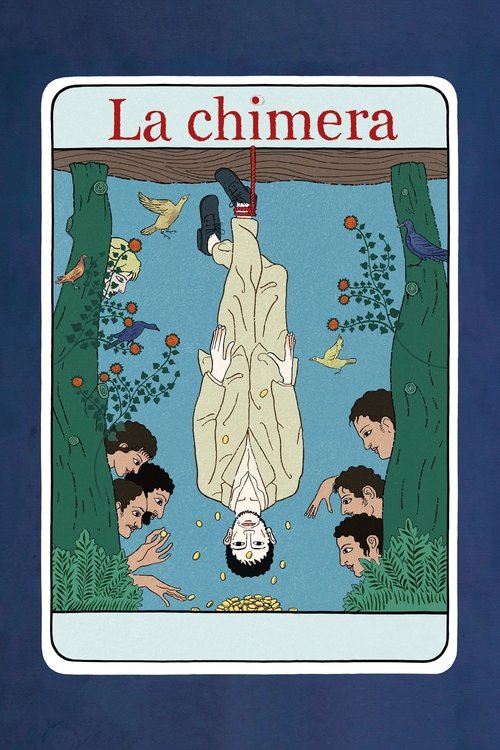
La Chimera
2023 · Alice Rohrwacher
For when you want to be enchanted rather than entertained — a film to wander into with no schedule, half fairy tale and half hangout. A gentle challenge: it asks you to give up the plot-driven habit and just follow.
What it's about
In a scuffed 1980s Italy, Arthur — a rumpled, grieving Englishman with a dowser's uncanny gift for sensing what lies buried — falls in with a scruffy band of tombaroli, grave robbers who loot Etruscan tombs along the coast. He's haunted by a lost love named Beniamina, and his search for her pulls him on a picaresque journey between the living and the dead, through forests, crumbling villas, and raucous village celebrations.
The experience
Shaggy, sun-cracked, and quietly enchanted — it drifts between earthy comedy and aching melancholy, sometimes speeding up like a silent film, sometimes stopping dead for a moment of grace. It casts a spell that lingers for days.
Performances
Josh O'Connor is magnetic in a dirty linen suit, playing grief as a kind of sleepwalking; Isabella Rossellini is a delight as the matriarch of a crumbling villa full of singing students.
The craft
Alice Rohrwacher and cinematographer Hélène Louvart mix 35mm, 16mm, and Super 16 into a handmade roughness — scenes crank up to silent-comedy speed, characters glance at the camera, and the whole thing feels dug out of the earth like its treasures. It's gorgeous in a scuffed, tactile way that rewards a big screen.
Why it matters
The film that confirmed Rohrwacher as the great contemporary heir to Italian cinema's fabulist line — carnival, peasant piety, the sacred and the profane — and completed the loose triptych begun with The Wonders and Happy as Lazzaro, winning her a devoted international following.
Alice Rohrwacher completes the loose triptych begun with The Wonders and Happy as Lazzaro with this shaggy, sun-cracked fable about tombaroli — the grave robbers who loot Etruscan tombs along the Tyrrhenian coast of a scuffed 1980s Italy. Josh O'Connor, rumpled and grieving in a dirty linen suit, plays Arthur, an Englishman with a dowser's gift for sensing what lies beneath; Isabella Rossellini presides over a crumbling villa full of singing students. Rohrwacher is the great contemporary heir to Italian cinema's fabulist line — Fellini's carnival, Olmi's peasant piety, Pasolini's sacred profane — and her signature is a handmade roughness: with cinematographer Hélène Louvart she mixes 35mm, 16mm and Super 16, lets scenes crank up to silent-comedy speed, lets characters glance at the camera. Beneath the picaresque sits a serious question about what a culture owes its dead, and who has the right to touch what was buried with love. The image that lingers is a red thread, dangling somewhere between this world and the other one.
Reception
It left Cannes 2023 empty-handed in a jury decision critics immediately called a snub, then slow-burned through its 2024 US release into year-end top-tens and 'best of the decade so far' conversations.
How La Chimera was received, from release to now →
Influences: the films it descends from and the films it influenced
- La Strada (1954) — Supplies the itinerant picaresque-fable template — a wanderer moving town to town as episodic tableaux — that structures Arthur's dowsing circuit among the tombaroli.
- The Hawks and the Sparrows (1966) — Episodic road-fable that yokes broad Totò slapstick to Franciscan allegory, the exact sacred-comic register Rohrwacher inherits for her ragtag grave-robbers.
- Mamma Roma (1962) — Frontal, Renaissance-painting framing of the Roman sub-proletariat that sacralizes the profane margins — Pasolini's iconographic staging La Chimera quotes in its tomb tableaux.
- The Tree of Wooden Clogs (1978) — Casts local non-professionals and uses available-light, grainy naturalism to consecrate peasant labor, the earthy ensemble method behind Rohrwacher's tombaroli crew.
- Amarcord (1973) — Carnivalesque provincial ensemble punctuated by fourth-wall-breaking narrators — the direct-address device Rohrwacher deploys via her singing ballad-chorus.
- Sherlock Jr. (1924) — Model of undercranked, sped-up silent slapstick — the in-camera fast-motion Rohrwacher uses to turn the tomb-robbers' scrambles into comic ballet.
- Orphée (1950) — Renders the Orphic descent and mirror-threshold to the underworld with in-camera trickery — the liminal crossing figured by La Chimera's red thread to the dead.
- Miracle in Milan (1951) — Neorealist-fable hybrid where the destitute touch the miraculous, using practical in-camera magic effects grafted onto documentary streets.
- Journey to Italy (1954) — Its Pompeii-excavation of the embracing ancient dead binds archaeology to grief and the sacred — the Rossellinian lineage Isabella Rossellini literally carries into the film.
- Happy as Lazzaro (2018) — Same DP Hélène Louvart's mixed-gauge Super 16 grain, a holy-fool protagonist and a time-slippage fable structure — the direct formal predecessor to La Chimera.
- Invisible Life (2019) — Extends the Louvart method Aïnouz used: analog film stock and earthy, luminous color grading that make history feel physically present, the palette treated as a fabric rather than a filter.
- Corpo Celeste (2011) — Rohrwacher's debut establishing the 16mm handheld, observational Calabrian realism and sacred/profane theme her later fables refine.
- The Wonders (2014) — Celluloid-shot rural family idyll with non-professional children and a fabulist TV-pageant intrusion — her signature mix of documentary texture and magic.
- The Lost Daughter (2021) — Showcases collaborator Hélène Louvart's restless, skin-close handheld camera — the same shooting method that gives La Chimera its intimate instability.
- Beach Rats (2017) — Louvart again working in soft, grainy 16mm to make bodies and light tactile — the DP's analog-texture approach shared across Rohrwacher's palette.
- God's Own Country (2017) — Draws the same mud-and-hands, inarticulate rural physicality from Josh O'Connor that Rohrwacher casts as Arthur's grief-worn body.
- Uncle Boonmee Who Can Recall His Past Lives (2010) — Renders a porous membrane between the living and the dead on grainy celluloid, letting spirits arrive without spectacle — kindred to La Chimera's duty-to-the-dead liminality.
- Tale of Tales (2015) — Contemporary Italian fabulism reviving folk-tale grotesquerie through practical, analog craft rather than digital effect, a parallel revival of the national fable tradition.
- Romería (2025) — Shares the Louvart-shot grammar of digging into a buried family past where the dead become tangibly present, and the same lyrical slippage between documentary texture and myth.
Similar films
- Happy as Lazzaro (2018) — influence & lineage
- The Tree of Wooden Clogs (1978) — influence & lineage
- Pan's Labyrinth (2006) — same viewing thread
- Guillermo del Toro's Pinocchio (2022) — same viewing thread
- The Wolf House (2018) — same viewing thread
- Poor Things (2023) — often watched together
- Bones and All (2022) — shared sensibility
- Trenque Lauquen (2023) — shared sensibility
All the films related to La Chimera →
Watch it with: curated runs of related films
- Where Children Meet the Dead — Watch these together and Coco's candlelit sweetness darkens by degrees into a run of folk fables where the dead won't stay buried and children bargain with mortality under the shadow of war and fascism.