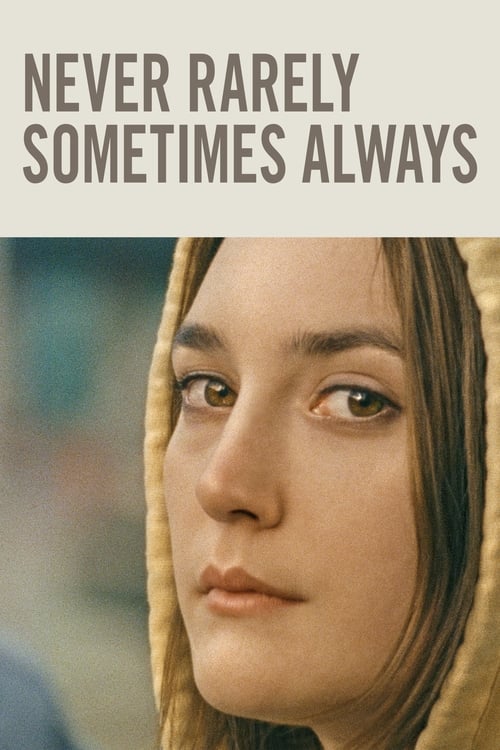
Never Rarely Sometimes Always
2020 · Eliza Hittman
For when you want something honest and unflinching — a film to sit with, not escape into. This is a challenge, not comfort viewing, but it repays the attention with one of the most humane portraits of teenage girlhood in recent memory.
What it's about
Autumn, a withdrawn teenager in rural Pennsylvania, is pregnant and doesn't want to be. With her cousin Skylar, a stolen handful of cash, and a bus ticket, she travels to New York City to get medical help — and the film follows the trip as pure logistics: where to sleep, what things cost, what the clinic asks, and what two girls do to get each other through it.
The experience
Quiet, close, and almost unbearably intimate — long stretches pass with barely a word, and the tension lives in faces and hands rather than dialogue. It's not grim for grimness's sake; the loyalty between the two cousins keeps it warm even when the world isn't.
Performances
Newcomer Sidney Flanigan is extraordinary as Autumn — a nearly wordless performance where everything happens behind the eyes. The scene built around the clinic questionnaire that gives the film its title is a single unbroken shot resting entirely on her face, and she carries it.
The craft
Hélène Louvart's 16mm cinematography stays on skin, faces, and the backs of necks, finding drama in what goes unsaid. Eliza Hittman writes and directs with total restraint — no speeches, no villains, just accumulating detail — and the film's centerpiece is one slow, devastating push-in with no cutaways.
Why it matters
A prize-winner on the festival circuit and a landmark of American independent realism — proof that the most politically charged subjects can be handled through observation rather than argument, and the film that announced Hittman as a major director.
Eliza Hittman's third feature strips a politically radioactive subject down to logistics: two teenage cousins from rural Pennsylvania, a bus to New York, a handful of dollars, and the quiet arithmetic of where to sleep when the clinic says come back tomorrow. Hittman, who emerged from American independent cinema's neorealist wing with It Felt Like Love and Beach Rats, works close to the body — Hélène Louvart's 16mm camera stays on faces, hands, the backs of necks, finding the whole drama in what the nearly wordless Autumn (newcomer Sidney Flanigan, extraordinary) refuses to say aloud. The title comes from the four answers offered on a clinic intake questionnaire, and the scene built around it — a single slow push-in, no cutaways — is one of the most devastating uses of an unbroken take in recent American film. It won the Grand Jury Prize at Berlin in 2020, weeks before theaters closed. What lingers is the smallest gesture in the film: a hand reached backward in a moment of need, and taken.
A Deleuzian reading
A girl reaches one hand backward, down and behind her where no one will see it, and waits.
The full Deleuzian reading of Never Rarely Sometimes Always →
Reception
It won the Silver Bear Grand Jury Prize at Berlin and hit US theaters in March 2020 — days before COVID shut everything down, making it the poster child for great films swallowed by the pandemic. After Roe fell in 2022 it was re-read as prophetic, and it now regularly tops lists of essential films about abortion access.
How Never Rarely Sometimes Always was received, from release to now →
Influences: the films it descends from and the films it influenced
- 4 Months, 3 Weeks and 2 Days (2007) — Renders an illegal abortion as near-real-time procedure built from long, static, unbroken takes with exposition withheld — the clinical restraint and logistics-first grammar Hittman inherits, including her centerpiece unbroken close-up.
- Rosetta (1999) — Over-the-shoulder handheld camera pinned to the back and nape of a young woman as she problem-solves survival minute to minute, refusing establishing shots — the moral-realist proximity Hittman applies to travel and money.
- Wanda (1970) — Grainy 16mm and a near-wordless, passive female drift through transactional encounters, the drifting-woman road structure and nonprofessional texture that Hittman's grammar descends from.
- Vagabond (1985) — Lateral tracking shots trailing a solitary young woman, the journey built as episodic encounters with strangers who each extract or offer something — Hittman's bus-terminal itinerary of dependencies.
- Ratcatcher (1999) — Poetic social realism in tactile close-up — skin, hands, surfaces — privileging bodily sensation over dialogue, the sensory adolescent subjectivity Hittman foregrounds.
- Fish Tank (2009) — A nonprofessional newcomer lead (Katie Jarvis) filmed in boxed Academy-ratio handheld pressed tight to an inarticulate teenage girl's face — the restraint-plus-intimacy template Hittman runs on 16mm.
- Beach Rats (2017) — Hittman's own prior collaboration with DP Hélène Louvart: tactile 16mm close-ups of faces and skin, slow push-ins, and performance built on withheld affect — the direct authorial precedent.
- Invisible Life (2019) — Another Louvart collaboration foregrounding female solidarity and women's bodily autonomy through saturated, close, tactile camerawork — the DP's method extending the same craft lineage.
- American Honey (2016) — Road journey anchored by a nonprofessional newcomer (Sasha Lane), Robbie Ryan's Academy-ratio handheld hugging her face amid economic precarity — youth-on-the-margins realism parallel to Hittman.
- Vera Drake (2004) — Treats abortion as a matter of class logistics and bureaucratic obstacle, anchored by a single sustained held close-up (the title interview) that descends directly from the Staunton/Cassavetes face.
- One Sings, the Other Doesn't (1977) — A two-woman journey to obtain an abortion whose cousins' near-wordless solidarity extends Varda's model of friendship as the vehicle of reproductive self-determination.
- Story of Women (1988) — Restrained observational framing of abortion access, letting dramatic irony and procedural detail carry the indictment in place of sentiment.
- Happening (2021) — Camera locked to a young woman's body as she navigates the procedure and bureaucracy of an illegal abortion, near-wordless mounting dread and bodily restraint extending Hittman's logistics-of-need approach.
- Lingui, the Sacred Bonds (2021) — Traces the practical steps and quiet female solidarity required to obtain an abortion, dramatizing access as a chain of small obstacles rather than debate — Hittman's structure transposed.
- The Wonders (2014) — Shares Louvart's soft, grainy 16mm naturalism and observational patience around a teenage girl's world — the same cinematographer's method that gives Never Rarely its handheld-intimacy palette.
- Happy as Lazzaro (2018) — Louvart's 16mm again: available-light interiors, humane close-ups, and unhurried framing of the poor and dispossessed, the collaborator's signature texture linking it to Hittman.
- Nomadland (2020) — American neorealism blending a professional lead with nonprofessionals playing themselves along a road of transient labor — the docu-fiction naturalism Hittman shares in the same season.
- The Rider (2017) — Nonprofessional newcomers enacting versions of their own lives in natural light, restraint over melodrama — the newcomer-performance ethic Hittman uses with Sidney Flanigan.
- The Florida Project (2017) — Contemporary American neorealism observing the logistics of poverty from a young protagonist's eye level, nonprofessional casting and unforced performance registering need without speeches.
- The Assistant (2020) — Near-wordless, procedural observation of one young woman inside an exploitative system, restraint and accumulating small tasks standing in for exposition — the same withheld-affect realism as Never Rarely.
- Romería (2025) — A Louvart-shot inquiry plot driven by a near-silent young woman whose quest organizes the film while her affect stays illegible — the same vérité-of-the-withheld-face approach as Marina's search.
- Belén (2025) — Observes a minimally verbal, reactive female lead in handheld naturalism as she is worn down by bureaucratic obstruction of reproductive care — argument delivered through duration and face, not dialogue.
Similar films
- Happening (2021) — influence & lineage
- 4 Months, 3 Weeks and 2 Days (2007) — influence & lineage
- Belén (2025) — shared sensibility
- The Quiet Girl (2022) — shared sensibility
- C'mon C'mon (2021) — shared sensibility
- Petite Maman (2021) — shared sensibility
- Certain Women (2016) — shared sensibility
- Nomadland (2021) — shared sensibility