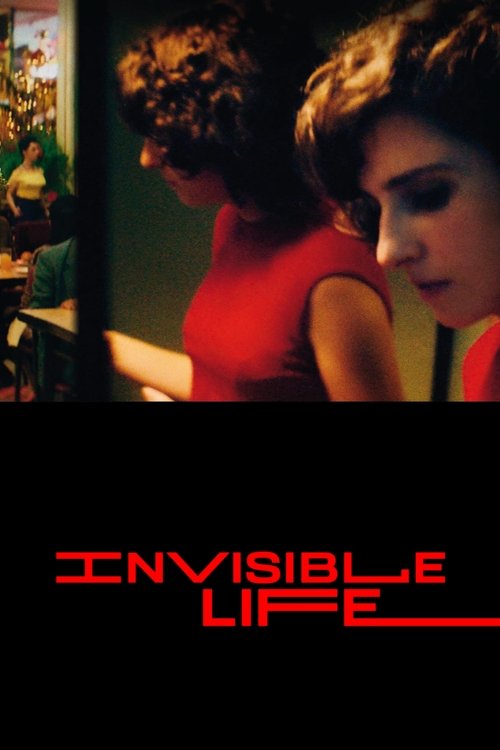
Invisible Life
2019 · Karim Aïnouz
For when you want a proper cry and a film that makes anger and beauty coexist — a big, sweeping story of sisters and stolen lives. This is challenge wrapped in gorgeousness, not a light comfort watch.
What it's about
Rio de Janeiro, 1950. Eurídice and Guida are inseparable sisters in a conservative household — one dreaming of a career as a concert pianist, the other rushing headlong into romance — until a patriarchal lie tears them apart. Each goes on living in the other's imagined shadow, convinced her sister got the life she was denied.
The experience
Lush, feverish, and heartbreaking — a full-blooded melodrama that earns its tears honestly. The heat and color keep it sensual even as the injustice of it tightens around you; it builds to an emotional payoff that lingers for days.
The craft
The director calls it a 'tropical melodrama' and the phrase is exact: classic Hollywood weepie transplanted to a Rio of rain, sweat, and saturated green. Hélène Louvart, one of the finest cinematographers working anywhere, shoots the city like a hothouse where everything blooms except freedom — it's ravishing on a good screen.
Why it matters
It won the Un Certain Regard prize at Cannes in 2019 and became a standard-bearer for Brazilian cinema on the international stage.
Karim Aïnouz calls it a 'tropical melodrama,' and the phrase is exact: Douglas Sirk's genre transplanted to a Rio de Janeiro of rain, sweat, and saturated green. Adapted from Martha Batalha's novel, it follows the sisters Eurídice and Guida through the 1950s as a patriarchal lie splits them apart — each living in the other's imagined shadow, each convinced the other is living the life she herself was denied. Aïnouz, a Brazilian director of Algerian descent who broke through with the queer landmark Madame Satã, orchestrates the heartbreak through sensual, almost feverish surfaces; Hélène Louvart, among the finest cinematographers working anywhere, shoots the city like a hothouse where everything blooms except freedom. The film won the Un Certain Regard prize at Cannes in 2019 and became a standard-bearer for Brazilian cinema at a moment when the country's film culture was under open political attack. Its architecture is patient and cumulative, and it reserves its final movement for Fernanda Montenegro, the grande dame of Brazilian acting.
Reception
It premiered at Cannes 2019 to raves and took the top prize in Un Certain Regard, but arriving in the stacked miracle-year of Parasite, Portrait of a Lady on Fire and Bacurau, it got a little buried — since then it's quietly become a word-of-mouth favorite passed between cinephiles as one of 2019's great overlooked films.
How Invisible Life was received, from release to now →
Influences: the films it descends from and the films it influenced
- Imitation of Life (1959) — The template for Aïnouz's 'tropical melodrama': lush Technicolor saturation weaponized to expose the social entrapment of women, staging emotion the characters cannot speak through color, decor and framing rather than dialogue.
- All That Heaven Allows (1955) — Sirk's use of glass, mirrors and window frames to imprison a woman inside domestic space is echoed in Aïnouz's compositions that box Guida and Eurídice within thresholds and doorways of the patriarchal household.
- Written on the Wind (1956) — Establishes the 'hysterical' color melodrama register — heightened, near-camp emotional pitch justified by expressionist lighting — that Aïnouz revives without irony for postwar Rio.
- Letter from an Unknown Woman (1948) — The epistolary engine: an unanswered letter read in voiceover structures the whole film around two lives that never reconnect, the exact device driving Aïnouz's parallel-lives cutting and its devastating near-miss.
- Ali: Fear Eats the Soul (1974) — The key intermediary that proved Sirkian melodrama could be reclaimed as political cinema about outsiders, licensing Aïnouz to route class and gender critique through unironic 1950s-style romantic suffering.
- Central Station (1998) — Supplies Fernanda Montenegro's iconography of Brazilian maternal endurance and the letter-as-lifeline motif, which Aïnouz recasts in her late-film appearance as the aged Eurídice.
- Hour of the Star (1986) — Takes Amaral's theme of women's erasure and its anti-melodramatic ethic and reworks melodrama itself to make legible the interior lives of women history overlooked, a direct extension of Brazilian women's cinema.
- Love for Sale (2006) — Carries forward the fascination with women's inner lives and abandonment, refusing pity while intensifying the saturated palette into full melodramatic color.
- La Chimera (2023) — Extends the Louvart method Aïnouz used: analog film stock and earthy, luminous color grading that make history feel physically present, the palette treated as a fabric rather than a filter.
- The Lost Daughter (2021) — Louvart's intimate, close-pressed handheld camerawork on a woman's interior life — the same technique that keeps Aïnouz's lens tight to the sisters' skin and glances — carried into contemporary literary adaptation.
- Never Rarely Sometimes Always (2020) — Louvart again applies her naturalist, empathetic proximity to women navigating institutional and patriarchal constraint, extending the cinematographic ethic of bodily closeness she built with Aïnouz.
- Madame Satã (2002) — Aïnouz's own origin point — the same sensuous, sweat-and-color attention to marginalized Rio bodies and the queer/outsider gaze, here transferred from Lapa's nightlife to the sisters' thwarted desires.
- Far from Heaven (2002) — The other great modern Sirk reconstruction — a scholarly rebuild of 1950s saturated palette and mannered staging — sharing Aïnouz's project of using period-accurate melodrama form to indict period repression.
- In the Mood for Love (2000) — Longing choreographed through saturated color, cramped period interiors and the aesthetics of the perpetual near-miss; both films make thwarted proximity the central formal subject.
- Julieta (2016) — Almodóvar's Sirk-via-melodrama of an epistolary mother-daughter separation, adapted from literary source with primary-color mise-en-scène — nearly a structural twin to Aïnouz's separated-women-writing-into-the-void design.
- Portrait of a Lady on Fire (2019) — Cannes 2019 companion in the women's-melodrama revival: a painterly, patriarchy-bounded love told through absence and remembered image, sharing the epistolary logic of two women preserving each other across separation.
- Happy as Lazzaro (2018) — Cinematographer Hélène Louvart's signature here — grainy Super16 textures and sun-warmed, tactile naturalism — is the exact craft she brings to Invisible Life's saturated but organic period images.
- Volver (2006) — A melodrama of sisterhood and female solidarity surviving male violence, staged in vivid Sirkian reds and built on the cumulative-revelation structure Aïnouz also uses to withhold the sisters' fates until the emotional detonation.
- Romería (2025) — Louvart's saturated, sweat-and-foliage sensory melodrama of a fractured family and unspoken loss, demonstrating the same painterly tactility she brings to the Galician coast.
Similar films
- Central Station (1998) — influence & lineage
- Portrait of a Lady on Fire (2019) — influence & lineage
- I'm Still Here (2024) — shared sensibility
- Romería (2025) — shared sensibility
- Beanpole (2019) — shared sensibility
- The Mysterious Gaze of the Flamingo (2025) — shared sensibility
- Love for Sale (2006) — shared sensibility
- All We Imagine as Light (2024) — shared sensibility