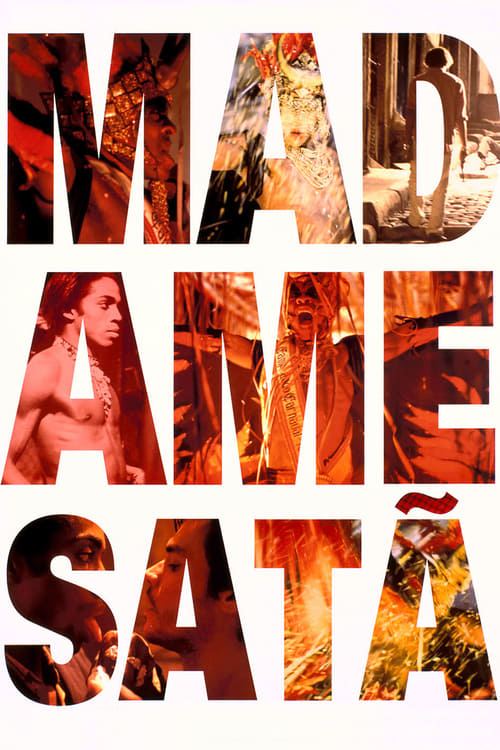
Madame Satã
2002 · Karim Aïnouz
For when you want something raw and alive — a character study with real body heat, not a polite biopic. This is a challenge night, not a comfort watch, and it pays you back with a person you won't forget.
What it's about
In the rough, glittering Lapa district of 1930s Rio de Janeiro, João Francisco dos Santos — son of slaves, ex-convict, street fighter, and gay man in a world that punishes all of those things — scrapes out a living between the cabaret and the alley. He gathers a makeshift family of outcasts around him while dreaming himself onto the stage, slowly assembling the flamboyant persona that will make him a Carnival legend: Madame Satã. It's a portrait of a man inventing himself out of rage, glamour, and sheer nerve, years before the legend exists.
The experience
Sweaty, sensual, and volatile — tenderness and violence sit inches apart, and the film moves with the heat and danger of the streets it lives in. It's abrasive one minute and heartbreaking the next, and it never asks you to simply like its hero, only to feel his hunger to be seen.
Performances
Lázaro Ramos is ferocious as João — coiled, wounded, seductive, capable of flipping from menace to vulnerability inside a single scene. It's the kind of full-body, star-making performance a film like this lives or dies on.
The craft
Aïnouz skips the cradle-to-grave biopic formula and compresses everything into one incandescent stretch of João's youth, which gives the film urgency instead of dutiful history. The camera stays close and handheld, drenched in the low light and saturated color of cabarets and tenement rooms — it's a film you feel on your skin, and it rewards a dark room and good sound.
Why it matters
A landmark of the Brazilian film revival of the late '90s and 2000s and a key work of queer cinema from the Global South, it launched Karim Aïnouz onto the international stage and reclaimed a real Afro-Brazilian icon for the screen.
Snapshot
Madame Satã is Karim Aïnouz's debut feature, a sensuous and abrasive portrait of João Francisco dos Santos — the real Afro-Brazilian malandro, cook, brawler, sometime prostitute, and celebrated Carnival drag performer who terrorized and enchanted the Lapa district of 1930s Rio de Janeiro. Rather than the cradle-to-grave biopic the subject might invite, Aïnouz compresses his attention into a single incandescent stretch of João's youth, when the man who would become the Lapa legend "Madame Satã" is still assembling that persona out of rage, desire, borrowed glamour, and the demimonde family he gathers around him. The film belongs to the international revival of Brazilian cinema known as the retomada, but it is equally legible within the transnational lineage of New Queer Cinema — a connection grounded in Aïnouz's own apprenticeship in the New York independent scene. It premiered in the Un Certain Regard section at the 2002 Cannes Film Festival and announced both a major director and, in Lázaro Ramos, a major screen actor.
Industry & production
The film emerged from the institutional and financial ecology of Brazil's post-1990s recovery. Its most important production partner was VideoFilmes, the São Paulo–based company associated with Walter Salles and Daniela Thomas, which had become a key engine of the retomada and a magnet for international co-financing after the success of Central Station (1998). Madame Satã was mounted as a Brazil–France co-production, drawing on French partners and the broader European art-house financing and sales infrastructure that Brazilian projects of this period increasingly relied upon; the pairing of Brazilian public-cinema mechanisms with French co-production money was, by 2002, a well-worn route to the festival circuit. (The precise contractual breakdown among the companies involved is not something I can reconstruct reliably, and I will not invent figures.)
For Aïnouz the project was a long-gestating first feature. Born in Fortaleza, in Brazil's northeastern state of Ceará, he had trained in architecture before studying film in the United States and working inside the American independent milieu — experience that shaped both the film's queer politics and its willingness to treat a marginal, criminalized Black life as worthy of tragic-heroic scale. The screenplay was developed collaboratively, with Aïnouz working alongside other writers who would themselves become significant figures in Brazilian cinema, most notably Marcelo Gomes, with additional writing contributions credited to collaborators including Sérgio Machado and Mauricio Zacharias. That workshop-like authorship is characteristic of the tightly networked cohort of northeastern and independent Brazilian filmmakers who came up together in this era.
Technology
Madame Satã was shot photochemically on 35mm, in the era just before digital acquisition became the default for art cinema, and its images bear the grain, latitude, and tactile density that motivated cinematographer Walter Carvalho's approach. The production is a period reconstruction: 1930s Lapa is built through sets, costume, and controlled interior lighting rather than through digital augmentation, and the film's visual signature comes from analog craft — practical and motivated light sources, warm sodium-and-lamp tonalities, and the physical camera's mobility — rather than from any conspicuous technological novelty. Its ambitions are expressive and material, not technical.
Technique
Cinematography
The photography, by Walter Carvalho — one of the defining Brazilian cinematographers of the period, and Salles's collaborator on Central Station — is the film's most celebrated technical achievement. Carvalho works close to the body, favoring handheld intimacy, shallow focus, and a palette of hot ambers, deep reds, and shadowed browns that render Lapa as a nocturnal, sweat-slick, half-lit organism. Skin is a primary subject: the camera lingers on faces, backs, and muscles until the film's eroticism and its violence begin to share the same tactile register. The framing is frequently tight and destabilizing, refusing the picturesque distance a period film might otherwise adopt, so that the viewer is held inside João's proximity — his physicality, his volatility, his desire — rather than observing him from the safe remove of costume-drama spectacle.
Editing
The film is cut for sensation and rhythm rather than for expository clarity, moving in charged episodes — the cabaret, the tenement rooms, the streets, the police cell — that accumulate a life more than they plot one. The editing (credited to Isabela Monteiro de Castro) sustains long, immersive passages in the club and in João's domestic world, then punctuates them with sudden ruptures of violence or arrest, mirroring the shape of a life lived between ecstatic performance and carceral interruption.
Mise-en-scène / staging
Aïnouz stages Madame Satã almost entirely within the enclosed, overheated interiors of Lapa's demimonde: the cabaret where João watches, imitates, and eventually eclipses the white chanteuse whose act he memorizes; the cramped apartment he shares with the prostitute Laurita, her baby, and the young hustler Tabu; the jail. This spatial claustrophobia is expressive. The recurring motif of the mirror and the stage — João studying performance, trying on gesture and glamour — makes the film's central action the construction of a self: the drag persona of Madame Satã is shown being built, borrowed, and fought for, not simply displayed. The film's title itself points to this act of appropriation, the persona's name lifted from imported Hollywood glamour and reclaimed by a poor Black queer man in the Brazilian tropics.
Sound
Music and sound design are integral to the film's texture. The score was composed by Sacha Amback and Marcos Suzano, whose work knits together percussive, Afro-Brazilian rhythmic elements with atmospheric scoring, so that the soundtrack carries both the cabaret's diegetic glamour and the pulse of the streets outside it. Suzano in particular is known as a percussionist working within Brazilian popular and experimental traditions, and the film's rhythmic undercurrent grounds João's story in a specifically Afro-Brazilian cultural body rather than in generic period pastiche.
Performance
Lázaro Ramos's performance as João is the film's center of gravity and the vehicle of its power. Ramos, then a young actor, gives João a coiled, contradictory presence — tender and brutal, wounded and grandiose, capable of murderous violence and of maternal care toward his makeshift family. The role demands a full physical and emotional register, from street combat to the transformative vulnerability of the drag performance, and Ramos's work here effectively launched him as one of the most prominent Black actors in Brazilian cinema. He is surrounded by a strong ensemble, including Marcélia Cartaxo — herself an icon of Brazilian cinema from A Hora da Estrela — as Laurita, and Flávio Bauraqui and Fellipe Marques among the pariahs who form João's chosen household.
Narrative & dramatic mode
The film's dramatic mode is deliberately anti-biographical. It rejects the biopic's synoptic sweep in favor of a fragment: a compressed, episodic slice of João's early adulthood, presented with the intensity of a character study rather than the tidiness of a life-story. Aïnouz frames this fragment with a striking bureaucratic device — a dry official/police account of João's crimes and physical description, the language of the state cataloging a Black criminal body — set against the living, defiant particularity of the man himself. This tension between the archival record (which reduces João to a rap sheet of offenses and slurs) and the film's own empathetic, sensual attention is the movie's structuring irony. The result is a portrait of self-fashioning: the drama is less "what happens to João" than "how João authors himself" in a society that has already written him off.
Genre & cycle
Madame Satã sits at a crossroads of genres — crime film, queer drama, period romance, and biographical portrait — without settling comfortably into any. It draws on the iconography of the malandro (the roguish trickster-outlaw of Brazilian urban folklore) and on the crime film's world of brothels, thieves, and police, but it redirects those conventions toward an interior, queer, racialized story that the classic malandro myth tends to sanitize or straighten. As a Carnival/performance film it participates in the long Brazilian fascination with masquerade and self-transformation, while as a queer film it belongs to a turn-of-the-millennium cycle of international art cinema centering LGBTQ lives with erotic frankness and formal ambition.
Authorship & method
Madame Satã is a first feature by a director whose sensibility was formed across two cinemas. Aïnouz's northeastern Brazilian roots and his formation in the American independent and queer film world — including collaboration with figures of the U.S. New Queer Cinema movement — converge in a method that treats a criminalized, marginal life with both political seriousness and aesthetic sensuality. His authorial signature, visible here and developed across his later career (O Céu de Suely, Praia do Futuro, The Invisible Life of Eurídice Gusmão), is an attention to bodies, desire, displacement, and the emotional lives of people at society's edges.
His key collaborators shape the film decisively. Walter Carvalho (cinematography) supplies the tactile, body-close visual language that defines the film. The score by Sacha Amback and Marcos Suzano grounds it in Afro-Brazilian rhythm. Isabela Monteiro de Castro's editing builds the film's episodic, sensation-driven structure. The screenplay, led by Aïnouz with Marcelo Gomes and further writing collaborators, reflects the collective working method of his filmmaking generation. And Lázaro Ramos, as performer, is effectively a co-author of João, giving the written persona its charismatic, dangerous flesh.
Movement / national cinema
The film is a landmark of the Brazilian cinema da retomada — the "resumption" or renaissance of national film production that followed the near-collapse of the industry in the early 1990s and its rebuilding through new state incentive mechanisms. Within that revival, Madame Satã marks an important widening of subject matter: where much retomada cinema turned to social realism and national allegory, Aïnouz's film brought race, queerness, and the body to the foreground with unusual explicitness. It is also one of the anchor works of the flourishing northeastern Brazilian cinema (the so-called Cinema do Sertão / Pernambuco-Ceará axis) whose filmmakers — Aïnouz, Gomes, Machado — reshaped the national image-repertoire. Simultaneously, through Aïnouz's biography and aesthetics, the film reads as a Brazilian entry in the broader transnational current of New Queer Cinema.
Era / period
Set in the Lapa of the early-to-mid 1930s, the film reconstructs a specific historical Rio: a bohemian, dangerous, racially and sexually mixed nightlife district under a modernizing, authoritarian-leaning Brazilian state (the Vargas era), in which an openly queer Black ex-convict was subject to relentless policing. The period setting is not nostalgic scenography but a pressure system: the film insists on the racial and sexual violence structuring João's world, and on the way state power criminalized his very existence. As a film of 2002, it belongs to a moment when Brazilian cinema had regained international visibility and could carry such a story to Cannes and the world's art houses.
Themes
The dossier's central threads are self-invention, marginality, and dignity. Madame Satã is above all about the fashioning of an identity in defiance of a society that offers none — João builds "Madame Satã" out of glamour he is not supposed to possess, appropriating imported Hollywood mystique and Carnival's licensed transgression to author a self on his own terms. Race and coloniality run throughout: the film foregrounds the Black body as an object of desire, labor, spectacle, and state violence. Queer desire is rendered with erotic candor and without apology, refusing both shame and martyrdom. Chosen family — the household of prostitutes, hustlers, and outcasts João protects — offers a counter-model of kinship against a hostile world. And performance itself is thematized as survival: the stage is where João becomes fully himself, and where powerlessness is briefly transmuted into command.
Reception, canon & influence
Critically, Madame Satã was received as a bold and accomplished debut, praised in particular for Walter Carvalho's cinematography and for Lázaro Ramos's ferocious lead performance; its premiere in Un Certain Regard at Cannes 2002 secured its international art-house circulation and festival travel. It drew attention as a rare film placing a Black, queer, historically real Brazilian outsider at its tragic-heroic center. (The film accumulated festival recognition on this circuit; I would rather not attribute specific named prizes I cannot verify than risk misstating the award record.)
Looking backward, the film's influences are layered: the historical figure and oral legend of João Francisco dos Santos and the Lapa demimonde; the malandro tradition of Brazilian culture; the appropriated Hollywood glamour signaled by the very name "Madame Satã," borrowed from imported cinema; and, on the level of form and politics, the New Queer Cinema and American independent sensibilities Aïnouz absorbed abroad, which licensed the film's erotic frankness and its refusal of respectability.
Looking forward, its legacy is substantial. It launched Karim Aïnouz as an internationally significant auteur and helped establish Lázaro Ramos as a leading figure of Afro-Brazilian screen acting. Within Brazilian cinema it stands as a foundational text for the increasingly visible strands of Black and queer filmmaking that followed, expanding what the retomada and its successors would consider representable. As a portrait of a real cultural legend, it also helped fix João Francisco dos Santos in the contemporary Brazilian and international imagination as a figure of queer, Black, working-class defiance — an origin story not just of one man's persona but of a whole lineage of self-authored, unassimilable outsiders in Brazilian art.
A Deleuzian reading
He's at the back of the cabaret while a white woman sings, and he isn't watching her the way the paying customers watch.
The full Deleuzian reading of Madame Satã →
Reception
It premiered in Un Certain Regard at Cannes in 2002 — the same banner year City of God exploded — and got respectful-but-quieter attention abroad; two decades on it's been fully canonized as a foundational work of Brazilian queer cinema, with restorations and retrospectives (UCLA, Frieze essays) treating it as the era's other great Brazilian film.
How Madame Satã was received, from release to now →
How to watch Madame Satã: what to notice on a first viewing
- Watch João study another performer's wrist and breathing. At the back of the cabaret, Ramos watches a singer's gestures instead of enjoying the show, filing away the tilt of a wrist and the breath before a note. Aïnouz shows you the persona being assembled from someone else's gestures, not revealed as something that was already there.
- Watch him rehearse the drag persona in front of a mirror. Aïnouz returns again and again to João at the mirror, the reflection and the man rehearsing each other rather than one copying a finished original. The glass never settles into a copy of a fixed self; both sides keep changing the other.
- Notice how close the camera stays to skin and sweat. Walter Carvalho holds tight on faces, backs, and muscles for most of the film, rarely pulling back to a wide establishing shot. The proximity keeps you inside João's body instead of watching him from the safe distance of a costume drama.
- Notice the amber and red light in every room. Carvalho lights the cabaret, the tenement, and the jail in the same hot, shadowed palette, so every space in João's world feels like the same overheated room. One continuous light links the club, the home, and the cell into a single nocturnal world João never fully leaves.
- Listen for the percussion under the cabaret and the streets. Amback and Suzano keep a percussive Afro-Brazilian pulse running whether João is on stage or out in Lapa, tying performance and daily life to one rhythm. The score refuses to separate performance from ordinary life, treating both as versions of the same beat.
The whole guide to watching Madame Satã, with the keys for a rewatch →
Influences: the films it descends from and the films it influenced
- Central do Brasil (1998) — Shot by the same cinematographer, Walter Carvalho, whose humanist handheld intimacy and warm location light established the retomada visual grammar Madame Satã inherits directly.
- Rio, 40 Graus (1955) — Cinema Novo's foundational method of shooting Rio's malandro and favela underclass on real streets, giving Aïnouz the template for filming Lapa's demimonde as living social space rather than backdrop.
- Pixote (1981) — Docu-fictional treatment of criminalized, marginal Brazilian bodies—casting and framing that refuse moralizing distance—directly precedes Madame Satã's tragic-heroic outsider portraiture.
- Un Chant d'Amour (1950) — The urtext of carceral queer eroticism, filming criminal desire as tactile close-ups of sweating bodies; its Genet-derived fusion of outlaw and lover underlies João's construction.
- Querelle (1982) — Adapts Genet through overtly theatrical, artificial staging where mirror and stage frame queer-criminal masculinity—the same stagey self-display device Madame Satã foregrounds.
- Paris Is Burning (1990) — Documents self-fashioning through appropriated Hollywood glamour and chosen-family 'houses,' the exact logic of a Lapa hustler renaming himself after an imported movie ('Madame Satã').
- Tongues Untied (1989) — New Queer Cinema's poetic-fragment mode built around the Black queer body and voice, licensing Madame Satã's sensation-driven, non-linear assembly over conventional biography.
- Poison (1991) — A key NQC work Aïnouz absorbed abroad, whose episodic, fragmented Genet-sourced structure models Madame Satã's anti-biographical, episode-by-episode construction.
- Looking for Langston (1989) — Frames Black queer history through an archival, lyrical register rather than plot, prefiguring Madame Satã's opening archival-record framing of a real historical figure.
- Orfeu Negro (1959) — Anchors a Black Rio demimonde in Afro-Brazilian percussive rhythm as structuring pulse—the same score-as-engine strategy Suzano and Amback bring to Madame Satã.
- O Céu de Suely (2006) — Aïnouz and Carvalho reprise the self-fashioning outsider who renames herself to survive, developing Madame Satã's theme of the self-authored identity in northeastern light.
- Moonlight (2016) — Renders Black queer self-fashioning through warm, saturated close cinematography and tender masculinity under state and street violence—Madame Satã's palette and body-politics fully realized.
- Tatuagem (2013) — Extends the Brazilian queer-counterculture strand Madame Satã opened, centering marginal performers whose stage-and-cabaret self-display carries the same performance-as-defiance motif.
- Pariah (2011) — Uses handheld, body-close intimacy (Bradford Young) to chart a Black queer coming-into-self, inheriting Madame Satã's fusion of tactile camera with the drama of self-authorship.
- Latin Blood – The Ballad of Ney Matogrosso (2025) — Renders a real Brazilian queer performer through intense physical body-work and drag/stage theatricality staged as social defiance — the ancestor for staging queer performance as bodily liberation and resistance.
- City of God (2002) — Contemporaneous retomada landmark using kinetic handheld camera and sensation-driven cutting on Black Brazilian bodies, sharing Madame Satã's editorial energy and marginal-milieu focus.
- Cidade Baixa (2005) — Builds a sweaty, sensual Brazilian port-city eroticism around Lázaro Ramos as lead, extending the charismatic, body-forward performance mode he pioneered as João.
- Happy Together (1997) — Pairs a saturated warm-amber palette with restless handheld intimacy to render queer displacement, the same color-and-camera coupling Madame Satã uses for claustrophobic desire.
- Beau Travail (1999) — Choreographs the male body through Genet (Billy Budd) with Agnès Godard's body-close camera, a parallel translation of Genet's outlaw eroticism into pure physical staging.
- Mango Yellow (2002) — Walter Carvalho's cinematography again, the same year, rendering queer, sweaty, abject corporeality in close mobile framing — the shared DP signature linking two transgressive bodies of work.
- Invisible Life (2019) — Aïnouz's own origin point — the same sensuous, sweat-and-color attention to marginalized Rio bodies and the queer/outsider gaze, here transferred from Lapa's nightlife to the sisters' thwarted desires.
- The Man Who Copied (2003) — Contemporaneous Brazilian film built around Lázaro Ramos's charismatic physical performance, part of the same early-2000s showcase that established the actor's screen presence.
- To the Left of the Father (2001) — Walter Carvalho's immediately following work: sweaty, body-close chiaroscuro and immersive sensory texture extend the same cinematographic method into a different milieu.
- Ó Paí, Ó: Look at This (2007) — Uses Lázaro Ramos's body as the film's principal formal instrument — cabaret numbers staged as performances within the performance, the camera holding on transformation rather than cutting away — the same performance-as-authorship logic that lets Ó Paí, Ó carry whole scenes on typed comic bodies alone.
Similar films
- City of God (2002) — influence & lineage
- Love for Sale (2006) — influence & lineage
- Black God, White Devil (1964) — shared sensibility
- Antonio das Mortes (1969) — shared sensibility
- Latin Blood – The Ballad of Ney Matogrosso (2025) — shared sensibility
- The Secret Agent (2025) — shared sensibility
- Mango Yellow (2002) — shared sensibility
- Law of Desire (1987) — shared sensibility