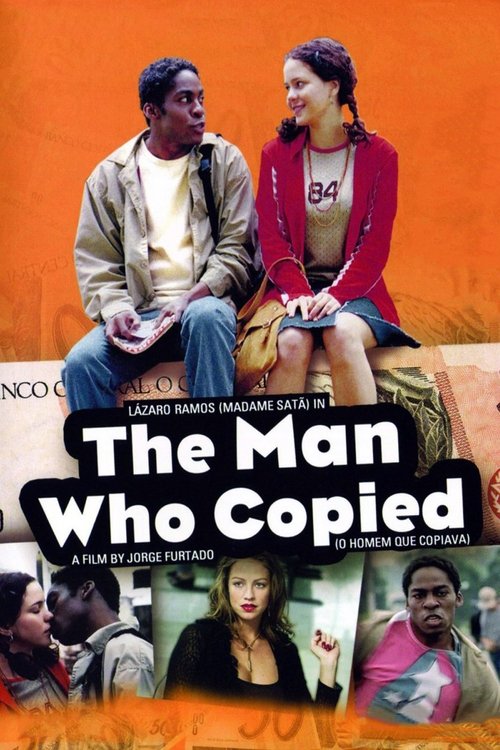
The Man Who Copied
2003 · Jorge Furtado
When you want something clever and surprising that refuses to stay in one genre — light enough for a weeknight, sly enough to argue about after. Comfort that curdles, pleasurably.
What it's about
André runs the photocopier in a small Porto Alegre stationery shop, drawing cartoons and watching Sílvia, the girl in the boutique across the street, through binoculars from his bedroom window. He's broke — too broke to buy even the dress that would give him an excuse to talk to her — so his daydreams start turning into schemes, beginning with what a color copier might do to a banknote. What starts as a shy romantic comedy keeps sliding, step by escalating step, into a crime story.
The experience
Playful and inventive on the surface — narration, animation, visual jokes — with a genuine moral undertow that keeps tightening. You're charmed, then complicit, then not quite sure when the comedy stopped being safe.
Performances
Lázaro Ramos is magnetic as André, holding your sympathy through choices that should lose it, with Leandra Leal giving Sílvia a guarded warmth that makes the longing feel real.
The craft
Jorge Furtado writes and directs with a collagist's energy — first-person narration, cartoon inserts, and pop storytelling tricks that mirror André's comic-strip imagination. The genre shift is the craft: the film changes temperature so gradually you only notice when it's already dark.
Why it matters
One of the standout Brazilian films of the early-2000s revival, it helped announce Lázaro Ramos as a major star and showed Brazilian popular cinema could be formally playful and morally serious at once.
Snapshot
O Homem que Copiava is a Brazilian romantic comedy that mutates, gradually and slyly, into a crime story. Its protagonist, André (Lázaro Ramos), is a nineteen- or twenty-year-old who runs the photocopier at a small stationery-and-copy shop in Porto Alegre, the capital of Rio Grande do Sul in Brazil's far south. He is poor, restless, an amateur cartoonist, and infatuated with Sílvia (Leandra Leal), a young woman he watches through binoculars from his bedroom window as she works in a clothing boutique across the street. Because he cannot afford anything — not the dress in her shop, not a life beyond his mother's flat — the film follows him from harmless fantasy into escalating schemes: forging banknotes on the shop's color copier, and eventually into robbery and violence. Directed and written by Jorge Furtado, one of the central figures of Brazil's cinema da retomada, the film is best understood as a machine about copying: reproduction, imitation, counterfeiting, and the gap between the reproduced image and the thing itself. It runs roughly two hours, was a notable domestic success, and helped consolidate both Furtado's feature reputation and Lázaro Ramos's rise as a leading Brazilian actor.
Industry & production
The film was produced by Casa de Cinema de Porto Alegre, the production house Furtado co-founded in 1987 alongside collaborators including Giba Assis Brasil, Ana Luiza Azevedo, and others. This is the essential industrial fact about the film: it is a regional, auteur-collective product from Rio Grande do Sul rather than a Rio–São Paulo studio picture, and much of its texture — its intimacy, its low-budget ingenuity, its recurring ensemble of performers and technicians — follows from that. Casa de Cinema had built its identity across the 1990s on acclaimed short films (most famously Furtado's Ilha das Flores, 1989) and modestly scaled features, developing a house style of literate, playful, socially attentive cinema made on limited means.
O Homem que Copiava arrived during the retomada ("resumption"), the revival of Brazilian feature production that began in the mid-1990s after the near-collapse of the industry when the Collor government dismantled state film support at the start of the decade. Recovery was driven substantially by the Lei do Audiovisual and related tax-incentive mechanisms, and, later, by the marketing and distribution muscle of Globo Filmes, the cinema arm of the Globo media empire, which partnered on a large share of the era's commercially successful films. Furtado himself came out of television — he was a prolific writer for Globo, associated with series and specials — and that television literacy in comedy, voiceover, and audience address is legible throughout the film. Beyond these structural facts, precise budget and box-office figures are not something I can state reliably here; the film is generally described as one of the stronger domestic performers of its year, but I will not attach specific numbers I cannot verify.
Technology
Technology is not a production footnote for this film; it is the premise. The photocopier is simultaneously André's workplace, his metaphor, and his instrument of crime. The color Xerox-type copier lets him reproduce a banknote, and counterfeiting becomes the plot's engine. The title's "copying" therefore operates on at least three registers at once: the literal machine, the economic act of forgery, and a broader meditation on mechanical reproduction — the sense, familiar from Walter Benjamin, that in an age of copies the "original" becomes an unstable, almost sentimental idea. The binoculars through which André surveils Sílvia form the film's second key apparatus: an optical technology of desire and distance that frames the romance as, from the outset, a matter of looking rather than touching. The film sits at a specific technological moment for its medium as well — a 2003 production made photochemically for theatrical release, but stylistically hungry for the graphic vocabulary (freeze-frames, on-screen drawing, superimposed text and animation) that digital tools and a post-Trainspotting, post-Amélie sensibility had made current.
Technique
Cinematography
The visual scheme is organized around windows, screens, and framing devices — the apartment window, the shop window, the copier's platen glass, the circular mask of the binoculars. Point-of-view looking is a structuring principle: we are repeatedly aligned with André's watching eye. The palette leans warm and everyday, matching the film's affection for lower-middle-class Porto Alegre interiors and streets rather than any picturesque Brazil. I want to be candid that I cannot confidently name the director of photography from memory, and I would rather flag that gap than assign a credit I am unsure of; the reliable observation is stylistic — the camera is expressive and mobile in service of a first-person, subjective account rather than a detached realist one.
Editing
Editing is arguably the film's signature craft. The cutting is brisk and self-aware, marbled with freeze-frames, rewinds, inserts, and hand-drawn/animated interpolations that literalize André's inner life and his cartoonist's imagination. This is continuous with the Casa de Cinema house grammar, and in particular with the essayistic montage of Ilha das Flores, where rapid, associative cutting and interpolated graphics carry an argument. The film's longtime editorial hand at the studio is Giba Assis Brasil, a co-founder of Casa de Cinema and Furtado's frequent collaborator; his sensibility — rhythmic, digressive, comic — is consistent with what is on screen, though readers should confirm the specific credit.
Mise-en-scène / staging
Furtado stages the film in a deliberately modest, recognizable urban world: the cramped copy shop, the boutique, apartment blocks, banks, buses. The mise-en-scène is keyed to class — the objects André cannot afford, the money he counts, the consumer surfaces he presses his face against. Recurring props (banknotes, photographs, drawings, the copier) are staged as motifs. The two facing windows — his and Sílvia's shop — create a spatial diagram of longing and separation that the film returns to as a visual refrain.
Sound
The dominant sonic element is André's first-person voiceover, near-constant, conversational, digressive, and directly addressed to the audience. It is the film's motor of tone and information, and it establishes the narrator as charming but not fully reliable. Music is used to buoy the comic-romantic register and to underscore the tonal shift as the story darkens; I don't have a firm, verifiable composer credit to offer and won't invent one, but the scoring functions in the pop-inflected, lightly ironic mode typical of the retomada's youth-facing comedies.
Performance
Lázaro Ramos anchors the film with a performance of enormous likeability — nervy, quick, self-deprecating — that makes André's slide into crime feel like a series of small, forgivable steps rather than a moral cliff. The role was a major showcase for Ramos, then an emerging talent, and it is central to why the film works: we stay complicit with him. Leandra Leal as Sílvia, Luana Piovani as Marinês, and Pedro Cardoso as André's coworker and confidant round out an ensemble that plays the material with a light, sketch-comedy precision — several of these performers were connected to television comedy, and the timing shows.
Narrative & dramatic mode
The film is built on direct-address, first-person narration — a mode Furtado had already perfected in short form. André tells us his own story, editorializes on it, digresses into asides about numbers, probability, sex, money, and drawing, and openly manipulates the telling. This produces a metafictional, unreliable-narrator structure: we are always aware that we are being told a story by someone with reasons to shape it. Dramatically, the film executes a genre slide: it opens as whimsical romantic comedy, introduces the counterfeiting as a lark, and then lets the consequences accrete into genuine crime — theft, deception, and violence — without ever fully abandoning its comic voice. The tonal control of that slide is the film's chief formal achievement: the audience is lulled by charm into territory that, described flatly, would be sordid.
Genre & cycle
Generically the film is a romantic comedy crossed with a crime/caper picture, with a strong streak of coming-of-age and social observation. It belongs to a distinct early-2000s international cycle of stylized, voiceover-driven, graphically playful youth films — the lineage that runs through Danny Boyle's Trainspotting (1996) and Jean-Pierre Jeunet's Amélie (2001), pictures that treat first-person narration, freeze-frames, and animated flourishes as a native vocabulary. Within Brazilian cinema it sits in the retomada's more commercial, audience-friendly wing — accessible comedies and genre hybrids — as opposed to the harder social realism of contemporaries like Cidade de Deus (2002), though it shares that period's preoccupation with money, class, and survival.
Authorship & method
The film is thoroughly a Jorge Furtado work: he wrote and directed it, and its voice — witty, numerate, digressive, humane, fascinated by information and by the mechanics of storytelling — is continuous across his filmography. Furtado's formation matters: a Porto Alegre writer-director shaped by the collaborative discipline of Casa de Cinema de Porto Alegre and by years of Globo television writing, he brought to features a comic-essayistic method most fully realized in the celebrated short Ilha das Flores, whose associative narration and graphic interpolations are the clear ancestor of O Homem que Copiava's style. The key collaborators are best understood as the Casa de Cinema collective, chief among them editor and co-founder Giba Assis Brasil; the cinematography and score credits I cannot attribute from memory with confidence and decline to guess. The method is auteur-within-a-collective: a personal voice supported by a stable, regionally rooted ensemble of technicians and actors.
Movement / national cinema
The film is a *Rio Grande do Sul / gaúcho cinema production and an exemplar of the cinema da retomada. Its significance within national cinema is partly geographic: it insists on Porto Alegre as a legitimate cinematic city, decentering the Rio–São Paulo axis. Casa de Cinema de Porto Alegre is one of the most important regional film institutions in Brazil, and O Homem que Copiava* is among its highest-profile features — evidence that a durable, locally grounded studio could produce nationally successful, formally distinctive work outside the traditional metropolitan centers.
Era / period
Contemporary and near-contemporary in setting, the film is a document of early-2000s urban Brazil as experienced from below: minimum-wage work, consumer desire outrunning income, bank tellers and copy shops and buses. Industrially it belongs to the *post-retomada consolidation, the moment when Brazilian cinema had recovered enough infrastructure — incentive laws, Globo Filmes distribution — to make polished, commercially minded films with authorial personality. Its aesthetic era is equally specific: the flush of post-Amélie* graphic whimsy that briefly made kinetic voiceover comedies a global mode.
Themes
The governing theme is copying and originality — reproduction as economics (counterfeiting), as ethics (imitation, fraud), and as metaphysics (what is an "original" self, or an "original" love, in a world of copies?). Around it cluster: voyeurism and desire, staged through binoculars and windows, which frames love as looking and possession-at-a-distance; class and money, the film's most persistent social concern, in which almost every plot turn is driven by not having enough; storytelling and unreliability, the metafictional awareness that a life is something one narrates and edits; and the fantasy life of the ordinary worker, the way imagination (André's drawings, his schemes) becomes both an escape from and a route deeper into trouble. The film is unusually honest that its charming hero's romance and his crimes spring from the same root — wanting things he cannot buy.
Reception, canon & influence
Critical reception in Brazil was strong: the film was well reviewed and is generally counted among the more successful and well-liked Brazilian releases of 2003, praised for its inventive style, its warmth, and Lázaro Ramos's performance. It circulated at Brazilian festivals and awards and had some international festival exposure, though I won't cite specific prizes or figures I cannot confirm; readers should verify individual award claims against the record.
Influences on the film (backward) are legible and largely acknowledged by its own form: Furtado's short Ilha das Flores as the direct stylistic parent; the self-aware, direct-address narration of the French New Wave and of comic narrators in the Woody Allen mold; and the immediate international vogue of Trainspotting and Amélie for kinetic voiceover, freeze-frames, and animated interpolation. Conceptually it draws on a long modern preoccupation — reaching back to Benjamin — with mechanical reproduction and the fate of the original.
Legacy and what it shaped (forward) is clearest in two directions. First, it was a career-defining showcase for Lázaro Ramos, who went on to become one of Brazil's most prominent actors, and a confirmation of Furtado's stature as a feature director, feeding directly into his subsequent films such as Meu Tio Matou um Cara (2004) and Saneamento Básico (2007). Second, it stands as a flagship for *Casa de Cinema de Porto Alegre and gaúcho cinema, demonstrating that a regionally rooted, stylistically personal Brazilian comedy could reach a national audience. Within Brazilian popular cinema of the 2000s, it is frequently invoked as a model of the smart, warm, formally playful romantic comedy — proof that accessibility and authorial voice were not mutually exclusive in the retomada*'s commercial wing. Its broader international footprint is comparatively modest, and its canonization remains stronger within Brazil than beyond it — a point worth stating plainly rather than overselling.
Reception
A homegrown hit of Brazil's early-2000s cinema boom, it was embraced at home (São Paulo critics named it the year's best Brazilian film) while staying in City of God's international shadow — two decades on it's settled into beloved modern-classic status in Brazil, still barely known abroad.
How The Man Who Copied was received, from release to now →
How to watch The Man Who Copied: what to notice on a first viewing
- Watch for circles and window frames boxing in what you see. The film keeps looking through frames within the frame, apartment window, shop window, the copier's glass, the circular mask of binoculars, aligning you with Andre's watching eye. You are placed in the position of someone looking at life through glass rather than living inside it.
- Listen for Andre talking to you directly, not to another character. His voiceover runs almost continuously, conversational and digressive, narrating his own story and openly editorializing on it as he goes. You're hearing events shaped by someone with his own reasons for how he tells them.
- Watch for freeze-frames and hand-drawn images cutting into the story. The editing keeps stopping the action, rewinding it, or dropping in Andre's own cartoon drawings, literalizing his imagination directly onto the film. His inner life is not just narrated. It is drawn straight into the picture for you to see.
- Notice how often the film returns to the two facing windows. Andre's window and Silvia's shop window recur across the film as a fixed spatial diagram, the same two openings staging his longing every time he looks. The distance between those two windows never actually closes, no matter how the story around them changes.
- Watch how easily Andre smiles while explaining his own bad ideas. Lazaro Ramos plays him nervy and self-deprecating, charming enough that each new bad decision arrives looking like a small, forgivable step rather than a leap. His likeability is doing real work, keeping you on his side longer than the choices alone would earn.
The whole guide to watching The Man Who Copied, with the keys for a rewatch →
Influences: the films it descends from and the films it influenced
- Ilha das Flores (1989) — Furtado's own mock-documentary short is the direct template: associative essayistic voiceover that chains disparate facts through pseudo-scientific logic, punctuated by graphic and statistical interpolations — the exact digressive, numerate narration engine of O Homem que Copiava.
- Trainspotting (1996) — Supplies the propulsive first-person voiceover fused with freeze-frames and on-screen labeling of characters — the kinetic late-90s pop grammar the film openly adopts for André's narration.
- Amélie (2001) — Its whimsical omniscient narrator cataloging characters' likes/dislikes plus animated interpolations that visualize inner life are echoed in the film's playful graphic asides and object-level narration.
- Annie Hall (1977) — Establishes the comic protagonist who breaks the fourth wall in direct address, turning confessional digression and audience complicity into the narrative motor Furtado's narrator inherits.
- Breathless (1960) — New Wave self-consciousness — jump cuts and a petty-criminal antihero who addresses the camera — licenses the film's genre-slide from romance into crime and its knowing narrator.
- Jules and Jim (1962) — Model for rapid-fire literary voiceover laid over freeze-frames that arrest emotional beats, a Truffaut device the film reuses to punctuate its love-and-money plotting.
- Rear Window (1954) — Codifies voyeurism built through binocular/optical POV framing that implicates the watcher — the precise grammar of André's binocular spying on the woman across the street.
- Pickpocket (1959) — Provides the first-person diaristic voiceover of a thief and the fetishized close-ups on hands and objects executing the crime, informing the film's mechanics-of-money and forgery imagery.
- Meu Tio Matou um Cara (2004) — Furtado's immediate follow-up extends the numerate, digressive young narrator and reunites Lázaro Ramos within the Casa de Cinema de Porto Alegre method and voice.
- Saneamento Básico (2007) — Continues the self-reflexive comedy about the making and economics of images with the same essayistic wit and gaúcho ensemble, deepening the copying/originality preoccupation.
- (500) Days of Summer (2009) — Non-linear romantic comedy driven by a wry omniscient narrator, chapter cards and associative montage that formalize the mechanics of a love story — the same accessible-but-playful architecture.
- Scott Pilgrim vs. the World (2010) — Fully realizes the comic-book graphic interpolation and on-screen text overlay the film flirts with, pushing the romance-into-genre slide into overt animated fourth-wall play.
- City of God (2002) — Fellow Retomada hit using a chaptered voiceover narrator, freeze-frames and hyperkinetic associative montage to make a marginal narrator's story pop — the same commercial-yet-formalist grammar.
- Madame Satã (2002) — Contemporaneous Brazilian film built around Lázaro Ramos's charismatic physical performance, part of the same early-2000s showcase that established the actor's screen presence.
- Fight Club (1999) — Unreliable direct-address narrator whose voiceover actively manipulates the audience and slides genre, with graphic interpolation of the narrator's mental imagery — the same reflexive toolkit.
- Run Lola Run (1998) — Shares the freeze-frame, animated-interpolation and propulsive-montage pop grammar, using formal play to compress a chase-for-money plot into breathless visual rhythm.
- High Fidelity (2000) — A romantic-comedy narrator who speaks straight to camera and organizes his love life into list-like digressions — the same fusion of direct address with rom-com confession.
- Lisbela and the Prisoner (2003) — Retomada sibling: first-person direct address and playful graphic/editing interruptions harnessed to a class-aspiration satire, the same year and the same populist-formal wing of the revival.
- Basic Sanitation, the Movie (2007) — Built by the same Casa de Cinema team and editor Giba Assis Brasil, it deploys Furtado's reflexive first-person narration and montage-driven digressions within a Cinema Gaúcho ensemble.
Similar films
- City of God (2002) — influence & lineage
- Madame Satã (2002) — influence & lineage
- Pickpocket (1959) — influence & lineage
- Lisbela and the Prisoner (2003) — shared sensibility
- Estômago: A Gastronomic Story (2008) — shared sensibility
- Mango Yellow (2002) — shared sensibility
- São Paulo, Incorporated (1965) — shared sensibility
- Rio, Northern Zone (1957) — shared sensibility