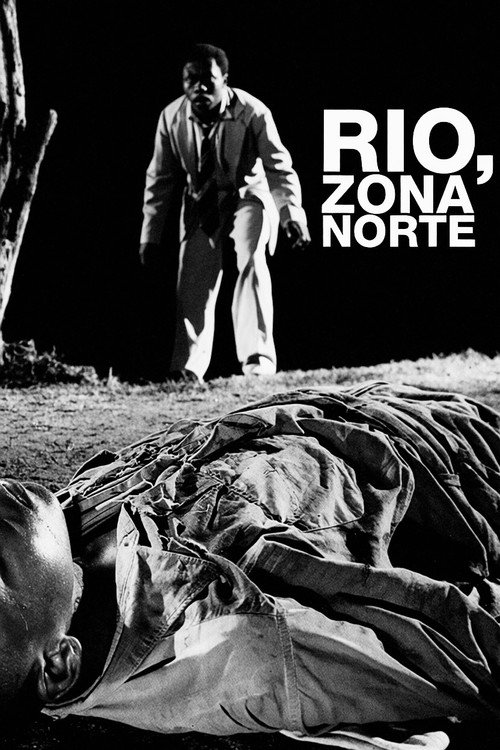
Rio, Northern Zone
1957 · Nelson Pereira dos Santos
For when you want music woven into a story — and a film with a conscience under its charm. It's tender rather than punishing, but it will leave a bruise; reach for it when you're ready to feel something for a person the world overlooked.
What it's about
Espírito is a gifted samba composer from Rio's working-class northern suburbs whose songs keep getting lifted by the radio professionals and record men of the city's music business — while he stays broke. The film opens with him falling from a suburban train, then pieces together the life that led him to those tracks: the compositions, the hustles, the small betrayals of an industry that wants his music but not him.
The experience
Warm and melancholy at once — the sambas are genuinely lovely, and the film lets you fall for them even as it shows you exactly who profits from their beauty. It moves with an easy, humane rhythm that turns quietly heartbreaking.
Performances
Grande Otelo, one of Brazil's great screen presences, carries the film as Espírito — funny, dignified, and wounded, often all in the same scene, in a role that lets a performer usually confined to comic parts show his full range.
The craft
Nelson Pereira dos Santos shoots the northern suburbs and the samba world with a documentary-inflected directness rare for its time, letting real locations and popular music do the storytelling. The retrospective structure — a life assembled from memory after the fall from the train — gives the songs an ache they wouldn't have played straight, and the samba score is the film's beating heart.
Why it matters
With its 1955 companion piece about Rio's street kids, it laid the groundwork for Cinema Novo, the movement that would remake Brazilian film in the 1960s — proof that a national cinema could be built from favelas, suburbs, and popular song rather than studio glamour.
Snapshot
Rio, Zona Norte is Nelson Pereira dos Santos's second feature, made in São Paulo and Rio de Janeiro in 1957 and released as the companion piece to his 1955 debut Rio, 40 Graus (Rio, 100 Degrees F.). Where the earlier film moved laterally across a Sunday in the city — five boys selling peanuts, a mosaic of Rio's social strata connected by geography and chance — this one narrows to a single life: Espírito (Grande Otelo), a samba composer from the northern working-class suburbs, whose songs are taken from him by the professionals of the recording industry and the radio while he himself remains poor. The film opens with Espírito falling from a suburban train, and the narrative that follows is largely retrospective, assembling the events that brought him to the tracks.
The film's importance is easier to state than its reputation is to measure. It is one of the small number of Brazilian films from the 1950s made outside the studio model — outside Vera Cruz's prestige-cinema ambitions and outside the chanchada production line at Atlântida — that treated the urban poor as subjects rather than as comic material. Along with Rio, 40 Graus, it is routinely identified in histories of Brazilian cinema as the immediate precursor to Cinema Novo, the movement that Glauber Rocha, Ruy Guerra, Carlos Diegues, Leon Hirszman, and Pereira dos Santos himself would consolidate around 1960–1965. Rocha's own critical writing treated Pereira dos Santos as the movement's originating figure — the "father," in the phrasing that has attached itself to him in the literature.
It is also, and this is not incidental, a film about samba that gives its central role to Grande Otelo, the most recognizable Black performer in Brazilian popular cinema, in a register almost entirely opposed to the one that had made him famous. That casting decision carries much of the film's argument.
Industry & production
The Brazilian film industry in 1957 was in a state of visible failure at its most ambitious end. Companhia Cinematográfica Vera Cruz, founded in São Paulo in 1949 on the model of an integrated European-style studio — imported technicians, imported equipment, high production values, an explicit aspiration to international prestige — had collapsed financially in 1954, having produced a body of work including O Cangaceiro (Lima Barreto, 1953), a Cannes prizewinner that did not save the company. Vera Cruz's failure was read across the industry as a verdict on capital-intensive filmmaking in a market without a distribution apparatus of its own; Brazilian screens were dominated by American imports, and a domestic feature had no reliable route to recouping a studio-scale budget.
What survived commercially was the chanchada: the carnival-timed musical comedy, produced chiefly by Atlântida in Rio, built on radio stars, samba and marcha numbers, and a broad, often parodic comic idiom. The chanchada was popular, profitable within its scale, and critically despised by the generation of cinephiles and critics who were forming their positions in the film clubs of São Paulo and Rio in the 1950s.
Pereira dos Santos's production model was constructed against both. Rio, 40 Graus had been financed cooperatively — with deferred payments, small investors, and participation from collaborators — and shot on location with a small crew, and Rio, Zona Norte followed the same logic. This was not simply a budget constraint made into a virtue; it was a position about what kind of cinema was possible in Brazil, and it drew directly on the example of Italian neorealism, which Pereira dos Santos knew from the film-club culture and from his own political formation. He had been associated with the Brazilian Communist Party and with the broadly left cultural milieu of São Paulo, and the neorealist example arrived in Brazil carrying that political charge: cinema made cheaply, in real locations, about working people, without studio mediation.
Rio, 40 Graus had also been censored — banned by the Rio police authorities and released only after a public campaign — which gave Pereira dos Santos a certain notoriety and made the second film's reception partly a continuation of that fight. Detailed production records for Rio, Zona Norte are thin in the English-language literature, and specific budget figures, shooting schedules, and box-office returns should not be asserted with confidence; what is well established is the cooperative, low-cost, location-based method and the fact that the film did not repeat the first film's succès de scandale.
Technology
The film was shot on 35mm black-and-white stock with direct location work in Rio's northern suburbs — the zona norte of the title, the rail-served working-class districts distinct from the beachfront zona sul that supplied most images of Rio for export. The technological conditions are those of mid-1950s Brazilian independent production: relatively heavy cameras, no lightweight synchronous-sound rigs of the kind that would arrive with the Nagra and the Éclair in the 1960s and transform documentary and Cinema Novo practice alike.
This matters for how the film sounds and moves. Sound was recorded and assembled by conventional post-production means, with the musical numbers built as performances that the image accommodates rather than as spontaneously captured events. The film therefore sits just before the technological threshold that made the handheld, direct-sound aesthetic of Vidas Secas (1963) and the early 1960s documentaries possible. Its realism is a realism of location, subject, and casting rather than of recording apparatus — a distinction worth holding onto when the film is described, as it often is, as neorealist.
Film stock and laboratory work in Brazil at the time were also a practical constraint on the image: a certain coarseness of contrast and grain in surviving prints is characteristic of the period's domestic processing conditions as much as of any deliberate choice. Restoration work on Pereira dos Santos's early features has been undertaken in Brazil in recent decades, and the film circulates in better condition now than it did for much of the twentieth century.
Technique
Cinematography
The photography is credited to Hélio Silva, who also shot Rio, 40 Graus and who was among the small group of Brazilian cinematographers willing to work outside studio conditions. The visual approach is documentary-inflected: real streets, real interiors, available light where possible, and a preference for the medium and long shot that keeps figures inside their environment rather than isolating them in close-up.
The consequence is a Rio composed of trains, tracks, embankments, hillside housing, and the interiors of studios and clubs — an infrastructural city. The train is the film's organizing visual fact: it is the mechanism of the framing accident, the daily conveyance between the zona norte and the center where the music business operates, and the literal line along which the film's geography of class is drawn. The camera's interest in rail lines and suburban platforms is not scenic; it is the mapping of a commute that structures a life.
Where the film moves into the professional spaces of radio and recording, the photography shifts register — more contained, more artificially lit, the difference between the suburb and the industry registered in the quality of the light. This is a modest effect by the standards of later Cinema Novo, but it is doing consistent work.
Editing
The film's most conspicuous formal decision is its structure: the fall from the train comes first, and the body of the film reconstructs how Espírito arrived there. The flashback organization is not a modernist fracture — it is legible, sequential, and closer to the melodramatic recall structure familiar from classical cinema than to the elliptical constructions Pereira dos Santos would attempt later. But it changes the film's meaning fundamentally. Knowing the outcome, the viewer watches each of Espírito's hopes as already foreclosed; the songs he composes are heard as things that will be lost.
Within scenes the cutting is unemphatic, giving performances and especially musical numbers room to play. The film does not chop its songs into montage; it lets them run, which is both a musical decision and a dramatic one, since the songs are the evidence of Espírito's talent and the film's argument depends on the audience granting that talent.
Mise-en-scène / staging
Pereira dos Santos stages the film across a small number of distinct social spaces, and the movement between them is the drama. The suburban home and street, where Espírito lives and composes; the train and station, the connective tissue; the radio station and recording studio, where his songs enter a commercial machine that does not credit him; the nightclub and performance venue, where samba is consumed by people who did not make it.
The staging is unshowy and largely functional, with the crucial exception of the scenes in which a song changes hands. These are staged as ordinary transactions — a conversation, an arrangement, a handshake — and the ordinariness is the point. There is no villain twirling a mustache; there is a system in which a poor Black composer's material is absorbed by professionals with access, and the absorption looks like normal business. Pereira dos Santos's refusal to melodramatize the theft is one of the film's genuinely modern gestures.
Sound
Music is the film's substance rather than its decoration. Samba appears here not as production number but as labor: composition, rehearsal, negotiation, performance, and the process by which a song made in the suburbs becomes a commodity downtown. The film's engagement with the morro/asphalt relation — the hillside and suburban origin of samba versus its commercial exploitation in the city center and its export as national symbol — is the substance of its social critique.
The technical realization of sound is post-synchronized in the manner of the period, and the film's sonic texture is accordingly cleaner and more controlled than the direct-sound documentaries of the following decade. The songs themselves are presented with respect and at length. Contemporary sources credit the participation of established figures from Rio's samba world in the film's music, and the record on precise individual song attributions is uneven enough that specific claims about which composer wrote which cue should be checked against a discography rather than asserted here.
Performance
Grande Otelo's performance is the film's central achievement and its central provocation. By 1957 he was a national star, formed in circus, theater, and radio, and made famous on screen through the chanchadas, frequently paired with Oscarito, in a comic register that Brazilian audiences knew intimately. He had also appeared in Orson Welles's unfinished It's All True (shot in Brazil, 1942), a fact that has attached itself to his biography as an emblem of what Brazilian cinema might have been.
Casting him as Espírito — a dramatic role, largely without comedy, in a film about the dispossession of Black samba composers — was a deliberate use of a star image against itself. The comic energy the audience expected is present in the body and the timing, but redirected into a portrait of hopefulness that the film's structure has already told us will not be rewarded. The performance is warm rather than abject, which is what keeps the film from condescension: Espírito is not a victim-figure but a working artist whose work is good and whose position is untenable.
The surrounding cast, in the neorealist manner, mixes professionals with less-known performers, and the film does not build star vehicles around any of them.
Narrative & dramatic mode
The film operates in a hybrid mode that later criticism has found easier to describe than to categorize: neorealist in setting, casting logic, and social diagnosis; melodramatic in its narrative architecture, with the retrospective structure, the accumulating misfortune, and the emotional directness of its central performance.
This hybridity is not confusion. Brazilian popular culture in the 1950s — radio drama, the chanchada, samba lyric itself — was saturated with melodramatic form, and Pereira dos Santos's project was not to import an aesthetic wholesale but to make a Brazilian film about Brazilian conditions. The melodrama is the vernacular; the neorealism is the analytic. Where Italian neorealism at its most austere (De Sica's Umberto D., say) resists narrative shaping, Rio, Zona Norte accepts a shaped narrative and uses it to make an argument about causation: this is what happens, and here is the chain of events by which it happens.
The dramatic mode is also, importantly, one of thwarted aspiration rather than of revolt. Espírito does not organize, resist, or confront; he keeps composing and keeps being displaced. Some later Cinema Novo criticism found this politically insufficient — the film diagnoses exploitation without imagining collective response — and the criticism is fair as description, though the film's pessimism is arguably its most honest feature.
Genre & cycle
Rio, Zona Norte sits at an angle to every available Brazilian genre of its moment. It is a musical film that is not a chanchada: it uses samba, popular performers, and radio-industry settings, all chanchada materials, and drains them of the comic and celebratory function they served there. It is a social-realist drama that keeps the popular music that social realism elsewhere tended to exclude.
The most useful framing is as the second entry in a two-film urban cycle by Pereira dos Santos, with Rio, 40 Graus as its complement. The pair constitutes a deliberate project: a portrait of the city from below, in two formal modes — the mosaic and the individual case study. Read together they establish the terms that Cinema Novo would inherit: the city as a stratified social space, the poor as protagonists, the popular musical form as both cultural resource and site of expropriation.
Its relationship to the international art cinema of the moment is genuine but not derivative. The Italian films that circulated in Brazilian film clubs — Rossellini, De Sica, Visconti's La terra trema — supplied a method and a permission rather than a template, and the specifically Brazilian problem the film addresses (samba's commercialization, the racial economy of Brazilian popular music) had no Italian analog.
Authorship & method
Nelson Pereira dos Santos (1928–2018) came to filmmaking from São Paulo, from a law education, from film-club criticism, and from a left-political formation. His method across a long career — which would include Vidas Secas (1963), How Tasty Was My Little Frenchman (1971), Memórias do Cárcere (1984), and adaptations of Graciliano Ramos and Jorge Amado — was consistently one of adjusting form to material rather than imposing a signature. Rio, Zona Norte is early evidence of this: the film's mixture of neorealist observation and popular melodrama is a response to what Brazilian audiences and Brazilian subjects actually were.
The key collaboration is with Grande Otelo, whose stardom the film both uses and reinterprets, and whose knowledge of the samba and radio worlds the film depicts was firsthand.
Hélio Silva's cinematography on both Rio films made him the visual author of Pereira dos Santos's early urban style, and his willingness to shoot on location under improvised conditions was a precondition for the whole approach.
The film's music draws on Rio's samba community, and its treatment of composition as craft reflects consultation with people who did that work. The precise division of labor among the film's musical contributors is inconsistently documented in accessible sources; the general fact of collaboration with working sambistas is not in doubt.
Editing and screenplay credits sit within a small crew in which roles overlapped — a normal condition of Brazilian independent production at the time. Pereira dos Santos wrote the film himself, and its screenplay is best understood as an outgrowth of the research and location knowledge that produced Rio, 40 Graus.
Movement / national cinema
The film's canonical position is as a precursor to Cinema Novo, and this position is well earned rather than retrospectively assigned. Cinema Novo, emerging around 1960 with Rocha's Barravento, Diegues's Ganga Zumba, Hirszman's work, and Pereira dos Santos's own Vidas Secas, was defined by a set of commitments — location shooting, low budgets, a refusal of studio polish, an insistence on Brazilian social reality, and an ambition to found a national cinema on national conditions rather than imported models — every one of which Rio, 40 Graus and Rio, Zona Norte had already put into practice.
Rocha's Revisão Crítica do Cinema Brasileiro (1963) and his subsequent polemics placed Pereira dos Santos at the origin of the line the movement claimed, and the younger filmmakers' regard for him was practical as well as rhetorical: he participated directly in the movement rather than being honored from a distance.
The film also belongs to a specific national conversation about samba, race, and national identity. Samba's institutionalization as the emblem of Brazilian nationhood — a process running from the 1930s through the Vargas era and consolidated by radio and the recording industry — depended on the labor of Black composers and musicians from Rio's hillsides and northern suburbs whose material and cultural authority were systematically monetized by others. Rio, Zona Norte is one of the earliest Brazilian films to make that expropriation its explicit subject, decades before it became a common theme in Brazilian documentary and scholarship.
Era / period
1957 sits at the crest of Brazilian developmentalist optimism: Juscelino Kubitschek's presidency, the "fifty years in five" program, Brasília under construction, the automobile industry arriving, bossa nova about to emerge from the middle-class zona sul and become the country's international musical signature by the end of the decade.
Rio, Zona Norte is a film made against that mood. Its Rio is the suburban north, not the beach; its music is samba, not the cool modernist synthesis then forming; its protagonist's trajectory is downward while the national narrative is upward. The film's insistence that the country's cultural wealth was being generated by people excluded from its material prosperity reads, from this distance, as a precise counter-statement to the developmentalist consensus. The military coup of 1964 and the subsequent hardening of censorship would eventually make such statements far more dangerous to make.
Themes
Expropriation of cultural labor. The film's central subject is not poverty as a condition but poverty as a result: a man who produces value that is realized by others. Samba is the specific case, but the structure is general.
Race and the Brazilian racial order. The film does not editorialize about race, and its politics are articulated primarily in class terms — a characteristic of Brazilian left culture in the 1950s, where the ideology of racial democracy discouraged explicit racial analysis. But the casting of Grande Otelo, the location of the story in Black musical culture, and the film's depiction of who makes samba and who profits from it constitute a racial argument that the dialogue does not need to state.
The city as stratified geography. North and south, suburb and center, hill and asphalt, connected by trains that carry labor in one direction and value in the other.
Art under commodification. Espírito's songs are good; this is not in question. The film's pessimism concerns what happens to good work in a market that its maker does not control.
Failure and its structure. The retrospective form makes the film an inquiry into causation rather than a lament. It asks how a man ends up on the tracks, and answers in institutional terms.
Reception, canon & influence
Contemporary reception. Rio, Zona Norte did not have the public impact of Rio, 40 Graus, whose censorship battle had given it a visibility the second film could not match. The commercial performance of Brazilian independent features in a market dominated by imports was in general poor, and reliable box-office figures for the film are not available in accessible sources — a caution worth stating plainly rather than filling with invention. Critically, the film was received within the film-club and cine-critical culture that had championed the first film, and its reputation was largely made retrospectively, once Cinema Novo had established the genealogy in which it mattered.
Influences on the film (backward). Italian neorealism is the dominant one: the location shooting, the working-class protagonist, the refusal of studio artifice, the ethical premise that the poor are worth the camera's sustained attention. Pereira dos Santos absorbed this through film-club exhibition and through the wider international left-cultural circulation of neorealism in the early 1950s. The Brazilian chanchada is the second, negatively: the film takes the chanchada's materials — samba, radio, Grande Otelo — and reverses their valence. Brazilian literary regionalism and the social novel, particularly the tradition running through Graciliano Ramos and Jorge Amado that Pereira dos Santos would adapt directly later, supplied a model of writing about the poor without folklorizing them. And the samba tradition itself, with its own long lyric practice of documenting hardship, is an influence rather than merely a subject.
Legacy (forward). The film's most consequential legacy is Cinema Novo, which took its method, its subjects, and its example of what independent Brazilian production could look like. Rocha, Diegues, Hirszman, Guerra, and Joaquim Pedro de Andrade were all working within a decade in terms the two Rio films had established.
Its treatment of samba's commercial expropriation opened a subject that Brazilian cinema and scholarship have returned to repeatedly since — in documentary work on samba's history, in later fiction films about the morro and its music, and in academic writing on race, popular music, and national identity in Brazil. The film's argument that Brazil's most exported cultural product was built on uncompensated Black labor has aged into orthodoxy; in 1957 it was a claim a film had to make on its own.
Grande Otelo's performance also has a legacy of its own, as a demonstration that a comic star formed in the chanchada could carry serious dramatic material — a reevaluation of his career that Brazilian criticism has continued to develop, and which reached a wider audience through his later work with Cinema Novo and Tropicalist filmmakers, notably in Joaquim Pedro de Andrade's Macunaíma (1969).
Internationally, the film remains far less seen than Vidas Secas, which carried Pereira dos Santos's name to Cannes and into the world-cinema canon. Rio, Zona Norte circulates chiefly through Brazilian restoration and retrospective programming, and through the historical accounts that place it — accurately — at the point where Brazilian cinema turned toward its own conditions and found a method for filming them.
A Deleuzian reading
A man falls from a suburban train on the way into Rio.
The full Deleuzian reading of Rio, Northern Zone →
Reception
Overshadowed on release by the splash of Rio, 40 Graus and a commercial disappointment that pushed dos Santos into a lean stretch before Vidas Secas, it's now championed as the true bridge between neorealism and Cinema Novo — the deeper cut that earned its retrospective slots at MoMA and beyond.
How Rio, Northern Zone was received, from release to now →
How to watch Rio, Northern Zone: what to notice on a first viewing
- Notice the film shows you the fall before the story. Espirito falls from the train in the first scene, and everything that follows explains how he ended up there rather than building toward it. You watch every hope already knowing it will not be enough.
- Track the train line every time it appears on screen. The rails run between his suburban home and the downtown radio stations and studios, the same route his songs and his body both travel. One piece of infrastructure is drawing the whole map of who profits from whom.
- Notice the light change once he reaches the radio station. The suburb is shot in available daylight, but the studios and recording rooms turn more contained and artificially lit the moment his music enters them. The industry looks and feels like a different world from the one he composes in.
- Notice a song play all the way through, uncut. The film refuses to chop its musical numbers into montage, letting each song run at length as evidence of his talent. You are given the same proof of his gift that the film's argument depends on.
- Watch how casual it looks when a song changes hands. A song is taken from him in what plays like an ordinary conversation or handshake, with no confrontation and no villain staged for the moment. The theft looks exactly like normal business, which is the whole point.
The whole guide to watching Rio, Northern Zone, with the keys for a rewatch →
Influences: the films it descends from and the films it influenced
- Favela dos Meus Amores (1935) — First Brazilian feature to shoot on a morro with its residents and to build sequences around samba performed in situ rather than staged in a studio, establishing the location-plus-music grammar Pereira dos Santos inherits and strips of its romance.
- Le Jour se lève (1939) — Supplies the structural template of the doomed working-class man whose story is told in flashback from a terminal present, so that every remembered scene is read against an outcome the audience already knows is foreclosed — exactly the architecture of Espírito's fall from the train.
- Rome, Open City (1945) — Legitimized the working method Hélio Silva reproduces in Rio: available-light shooting in real streets and interiors with fast stock, dialogue post-synchronized afterward, treating sonic and visual roughness as evidence rather than as a defect to be corrected.
- Bicycle Thieves (1948) — Model of the single-object plot — a life staked on one recoverable thing — carried by a non-professional lead through a city filmed at street level in medium and long shot, with the camera declining close-up access to grief.
- La terra trema (1948) — The direct precedent for the film's economic argument as dramaturgy: a producer of value (fisherman / samba composer) is systematically separated from it by middlemen, staged in sustained long takes with locals playing themselves and their own dialect/idiom intact.
- Também Somos Irmãos (1949) — Atlântida's own attempt to place Grande Otelo in serious dramatic material about Black exclusion, proving the actor could hold a non-comic register — the precedent Pereira dos Santos exploits when he turns the chanchada clown into a tragic protagonist.
- Carnaval Atlântida (1952) — The chanchada at its most self-conscious — Grande Otelo as the figure who converts high tragedy into carnival number — providing the exact star image and the uninterrupted-musical-number convention that Rio, Zona Norte quotes formally while reversing its valence.
- Agulha no Palheiro (1953) — The immediate Brazilian precursor Pereira dos Santos worked on as assistant director: a low-budget, independently financed feature shot in real Rio apartments and streets, demonstrating that neorealist method could be produced outside the Vera Cruz studio system.
- Rio, 40 Graus (1955) — Same director, same cinematographer (Hélio Silva), same cooperative production model; establishes the mixed professional/non-professional cast and the city-as-network structure that the second film compresses into a single biography.
- Assalto ao Trem Pagador (1962) — Takes over the suburban-train motif and the Black Rio working class as dramatic subject, casting Grande Otelo again in a non-comic role, and repeats the foreclosed-outcome structure in which class mobility is punished rather than achieved.
- Barravento (1962) — Rocha's first feature applies the Rio films' method to a Bahian fishing village — non-professional locals, location sound and long-lens observation, popular religious/musical performance filmed unbroken — and states the expropriation argument Pereira dos Santos had made about samba in terms of nets and catch.
- Cinco Vezes Favela (1962) — Collective proof of the production model — cheap, cooperative, shot on location with residents — and Diegues's samba-school episode extends directly the argument that the escola's labor is organized and consumed by interests outside the morro.
- Vidas Secas (1963) — Carries forward the principle of adjusting form to material: non-professionals, minimal dialogue, no score, and Luiz Carlos Barreto's deliberately overexposed flat light — the sertão equivalent of the anti-picturesque location realism Hélio Silva gave the morro.
- A Falecida (1965) — Hirszman films the Rio suburbs with the same refusal of glamour and the same fatal structure — a working-class person's single organizing ambition pursued to a dead end — with popular ritual (football, funeral pomp) filmed as observed social practice rather than as color.
- Macunaíma (1969) — Completes the reappraisal of Grande Otelo that Rio, Zona Norte began, casting him as the Black Macunaíma so his chanchada-formed persona carries an allegory about national culture consuming and discarding its own producers.
- Partido Alto (1982) — Documentary continuation of the film's central claim: it records partido-alto composers improvising in their own spaces and follows the authorship and payment of the songs, turning uncompensated Black musical labor from dramatic premise into recorded testimony.
- Orfeu Negro (1959) — Shoots the same hillsides and the same samba-school apparatus with a mixed non-professional cast and long unbroken musical numbers, but reverses the ethics — Camus makes the morro a chromatic spectacle, which retrospectively defines what Pereira dos Santos's flat, unbeautified framing was refusing.
- Boca de Ouro (1963) — Pereira dos Santos rebuilds the same device — a suburban Rio life reconstructed in flashback after its subject's death — but multiplies the narrator so the flashbacks contradict each other, testing the reliability of the retrospective structure Rio, Zona Norte had used straight.
Similar films
- Barren Lives (1963) — influence & lineage
- Black Orpheus (1959) — influence & lineage
- Antonio das Mortes (1969) — shared sensibility
- Entranced Earth (1967) — shared sensibility
- Central Station (1998) — shared sensibility
- The Man Who Copied (2003) — shared sensibility
- Memories of Prison (1984) — shared sensibility
- Black God, White Devil (1964) — shared sensibility