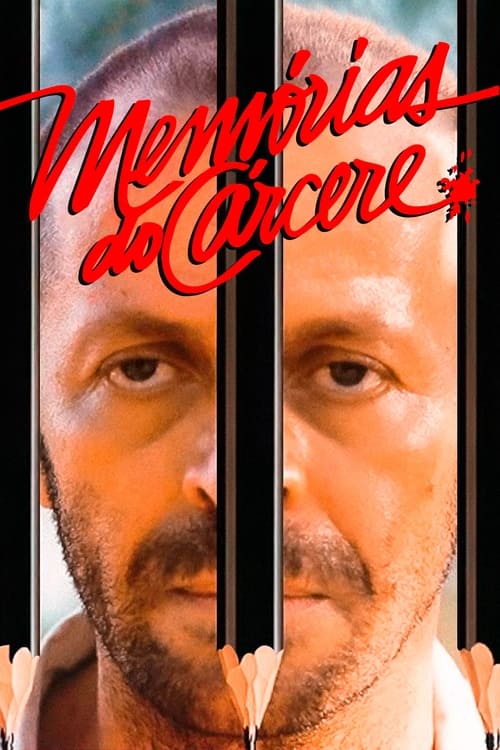
Memories of Prison
1984 · Nelson Pereira dos Santos
For when you want a serious, immersive epic that earns its three hours — a film to sit with, not snack on. Reach for it when you're ready to be challenged and moved by how people keep their humanity when everything is designed to strip it away.
What it's about
In 1936, the celebrated novelist Graciliano Ramos is arrested in Brazil's northeast as a suspected communist sympathizer and held for months without ever being charged. The film follows his passage through police custody, the hold of a coastal steamer, a Rio detention house, and the penal colony on Ilha Grande — a writer thrown among common prisoners, watching, listening, and committing what he sees to memory.
The experience
Long, patient, and quietly devastating — it accumulates rather than shocks, building its portrait of dignity under degradation scene by scene. What stays with you is less the brutality than the solidarity: the small economies, kindnesses, and codes prisoners build inside the machine.
The craft
Nelson Pereira dos Santos adapts Ramos's posthumous prison memoir with novelistic sweep, moving through four distinct carceral worlds — each with its own texture, population, and rules — while keeping the writer's observing eye as the film's center of gravity. The scale and detail of the prison scenes make it feel lived-in rather than staged.
Why it matters
Made in 1984, at the tail end of Brazil's own military dictatorship, it doubled as a pointed act of political address — a 1930s story aimed squarely at the present — and stands as the summit of dos Santos's late career, capping the movement he helped found decades earlier.
Snapshot
Memórias do Cárcere is Nelson Pereira dos Santos's three-hour adaptation of Graciliano Ramos's posthumous prison memoir, and it stands as both the summit of the director's late career and a deliberate act of political address to the Brazil of 1984. Ramos — one of the two or three indispensable Brazilian novelists of the twentieth century — was arrested in Alagoas in March 1936, during the wave of repression that followed the Communist-led uprising of November 1935, and held for roughly ten months without ever being charged. He passed through police custody in Recife, the hold of a coastal steamer bound for Rio de Janeiro, the capital's Casa de Detenção, and the penal colony at Dois Rios on Ilha Grande, before returning to Rio and release in early 1937. He wrote the account only in the last years of his life; it was published, unfinished, in 1953, the year he died.
Pereira dos Santos had adapted Ramos once before, in Vidas Secas (1963), a founding text of Cinema Novo. Returning to the same author twenty-one years later, at the end of a military dictatorship and with state money, produced something very different in register: patient, ensemble-driven, novelistic rather than lapidary. The film premiered in competition at Cannes in 1984, where it took the FIPRESCI prize. Its subject is not escape or resistance in the heroic mode but the texture of arbitrary detention — the boredom, the promiscuous mixing of political prisoners with common ones, the slow erosion and stubborn persistence of a writer's capacity to observe.
Industry & production
The film is a product of the Embrafilme system at its late peak. Embrafilme — the state film enterprise created under the military government in 1969 and expanded through the 1970s — financed and distributed a substantial share of Brazilian features by the early 1980s, and Memórias do Cárcere is unimaginable without it: a period reconstruction spanning several institutions, hundreds of extras, coastal shipping, and island locations, running past three hours, is not a film that independent Brazilian financing of the era could easily have carried. Pereira dos Santos produced through his own company, Regina Filmes, in the co-production arrangement typical of the period.
The irony is not incidental, and Brazilian critics noted it at the time: a state agency founded under one authoritarian regime paid for a film about political imprisonment under an earlier one, released as the country's abertura moved toward the mass Diretas Já campaign for direct presidential elections. That irony is also a good index of how the Embrafilme era actually worked — a technocratic apparatus whose cultural-nationalist remit could be turned, by directors with standing, toward openly critical material. Pereira dos Santos had standing: by 1984 he was the elder figure of Brazilian cinema, the man who had made Rio, 40 Graus (1955) before Cinema Novo had a name.
Production drew on the actual geography of Ramos's ordeal, with location work in Rio and on Ilha Grande, where a penal institution still operated (it was not demolished until 1994). Detailed English-language documentation of the shoot — schedule, budget, the precise extent to which working prison facilities were used — is thin, and I won't reconstruct it from inference. What the film's surfaces make plain is that it was shot in real, worn, humid spaces rather than on built sets, and that its scale came from bodies rather than from spectacle.
Technology
Standard 35mm color production, processed through Brazilian labs, and technically unassuming by design. There is no optical showmanship, no anamorphic sweep, no elaborate camera machinery; the film's technological argument is that a nation's cinema can mount a serious historical reconstruction with a modest kit and real locations. Its most demanding technical problem is one of coverage: crowded interiors, low ambient light, and large groups of actors who must all remain legible in the frame.
Sound is the area where caution is warranted. Brazilian features of this period frequently relied on post-synchronization rather than location recording, and the finished track's controlled clarity in acoustically hostile spaces — a ship's hold, a stone cell block — is consistent with substantial post work. I can describe what the soundtrack does; I would be inventing to specify how it was captured.
The film's later technological history is a familiar Latin American one: a major title with poor international circulation on home video for decades, sustained mainly by festival prints and retrospectives, and only latterly a candidate for the digital restoration work that Pereira dos Santos's catalog has begun to receive.
Technique
Cinematography
José Medeiros, the director's cinematographer of this period, shoots in an unemphatic, observational register that is nonetheless carefully keyed to institution. The film moves through a sequence of enclosures, each with its own light: the flat domestic daylight of Maceió before the arrest; the near-darkness of the ship's hold, where bodies are sensed as much as seen; the greenish, secondhand light of the Rio detention block; and then the hard tropical glare of Ilha Grande, where the sun is not liberation but exposure — the work details and the open compound offer no shade and no privacy. Sunlight becomes a punitive medium.
Compositionally the camera favors the medium shot and staging in depth: Graciliano is almost always in a group, frequently placed at the edge or rear of the frame, watching. Close-ups are rationed, which makes them count when they come. The camera prefers to reframe within a take rather than cut to emphasis, which keeps the surrounding population continuously present. This is a film that refuses to isolate its protagonist from the collective even when it is entirely about his interiority.
Editing
The cutting, credited to Carlos Alberto Camuyrano, is patient to the point of being an argument. Scenes are allowed to run past their informational purpose; the film's three-hour length is not a byproduct of source fidelity but the formal equivalent of a sentence served. Structurally the editing follows the chain of transfers — arrest, custody, ship, detention house, penal colony, return — with each stage given room to establish its own social ecology before the next dislocation. Transitions tend to be plain and unaccented. There is little cross-cutting and almost no suspense architecture, because the film declines the prison genre's usual engine.
Mise-en-scène / staging
The staging is where the film does its densest work. Pereira dos Santos organizes every space around who is placed with whom: political prisoners and common criminals, the literate and the illiterate, the deferential and the brutal, sorted and re-sorted by an administration whose logic is never explained to them. Crowding is the primary compositional fact — bunks, corridors, holds, and yards packed with figures whose individual stories surface briefly and then submerge. Period reconstruction is handled through wear and use rather than display: uniforms, tin plates, shaved heads, the paperwork of an indifferent bureaucracy.
The film is unusually attentive to the material conditions of writing. Notebooks, pencils, confiscations, the smuggling and losing of pages: these are staged as the central drama, since Ramos's memoir is famously a book reconstructed from memory precisely because the contemporaneous record did not survive. The title's first word is the film's method.
Sound
The dominant sonic texture is collective and ambient — the low continuous murmur of many men in a confined room, off-screen shouts, orders, the engine drone of the ship, the noise of a working institution. Music arrives chiefly from within the world: prisoners singing, popular song, radio. The film is markedly sparing with non-diegetic scoring, and its most effective sequences run on room tone and voices alone. I have not been able to verify a music credit with confidence, and would rather note the absence than fill it.
Performance
Carlos Vereza's Graciliano is a performance built almost entirely from withholding. Gaunt, ironic, physically unwell, he is a listener rather than a speaker; the character's authority comes from the quality of his attention, and Vereza plays the writer's mind as a kind of continuous restraint. It is one of the great Brazilian screen performances of the decade and it works precisely because it refuses the biopic's habit of externalizing genius. Glória Pires, as his wife Heloísa, carries the film's thin thread to the outside world — visits, letters, the domestic life that continues without him — and supplies its only sustained register of tenderness. Around them the very large supporting ensemble is directed toward group realism: overlapping talk, unpolished physicality, characters who exist as fully as their brief screen time allows and are then simply gone, which is exactly how a prison population behaves.
Narrative & dramatic mode
This is chronicle, not plot. A first-person memoir has been rendered as third-person observational cinema, which is the film's key adaptive decision: there is no voice-over guiding us through Graciliano's judgments, so his interpretive labor must be inferred from what the camera chooses to look at. Episodes accumulate rather than build; characters enter, are studied, and vanish; nothing is resolved because nothing was ever charged. The dramatic mode is closer to picaresque — a passive protagonist carried through a sequence of worlds — than to the tragedy or thriller structures the prison film usually adopts. There is no escape attempt, no ticking clock, no redemptive violence. The withheld payoff is itself the point: the arbitrary state does not supply narrative satisfaction, and the film will not supply one on its behalf.
Genre & cycle
Formally it belongs to the prison film and to the literary adaptation; historically it belongs to a distinct 1980s Latin American cycle of reckoning with authoritarian pasts. Its nearest Brazilian companions are Leon Hirszman's Eles Não Usam Black-Tie (1981), Roberto Farias's Pra Frente, Brasil (1982), and — most strikingly, since it appeared the same year — Eduardo Coutinho's Cabra Marcado para Morrer (1984), a documentary about a film interrupted by the 1964 coup and resumed two decades later. Both 1984 films are about the retrieval of a suppressed past, and both were possible only because the dictatorship was ending. The wider regional cycle includes Argentina's La historia oficial (1985). Memórias do Cárcere is unusual within it for displacing its politics onto an earlier dictatorship — a strategy that gains rather than loses force, since the parallel between Vargas's prisons and the military regime's was unmistakable to Brazilian audiences.
Authorship & method
Pereira dos Santos is the great adapter of Brazilian letters, and this film is the keystone of that project: Ramos twice (Vidas Secas, 1963; Memórias do Cárcere, 1984), Jorge Amado twice (Tenda dos Milagres, 1977; Jubiabá, 1987), Machado de Assis (Azyllo Muito Louco, 1970), Nelson Rodrigues (Boca de Ouro, 1963), Guimarães Rosa (A Terceira Margem do Rio, 1994). He wrote the screenplay himself, as he generally did. In 2006 he became the first filmmaker elected to the Brazilian Academy of Letters — an institutional confirmation of what his filmography already argued, that cinema was a legitimate continuation of the national literary tradition rather than its illustrator.
His method throughout was documentary-inflected fiction: neorealist in ancestry (the debt of Rio, 40 Graus to Italian postwar cinema is explicit and often noted), attentive to popular and Afro-Brazilian culture, resistant to stylistic display. Where Glauber Rocha pursued an aesthetics of rupture, Pereira dos Santos pursued patience. Among collaborators, cinematographer José Medeiros and editor Carlos Alberto Camuyrano are the significant names on this production; Carlos Vereza's contribution should be counted as authorial in its own right, since the film's point of view is effectively delegated to his face.
Movement / national cinema
Memórias do Cárcere is the late, institutional phase of Cinema Novo speaking in its own voice. The movement's first phase (1955–64) produced Rio, 40 Graus, Vidas Secas, Deus e o Diabo na Terra do Sol; its second turned allegorical and hermetic under censorship; its third — sometimes called the Embrafilme phase — produced large-scale, literate, state-financed pictures aimed at a domestic mass audience. This film is the most serious achievement of that third phase, and its existence sharpens a long-running critical argument: whether Cinema Novo's move into well-funded historical adaptation represented maturation or domestication. Set against Vidas Secas — thirteen characters, blinding white light, the squeal of an oxcart in place of a score, an aesthetics of scarcity that Rocha would theorize as the "aesthetics of hunger" — the 1984 film is manifestly a cinema of means. What it retains is the ethical core: refusal of spectacle, respect for the duration of ordinary suffering, insistence that the intellectual's proper position is inside the collective rather than above it.
The film also sits near the end of an era. Embrafilme was dismantled in 1990, and Brazilian production nearly ceased before the mid-1990s Retomada.
Era / period
Two eras are in play. The depicted one is 1936–37: the repression following the Communist uprising of November 1935, mass detentions without charge, the deportation of foreign-born radicals, and the slide toward Vargas's Estado Novo dictatorship declared in 1937. The film's Brazil is a country in which a provincial director of public instruction can be removed from his home and disappeared into the penal system on suspicion alone.
The era of production is 1984: twenty years after the coup, five years after the Amnesty Law returned exiles and closed the book on accountability, and in the midst of the Diretas Já mobilization. A substantial Brazilian readership had by then encountered the memoirs of a more recent generation of political prisoners. To stage Ramos's detention at that moment was to make an argument about recurrence — that the machinery the audience had just lived through had a national genealogy.
Themes
Testimony and its unreliability run through everything: the memoir exists because the notes did not survive, so memory is presented as an act of reconstruction under duress rather than a retrieval of record. Writing itself is thematized as physical labor and contraband. The film is persistently interested in the class structure of imprisonment — the political detainees' relative privileges, the common prisoners' expendability, and the writer's discomfort at benefiting from a hierarchy he opposes. Solidarity is treated without romance: it is intermittent, negotiated, and frequently withheld. Above all the film is about arbitrariness as a governing technique. No charge is filed, no trial held, no explanation offered; the state's power is demonstrated precisely by its refusal to give reasons.
Reception, canon & influence
The film's international standing was established at Cannes in 1984, where its FIPRESCI award marked it as the most substantial Brazilian film in years. Domestic reception treated it as a major national work and as the vindication of Pereira dos Santos's return to Ramos; it circulated in the United States and Europe on the festival and art-house circuit, though it has never had the sustained home-video life of comparable European titles. It is a fixture in the scholarly literature on Brazilian cinema — the work of Randal Johnson and Robert Stam on Cinema Novo and the Embrafilme system, and Ismail Xavier's writing on allegory and underdevelopment, provide the standard frames — and it appears on Brazilian critical canon lists of the country's essential films.
Looking backward, its lineage runs through Italian neorealism to the director's own Rio, 40 Graus and Vidas Secas; through the Brazilian regionalist novel of the 1930s, of which Ramos was the hardest and least sentimental practitioner; and through the tradition of prison testimony as a Brazilian literary form. Its most direct ancestor is Ramos's prose itself, whose refusal of ornament the film translates into a refusal of style.
Looking forward, it established the terms for two subsequent Brazilian currents. The first is the prison film as sociological instrument: Hector Babenco's Carandiru (2003), likewise adapted from a first-person account of incarceration, and Paulo Sacramento's documentary O Prisioneiro da Grade de Ferro (2004) both work in the observational, population-scale mode this film established, and Lúcia Murat's Quase Dois Irmãos (2004) returns literally to Ilha Grande and to the same explosive premise — political prisoners and common criminals confined together. The second is the cinema of dictatorship memory that ran through the Retomada and after, from O Que É Isso, Companheiro? (1997) to Batismo de Sangue (2006) and Marighella (2021), all of which inherited from Memórias do Cárcere the proposition that Brazilian political history is properly told through the body of a detained individual rather than through the movements of the state.
Its subtler legacy is a matter of ethics rather than genre. Pereira dos Santos, who died in 2018, spent his career arguing that the camera's job was to look steadily at people the nation preferred not to see, and to keep looking after the point at which drama would ordinarily intervene. Memórias do Cárcere is the most sustained demonstration he made of that principle, and it remains the strongest counterargument to the idea that Cinema Novo's late, institutional phase had lost its nerve.
A Deleuzian reading
Find him at the back of the shot.
The full Deleuzian reading of Memories of Prison →
Reception
It premiered in the 1984 Cannes Directors' Fortnight to a rapturous reception — winning the FIPRESCI Prize — at the exact moment Brazil's military dictatorship was crumbling, which made a film about a writer jailed under an earlier regime feel electrically current. Today it stands as a late-career summit for Nelson Pereira dos Santos, canonical in Brazil even if far less seen abroad than Vidas Secas.
How Memories of Prison was received, from release to now →
How to watch Memories of Prison: what to notice on a first viewing
- Watch where Graciliano stands in each crowded room. Pereira dos Santos keeps him at the edge or rear of the group, watching rather than speaking. The camera almost never isolates him from the men around him. The arrangement of bodies shows a social order the film never states out loud.
- Notice the light change with every new place he is held. Flat daylight in Maceio gives way to the near dark of a ship's hold, then a greenish detention block, then the hard glare of Ilha Grande. Each light is what there is to see once no action can change the situation.
- Listen for the murmur of many men and no music. The track runs on room tone, off-screen orders, engine drone, and prisoners singing. Composed score is almost entirely absent through the whole film. The prison speaks for itself instead of being told how to feel.
- Watch the camera pan to a new face instead of cutting. Medeiros favors the medium shot staged in depth, reframing within a single take rather than cutting to a close-up. Close-ups are rationed and therefore count. The surrounding population stays in frame even when the scene is about one man's mind.
The whole guide to watching Memories of Prison, with the keys for a rewatch →
Influences: the films it descends from and the films it influenced
- La Grande Illusion (1937) — Renoir's barracks scenes run the grammar the film adopts for the ship's hold and the Ilha Grande pavilion — deep staging with three or four conversational planes alive at once, the camera panning to reframe rather than cutting, so the prisoner collective rather than the cut holds the composition together.
- Paisà (1946) — Supplies the episodic chronicle armature — self-contained blocks joined by a moving witness instead of a rising arc — plus the non-professional faces and unscored ambient location sound Pereira dos Santos imported into Brazil and here applies to a penal population.
- Rio, 40 Graus (1955) — His own debut established the method the prison inherits: a multi-strand cross-section in which the protagonist is a population, shot on location with non-actors and cut so that no single strand is permitted to harden into the plot.
- Un condamné à mort s'est échappé (1956) — Bresson made the cell audible before it was visible — off-screen doors, keys, boots and distant trains carrying the narrative load; Memórias do Cárcere strips the score for the same reason, letting diegetic ambience do the work a music cue would otherwise do.
- Le Trou (1960) — Becker's real-time labor in a confined cell — deep-focus staging of five bodies in a space too small for conventional coverage, cast to include an actual participant in the events — is the model for treating incarcerated duration as the unit of construction rather than something to elide.
- Vidas Secas (1963) — The first Ramos adaptation set the translation rule: unornamented prose syntax becomes chapter-blocks and refused music, and light is treated as a punishing physical agent — the sertão's blinding overexposure inverted here into the hold's darkness and the interrogation lamp.
- Os Fuzis (1964) — Guerra's long takes observing an armed detachment among a starving population, recorded with direct sound and reframed by pan rather than cut, is the Cinema Novo precedent for staging an institution as a crowd problem instead of a set of named antagonists.
- The Battle of Algiers (1966) — Population-scale staging with non-professionals filling the frame's full depth, and detention and torture shot without score or reaction-shot cueing, is the template for filming a repressive apparatus as procedure carried out by functionaries rather than as villainy.
- São Bernardo (1972) — Hirszman's Ramos adaptation solved the identical problem — how to carry a stripped first-person prose voice without narration — by holding austere near-static frames and refusing to psychologize the narrator; Pereira dos Santos takes that no-voice-over solution and gives it a crowd.
- Tenda dos Milagres (1977) — His Embrafilme-phase Amado adaptation worked out the production grammar this film scales up: state-financed period reconstruction of a repressive moment staged as popular collective life rather than as heritage decor.
- O Que É Isso, Companheiro? (1997) — Adapts Fernando Gabeira's first-person memoir on the seed's proposition that the dictatorship is narrated through a detained body and its captors sharing one confined room, not through the movements of the state.
- Carandiru (2003) — Adapts Dráuzio Varella's first-person account with the same architecture — an observing witness who mostly listens while the cell-block delivers its picaresque inset stories — shot in the actual condemned pavilion with a population-scale ensemble.
- O Prisioneiro da Grade de Ferro (2004) — Sacramento hands cameras to Carandiru's inmates, pushing the seed's ethic — keep looking past the point where drama would ordinarily intervene — to its endpoint: unscored long-take observation of institutional routine, authored from inside the crowded space.
- Quase Dois Irmãos (2004) — Returns literally to Ilha Grande and restages the seed's central premise — political prisoners and common criminals confined in one pavilion — but cross-cuts the 1970s cell against its present-day consequence instead of holding the single chronicle line.
- Batismo de Sangue (2006) — Adapts Frei Betto's prison memoir with the seed's refusal of state-level exposition: torture is staged as duration in a room, the detained body supplying the only vantage the film permits itself.
- Marighella (2021) — Inherits the premise that Brazilian political history is properly told through a hunted or detained individual, and stages its interrogation sequences as the seed does — sustained, unscored, with the apparatus's operatives played as salaried workers rather than monsters.
- Pixote (1981) — Babenco's reformatory dormitories, cast from street children and staged as over-populated institutional space where the camera keeps looking past the nominal subject, run the same documentary-inflected fiction ethic in the same abertura moment.
- Cabra Marcado para Morrer (1984) — Coutinho's same-year companion makes suppressed testimony the form itself — direct-sound first-person account restored against the state's chronology — the documentary counterpart to adapting Ramos's memoir with no narrating voice imposed over it.
Similar films
- Barren Lives (1963) — influence & lineage
- Marighella (2021) — influence & lineage
- Carandiru (2003) — influence & lineage
- Four Days in September (1997) — influence & lineage
- Twenty Years Later (1984) — influence & lineage
- A Twelve-Year Night (2018) — shared sensibility
- I'm Still Here (2024) — shared sensibility
- The Secret Agent (2025) — shared sensibility