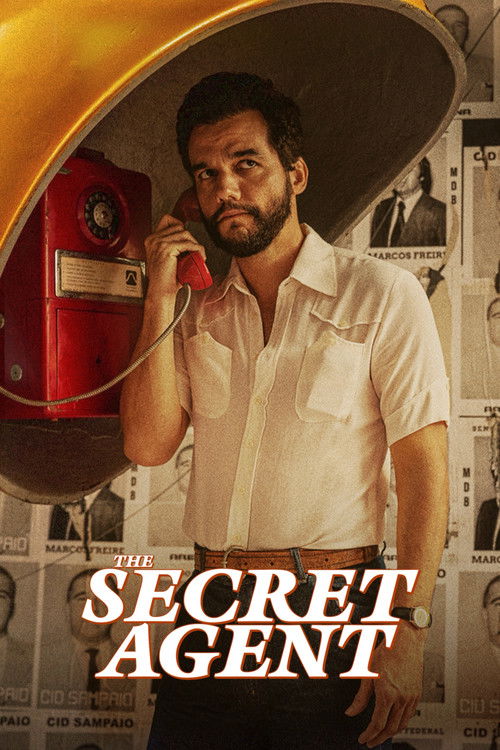
The Secret Agent
2025 · Kleber Mendonça Filho
Bacurau's cult keeps growing, and The Secret Agent's Cannes double win (director plus actor for Wagner Moura) made him Brazil's arthouse standard-bearer and a 2025 Oscar-season fixture.
For when you want a substantial, atmospheric thriller with real history in its bones — a film to sink into and chew on for days. More simmer than jolt; bring your patience and it pays off.
What it's about
Recife, Brazil, 1977 — the height of the military dictatorship, in the middle of Carnival. Marcelo, a technology expert in his forties, arrives in the city hoping to reunite with his young son, believing the festive chaos will give him cover. Instead he finds that beneath the costumes and percussion, the city has its own machinery of surveillance and violence, and that he hasn't outrun whatever he's fleeing.
The experience
A slow-coiling political thriller that trades car chases for creeping dread — the tension of being watched in a crowd that's dancing. Rich, textured, and unhurried, with flashes of dark humor and strangeness, it builds a paranoia that lingers well after it ends.
Performances
Wagner Moura is superb as Marcelo — warm, watchful, and quietly desperate, a performance that won him the Best Actor prize at Cannes.
The craft
Kleber Mendonça Filho shoots 1977 Recife with a collector's love of period texture — the film breathes with Carnival's heat, noise, and color while dread accumulates at the edges of the frame. The sound design and music are half the experience; see it loud.
Why it matters
A major Cannes prize-winner that arrived amid a wave of films reckoning with authoritarian memory, and the work that confirmed Mendonça Filho as the great chronicler of Recife's political life.
Snapshot
A political thriller set in Recife during Carnival 1977, The Secret Agent is Kleber Mendonça Filho's most overtly genre-coded film since Bacurau (2019) and his most direct engagement with Brazil's military dictatorship (1964–1985). A man in his early forties — Marcelo, described as a technology expert — attempts to slip through the festive noise of Carnival to reach his son, only to discover that the city harbors its own surveillance architecture beneath the costumes and percussion. The film arrives in a period of renewed international interest in authoritarian memory films, and it consolidates Mendonça Filho's position as the pre-eminent chronicler of Recife's layered social and political life.
Industry & production
Mendonça Filho has built a production infrastructure rooted in Recife rather than São Paulo or Rio de Janeiro — an unusual choice in Brazilian cinema that carries both artistic and industrial significance. His production company Cinemascópio has anchored all his feature work, and The Secret Agent continues that pattern of regionally embedded, director-controlled production. Brazilian co-production with European partners has been standard for his later work — Aquarius (2016) carried French investment, and Bacurau was a France-Brazil co-production with Wild Bunch handling international distribution. The specific financing architecture for The Secret Agent had not been comprehensively reported at the time of writing, but the film was selected for the Cannes Film Festival 2025, continuing a relationship with that festival that began with Neighboring Sounds's ACID sidebar and deepened substantially through Aquarius and Bacurau. Cannes has been structurally important to Mendonça Filho: Bacurau shared the Jury Prize in 2019, and the festival's sustained attention has underwritten international distribution in markets that might otherwise overlook a Brazilian film set in Recife.
The casting draws on the network of performers — some internationally recognized, some embedded in Brazilian television and theater — that characterizes his ensemble approach. Specific cast details were not fully confirmed in available records at the time of writing; any attribution beyond what is directly documentable would risk fabrication.
Technology
The film's title and its diegetic premise both mobilize technology as a contested resource. In 1977 Brazil, surveillance technology was a central instrument of state control: the SNI (Serviço Nacional de Informações, the national intelligence service) and the DOI-CODI (the military's internal security apparatus) operated wiretapping infrastructure, informant networks, and photographic surveillance with increasing sophistication. A "technology expert" in this environment occupies a dangerous position — potentially a builder of the state's instruments, potentially a defector who knows too much about them, potentially someone recruited by resistance cells to counter state communications.
Brazil in the mid-to-late 1970s was also undergoing a distinctive domestic technology policy push: the government's nascent informatics nationalism, which would eventually produce the "Lei de Informática" of 1984, was already taking shape, and mainframe computing was being introduced into state bureaucracies and private industry. The film's historical moment therefore stages technology not merely as surveillance hardware but as a domain of ideological contest — who controls technical knowledge, who can disappear inside its circuits, and who can be made to disappear because of them.
Technique
Cinematography
Mendonça Filho's visual grammar has been developed in close collaboration with cinematographer Pedro Sotero, who has shot his features since Neighboring Sounds. Sotero's work with the director established a recognizable optic: long focal lengths that compress Recife's dense residential fabric, an attention to the relationship between interior and exterior light (the equatorial sun bleaching facades while interiors pool in shadow), and a documentary-inflected patience — shots that hold long enough for behavioral texture to accumulate. For a film set during Carnival, the visual challenge is pronounced: Carnival is noise, density, moving bodies, firelight and artificial color. Mendonça Filho's previous films have typically inhabited the stillness that Carnival temporarily ruptures; The Secret Agent must work inside the rupture itself. Specific cinematographic credits for this production were not fully available in reported sources at time of writing.
Editing
Mendonça Filho's editing in earlier films — Bacurau especially — deploys a structural patience punctuated by sharp discontinuities. The genre hybrid of Bacurau used editing rhythm to manage tonal oscillation between deadpan community drama and genre violence; the thriller template of The Secret Agent presumably demands more pressure on the cut, more rhythmic anxiety. Whether the film presses toward the procedural thriller's clipped economy or preserves Mendonça Filho's characteristic durational investment is one of the central formal questions the film poses.
Mise-en-scène / staging
Recife is not background in Mendonça Filho's cinema — it is argument. From Neighboring Sounds's gated residential block to Aquarius's beachfront apartment building to Bacurau's sun-hammered sertão village, the built environment functions as a map of power relations. The 1977 Recife of The Secret Agent adds a temporal dimension: the city that Mendonça Filho has filmed in the present is now rendered as it was half a century earlier, and the continuities and ruptures between these two versions of the same city form part of the film's implicit argument. Carnival, with its street stages, sound trucks, and costumed crowds, reorganizes the city's spatial hierarchy temporarily — and that reorganization is exactly the kind of liminal condition a fugitive requires. The staging presumably exploits this: moving bodies as cover, festive anonymity as tactical resource, the Carnival's sonic envelope as concealment.
Sound
Sound has been a conceptual anchor in Mendonça Filho's work since his first feature's title announced it. Neighboring Sounds organized its entire social argument around acoustic permeability — who can be heard, who can hear, what sounds penetrate which walls. Bacurau used the drone of the drone itself as a sound-design event. The Secret Agent inherits this lineage and extends it into one of the most acoustically specific environments in Brazilian culture. Recife's Carnival is not Rio's — it is defined by maracatu (African-derived percussion ensembles of considerable volume and ceremonial density), frevo (the fast, brass-heavy Pernambucan street music), and the batuque of the blocos de rua. This sound world is simultaneously celebratory and overwhelming, joyous and disorienting — a Carnival that deafens as much as it reveals. For a thriller about surveillance and concealment, sound is also always epistemology: what can be heard, what can be overheard, what is masked by the noise of the street.
Performance
Mendonça Filho's direction of actors tends toward behavioral naturalism within heightened structural conditions. His protagonists — the neighborhood observer of Neighboring Sounds, Clara of Aquarius, the community of Bacurau — are embedded in specific social and spatial matrices that generate meaning through accumulation rather than dramatic declaration. The thriller mode of The Secret Agent presumably places its protagonist under acute external pressure while maintaining that behavioral register. The interplay between Carnival's performative exuberance and the controlled concealment of a hunted man creates a natural dramatic tension between visible performance and invisible interiority.
Narrative & dramatic mode
The film operates in the mode of the political chase thriller — a genre whose grammar was largely fixed in postwar European and American cinema (from Carol Reed's The Third Man to Costa-Gavras's Z and State of Siege) but that carries particular charge in the Latin American context, where the political persecution it dramatizes is historical reality rather than generic convention. The Carnival setting introduces a carnivalesque inversion of normal social order — Bakhtin's formulation is directly applicable here — in which hierarchies are suspended, identities are masked, and the state's surveillance apparatus must work against a social environment designed to defeat it. Whether the film resolves into escape, capture, or something more formally ambiguous is consistent with Mendonça Filho's preference for endings that refuse consolation while remaining emotionally precise.
Genre & cycle
The Secret Agent belongs to a global cycle of films revisiting authoritarian periods through genre frameworks. Brazilian cinema has a significant tradition here: Bruno Barreto's O que é isso, companheiro? (Four Days in September, 1997) and Sérgio Rezende's Zuzu Angel (2006) addressed the kidnapping of U.S. ambassador Burke Elbrick and the murder of the dress designer by the military respectively; more recently, Walter Salles's I'm Still Here (Ainda Estou Aqui, 2024) returned to the dictatorship period through the story of Eunice Paiva, whose husband was disappeared by the regime. The cluster of 2024–2025 Brazilian films engaging the dictatorship era reflects both the long shadow of the Bolsonaro years (2019–2022) and the political urgency of reconstructing democratic memory in a polarized present. Mendonça Filho's contribution to this cycle is the most generically self-conscious — the thriller framework foregrounds the mechanisms of state terror rather than its domestic aftermath.
Authorship & method
Kleber Mendonça Filho trained first as a film critic, a formative discipline visible in the analytical precision of his mise-en-scène and the density of his film-historical awareness. His debut feature, Neighboring Sounds (2012), emerged from years of short films and was developed through deep knowledge of both Brazilian and international film history. His Recife trilogy — the first two films treating contemporary Recife, Bacurau displacing to a near-future sertão — represents a coherent body of work united by spatial intelligence, class analysis, and a sustained attention to how power inscribes itself on bodies and buildings.
The political sharpness of Bacurau — which was understood by Brazilian audiences and international critics alike as a fury directed at the Bolsonaro era's authoritarian drift, even as its narrative was technically set in the future — gives The Secret Agent's historical setting a layered temporality. Writing about 1977, Mendonça Filho is also writing about now; the film joins a tradition of historical allegory in Brazilian political cinema that runs from Glauber Rocha through Nelson Pereira dos Santos and forward.
His collaboration with Sotero on cinematography and his long working relationship with sound designers across his films has produced a consistent audio-visual language. The Secret Agent appears to push that language into more overtly thriller-coded territory while retaining the authorial signatures — the spatial intelligence, the acoustic density, the political specificity — that distinguish his work from generic filmmaking.
Movement / national cinema
Mendonça Filho occupies a specific position in contemporary Brazilian cinema: rooted in the northeast rather than the southeast, connected to a Pernambuco-based filmmaking community (including Juliano Dornelles, his Bacurau co-director, and the constellation of Recife directors who emerged in the 1990s and 2000s), and oriented toward international festival circulation while maintaining deep regional specificity. The "Pernambuco film revival" is a recognized phenomenon in Brazilian film history — a cluster of films from the state, beginning in the mid-1990s, that drew on low budgets, local landscapes, and a distinctive irreverence. Neighboring Sounds marked the moment when this regional movement produced a work of unambiguous international significance.
The Secret Agent is set in the Recife of 1977, when the Pernambuco film community that would eventually produce Mendonça Filho did not yet exist. But the film claims that earlier Recife as his own — an act of temporal possession, of asserting authorship over the city's entire history.
Era / period
The Brazil of 1977 sits at a specific fulcrum in the military dictatorship's arc. General Ernesto Geisel, who governed from 1974 to 1979, pursued a policy of distensão — gradual, controlled political relaxation — while maintaining the apparatus of repression. The AI-5, the institutional act of 1968 that had suspended habeas corpus and concentrated emergency powers in the executive, remained in force until December 1978. The "Pacote de Abril" — Geisel's unilateral closure of Congress and rewriting of electoral rules — occurred in April 1977, just weeks after Carnival. A fugitive moving through Recife during that Carnival inhabits a moment when liberalization is being promised but repression has not yet been dismantled; when a careful reader of political signals might believe the worst was over, and when that belief might prove fatal.
Recife's specific position in this moment included a significant university sector (the Universidade Federal de Pernambuco and the Universidade Católica were centers of opposition culture and student organizing) and a labor movement that would gain force in the late 1970s. The city's African-derived Carnival culture also carried its own forms of political resistance — maracatu and coco had survived colonial and state suppression and carried continuous memory of resistance.
Themes
Power and its spatial inscription; the city as surveillance apparatus; festivity as both cover and exposure; the fragility of fatherhood under state terror; the relationship between technical knowledge and political danger; memory and the unreliability of the "safe haven" as concept. Recurrent across Mendonça Filho's work is the theme of contested habitation — who has the right to remain in a space, who is expelled, and what mechanisms of power enforce that expulsion. The Secret Agent literalizes this concern by making the protagonist's presence in his own city a criminal act. The reunion with his son, as narrative motor, introduces familial continuity against the state's drive toward erasure.
Reception, canon & influence
The Secret Agent premiered at Cannes 2025, and early critical attention was consistent with the festival's treatment of Mendonça Filho's previous work: serious engagement with the film's political argument, attention to its genre architecture, and placement within both his authorial trajectory and the broader Brazilian moment. Specific prize outcomes and review aggregates were not fully available in sources accessible at time of writing.
Looking backward, the film's influences are identifiable. The Costa-Gavras political thriller tradition is directly relevant — Z (1969) and State of Siege (1972, set in Uruguay under similar conditions) established the grammar of the left-political thriller that The Secret Agent inherits. John Boorman's The General and Carol Reed's The Third Man provide models of the morally compromised protagonist in a landscape turned hostile. Within Brazilian cinema, the political films of the Cinema Novo period — Glauber Rocha's Terra em Transe (1967), Nelson Pereira dos Santos's How Tasty Was My Little Frenchman (1971) — provide a national framework, though Mendonça Filho's approach is less aesthetically radical and more formally classical than Rocha's agitation. Walter Salles's I'm Still Here (2024), which won the Academy Award for Best International Film, is an immediate predecessor in the cycle of contemporary Brazilian films addressing the dictatorship's human cost.
Looking forward, it is too early to assess the film's canonical position or lasting influence. What can be said is that The Secret Agent arrives at a moment when Brazilian democracy has survived a significant authoritarian stress test, and when the cultural reckoning with fifty years of post-dictatorship memory is actively underway. Mendonça Filho's decision to work in genre — to make a thriller about the terror rather than a memorial drama — may prove to be its most durable formal contribution: the argument that the mechanisms of state repression are best illuminated not by elegiac distance but by the present-tense machinery of suspense.
A Deleuzian reading
Start with a sound whose source you can't see.
The full Deleuzian reading of The Secret Agent →
Reception
No reappraisal needed yet — it arrived a hit: a 13-minute Cannes ovation, the most-awarded film of the 2025 festival, then a Best Picture Oscar nomination, though it lost Best International Feature to Sentimental Value after winning the equivalent Golden Globe and Critics Choice prizes.
How The Secret Agent was received, from release to now →
Influences: the films it descends from and the films it influenced
- Z (1969) — Establishes the left-political thriller's editing grammar: forensic cross-cutting between state perpetrators, civilian witnesses, and investigators to indict systems of murder through suspense mechanics rather than documentary sobriety.
- State of Siege (1972) — Non-linear procedural structure that reconstructs the bureaucratic architecture of a South American torture state from fragmentary testimony, using genre thriller mechanics to map institutional complicity rather than individual guilt.
- The Third Man (1949) — Vienna's ruins and sewer geography rendered as a three-dimensional power map where location determines moral fate — the template for staging a political thriller through a protagonist's progressive spatial disorientation within an occupied, ideologically hostile city.
- The Battle of Algiers (1966) — Documentary-inflected cinematography — natural light, non-professional cast, ambient sound recording — embeds the spectator inside a surveillance cityscape where the Casbah's architecture determines cover and exposure for both occupier and occupied.
- Army of Shadows (1969) — The clandestine operative's spatial intelligence codified as thriller grammar: every built environment — safe house, street, metro — is read as a survival map whose sight lines determine whether a cell member lives; behavioral naturalism strips tradecraft of romanticism.
- The Conversation (1974) — Sound as surveillance epistemology: the thriller's entire mechanism is built from acoustic monitoring, and ambient noise simultaneously conceals and reveals meaning — the same logic The Secret Agent deploys in carnival sequences where crowd sound functions as operational cover.
- The Parallax View (1974) — Long-lens telephoto compression deployed as political paranoia aesthetics: surveillance distance encoded as focal length, the protagonist's visibility to state forces rendered through the camera's persistent observation from remote, uninvolved distance.
- Terra em Transe (1967) — Brazilian carnivalesque as political allegory: civic pageant and spectacle expose the theatricality of authoritarian power, establishing the tradition of carnivalesque inversion as political critique within national cinema that The Secret Agent inherits and classicizes.
- How Tasty Was My Little Frenchman (1971) — Cinema Novo historical allegory using the colonial past as a transparent mirror for present political conditions, with indigenous ritual used to spatially and symbolically invert the hierarchy between colonizer and colonized — carnival inversion as structural critique.
- Neighboring Sounds (2012) — Mendonça Filho's own formal laboratory: Recife's apartment complex mapped as a class power diagram through long-focal-length observation, acoustic wall-permeability rendered as ambient surveillance, and architecture made to carry the somatic weight of historical anxiety.
- Bacurau (2019) — Near-future historical allegory using Western genre conventions to anatomize authoritarian violence; the topographic drone-map appearing onscreen as a literal life-or-death power diagram prefigures The Secret Agent's staging of built environment as a survival map.
- I'm Still Here (2024) — Immediate predecessor in the contemporary Brazilian dictatorship cycle: behavioral naturalism depicting domestic routine disrupted by state disappearance, with the middle-class home staged as the first site of terror's incursion into civilian life.
- Tony Manero (2008) — Pinochet-era Santiago rendered through behavioral naturalism of an unremarkable sociopathic protagonist; the built environment under curfew treated as criminalized space, with popular cultural performance as a screen for the political pathology that authoritarian terror produces.
- No (2012) — Southern Cone dictatorship film that similarly uses popular spectacle — advertising jingles — as the terrain on which authoritarian power is contested; period-accurate video aesthetics used as political argument rather than nostalgia, paralleling The Secret Agent's genre-as-argument strategy.
- Zama (2017) — Latin American historical allegory using durational discontinuity and long-focal-length isolation to render colonial power as existential condition; behavioral naturalism encoding subjugation in the protagonist's body as it is slowly immobilized by the landscape of domination.
- Memoria (2021) — Acoustic permeability as both formal device and epistemological question: the protagonist's sensitivity to an unexplained sonic event structures a meditation on how historical violence persists acoustically in the body, using the same durational patience and behavioral naturalism The Secret Agent employs.
- Marighella (2021) — Descendant that inherits Marighella's clandestine-flight staging — false papers, borrowed rooms, a man measuring exits — and casts Moura himself in the role, completing the loop from the actor who directed the dictatorship's hunted man to the actor who performs one.
Similar films
- I'm Still Here (2024) — influence & lineage · same viewing thread
- Entranced Earth (1967) — influence & lineage · same viewing thread
- Z (1969) — influence & lineage · same viewing thread
- Bacurau (2019) — influence & lineage
- Twenty Years Later (1984) — same viewing thread
- Soundtrack to a Coup d'Etat (2024) — same viewing thread
- Black God, White Devil (1964) — same viewing thread
- Foreign Land (1996) — same viewing thread
All the films related to The Secret Agent →
Watch it with: curated runs of related films
- Cinema Novo & the Aesthetics of Hunger — Watch these together to trace Brazil's 1960s new wave — Rocha's messianic sertão, the São Paulo boom's alienation, and the anarchic Marginal cinema that answered it.
- The Long Shadow of the Coup — A run of films tracing political violence from the mutiny and the massacre through martial law to the decades-long reckoning that follows — watch them near each other and the same machinery of power keeps rhyming across continents and eras.