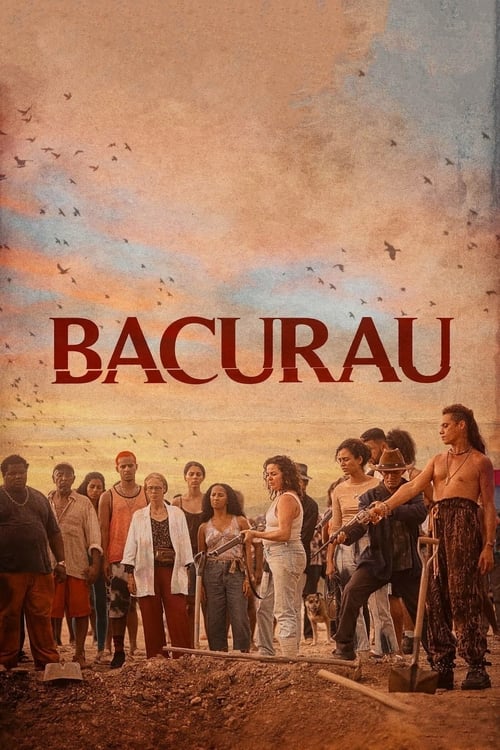
Bacurau
2019 · Juliano Dornelles
For when you want something wild and unclassifiable — a genre movie with teeth and politics — and you're ready to be patient before the payoff. This is a challenge pick, not comfort food, but it rewards you with one of the most satisfying builds in recent memory.
What it's about
In a small town deep in the Brazilian backlands, the residents bury Carmelita, their 94-year-old matriarch, and then notice something strange: their community has disappeared from the maps. The water truck arrives riddled with bullet holes, the cell signal dies, and unfamiliar outsiders start turning up with unclear intentions. What begins as a portrait of a scrappy, tight-knit village slowly hardens into a standoff between the town and forces that would prefer it didn't exist.
The experience
It moves like a slow fuse — loose, funny, and communal at first, then increasingly ominous until it erupts. You spend the first hour falling for the town and the last stretch gripping your armrest on its behalf; the violence, when it comes, lands hard and feels earned.
Performances
Udo Kier is unforgettable as the leader of the outsiders — courtly, alien, and quietly terrifying — while Sônia Braga brings ferocious authority to the town's hard-drinking doctor.
The craft
The film splices a Western's widescreen dust and standoffs with siege-thriller mechanics and a faint science-fiction shimmer, and the joins never show. Its throbbing synth cues and sun-blasted vistas of the sertão beg for a big screen and loud speakers, and the editing keeps planting small oddities that pay off later.
Why it matters
A Cannes Jury Prize winner that became a rallying point for Brazilian cinema at a tense political moment, it announced that regional genre filmmaking could carry global weight and fury at once.
Snapshot
Bacurau is a Brazilian genre hybrid — part Western, part siege thriller, part science-fiction fable — set in a fictional village in the arid sertão (backlands) of Pernambuco in a lightly displaced near future. Though the brief names Juliano Dornelles alone, the established record credits the film to two directors working in tandem: Kleber Mendonça Filho and Dornelles, who had long been creative partners (Dornelles served as production designer on Mendonça Filho's earlier features). The film opens on a funeral — the village mourns Carmelita, its 94-year-old matriarch — and gradually reveals that Bacurau has vanished from digital maps, its water supply throttled, its cell signal cut, as a party of gun-tourists, mostly foreign and led by a chilling Udo Kier, arrives to hunt its residents for sport. The town, aided by a queer outlaw named Lunga, turns and slaughters them. Premiering in Competition at Cannes in 2019, where it shared the Jury Prize, Bacurau became one of the most discussed political films of its year: an allegory of resistance read against Brazil's authoritarian turn.
Industry & production
Bacurau was a Brazil–France co-production, built on the model Mendonça Filho had used for Aquarius (2016). The Brazilian side ran through the directors' Recife-based outfit CinemaScópio; the French side involved Saïd Ben Saïd's SBS Productions and Arte France Cinéma, with the project developed over several years — the directors have said the screenplay's origins predate its eventual production by nearly a decade. Shooting took place in the Pernambuco interior, and much of the film's texture derives from that rooted, regional production base: a Recife filmmaking scene that has, over the 2010s, become one of the most distinctive in Latin America, deliberately decentered from the São Paulo–Rio axis.
The production's timing matters to its meaning. It was conceived and shot across the years of Brazil's political rupture — the 2016 impeachment of Dilma Rousseff, and the 2018 election of Jair Bolsonaro — and released in 2019 into a cultural-funding environment openly hostile to exactly this kind of critical cinema. Internationally it was carried by strong festival distribution; Kino Lorber handled the U.S. release. I won't cite box-office figures, as I can't verify specific numbers, but the film's commercial profile was that of a well-traveled arthouse title amplified by its Cannes prize and its political charge rather than a wide theatrical earner.
Technology
Bacurau is a film pointedly about surveillance technology, and its plot turns on tools of seeing and un-seeing: the town's erasure from GPS mapping, the severing of communications, and above all the drone that hovers over the sertão — designed to look like a 1950s flying saucer, a deliberately retro UFO. That anachronism is the film's central technological joke and thesis: the instruments of a supposedly advanced, digital, globalized order are dressed as pulp science fiction, exposing the "high-tech" hunt as an old colonial ritual in new clothes. On the production side, I can't confirm the exact capture format with certainty, but the film's look is engineered around widescreen anamorphic-style scope framing to evoke 1970s genre cinema (see Cinematography). Its most conspicuous "technology," narratively, is analog and communal — CB-style radios, a museum of local history, firearms hidden in the collective memory of the town.
Technique
Cinematography
Pedro Sotero, Mendonça Filho's regular collaborator, shot the film in a wide, horizontal 'scope format that consciously recalls the widescreen Westerns and genre pictures of the 1960s–70s. The camera favors expansive establishing views of the sertão — the dry scrub, the single road, the low buildings — punctuated by sudden, aggressive zooms and whip-pans lifted straight from the spaghetti-Western and exploitation vocabulary. Aerial and high-angle "drone's-eye" views are used pointedly, aligning the audience at moments with the hunters' surveillance gaze before the film reclaims the ground-level perspective of the villagers. The palette is sun-bleached and dusty by day, with a marked shift toward nocturnal, hard-shadowed compositions as the siege begins — a visual register that draws on horror as much as the Western.
Editing
Eduardo Serrano's cutting builds slowly. The first act is deliberately unhurried, almost ethnographic, letting the viewer inhabit Bacurau as a community — its funeral, its school, its brothel, its clinic — before the genre machinery engages. That patient exposition is a structural gamble: it makes the eventual violence land as a rupture in a known world rather than as spectacle. Once the hunt begins, the rhythm tightens into siege-thriller tempo, cross-cutting between the invaders' bickering camp and the town's coordinated response, with the reveal of the villagers' preparedness withheld and then sprung.
Mise-en-scène / staging
Dornelles's background as production designer is legible in every frame. Bacurau is built as a fully realized place: the town museum is a key set and thematic anchor, housing relics of past massacres and resistance, so that the town's history of surviving violence is physically present. Staging repeatedly emphasizes the collective — group compositions, the town acting as an ensemble body — against the atomized, self-regarding foreigners. Two staging choices carry particular weight: the decapitated heads and blood the invaders leave, and the underground/hidden spaces the town uses to turn ambush into slaughter. Costuming and props (the psychotropic plant the villagers consume, the traditional weapons) knit folk culture and pulp genre together.
Sound
The soundscape blends the ambient hum of the backlands with a genre-savvy use of pre-existing music. The film's needle-drops are doing thematic work: an opening traveling sequence set to Brazilian popular song establishes the journey into the interior, and the score leans on the ominous synth register of John Carpenter — whose siege cinema is one of the film's avowed touchstones — so that the music itself signals the horror/Western lineage. (Where I'm uncertain about the full original-score credits I'll flag it rather than invent one: the film is built substantially on curated tracks rather than a wall-to-wall original score.) Sound design also weaponizes silence and the drone's mechanical whir as instruments of dread.
Performance
The ensemble is the star. Sônia Braga — a titan of Brazilian cinema and Mendonça Filho's Aquarius lead — plays Domingas, the town's hard-drinking doctor, in a register of fierce, grieving authority. Udo Kier, cast against the film's naturalism, brings a mannered, European menace to Michael, the hunt's leader, embodying the film's critique of a self-satisfied Global North. Bárbara Colen, Thomas Aquino (as the gunman Pacote/Acácio), and Silvero Pereira (as the outlaw Lunga, a striking queer figure of vengeance) anchor the town's side. The performances hold a deliberate tonal line — grounded and communal among the villagers, heightened and grotesque among the invaders — that is central to the film's moral architecture.
Narrative & dramatic mode
The film's dramatic mode is a slow-burn genre inversion. It withholds its own genre identity: for a long stretch it behaves like a regional social-realist drama, an almost documentary portrait of a marginalized community, before mutating into a siege thriller and revenge Western. This structure — community first, carnage second — is the film's rhetorical engine, because it forces the audience to know and value the town before it is targeted. The narrative operates by concealment and reveal: the disappearance from the map, the identity and motives of the hunters, and crucially the town's own hidden capacity for organized violence. Its dramatic satisfaction is that of the turned tables — the hunted become the hunters — delivered without triumphalist catharsis but as grim, collective necessity.
Genre & cycle
Bacurau is a self-conscious anthology of genres: the Western (specifically the Italian and revisionist strains), the siege film, the "most dangerous game" human-hunt subgenre, horror, and science fiction. It belongs, crucially, to a distinctly Brazilian tradition of the Nordestern — the Northeastern "Western" of the sertão, whose ancestors include the cangaço bandit films and Glauber Rocha's Cinema Novo landmarks. It fuses that lineage with the low-budget genre energy of 1970s exploitation and Carpenter-style siege cinema. The result reads as part of a broader contemporary cycle of politically charged genre hybrids from the Global South that repurpose the tools of pulp cinema for decolonial critique.
Authorship & method
The film is authored jointly by Kleber Mendonça Filho and Juliano Dornelles, and it consolidates a specific Recife auteur practice. Mendonça Filho — a former film critic turned director of Neighboring Sounds (2012) and Aquarius (2016) — brings a career-long preoccupation with space, community, memory, and the pressures of power on place; for Dornelles, the film marks his co-directorial feature step up from his role as the production designer who had physically built those earlier worlds. Their method is collaborative and rooted: a repertory of trusted collaborators (cinematographer Pedro Sotero, editor Eduardo Serrano, actor Sônia Braga), a regional production base, and a long incubation that let the screenplay accrue meaning as Brazil's politics darkened around it. The authorial signature is the marriage of grounded, place-specific social observation with unabashed genre pleasure — genre not as escape but as a delivery system for political argument.
Movement / national cinema
Bacurau is a keystone of the 21st-century Pernambuco/Recife new wave — a regional Brazilian cinema that has deliberately displaced the national industry's center of gravity toward the Northeast. It stands in explicit dialogue with Cinema Novo, the 1960s movement of Glauber Rocha, Nelson Pereira dos Santos, and others, which mythologized the sertão as the ground of Brazilian identity and revolt (Rocha's "aesthetics of hunger"). It also nods to the anarchic energy of Cinema Marginal (the udigrudi), Brazil's late-1960s underground. In fusing these national lineages with international genre cinema, Bacurau positions itself as heir to Brazil's most politically committed film traditions while refusing their occasional solemnity.
Era / period
The film is a document of Brazil circa 2016–2019: the impeachment, the collapse of a governing consensus, the ascent of a reactionary, extractivist politics, and open contempt for the marginalized interior and for the cultural sector itself. Its near-future setting is a thin veil over the present. The water conflict at its heart — a corrupt local politician, Tony Junior, throttling the town's supply — speaks directly to the real hydro-politics and drought of the Brazilian Northeast. Read in period, Bacurau is a film about what an abandoned people owe an order that has written them off the map, and about the violence such abandonment authorizes on both sides.
Themes
Its governing themes are resistance and collective self-defense; colonialism and neocolonial exploitation, staged as literal foreign predation on Brazilian bodies; internal collaboration and the comprador figure who sells his own community; historical memory as a weapon (the museum); water, land, and the extractive politics of scarcity; and the dignity of a plural, marginalized community — poor, mixed-race, queer, elderly, self-governing — set against the atomized narcissism of its would-be exterminators. The town's psychotropic plant and its old hidden guns figure a knowledge and capacity the outside world underestimates. The film is unsentimental about violence: it presents communal slaughter of the invaders not as glory but as the only grammar left to the disappeared.
Reception, canon & influence
Critically, Bacurau was among the most acclaimed and debated films of 2019. Its Cannes Jury Prize (shared) certified it on the festival circuit, and it drew wide international praise for its formal daring and political urgency, while some critics debated the ethics and clarity of its revenge violence. It has since been widely read as a defining Brazilian film of the Bolsonaro era.
Influences on the film (backward): the Italian Western and Sergio Leone's iconography; the revisionist Western and the blood-ballet of Sam Peckinpah; John Carpenter's siege cinema (Assault on Precinct 13) and synth horror; the "most dangerous game" human-hunt narrative; and, on the national side, Glauber Rocha and Cinema Novo, the cangaço/Nordestern tradition, and Cinema Marginal's transgressive energy. The directors have been open about this genre-cinephile inheritance, which the film wears on its sleeve.
Legacy (forward): Bacurau substantially raised the international profile of the Recife/Pernambuco school and of decolonial genre hybridity as a mode, feeding a broader conversation about political filmmaking from the Global South that turns pulp forms to insurgent ends. Within its makers' own trajectory it cemented the Mendonça Filho–Dornelles partnership and Braga's late-career stature. Its full downstream influence is still consolidating, so I'll refrain from overstating a "school" it founded; but as a reference point — the town that fights back, the flying-saucer drone, the museum as arsenal of memory — it has already entered the shared vocabulary of contemporary political cinema.
A Deleuzian reading
Somebody looks up and there's a flying saucer over the scrub.
The full Deleuzian reading of Bacurau →
Reception
Premiered at Cannes 2019 to a Jury Prize and instant buzz, then its US run collided with the March 2020 lockdown — it became one of the first 'virtual cinema' hits and a pandemic-era word-of-mouth obsession, now widely treated as the defining Brazilian genre film of the Bolsonaro years.
How Bacurau was received, from release to now →
How to watch Bacurau: what to notice on a first viewing
- Notice the wide horizontal frame and the sudden zooms. Cinematographer Pedro Sotero shoots the sertao in scope format recalling 1960s and 70s Westerns, then breaks the wide calm with sudden zooms and whip-pans. The style keeps warning you a genre film is coming, even during the quiet scenes.
- Watch how often the town is shown as one group. Staging repeatedly favors group compositions, the town acting and moving as one ensemble body rather than separate characters with separate arcs. You are following a community, not a set of individual protagonists.
- Notice the town museum and what it holds. A small museum of relics from past massacres and resistance sits alongside the school and clinic as one of the town's key spaces. The town keeps its own history on display, not buried.
- Notice the high aerial shots looking down at the town's roofs. The film occasionally lifts to a drone's-eye view before dropping back to ground level with the people who live there. Height itself becomes a point of view you are meant to distrust.
- Notice how unhurried the first act is before anything happens. Editor Eduardo Serrano keeps the opening almost ethnographic, spending time in the funeral, school, clinic, and brothel before any genre machinery engages. The patience makes you know the town as a place before anything threatens it.
The whole guide to watching Bacurau, with the keys for a rewatch →
Influences: the films it descends from and the films it influenced
- Black God, White Devil (1964) — Cinema Novo's fusion of the cangaço/sertão myth with insurgent political allegory — the backlands as site of messianic revolt — is the national ancestor Bacurau updates into genre pulp.
- Aquarius (2016) — Sônia Braga's late-career stature as an emblem of rooted resistance, plus the theme of a community defending its memory against erasure, carries directly into Bacurau's Domingas and its museum.
- Pixote-adjacent — replaced
- Mango Yellow (2002) — Late fruit of the Pernambuco wave Assis legitimized — genre-transgressive cinema built from Recife-region collaboration, regional specificity, and a fearless engagement with the violated body.
- Barren Lives (1963) — Contemporary sertão film about arbitrary external power descending on a backlands community, self-consciously in dialogue with Cinema Novo's politics of the landscape and negative space.
- Entranced Earth (1967) — Contemporary reckoning with Rocha: the sertão restaged as political theater through genre-collision allegory and Cinema-Novo iconography turned into national parable.
- Hour of the Star (1986) — Relocates the sertão-and-margins subject into genre while drawing on the acting lineage Amaral launched — Cartaxo among its ensemble — sustaining the nordestino-dignity tradition Hour of the Star helped canonize.
- Love for Sale (2006) — Cinema do sertão extended: the backland village shot as real-location landscape with figures held in wide frames, the Northeast as sovereign world rather than exotic margin.
- The Red Light Bandit (1968) — Cannibalizes pulp genre (western, siege, exploitation) and weaponizes mass-media motifs to indict Brazil's peripheral condition — the estética do lixo strategy of turning imported trash-cinema into anti-imperial cultural critique.
- Memory of Judgment — placeholder
- The Secret Agent (2025) — Near-future historical allegory using Western genre conventions to anatomize authoritarian violence; the topographic drone-map appearing onscreen as a literal life-or-death power diagram prefigures The Secret Agent's staging of built environment as a survival map.
- Assault on Precinct 13 (1976) — The core siege architecture — an isolated community fortifying against a faceless, methodical assault force — is lifted wholesale, down to Carpenter's own self-composed synth pulse that Bacurau echoes in its retro score.
- The Most Dangerous Game (1932) — Supplies the human-hunt narrative engine: bored, wealthy outsiders paying to stalk people as game, which Bacurau inverts by handing agency and the kill to the hunted.
- The Wild Bunch (1969) — Peckinpah's revisionist-Western choreography of communal massacre — squibs, slow-burn tension detonating into balletic, morally queasy bloodletting — models Bacurau's climactic reversal of violence onto the invaders.
- Once Upon a Time in the West (1968) — Leone's anamorphic scope, extreme telephoto framing of arid landscape, and operatic use of the zoom to isolate faces against emptiness are the compositional grammar Sotero's camera adopts for the sertão.
- Antônio das Mortes (1969) — Extends Rocha's mythic Nordestern into color and spectacle, staging the sertão as a theater of decolonial reckoning that Bacurau's museum-of-resistance directly rhymes with.
- O Cangaceiro (1953) — Codifies the Nordestern's iconography — leather-clad bandits, backlands honor, the sertão as Brazilian frontier-Western space — that Bacurau reclaims and weaponizes.
- Rio Bravo (1959) — The template of a small band of defenders holding a town against a superior force, with community solidarity as the moral core, that Carpenter and then Bacurau restage.
- Neighboring Sounds (2012) — Establishes the authorial method Bacurau scales up: place-specific social observation of a community under invisible economic threat, with sound design mapping the geography of power.
- They Live (1988) — Sibling in Carpenter's mode of smuggling explicit anti-imperial political argument inside B-movie genre packaging, using pulp spectacle as a delivery system for ideology.
- Get Out (2017) — Sibling that turns genre-horror mechanics into a decolonial/anti-racist argument, weaponizing the hunt of marginalized people by affluent outsiders as social critique.
- District 9 (2009) — Sibling in Global-South genre hybridity: grafting sci-fi surveillance-drone iconography onto a concrete politics of dispossession and militarized outsiders.
- Sleep Tight / Kill list-adjacent — replaced
Similar films
- Black God, White Devil (1964) — influence & lineage
- Aquarius (2016) — influence & lineage
- Antonio das Mortes (1969) — shared sensibility
- The Secret Agent (2025) — shared sensibility
- Birds of Passage (2018) — shared sensibility
- I'm Still Here (2024) — shared sensibility
- The Blue Trail (2025) — shared sensibility
- Entranced Earth (1967) — shared sensibility