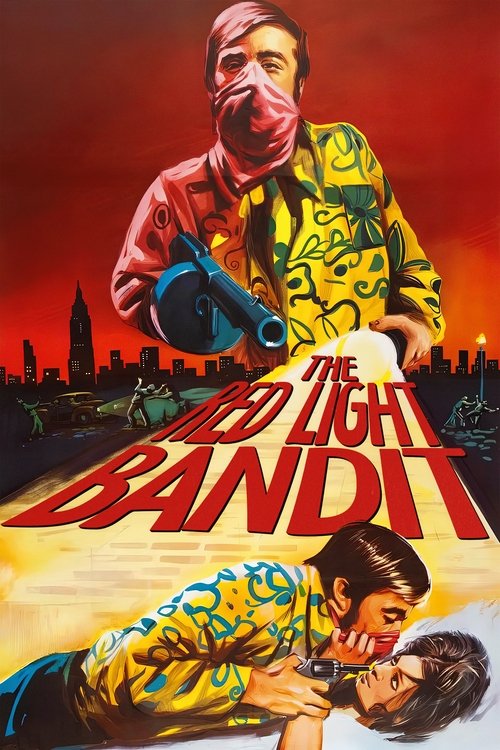
The Red Light Bandit
1968 · Rogério Sganzerla
For when you want cinema at its most unruly — something that tears up the rulebook and dares you to keep up. Definitely a challenge rather than a comfort watch, and thrilling precisely for that.
What it's about
Jorge grows up in São Paulo's slums and becomes a burglar of luxury homes, working by the glow of a red flashlight and taunting his hostages with irreverent patter while the tabloids crown him 'The Red Light Bandit.' But this is no straight crime story — it's a delirious collage of noir, B-movie, western, and science fiction, narrated by braying radio announcers from the decadent underworld of the Boca do Lixo.
The experience
Anarchic and abrasive, it comes at you like a pirate radio broadcast — sirens, samba, jingles, and mock-sensational narration colliding over images that refuse to sit still. It's funny, sleazy, and disorienting by design, closer to a provocation than a plot.
Performances
Paulo Villaça gives the bandit a loose, insolent charisma — part matinee outlaw, part street-corner clown — that keeps the film's chaos magnetically watchable.
The craft
Twenty-one-year-old critic Rogério Sganzerla directs like he's ransacking film history, mashing genres and letting the soundtrack — a pileup of samba, classical fragments, ads, and static — fight the images for control. The sound design alone makes it worth good speakers; it's a film you hear as much as see.
Why it matters
The founding manifesto of Brazil's Cinema Marginal, the scrappy, anarchic movement that split from Cinema Novo, and a debut that made Sganzerla an instant enfant terrible.
Snapshot
O Bandido da Luz Vermelha is the debut feature of the twenty-one-year-old critic Rogério Sganzerla and the founding manifesto of Brazil's Cinema Marginal — the anarchic, self-devouring current that broke away from Cinema Novo at the end of the 1960s. Loosely triggered by the real São Paulo house-burglar known to the tabloid press as the "Red Light Bandit," the film abandons any pretense of biography or crime-thriller coherence. Instead it assembles a delirious collage of film noir, Hollywood B-picture, western, science-fiction, radio melodrama, and Brazilian chanchada, narrated by braying sensationalist announcers over a soundtrack that clashes samba, classical fragments, jingles, and static. Its protagonist, Jorge (Paulo Villaça), robs the villas of the rich, taunts his hostages, squanders the loot, and drifts toward a nihilistic end in the decaying red-light and film district of Boca do Lixo. The film's governing motto — "Quando a gente não pode fazer nada, a gente avacalha" ("When you can't do anything, you make a mess of everything") — is one of the most quoted lines in Brazilian cinema and encapsulates the movie's stance: a jeering, despairing account of the "Third World" delivered in the very year the military dictatorship tightened into its harshest phase.
Industry & production
The film was made independently, on a small budget, inside the Boca do Lixo ("Mouth of Garbage") district of downtown São Paulo — the cluster of streets around Luz station that housed the cheap production companies, distributors, and studios of the city's low-budget cinema. That milieu is not merely the film's setting but its production base and its ethos: Sganzerla made a virtue of poverty and marginality, shooting in and around the neighborhood whose name he turned into an aesthetic program. Coming out of film criticism — he had written for the São Paulo press before directing — Sganzerla belonged to a generation that knew the international art cinema intimately and chose to answer it from the gutter rather than the festival circuit.
The production sits at a precise historical hinge. O Bandido da Luz Vermelha was released in 1968, the year of Tropicália and of Institutional Act No. 5 (December 1968), which suspended civil liberties and inaugurated the dictatorship's "years of lead." Made under intensifying censorship and a collapsing sense of political possibility, the film registers that pressure obliquely — through cynicism, incoherence, and derision rather than direct protest. Precise budget and box-office figures for the film are not reliably documented in the accessible record, and any specific numbers should be treated with caution.
Technology
Technically the film is a product of scarce means turned into style. It was shot on 35mm in black and white, using available and improvised light and the cramped, real locations of the Boca. There is no evidence of technical novelty in the equipment; the innovation is entirely in how commonplace, even degraded, tools are deployed. Sound is the film's most aggressively "technological" dimension, but again through recombination rather than invention: Sganzerla builds his track from radio, records, and voice, exploiting the sensationalist sonic vocabulary of Brazilian crime broadcasting. The rough grain, uneven exposures, and audible seams are not concealed limitations but the film's chosen surface — the "aesthetic of garbage" made material.
Technique
Cinematography
The photography is credited to Peter Overbeck. Its idiom is deliberately anti-glossy: high-contrast black and white, hand-held mobility, oblique and off-balance framings, and a documentary rawness in the streets of the Boca that collides with parodic noir stylization in the interiors. Deep-focus compositions and theatrical staging betray Sganzerla's worship of Orson Welles, while the loose, reactive camera aligns with the Godardian New Wave he also absorbed as a critic. The image frequently looks improvised or "wrong" on purpose — dead space, abrupt scale shifts, actors addressing the lens — refusing the polished coverage of commercial cinema.
Editing
The cutting is disjunctive by design. Scenes fail to connect causally; ellipses are jagged; tone lurches from slapstick to menace without transition. The film is structured less as a story than as a montage of citations and gags, so the editing works associatively and rhetorically rather than continuously, matching the fractured voice-over. The specific editor is not something I can attribute with confidence from the reliable record, so I will not guess a name; what is clear is that the discontinuity is a considered stylistic principle, not incompetence.
Mise-en-scène / staging
Staging oscillates between real, unglamorous locations — bars, rooming houses, wastelands, the neon-and-refuse streetscape of the Boca do Lixo — and consciously artificial, stagey tableaux where characters perform at the audience. Props and iconography are pulled from pop culture (the bandit's red flashlight, radios, guns, cheap luxury) and treated as ironic signs. The result is a Brechtian mise-en-scène that keeps puncturing its own illusion, presenting the "Third World" as a garish, cannibalized set assembled from the leftovers of the First.
Sound
Sound is arguably the film's central invention. Two (or more) radio-announcer narrators deliver a torrent of sensationalist, contradictory commentary in the register of tabloid crime broadcasting, so that the film is narrated the way the real bandit's exploits were consumed by the public. Over and against the images, Sganzerla layers a heterogeneous soundtrack — popular song, classical and operatic snatches, jingles, noise — in abrupt, ironic juxtaposition. Dialogue is often flat, declamatory, or absurd. This aural collage, more than any single visual device, is where the film's meaning lives: it dramatizes a culture mediated to death by mass media. Precise music credits are not something I can specify reliably, so I describe the method rather than attribute individual cues.
Performance
Paulo Villaça's Jorge is the film's engine: an insolent, self-mythologizing anti-hero who narrates his own legend and treats crime as performance and provocation. The acting style is anti-naturalistic throughout — declamation, direct address, caricature, and deliberate hamminess in the service of parody. Helena Ignez, Sganzerla's collaborator and the emblematic actress of Cinema Marginal, brings a magnetic, ironic sensuality to her role, embodying the movement's break with the earnest heroines of Cinema Novo. Supporting figures — corrupt politicians, a preacher-huckster, police, molls — are played as grotesque social types. The ensemble performs "badness" knowingly, converting amateurish theatricality into critique.
Narrative & dramatic mode
The film is anti-narrative. It takes the outline of a crime story — a slum-born burglar's rise, robberies, flight, and downfall — and refuses to develop it as suspense or psychology. Events are recounted after the fact, in fragments, by unreliable radio voices; the "plot" is repeatedly interrupted by digressions, jokes, songs, and philosophical wisecracks. The dramatic mode is ironic, Brechtian, and allegorical: Jorge is less a character than a figure for the marginalized Brazilian subject and for the country's condition, and his story is a pretext for a savage cultural essay. Genres are quoted and burlesqued rather than fulfilled, so the viewer is denied identification and catharsis. What holds the film together is tone and voice — a sustained mixture of derision, despair, and manic energy — rather than causality.
Genre & cycle
Nominally a crime thriller, O Bandido da Luz Vermelha is really a meta-generic pastiche: it cannibalizes noir, the western, science fiction, the musical, and the homegrown chanchada comedy tradition, splicing them into a single unstable object. This omnivorous quotation is characteristic of the Cinema Marginal cycle it inaugurated — a body of films that recycled the debris of both Hollywood and Brazilian popular cinema as an act of aggression and critique. The bandit-outlaw figure connects it to a broader Latin American fascination with the social bandit, but Sganzerla strips the type of any romantic redemption, leaving only pose and dissolution.
Authorship & method
The film is unmistakably an auteur work, the arrival of a distinctive voice. Sganzerla, a cinephile-critic before he was a director, made his method out of theft and collision — importing his heroes (Welles above all, along with Godard, Fuller, and the low Hollywood he loved) and detonating them against Brazilian reality. He coined the counter-slogan to Cinema Novo's estética da fome ("aesthetic of hunger," Glauber Rocha's term): the estética do lixo, an "aesthetic of garbage" that embraced marginality, refuse, and the underdeveloped condition rather than transcending it. His key collaborator was Helena Ignez, his partner and the incarnation of the movement's persona, with whom he would continue to work in subsequent films. Peter Overbeck's cinematography realized the raw, high-contrast look. For editing and music I decline to name individuals I cannot verify; the authorial signature, in any case, is Sganzerla's, and the film reads as the concentrated statement of a young critic turning his encyclopedic love of cinema into a weapon.
Movement / national cinema
O Bandido da Luz Vermelha is the cornerstone of Cinema Marginal — also called Udigrudi, a mocking Brazilianization of "underground." The movement emerged around 1968 in the Boca do Lixo of São Paulo and among like-minded filmmakers, positioning itself against the increasingly canonical Cinema Novo. Where Cinema Novo (Glauber Rocha, Nelson Pereira dos Santos, and others) pursued a politically committed national art cinema, Cinema Marginal answered with nihilism, formal anarchy, and a refusal of both bourgeois taste and the left's redemptive projects. Sganzerla stands alongside Júlio Bressane, Ozualdo Candeias, Andrea Tonacci, and their peers as a central figure of this current. The film is also a sibling of Tropicália, the parallel 1968 explosion in Brazilian music and art led by Caetano Veloso and Gilberto Gil, sharing its cannibalist strategy of devouring foreign pop and kitsch to spit out something defiantly local.
Era / period
The film belongs to the crisis year of 1968 and cannot be separated from it. Brazil was under military rule since the 1964 coup, and AI-5 at the end of 1968 crushed the residual openness of the culture, driving many artists into exile or silence. The optimism of early Cinema Novo had curdled; Tropicália was flaring and about to be repressed. O Bandido da Luz Vermelha channels this suffocating moment into its very form — its incoherence, its cynicism, its sense that meaningful action is foreclosed and all that remains is to "avacalhar," to jeer and make a mess. It is a period document of despair rendered as manic energy.
Themes
The film's great subject is underdevelopment and its psychic and cultural effects: the "Third World" as a condition of dependency, mimicry, and leftover consumption. Crime here is a distorted image of ambition in a society that offers the poor no legitimate path to the luxury it advertises; Jorge's thefts and squanderings parody the logic of a consumer culture he can only raid, never join. Mass media — radio, tabloid sensationalism — is a second major theme: the film shows a public that experiences reality as scandalous broadcast, and it implicates the spectator in that mediated appetite. Political corruption, religious hucksterism, and social hypocrisy are pilloried through grotesque secondary figures. Underlying all of it is a meditation on cinema itself — on a peripheral culture that can only reassemble the fragments of the metropolitan cinema it consumes, which Sganzerla turns from lament into an aggressive aesthetic.
Reception, canon & influence
On release the film was a provocation, dividing critics and audiences and quickly acquiring the status of a cult object and a scandal; it announced Sganzerla as a major, disruptive new voice at exactly the moment the political climate was closing down. Over the following decades its reputation only grew, and it is now firmly canonical: it is routinely cited among the greatest Brazilian films of all time and has placed very high in critics' polls of the national cinema, including the Abraccine (Brazilian film critics' association) survey of the best Brazilian films. I flag that I cannot certify an exact ranking or specific vote counts from memory, so I describe its standing rather than pin a number to it.
Looking backward, the film's influences are worn openly on its surface: Orson Welles above all (an obsession Sganzerla would pursue for the rest of his life, culminating in his work on Welles's aborted Brazilian project It's All True), the Godardian French New Wave, the pulp Hollywood of B-noir and westerns, and the Brazilian chanchada. Its counter-positioning against Glauber Rocha and Cinema Novo is itself a formative "influence" in the negative — the film defines itself by refusing that model.
Looking forward, its legacy is foundational. It launched Cinema Marginal as a recognized movement and licensed a whole practice of low-budget, formally insolent, citation-heavy Brazilian filmmaking. Its dialogue with Tropicália made it part of the broader cannibalist turn in 1960s Brazilian culture whose reverberations run through later music, art, and cinema. Sganzerla himself extended its language in subsequent films with Helena Ignez, and the movie remains a touchstone for filmmakers and scholars concerned with peripheral modernity, media critique, and the politics of "bad" form. More than half a century on, O Bandido da Luz Vermelha endures less as a crime film than as a manifesto — the moment Brazilian cinema learned to make art out of its own garbage.
Reception
Sneered at as 'udigrudi' (underground) by the Cinema Novo establishment — Glauber Rocha coined the mocking term for exactly this scene — it nonetheless swept the 1968 Brasília festival, taking Best Film and Director; today it's the founding classic of Brazil's Cinema Marginal and a fixture near the top of greatest-Brazilian-films lists.
How The Red Light Bandit was received, from release to now →
Influences: the films it descends from and the films it influenced
- Citizen Kane (1941) — The 'News on the March' newsreel prologue — an authoritative broadcast voice narrating a life in fragmented media bulletins — is the direct template for Sganzerla's ironic radio-announcer voice-over that assembles the bandit's legend out of tabloid headlines.
- Touch of Evil (1958) — Welles's baroque, wide-angle chiaroscuro of a sleazy border town supplies the high-contrast B&W grammar Sganzerla adopts — canted deep-focus compositions and expressionist blacks used to render a squalid urban periphery.
- À bout de souffle (1960) — The disjunctive jump-cut editing and open citation of pulp-Hollywood crime iconography — a doomed petty criminal filmed against the flow of continuity rules — is the New Wave method Sganzerla imports and radicalizes.
- Pierrot le Fou (1965) — Godard's collage of comic-strip color, advertising, direct-to-camera address and essayistic digression models the Brechtian rupture and media-scrap montage that break Sganzerla's narrative into a running commentary on itself.
- Pickup on South Street (1953) — Fuller's tabloid-tempo B-noir — lurid, headline-driven pulp shot fast and cheap from the gutter's point of view — is the low-Hollywood register Sganzerla venerated and grafted onto Brazilian underdevelopment.
- Kiss Me Deadly (1955) — Aldrich's apocalyptic, media-saturated pulp noir, where sensational crime dissolves into atomic dread, prefigures Sganzerla's linking of the crime-thriller shell to a wider hysteria broadcast through mass media.
- Nem Sansão nem Dalila (1954) — The chanchada's parodic burlesque of imported Hollywood genre — cheap studio pastiche puncturing epic pretension with vernacular comedy — is the native low-form tradition Sganzerla cannibalizes into meta-generic pastiche.
- Deus e o Diabo na Terra do Sol (1964) — Rocha's estética da fome — the sublime, transcendent framing of poverty — is the formative negative pole against which Sganzerla defines his estética do lixo, wallowing in refuse rather than aestheticizing hunger.
- À Meia-Noite Levarei Sua Alma (1964) — Mojica Marins's homegrown, technically 'poor' lumpen genre cinema — horror built from cheap sets, anti-naturalistic performance and provocation — is the precedent for making expressive virtue out of underdeveloped, low-budget means.
- Terra em Transe (1967) — A rival but contemporaneous experiment in delirious political montage and media-rhetoric collage, staging the crisis of underdevelopment as fractured allegory rather than linear drama.
- São Paulo, Incorporated (1965) — Takes Person's demonstration that São Paulo's periphery is legitimate cinematic territory and detonates the method: same Boca do Lixo location shooting and post-synchronized track, but the industrial ambience becomes a radio-and-newsreel sound collage that shouts over the image instead of grounding it.
- Limite (1931) — Cinema Marginal's explicit claim on Limite: collage editing that joins unmatched spaces by graphic and aural association, treating the feature as an assemblage of rhymes rather than a causal chain.
- A Mulher de Todos (1969) — Sganzerla's immediate follow-up carries forward the anti-naturalistic, insolent screen persona of Helena Ignez and the collage-and-citation authorial signature into a new provocation.
- Copacabana Mon Amour (1970) — Extends the estética do lixo and tropicalist sound-collage — kitsch, radio, popular song and marginal bodies assembled into an anti-narrative critique of media and underdevelopment.
- Bacurau (2019) — Cannibalizes pulp genre (western, siege, exploitation) and weaponizes mass-media motifs to indict Brazil's peripheral condition — the estética do lixo strategy of turning imported trash-cinema into anti-imperial cultural critique.
- Mango Yellow (2002) — Cinema Marginal's 'estética do lixo' (garbage aesthetic): lurid, trashy maximalism and abrasive sound collage as a deliberate assault on bourgeois decorum, Assis's confrontational house style.
- A Margem (1967) — Candeias's near-wordless portrait of the São Paulo riverbank underclass — anti-narrative drift among society's refuse — co-founds the Cinema Marginal grammar of peripheral squalor filmed without redemptive plot.
- Matou a Família e Foi ao Cinema (1969) — Bressane extends the marginal method with elliptical, deliberately jarring cuts and cinephile self-reflexivity, treating editing discontinuity as a critique of narrative cinema itself.
- Bang Bang (1971) — Tonacci pushes the anti-narrative chase into pure anarchic deconstruction — genre (the western/pursuit film) dismantled through repetition, dead time and self-sabotaging structure in the Cinema Marginal spirit.
Similar films
- Black God, White Devil (1964) — influence & lineage · same viewing thread · often watched together
- Entranced Earth (1967) — influence & lineage · same viewing thread · often watched together
- Bacurau (2019) — influence & lineage
- The Secret Agent (2025) — same viewing thread
- Throw Away Your Books, Rally in the Streets (1971) — often watched together
- Brazil (1985) — often watched together
- Elite Squad (2007) — shared sensibility
- Antonio das Mortes (1969) — shared sensibility
All the films related to The Red Light Bandit →
Watch it with: curated runs of related films
- Cinema Novo & the Aesthetics of Hunger — Watch these together to trace Brazil's 1960s new wave — Rocha's messianic sertão, the São Paulo boom's alienation, and the anarchic Marginal cinema that answered it.