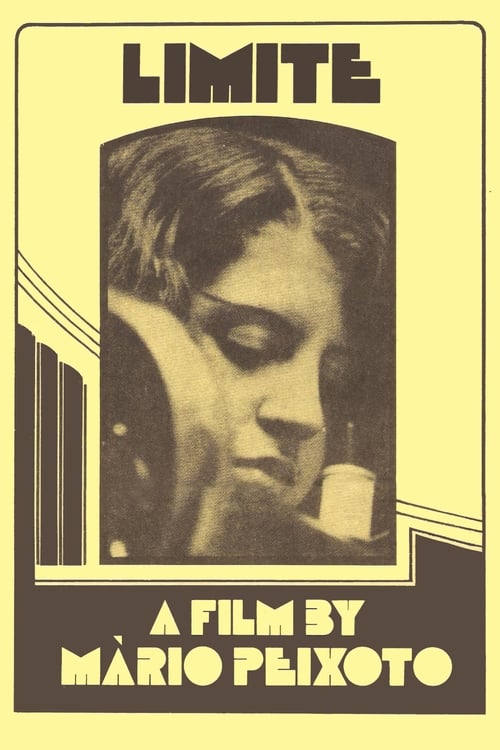
Limite
1931 · Mário Peixoto
For when you want cinema as pure meditation — a late night, no distractions, letting two hours of images wash over you. This is a challenge, not a comfort watch, and it's worth choosing on purpose.
What it's about
A man and two women drift in a small boat on the open sea, with no rescue coming. Between stretches of sun and water, the film reaches back into the fragments of each castaway's past — the confinements, dead ends, and choices that carried them to this drifting present. There's no plot to solve; the situation is the subject.
The experience
Hypnotic and wordless, closer to a dream or a long poem than a conventional story — hands, ropes, water, wind through grass, all set to a mesmerizing rhythm. It asks for patience and rewards it with images that lodge in your memory for good.
The craft
Made by a 22-year-old poet who never completed another feature, it's shot with a freedom that still looks radical: extreme close-ups of hands and feet, a camera that swings and drifts like the sea itself, the horizon line used as the whole film's organizing idea. Almost no intertitles — the images do everything — so a good screen and total quiet matter.
Why it matters
A legendary one-off, nearly lost and painstakingly restored, it's regularly named the greatest Brazilian film ever made and has become a touchstone for anyone tracing what silent cinema could do at its most free.
Snapshot
Limite is the great orphan of Latin American silent cinema: a two-hour, nearly title-free film made by a twenty-two-year-old Brazilian poet who had never directed before and would never complete another feature. Three unnamed castaways — Woman No. 1, Woman No. 2, and a Man — drift in an open boat with no land in sight, and the film moves between that suspended present and the fragmentary pasts that delivered each of them there. Nothing is solved. The boat does not reach shore.
What makes the film extraordinary is not its premise but its grammar. Peixoto and cinematographer Edgar Brasil built a picture out of hands, feet, ropes, telegraph wires, sewing-machine needles, rock faces, wind moving through grass, and above all water — a picture in which the horizon line is both the literal subject and the organizing idea. The title means limit or boundary, and the film treats the frame edge, the waterline, the skin, and the reach of an arm as versions of the same wall.
For decades Limite was more legend than film. It received a handful of screenings, then effectively vanished; its nitrate decayed while Peixoto guarded and mythologized it from a house on Ilha Grande. It became the movie Brazilian critics wrote about without having seen. Two restoration campaigns — a long photochemical salvage begun in the 1950s and a digital restoration completed in 2010 — returned it to circulation. In 2015 the Brazilian film critics' association (Abraccine) placed it first on its list of the hundred greatest Brazilian films. It is a canonical work that spent most of the twentieth century unavailable.
Industry & production
There was no Brazilian film industry to speak of in 1930, and Limite was made outside even that. The 1920s had produced the ciclos regionais — clusters of production in Cataguases, Recife, Campinas, Porto Alegre — mostly melodramas and local actualities made by enthusiasts with borrowed capital. Rio's Cinédia, founded by Adhemar Gonzaga in 1930, was the first serious attempt at a studio, and it moved almost immediately toward sound and toward the musical comedy that would become the chanchada, Brazil's dominant popular form for the next thirty years. Sound features were already appearing in Brazil by 1929–31. Limite arrived exactly as the door closed behind it.
Peixoto financed it himself, drawing on family money. He came from a wealthy Rio background and had been educated partly in England, and he returned from Europe having absorbed the Paris and London avant-garde repertory of the late 1920s. The production was small, improvised, and defiantly non-industrial: shot on location on the coast of Rio de Janeiro state, in and around Mangaratiba and the bay region south of the capital, with a cast that mixed semi-professionals and friends. Olga Breno, Taciana Rei, and Raul Schnoor play the three castaways; Brutus Pedreira — a musician and Chaplin Club member — appears as well as handling the film's musical program. Carmen Santos, a significant actress and later producer, appears briefly. Peixoto and Edgar Brasil themselves turn up on screen. Humberto Mauro, already the most accomplished director in Brazil, is listed in the cast and is generally described as an informal presence around the production; the precise extent of his involvement was disputed later, partly because Peixoto had an interest in minimizing it, and the documentary record is thin enough that the question remains genuinely open.
Distribution never happened in any normal sense. The film premiered on 17 May 1931 at the Cinema Capitólio in Rio, in a session organized by the Chaplin Club — the small, intensely doctrinaire cinephile society whose journal O Fan had spent 1928–30 arguing that silent cinema was a complete art and that sound was a betrayal of it. That audience was the ideal audience and essentially the only one. Commercial exhibitors had no use for a wordless two-hour art film in the year the talkies took Brazil. Limite passed almost immediately into rumor.
Technology
The film is silent 35mm, shot with a hand-cranked Debrie Parvo, in natural light, without a studio, and without access to an optical printer. Every superimposition, fade, and in-camera dissolve had to be executed at the moment of shooting or in a modest laboratory afterward, which makes the film's density of optical effect a feat of planning rather than post-production. Hand-cranking also means the film's speed is not fixed: Edgar Brasil could ramp within a shot, and the picture's characteristic slight unsteadiness of tempo — water that seems to move at a rate slightly off from life — is partly a function of the crank.
Peixoto had no intertitle apparatus to lean on because he barely used intertitles; the film is all but free of them, which was itself a technological choice as much as an aesthetic one, since it removed the last verbal crutch from a production with no synchronized track.
The more consequential technology story is preservation. Nitrate stock, a tropical climate, and an owner who screened the film rarely and stored it badly produced severe decomposition. From the late 1950s the physicist and former Chaplin Club member Plínio Süssekind Rocha, joined by Saulo Pereira de Mello, undertook a painstaking photochemical salvage — frame-level work reconstructing what could still be duplicated — completed in the 1970s. That restoration is the reason the film exists at all. In 2010 a digital restoration was carried out for Martin Scorsese's World Cinema Foundation in collaboration with Brazilian archives and the Mário Peixoto estate, premiering at Cannes Classics and subsequently issued on disc. The image most viewers know is therefore a reconstruction of a reconstruction, and it carries visible scars: the surviving material is not pristine, and no responsible account of the film's "look" can fully separate Edgar Brasil's diffusion from seventy years of chemical damage.
Technique
Cinematography
Edgar Brasil's camerawork is the film's central achievement and one of the most radical bodies of cinematography in the silent era. German-born and later naturalized Brazilian, he would go on to shoot Humberto Mauro's Ganga Bruta (1933), but nothing in his other work matches what he does here.
The camera is almost never neutral. It sits on the ground and looks up at legs; it swings on a rope; it executes full circular pans that dissolve orientation entirely; it rides the swell so that the horizon tilts and rights itself with a nauseating regularity. Extreme close-ups isolate a needle, a wrist, a mouth, a length of rope, a shoe on gravel, until the human figure is decomposed into parts. Faces are frequently withheld, shot from behind, cropped at the brow, or turned away — which is why the film's opening image lands so hard.
That opening reproduces a photograph Peixoto encountered on the cover of the French magazine Vu in 1929, an image by André Kertész of a woman's face encircled by handcuffed arms. The film begins by quoting a still photograph and then spends two hours refusing to hold still.
Brasil's tonal palette runs to soft, silvery diffusion and high-contrast blacks — sun on water blown to pure white, foliage rendered as a nervous gray lace. Depth is often flattened deliberately, so that a rock face or a wall of vegetation reads as an abstract field rather than a place.
Editing
Peixoto cut the film himself, and the editing is where his European viewing shows most legibly. The overall architecture is a rondo: present-tense boat material interleaved with three retrospective movements, each triggered associatively rather than announced. Transitions are made by rhyme — a curve of water into a curve of shoulder, a rotating wheel into a rotating pan — and the film often withholds the establishing information that would let you locate a scene until well after it has begun.
Within scenes, Peixoto builds rhythmic passages closer to Soviet montage than to French lyricism: short-duration cutting keyed to a mechanical or natural pulse, accelerating into the storm sequence that closes the film. Elsewhere he does the opposite, holding shots of grass, water, or a walking figure far past narrative need. The film's difficulty for first-time viewers is precisely this alternation between compression and an almost unbearable dilation.
Mise-en-scène / staging
There are essentially no interiors of consequence and no sets. Landscape does the work: beach, scrub, rock, cemetery, a small town reduced to a few walls and a doorway, and the open boat itself, which is the most constrained playing space imaginable — three bodies who cannot get away from one another, arranged and rearranged in a frame the width of a hull.
Peixoto stages for graphic composition rather than for psychology. Figures are placed against sky or water so that they read as silhouettes, or pushed to the frame's extreme edge, or turned into a diagonal that cuts the image. The recurring motif of a horizon bisecting the frame is not decoration; it is the film's thesis rendered as blocking.
Sound
Limite has no recorded track. It was conceived as silent at a moment when that was already a polemical position, and its premiere before the Chaplin Club was in part a statement about what sound would cost cinema.
The accompaniment is a compiled classical program assembled by Brutus Pedreira, drawing on late-Romantic and early-modernist repertory — Satie, Debussy, Franck, Borodin, and Stravinsky are among the composers regularly cited, though the exact cue sequence has varied between prints and restorations, and any claim of a single definitive score should be treated cautiously. The choice matters: rather than the through-composed orchestral scores of major silent features, Peixoto's film is accompanied by a mosaic of existing modernist pieces, matching its own mosaic construction.
The film also stages sound as an absence. A sequence set inside a movie theater, where a Chaplin short plays to an audience, folds the whole question of cinema-as-refuge into the narrative — and does so in a film whose makers had spent years arguing that this was the medium's last complete moment.
Performance
The performances are deliberately anti-theatrical and, by the standards of 1931 silent acting, remarkably unemphatic. Olga Breno, Taciana Rei, and Raul Schnoor are given almost no opportunity for the legible pantomime the silent cinema had trained audiences to read. Their work consists largely of stillness, small gestures isolated in close-up, and endurance — sitting in a boat under sun, walking, waiting. Emotion is displaced onto objects and landscape and returned to the actors only as exhaustion. The characters are credited without names, and the film treats them accordingly: as figures, not persons.
Narrative & dramatic mode
The film's mode is lyric rather than dramatic. There is a situation — three people adrift — but no plot in the sense of a chain of consequential decisions, and the flashbacks explain how each figure arrived without explaining anything about why they are together or what will happen.
Each retrospective movement sketches a life constricted by circumstance: a woman bound to routine labor and confinement, a woman inside a failing marriage, a man in flight. They are told elliptically, with crucial connective information simply omitted, so that the viewer assembles a shape rather than a story. Peixoto came to film from poetry and fiction, and the construction is closer to a long poem's — recurrence, variation, refrain — than to a screenplay's.
The dominant tense is a kind of suspended present. The boat sequences have no forward motion, literally or dramatically; they are the condition against which the pasts are measured. When the film finally introduces event, in the storm, it is annihilating rather than resolving.
Genre & cycle
Limite sits outside every cycle available to it. It is not a ciclo regional melodrama, not a Cinédia studio production, not a nascent chanchada, not a documentary or cavação short. Genre labels applied retrospectively — drama, adventure — capture the castaway premise and nothing of the film.
Its real generic company is the international art cinema of the late 1920s: the French avant-garde feature, the "city symphony," the ciné-poem. It belongs to the very short list of silent features conceived as pure visual composition and sustained at feature length — and among those, it is unusual in being made far from any of the metropolitan centers that produced the rest.
Authorship & method
Mário Peixoto (1908–1992) is one of cinema's genuine one-film authors. Educated partly in England, immersed in the European avant-garde repertory as a young man, he came back to Brazil convinced that cinema could do what modernist poetry did, and made Limite at twenty-two. He then made nothing else. He began a second feature, Onde a Terra Acaba, in the early 1930s with Carmen Santos, and abandoned it; surviving fragments have been recovered. He wrote novels and poetry, withdrew to Ilha Grande, and spent decades as the curator of his own legend — an activity that has complicated the historical record, since some of the claims attached to the film originate with him.
Edgar Brasil is the indispensable collaborator, and it is fair to describe Limite as co-authored in the way that certain films are: the conception is Peixoto's, but the film's actual perceptual texture is Brasil's. His subsequent work with Humberto Mauro carried some of that ambition into the sound era.
Brutus Pedreira served as musical arranger and appears on screen; his Chaplin Club affiliation places the film squarely inside that group's program. Peixoto took the writing and editing credits, and the film's structure — associative, poetic, unwilling to explain — is legibly the work of a writer who did not think in scenes.
Method, on the evidence: extensive location work, small crew, heavy reliance on found landscape, storyboarding-by-image rather than by scene, and a willingness to shoot enormous quantities of natural motion — water, grass, cloud — as primary material rather than as coverage.
Movement / national cinema
Brazilian cinema of 1931 had no avant-garde movement for Limite to join; the film essentially constitutes one, retroactively, along with the critical position staked out by the Chaplin Club. Its lineage runs sideways to Europe rather than backward through Brazil.
Its significance within Brazilian film history is therefore peculiar and enormous. It established, decades before anyone could act on it, the proposition that a Brazilian film could be a work of radical form rather than an imitation of foreign product or a vehicle for local music. When Cinema Novo arrived in the late 1950s and 1960s demanding exactly that, Limite was available as an ancestor — an ancestor almost none of them had actually seen. Glauber Rocha discussed it in his Revisão Crítica do Cinema Brasileiro (1963) with real ambivalence, respecting its formal command while questioning its detachment from Brazilian social reality, and that tension — masterpiece versus refusal of the national — has structured Brazilian writing on the film ever since.
Era / period
The film sits on a hinge. 1929–31 is the moment the sound conversion completes in the industrial centers and closes off the silent cinema's last experimental phase — the years of Ménilmontant, La Chute de la maison Usher, Un chien andalou, À propos de Nice, Man with a Movie Camera. Limite is a late, distant, and unusually sustained entry in that conversation, arriving after most of its interlocutors had stopped talking.
It is also a document of Brazil's First Republic in its final months, made in a country moving into the Vargas era, though it registers none of that directly. Its landscapes are pointedly unplaceable: coast, scrub, small town, cemetery. The refusal to be geographically specific is part of what made it suspect to later politically-minded critics and part of what has let it travel.
Themes
The boundary. Everything in the film is a limit: the horizon, the waterline, the boat's gunwale, the frame edge, the reach of the arm, the skin. The handcuffs of the opening image state it and the film never leaves it.
Confinement without a jailer. None of the three pasts involves a villain. The constriction is structural — work, marriage, poverty, obligation — and the open boat literalizes a condition the characters already inhabited on land. This is the film's most modern move: it locates its horror in circumstance rather than antagonism.
Erosion. Wind, water, and time work on rock, cloth, and faces throughout. The film's fascination with texture is thematic, not decorative; it is watching things be worn down.
The body in parts. By systematically fragmenting the human figure, the film denies its characters wholeness — an idea it shares with the surrealist and impressionist cinema it learned from, but which it pursues with unusual consistency.
Cinema as shelter and as illusion. The theater sequence, with Chaplin on the screen, offers respite inside a film that grants none — and the respite is itself a picture.
Reception, canon & influence
Reception. Immediate reception was tiny and adoring: the Chaplin Club circle recognized the film instantly as the vindication of everything they had argued in O Fan. Beyond that room there was almost nothing. No meaningful commercial run, no international release, and then decades of near-invisibility during which the film's reputation grew in inverse proportion to its availability. Writers cited it who could not have seen it. Peixoto encouraged the mystique, and the most famous claim attached to the film — that Sergei Eisenstein saw it and praised it extravagantly — has never been substantiated; it is widely regarded by scholars as unverifiable and quite possibly Peixoto's own invention, and it should not be repeated as fact. An anecdote that Orson Welles admired the film during his 1942 Brazilian sojourn circulates similarly and rests on thin evidence.
Serious critical reception effectively begins with the restoration work of Plínio Süssekind Rocha and Saulo Pereira de Mello, who did more than save the material: Mello's scholarship, including a shot-by-shot reconstruction of the film's découpage, gave critics something to work from. From the 1980s onward Limite was steadily canonized at home, culminating in its first-place ranking in Abraccine's 2015 poll of the greatest Brazilian films. The 2010 World Cinema Foundation restoration and subsequent home-video release finally made it a film that international viewers could watch rather than cite.
Influences on it (backward). The French impressionist and avant-garde feature is the clearest source: Jean Epstein's landscape-and-face lyricism, Germaine Dulac's rhythmic abstraction, and above all Dimitri Kirsanoff's Ménilmontant (1926), whose wordless construction, close-up fragmentation, and two-women-and-a-man melodrama-dissolved-into-poetry are the nearest available model. Soviet montage supplies the film's rhythmic cutting; Buñuel and Dalí supply permission for its more disjunctive juxtapositions. Still photography matters too — the Kertész Vu cover is quoted outright, and the film's compositional sense is closer to photographic modernism than to theatrical staging. The Chaplin Club's own theoretical position, hostile to sound and committed to a purely visual cinema, is a direct influence rather than a coincidence.
Legacy (forward). Limite's influence is unusual in being largely posthumous and largely symbolic. Because so few could see it, it functioned for decades as a permission structure rather than a stylistic model: proof that Brazilian cinema had once produced an unambiguously major work of world-scale ambition. Cinema Novo inherited that argument and quarreled with it; the Cinema Marginal filmmakers of the late 1960s, more sympathetic to formal excess and less interested in national-popular obligation, were more comfortable claiming it. Its enshrinement as Brazil's greatest film has made it a permanent reference point in debates about what Brazilian cinema is for.
Internationally, its recuperation belongs to the broader archival turn of the last thirty years — the recovery of national avant-gardes outside Europe and North America — and it has become one of the standard examples of how badly the silent canon was drawn. The film that could not be seen is now, unavoidably, part of the record.
A Deleuzian reading
The first image in Limite does not move.
The full Deleuzian reading of Limite →
Reception
Seen by almost nobody in 1931 — a handful of cine-club screenings, then decades locked away in a single decomposing nitrate print — it slowly resurrected through heroic restoration work and is now routinely voted the greatest Brazilian film ever made.
How Limite was received, from release to now →
How to watch Limite: what to notice on a first viewing
- Watch the opening face framed by handcuffed wrists. The film opens on a still image, a woman's face encircled by cuffed hands, held without movement before the film starts drifting for two hours. Captivity is shown here as a quality to sit with, not an event that leads anywhere.
- Notice extreme close-ups break bodies into parts: a wrist, a rope. Hands, mouths, rope, and a sewing needle are isolated in tight framing throughout, so the human figure keeps coming apart into fragments. Denying you a whole body to read makes you watch these fragments the way you'd watch an object.
- Notice the horizon line cutting straight across the frame. The boat, the shore, and the open sea are repeatedly composed so a horizon bisects the image, a division that recurs in nearly every setting. The film's title means limit or boundary, and this line is that idea turned into simple blocking.
- Watch shots of water or grass held far past need. Some passages dwell on natural motion, wind through grass, water moving, well beyond what any plot requires, before suddenly cutting rapidly elsewhere. These long stillnesses aren't padding; the film lets the ordinary, the wind and water, simply exist on screen.
The whole guide to watching Limite, with the keys for a rewatch →
Influences: the films it descends from and the films it influenced
- Ménilmontant (1926) — The direct structural model — a wholly intertitle-free melodrama in which a two-women-and-a-man triangle is carried by rhymed shot-scale and close-up fragmentation rather than titled plot, plus the swirling pan/superimposition passages Peixoto adapts into his rondo.
- Cœur fidèle (1923) — Epstein's harbor-and-fairground montage supplies the technique of layering rapt faces over dissolving surroundings in multi-exposure, holding the close-up past narrative usefulness so duration itself becomes the emotion.
- La Chute de la maison Usher (1928) — In-camera superimposition of figure over landscape plus systematic slow motion of wind-borne fabric, leaves and curtains — the ambient-movement photogénie that Limite converts into its dilated, becalmed tempo.
- La Souriante Madame Beudet (1923) — The confined-woman film built from optically superimposed interior states rather than acted reaction shots; Dulac's device of rendering entrapment through lens work is the grammar Peixoto uses for his passengers' land-bound flashbacks.
- Un chien andalou (1929) — Licenses the non-diegetic rhyme cut — joining a hand, a lens aperture, an insect, an eye on graphic likeness alone — which becomes Limite's principal transitional device between vessel and memory.
- Bronenosets Potyomkin (1925) — Metric and rhythmic montage cut on graphic conflict of screen-direction and mass; Limite grafts this shot-length arithmetic onto material with no dramatic event to accelerate toward.
- Rien que les heures (1926) — The Chaplin Club's proof-text by a Brazilian abroad: unnamed figures cross-cut by rhythm instead of story, with hands, feet and pavement isolated in photo-essay framing — the montage-of-anonymous-lives structure Limite abstracts further.
- La Passion de Jeanne d'Arc (1928) — Extreme close-up fragmentation that deliberately refuses to reassemble into coherent screen geography, paired with performance stripped to stillness and micro-expression — the anti-theatrical face-as-landscape Edgar Brasil reproduces in silvery diffusion.
- L'Étoile de mer (1928) — Diffusion generated in front of the lens with textured glass and gelatin, dissolving the image into a grain field — the photographic-modernist surface Brasil chased with filters and hand-cranked exposure variation on the Debrie Parvo.
- Meshes of the Afternoon (1943) — Deren's 'vertical' cine-poem formalizes what Limite had already built at feature length: rondo return to the same objects and gestures, each pass re-scaled and re-angled, with duration stretched by rhythmic repetition rather than by event.
- Vidas Secas (1963) — Luiz Carlos Barreto's deliberately overexposed, glare-blown horizon-bisected compositions carry Limite's sky-versus-line framing into Cinema Novo, together with a cast held to non-performing stillness in long, uncut takes.
- Deus e o Diabo na Terra do Sol (1964) — Rocha makes the 360-degree pan across empty terrain a structural rather than descriptive device — the same use of camera rotation as the film's organizing figure that Limite establishes in its opening circuit around the boat.
- O Bandido da Luz Vermelha (1968) — Cinema Marginal's explicit claim on Limite: collage editing that joins unmatched spaces by graphic and aural association, treating the feature as an assemblage of rhymes rather than a causal chain.
- Bang Bang (1971) — Extends Limite's duration dilation to the breaking point — shots held far past their informational value, gestures repeated with slight variation, performers kept deadpan and static so that rhythm, not action, is the film's subject.
- Tabu (1931) — Contemporaneous solution to the same problem: nonprofessional bodies staged against a sea horizon in Floyd Crosby's diffused register, with the drama advanced entirely by composition, water movement and shot rhythm rather than titles.
- Le Sang d'un poète (1930) — The parallel claim that a feature can be a first-person poem: in-camera trickery and reversal doing the work of narration, with a modernist score standing in for speech — the same sound-era configuration Limite reaches through its compiled Satie/Debussy/Stravinsky accompaniment.
- Ganga Bruta (1933) — Mauro's domestic parallel track: cutting on graphic rhyme through the ferry and quarry passages and using moving water as an editing metronome, elliptical enough that the love triangle survives as rhythm rather than exposition.
- L'Atalante (1934) — Boris Kaufman's soft silver photography plus the vessel-as-closed-world premise, in which interior longing surfaces as literal superimposition — the underwater apparition is Limite's dissolve grammar carried into sound.
Similar films
- L'Atalante (1934) — influence & lineage
- Barren Lives (1963) — influence & lineage
- Un Chien Andalou (1929) — influence & lineage · often watched together
- Black God, White Devil (1964) — influence & lineage · often watched together
- The Red Light Bandit (1968) — influence & lineage · often watched together
- Foreign Land (1996) — often watched together
- L'Avventura (1960) — often watched together
- Nostalgia (1983) — shared sensibility