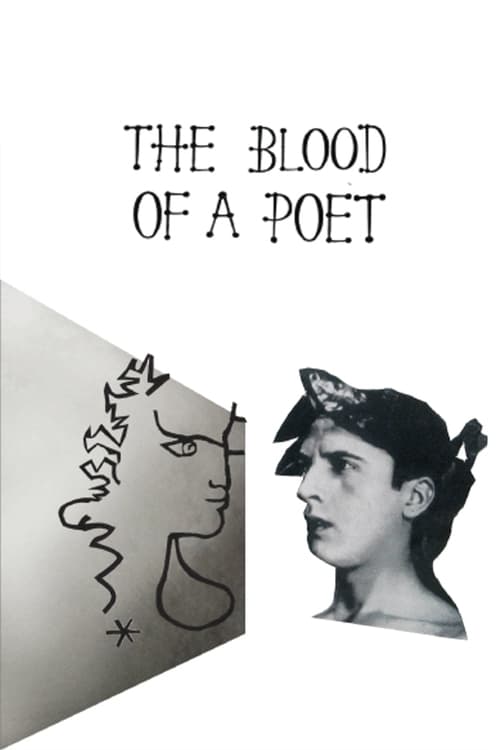
The Blood of a Poet
1932 · Jean Cocteau
When you want something short, strange, and unlike anything else — a late-night curiosity to let wash over you rather than figure out. This is a challenge watch, but a brief and hypnotic one.
What it's about
Alone in his room, a poet discovers that a mouth he's drawn has come alive on his own hand. He wipes it onto an armless statue — which wakes, speaks, and dares him to step through his mirror. On the other side is a strange hotel corridor where he peers through keyholes at scenes of cruelty and wonder, one episode dissolving into the next by dream logic rather than plot, before he fights his way back to the room he started in.
The experience
Fifty-odd minutes of pure hallucination — playful, morbid, and genuinely strange, closer to wandering through someone's dream than following a story. It can be unnerving, then suddenly witty, and images from it will lodge in your head for days.
The craft
Cocteau, a poet making his very first film, invents trick after trick with the simplest means — mirrors that swallow people, gravity turned sideways so a walk down a hallway becomes a struggle, drawings that breathe. Nearly a century later the in-camera effects still feel like sleight of hand performed right in front of you, and the film's four-part structure moves with the logic of a poem, not a script.
Why it matters
A founding document of avant-garde cinema whose mirror-crossings and dream corridors echo through generations of surreal, experimental, and music-video imagery; it opened the personal, first-person mode of filmmaking Cocteau would pursue for the rest of his life.
Snapshot
The Blood of a Poet (Le Sang d'un poète) is Jean Cocteau's first film, an approximately fifty-minute avant-garde fantasy in four loosely joined episodes. It was made in 1930 but not publicly released until 1932. A poet, alone in his room, finds that a mouth he has drawn comes alive on his hand; he transfers it to an armless statue, which speaks and dares him to pass through a mirror. Beyond the mirror lies the corridor of the "Hôtel des Folies-Dramatiques," where he spies through keyholes on scenes of cruelty and wonder before returning; a second movement stages a fatal children's snowball fight and a card game played over a dead boy's body, ending in the poet's suicide and the transformation of a woman into a statue. The whole is framed by a single image — a factory chimney beginning to topple at the start and completing its collapse at the end — so that the film announces itself as the contents of an instant. It is a foundational work of poetic cinema and of what later critics called the "trance film."
Industry & production
The film exists because of private aristocratic patronage rather than any studio. It was commissioned and financed by the Vicomte Charles de Noailles and his wife Marie-Laure de Noailles, among the most important patrons of the French modernist avant-garde. In the same period the Noailles bankrolled Man Ray's Les Mystères du Château de Dé and, most consequentially, Luis Buñuel and Salvador Dalí's L'Âge d'or. Cocteau was, by 1930, already a celebrated poet, playwright, novelist, and draughtsman with essentially no filmmaking experience; the commission gave him a free hand and, reportedly, an initial idea that the work might be an animated film before it became live action.
The delayed release is the central fact of the production history and is well documented. L'Âge d'or provoked a violent right-wing disturbance at its Paris screenings in late 1930 and a scandal that reached the Noailles personally, exposing them to social ostracism and threats surrounding their standing in Catholic and aristocratic circles. In that atmosphere the completed Sang d'un poète, which contains its own provocations — a sequence titled "The Profanation of the Host," images of self-wounding and suicide — was held back. It finally opened in Paris in 1932, notably at the Vieux-Colombier, an art-cinema venue. The two-year gap between production and release accounts for the film's shifting date in the literature. Precise budget figures are not something I can state reliably, so I will not invent one; what is secure is that the funding was wholly private and came from the Noailles.
Technology
The Blood of a Poet is an early sound film, made only two to three years into the European conversion to synchronized sound, and it is technologically a hybrid: much of it plays as silent cinema with a continuous musical score and sparse effects and narration rather than dialogue-driven scenes. Its expressive means are overwhelmingly optical and photographic — techniques already mature in the silent avant-garde and now carried into the sound era. Cocteau and his cinematographer relied on reverse motion, slow motion, superimposition, mattes, and, above all, on the reorientation of sets relative to the camera to produce impossible spaces. These are camera and printing tricks rather than special optical-effects wizardry, and Cocteau always insisted on their handmade, "poetic" character. He famously described his approach to trick effects as a kind of conjuring in which the artisanal seam should feel like magic rather than illusionism.
Technique
Cinematography
The photography is by Georges Périnal, one of the outstanding cinematographers of the era (he would soon shoot for Alexander Korda and, later, films including The Life and Death of Colonel Blimp). Périnal gives the film a lustrous, high-contrast monochrome surface — chalky whites, deep blacks, and a plasticity that makes the human body and the plaster statue read as related materials. The camera's key contribution is its complicity in Cocteau's spatial tricks: the celebrated "diving into the mirror" is achieved by building the poet's mirror as a horizontal pool or trough and shooting from above so that the descent reads as vertical; the sequence in which the poet crawls along the hotel corridor floor as though it were a wall is produced by standing the set on end and mounting the camera accordingly. The effect throughout is of a body subjected to a gravity the viewer cannot locate.
Editing
The film is organized as a rebus of discrete tableaux rather than through continuity cutting, and its rhythm is deliberately dreamlike, holding on transformations and reversals. The editing is generally credited to Cocteau himself, consistent with his total authorship of the project; the documentary record on a separately named editor is thin, and I will not attribute the cut to anyone beyond Cocteau without firmer grounds.
Mise-en-scène / staging
Staging is the film's true medium. Cocteau treats the frame as a proscenium and fills it with the furniture of his private mythology: the artist's room, the living statue, mirrors, playing cards, and Greek-classical fragments. The four parts are announced by intertitles, giving the whole a chaptered, emblematic structure. Two set-pieces dominate. The hotel corridor is presented as a series of keyhole vignettes — a man repeatedly shot and rising again in a Mexican execution, a girl coerced into flight along a ceiling, an opium scene, a hermaphrodite — each a self-contained tableau vivant of desire and cruelty. The concluding snowball fight recreates a walled Paris schoolyard (drawn from the same well of childhood memory as Cocteau's novel Les Enfants terribles), where a boy is killed by a snowball hardened around a stone; the subsequent card game is staged over his body with a formal, ritual stillness.
Sound
The score is by Georges Auric, Cocteau's close associate and a member of Les Six. The most discussed aspect of the film's sound is Cocteau's deliberate displacement of music against image: he is widely reported to have re-cut or re-laid Auric's music so that it no longer aligned "correctly" with the scenes, an experiment in what he thought of as accidental or non-illustrative synchronization, intended to break the sentimental bond between picture and accompaniment. Spoken language is minimal; Cocteau's own voice supplies aphoristic narration, and the film leans on effects and silence rather than dialogue.
Performance
Performance is stylized, posed, and closer to dance and mime than to naturalistic acting. The poet is played by Enrique Rivero, a Chilean-born actor whose lithe physicality suits the film's demands. The statue is played by Lee Miller — the American photographer, model, and associate of Man Ray — in what is essentially her only screen role; her marble stillness and sudden animation are among the film's signature images. The Senegalese dancer Féral Benga appears as the dark guardian angel who absorbs the dead boy, his movement supplying the sequence's gravity. Members of the Noailles circle, including the patrons themselves, appear as the elegant theater-box spectators who applaud the card game — a detail Cocteau reportedly had to reshoot because of an unintended resonance with a real suicide.
Narrative & dramatic mode
The film is anti-narrative in any conventional sense: it proceeds by metamorphosis, association, and repetition rather than cause and effect. Its dramatic mode is lyric and emblematic — a poem in images whose "plot" is the recurrence of a few charged motifs (the mouth, the mirror, the statue, the wound, the fall). The framing chimney insists that the entire action is simultaneous and instantaneous, collapsing the four episodes into a single dilated moment. Cocteau resisted allegorical decoding; he presented the work as the direct transcription of a poetic state rather than a story to be paraphrased. What holds it together is less a line of events than a governing idea: the artist's traffic with his own images, and the death that such traffic requires.
Genre & cycle
Nominally a fantasy, the film belongs more precisely to the tradition of the cinematic prose-poem or "ciné-poème." It is the first panel of what Cocteau would later frame as his Orphic cycle, completed decades afterward by Orphée (1950) and Le Testament d'Orphée (1960); across those films the mirror-as-threshold, the poet's death, and the negotiation with the beyond recur as a personal iconography. Within Cocteau's own career it stands nearly alone for years: he would not direct another feature until La Belle et la Bête in 1946, making The Blood of a Poet a solitary early experiment that he only later revealed as the opening of a lifelong project.
Authorship & method
The film is the purest example of Cocteau's conviction that cinema could be a vehicle for personal poetry rather than industrial storytelling — his idea of a "poésie de cinéma," where the camera records the poet's inner mythology as literally as a pen records verse. He wrote, directed, edited, narrated, and designed the imagery, drawing on his own drawings, novels, and obsessions. His essential collaborators were three men from his artistic milieu: cinematographer Georges Périnal, who realized the optical illusions and gave the film its silvered surface; composer Georges Auric, whose score Cocteau then productively "misaligned"; and, in front of the camera, performers chosen as much for their sculptural presence as their acting — Enrique Rivero, Lee Miller, and Féral Benga. Cocteau's method throughout privileged the handmade trick, the reoriented set, and the reversed strip of film over any pursuit of seamless realism.
Movement / national cinema
The film is a product of the French avant-garde, arriving at the very end of the experimental ferment of 1920s Paris (the milieu of Man Ray, Fernand Léger, Germaine Dulac, and the cinéma pur and Impressionist experimenters) and at the dawn of sound. It is frequently, and loosely, called Surrealist — a label complicated by real hostility. André Breton and the Surrealist group despised Cocteau and regarded him as a fashionable interloper, and Cocteau in turn insisted his imagery came from private mythology rather than automatism or the Freudian unconscious. It is more accurate to place the film adjacent to Surrealism than within it: a singular, personal offshoot of the French poetic avant-garde.
Era / period
Made in 1930 and released in 1932, the film sits at the hinge between silent and sound cinema and at the exhausted close of the great decade of European film experiment. The Depression and the coming pressures of the 1930s would soon narrow the space for such privately funded, non-commercial art films; The Blood of a Poet is in that sense a late flower of a passing moment, financed by an aristocratic patronage system that itself would not long survive. Its delayed release also placed it in dialogue, and in scandalous association, with L'Âge d'or and the broader censorship anxieties of the early sound era.
Themes
Its governing theme is the mythology of the poet — the artist as a figure who must pass through the mirror of the self, consort with his own images, and pay for creation with a kind of death. Mirrors and thresholds recur as the boundary between the ordinary and the poetic; statues and living flesh trade places, dramatizing the tension between art's immortality and life's mortality. The film is preoccupied with wounding and self-wounding (the mouth in the wounded hand, the poet's suicide), with childhood cruelty and its persistence into adult myth (the lethal snowball), and with the "boredom of immortality" — the notion that to become an enduring artwork, a bust or a legend, is also to be deadened. Blood, as the title promises, is the recurring substance that binds creation to sacrifice.
Reception, canon & influence
Contemporary reception was shaped by scandal and by the film's difficulty; it circulated first through art cinemas and cinephile and avant-garde circles rather than the commercial mainstream, and it attracted both fascination and the dismissal of the Surrealists who regarded Cocteau as a poseur. Over time its standing rose steadily, and it is now securely canonical as one of the essential works of experimental cinema.
Looking backward, the film draws on the French silent avant-garde's optical experimentation and on the classical and mythological repertoire Cocteau shared with his literary work; its keyhole-vignette structure and dream logic have clear affinities with the Surrealist provocations of Buñuel and with the trick tradition running back to Georges Méliès, even as Cocteau denied direct discipleship. Looking forward, its influence is large and specific. It became a touchstone for the postwar American avant-garde: the critic P. Adams Sitney identified it as a progenitor of the "trance film," and its imagery and structure inform the work of Maya Deren, Kenneth Anger, Stan Brakhage, and their contemporaries, for whom the mirror-threshold, the somnambulist protagonist, and the poet's autobiographical mythology became a usable grammar. Within Cocteau's own oeuvre it is the seed of the Orphic Trilogy, its mirrors and deaths reborn in Orphée and Le Testament d'Orphée. As the debut of a major artist working entirely outside the industry, it also remains a durable model for the idea that a poet might simply pick up a camera and film the inside of his own head.
A Deleuzian reading
A factory chimney begins to fall.
The full Deleuzian reading of The Blood of a Poet →
Reception
Born under a cloud — its patron the Vicomte de Noailles had also bankrolled Buñuel's scandalous L'Âge d'Or the same year, and the fallout delayed its release — and sniffed at by the official Surrealists, who loathed Cocteau. Now it's the founding text of avant-garde film poetry, the one every experimental filmmaker gets measured against.
How The Blood of a Poet was received, from release to now →
How to watch The Blood of a Poet: what to notice on a first viewing
- Watch a drawn mouth come alive on his hand. The poet sketches a face, and the mouth he drew stays behind, breathing on his palm, refusing to be wiped away. One small drawn detail keeps growing more alive than intended.
- Watch the poet dive headfirst into the mirror. Cocteau built the mirror as a flat pool of water shot from above, so the plunge reads as a real, continuous descent rather than a dissolve. Nothing is faked in the print. The trick is in how the set was built, not in editing.
- Watch him crawl along a corridor floor sideways. The hotel set was stood on end and the camera mounted to match, so gravity itself seems bent as he moves through it. You cannot locate where down actually is in this sequence.
- Watch him look through keyholes at separate scenes. Each door along the corridor opens onto its own sealed vignette, an execution, a girl in flight, other strange tableaux, with no connection explained between them. Each little scene stays closed off, a fragment rather than part of a story.
- Listen for music that never quite matches the scene. Cocteau reportedly re-laid Auric's score so it no longer lines up with the images the way a normal film score would. The sound and picture stop explaining each other and just run side by side.
The whole guide to watching The Blood of a Poet, with the keys for a rewatch →
Influences: the films it descends from and the films it influenced
- The Vanishing Lady (1896) — Cocteau's reliance on the in-camera stop-substitution and reversed-strip 'trick' over optical realism descends directly from Méliès's stop-trick tradition, which Cocteau prized as the handmade magic of cinema.
- Entr'acte (1924) — Establishes the Dadaist playbook of slow-motion, superimposition and gravity-defying trick photography deployed as pure non-narrative rhythm — the French avant-garde grammar Cocteau reorganizes around his own mythology.
- Ballet Mécanique (1924) — Its treatment of objects, faces and fragments as rhythmically edited plastic forms rather than story elements models the tableau/object-as-image logic behind Cocteau's cine-poème.
- The Seashell and the Clergyman (1928) — Pioneers the sustained first-person dream-vision — subjective optical distortion standing in for a mind's interior — the 'camera as pen recording inner life' method Cocteau makes his manifesto.
- L'Étoile de mer (1928) — Its gauzed, refracted Surrealist lens and use of Lee Miller as sculptural presence directly feed Blood of a Poet, which recruits Miller herself as a living statue chosen for form over acting.
- Un Chien Andalou (1929) — Supplies the associative shock-cut and body-transgression imagery (the sliced eye, migrating orifices) that Cocteau echoes in the mouth-in-the-hand, though he insisted on his own non-discipleship.
- The Fall of the House of Usher (1928) — Its dense superimposition, slow-motion and expressionist décor as psychological space anticipate Périnal's silvered surfaces and the reoriented-set illusions Cocteau builds.
- Orphée (1950) — Reworks the poet-through-the-mirror threshold into a full narrative: the mercury-mirror portal to Death is the mature realization of this film's mirror-plunge, using the same practical reversed-water trick.
- Le Testament d'Orphée (1960) — Closes the Orphic cycle by literalizing the premise — Cocteau himself walks through his own imagery — extending the reversed-film resurrection and self-as-mythological-poet device from the seed film.
- La Belle et la Bête (1946) — Transposes the handmade optical magic — disembodied living arms, slow-motion glides, reoriented sets read as enchantment — into feature form, sustaining Cocteau's preference for practical trick over seamless effect.
- Meshes of the Afternoon (1943) — The archetypal 'trance film' Sitney traced back to Cocteau: a somnambulist protagonist, mirror-faced figure and looping dream architecture built from the mirror-threshold grammar this film codified.
- At Land (1944) — Extends the trance-film's continuous-space dream editing — the protagonist drifting through discontinuous locations as a single subjective passage — inherited from Cocteau's keyhole-vignette structure.
- Fireworks (1947) — Takes up the autobiographical poet-mythology and somnambulist-dreamer frame, filming the inside of the artist's own head as personal ritual exactly on the Cocteau model.
- Inauguration of the Pleasure Dome (1954) — Builds ritual tableaux-vivants of costumed figures as living icons, extending Cocteau's staging of performers as sculptural presences within a hermetic personal cosmology.
- Dreams That Money Can Buy (1947) — Continues the 'poet picks up a camera' model — an artist-driven anthology of dream episodes with misaligned avant-garde scoring — carrying the cine-poème into the postwar émigré avant-garde.
- Reflections on Black (1955) — Adopts the blind/somnambulist wanderer and hand-scratched optical intervention on the emulsion, extending Cocteau's insistence that the film strip itself be a personal, physically worked surface.
- Eraserhead (1977) — Cocteau built a waking-dream film from hand-crafted in-camera optical effects and staging that renders the impossible as a material fact available to the camera; Lynch's approach to practical effects — constructing the infant creature through undisclosed physical means rather than optical post-production — follows this Cocteau precedent of materialist surrealism where the impossible must be literally present on set.
- Black Orpheus (1959) — Cocteau's spatial device of moving through mirrors and thresholds as literal passage between mortal and mythic realms established the cinematic grammar for underworld traversal that Camus literalized in his descent-to-Hades sequences, treating built space as permeable mythic boundary.
- Institute Benjamenta, or This Dream People Call Human Life (1995) — Cocteau's poet-architecture of tableaux linked by oneiric voice-over and a literary first-person sensibility models Benjamenta's adaptation of an interior text into discrete, narrated dream-emblems.
- Lot in Sodom (1933) — A contemporaneous American avant-garde poem built on the same superimposition, prismatic distortion and mythic tableau, independently pursuing cinema-as-visual-verse alongside Cocteau.
- L'Âge d'or (1930) — Sibling Surrealist feature commissioned by the very same patron, the Vicomte Charles de Noailles, and conceived in parallel — an independent test of poetic dream-cinema bankrolled by the same aristocratic experiment.
- The Face of Another (1966) — Ancestor for the surreal iconography of masks, mirrors, and faces detached from selfhood — the poetic-cinema tradition of treating the human face as a plastic, removable object that Teshigahara's mask sequences echo.
- Limite (1931) — The parallel claim that a feature can be a first-person poem: in-camera trickery and reversal doing the work of narration, with a modernist score standing in for speech — the same sound-era configuration Limite reaches through its compiled Satie/Debussy/Stravinsky accompaniment.
Similar films
- Orpheus (1950) — influence & lineage
- Testament of Orpheus (1960) — influence & lineage
- Beauty and the Beast (1946) — influence & lineage
- Un Chien Andalou (1929) — influence & lineage
- Resurrection (2025) — shared sensibility
- The Strange Ones (1950) — shared sensibility
- Vampyr (1932) — shared sensibility
- L'Âge d'or (1930) — shared sensibility